
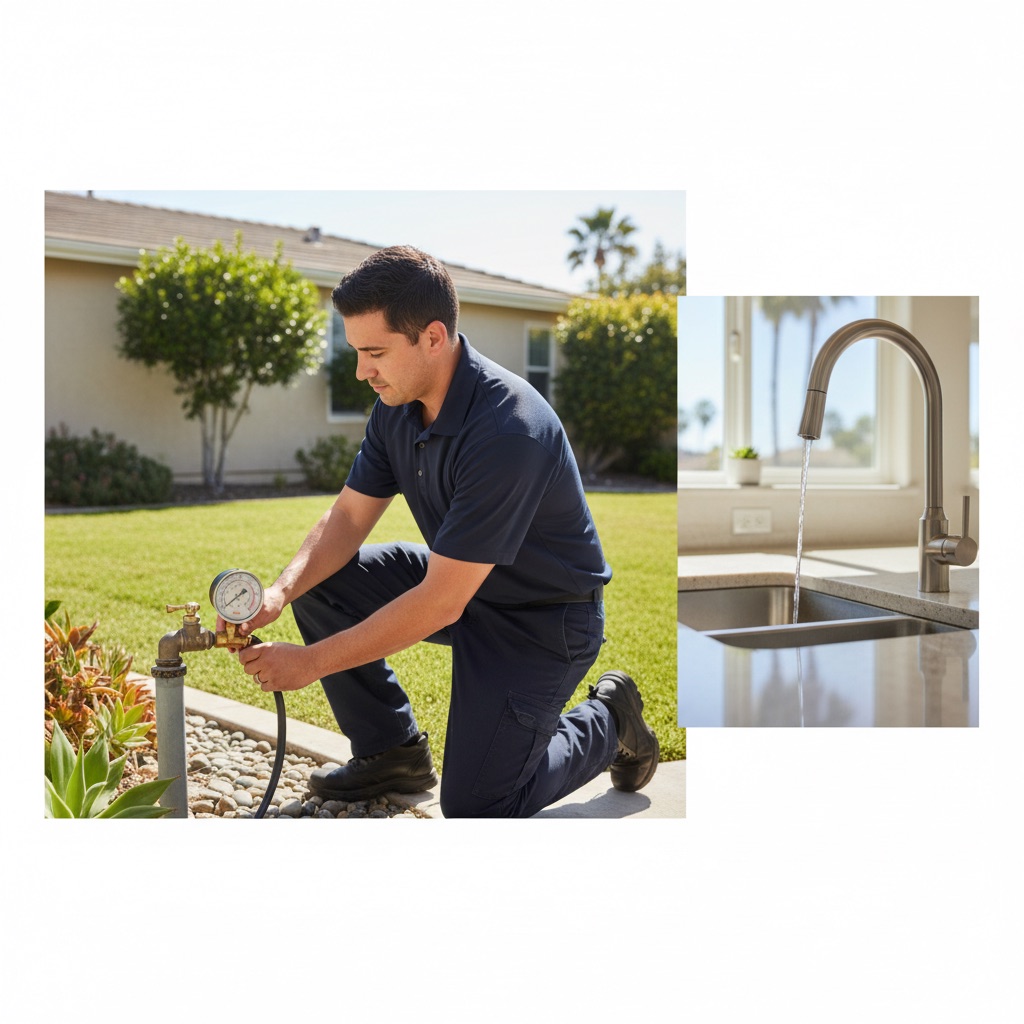
Bathroom remodel plumbing in San Diego: 2026 guide
San Diego bathroom remodel plumbing costs, permit rules, slab vs raised foundation, repipe timing, and Title 24 low-flow caps. Local plumber guide for 2026.
The short answer
- Plumbing-only cost: $1,800 to $4,500 for a same-layout refresh, $9,000 to $18,000 to move the toilet, tub, or shower.
- Slab homes cost more than raised foundations because moving a drain means cutting and patching concrete ($1,500 to $3,500 per fixture).
- You need a permit if you move fixtures or change drain or supply lines; a like-for-like swap usually does not.
- California caps toilets at 1.28 GPF, showerheads at 1.8 GPM, and bathroom faucets at 1.2 GPM on permitted remodels.
- If your pre-1970 home has galvanized pipe, repiping during the remodel costs 30 to 50 percent less. Call (858) 400-4417.
Plumbing is the most expensive part of a bathroom remodel after cabinetry. In San Diego, the plumbing scope alone runs $1,800 to $4,500 for a cosmetic refresh that keeps the same layout, $4,500 to $9,000 for a partial layout change, and $9,000 to $18,000 when you move the toilet, tub, or shower drain. A full primary bath gut with new rough-in can hit $20,000 to $28,000 on its own. Those numbers are the plumbing line item, not the full remodel.
Here is what actually drives those costs in this market, what the city wants to see, and where homeowners burn money they did not have to spend.
What plumbing scope a bath remodel actually includes
People underestimate this part. Plumbing in a remodel is not just hooking up the new fixtures.
The rough-in is the pipework hidden inside walls and below the floor. Water supply lines feed each fixture. Drain, waste, and vent lines carry water out and let air in so traps stay sealed. The vent stack ties into the roof. If you move a fixture more than a few inches, the rough-in moves with it.
Fixtures are the visible parts. Toilet, sink, faucet, tub, shower valve, shower head, hand-held, body sprays, and any drain trim. Each one needs a shutoff valve under it or behind it. If your old bath had shared shutoffs or none at all, your plumber adds them during the remodel.
Drain rework is the part that surprises people. Old 1.25-inch sink drains and 1.5-inch tub drains do not meet current code in most cases. Shower drains need 2-inch lines. A toilet flange in the wrong spot, off-level, or cracked gets replaced. Galvanized supply stubs hidden behind the old vanity get cut out and re-stubbed in copper or PEX.
Then there is the water heater check. If your remodel adds a soaking tub or a multi-head shower, your existing 40-gallon tank probably cannot keep up. That is a separate conversation but it shows up during planning.
Bathroom remodel plumbing cost in San Diego (2026)
These are plumbing-only ranges for San Diego County. Labor here runs higher than the national average because licensed plumber rates sit at $125 to $185 per hour. Materials are normal. Permit fees are not.
| Remodel scope | What changes | Plumbing cost |
|---|---|---|
| Cosmetic refresh, same layout | Swap toilet, vanity, faucet, shower trim. No drain moves. | $1,800 to $4,500 |
| Partial layout change | New shower valve location, vanity widened, second sink added. | $4,500 to $9,000 |
| Full layout reconfigure | Toilet relocated, tub-to-shower conversion, drain rework. | $9,000 to $18,000 |
| Primary bath full gut | New rough-in, freestanding tub, walk-in shower, double vanity, possible repipe. | $18,000 to $28,000 |
A few things push the upper end. A second-floor bathroom over finished living space adds $1,500 to $3,500 for access and patching. A concrete slab cut for a toilet relocation runs $800 to $1,600 by itself. A repipe of the whole bathroom branch adds $2,500 to $5,500. We break the foundation question down next because it changes the math.
For a full plumber rate breakdown across services, see our plumber cost guide for San Diego.
Slab vs raised foundation: how it changes the cost
San Diego has two construction eras that matter here. Older neighborhoods like North Park, Kensington, South Park, parts of La Mesa, and most of Coronado are raised-foundation homes built decades ago. Crawl spaces underneath. Tract homes built on, including most of Mira Mesa, Rancho Penasquitos, Santee, and Chula Vista, sit on concrete slabs.
Raised foundation is the friendlier remodel. Your plumber works from the crawl space. Drain relocations cost less because nobody is breaking concrete. Repiping during a remodel is straightforward. Expect $800 to $1,500 to move a toilet drain in a raised-foundation home.
Slab homes are a different story. Every drain line lives in or under the concrete. Moving a toilet, tub, or shower drain means cutting the slab, jackhammering the existing line, reworking the pipe, and patching the concrete. That is $1,500 to $3,500 per fixture relocation before tile or flooring goes back. If you have old cast-iron drain lines under the slab and one of them is corroded, you are looking at a partial drain replacement on top of that, another $2,000 to $4,500.
Two practical takeaways. First, in a slab home, plan your layout around existing drain locations if you can. Keeping the toilet and shower drains where they are saves real money. Second, if you have to cut the slab anyway, scope every other drain inspection at the same time. Doing it twice doubles the cost.
Permit and inspection in San Diego
The City of San Diego and most county jurisdictions require a plumbing permit for any remodel that moves fixtures, alters drain lines, or replaces supply lines. A like-for-like fixture swap in the same spot usually does not need one. A tub-to-shower conversion always does.
Permits run $185 to $650 for a typical residential bath remodel, depending on scope and jurisdiction. The City of San Diego, Chula Vista, El Cajon, Carlsbad, and unincorporated county each have their own fee schedule. Your plumber pulls the permit under their license, not yours.
You get two inspections. The rough-in inspection happens after the new pipes are in the walls and floor but before drywall or tile goes over them. The inspector checks pipe sizing, slope on drain lines (quarter-inch per foot for 2-inch and smaller), proper venting, secure strapping, and that supply lines hold pressure under test. Skip this step and the inspector will not sign off later. The final inspection happens after fixtures are set and trim is on. They run water, check for leaks, verify shutoffs work, and look at fixture flow rates.
Two failures we see often. Vent lines that tie in below the fixture flood rim, which is not legal, and shower pans that were not water-tested before tile. Both mean tearing out finished work to fix.
Repipe-during-remodel opportunity
If your home was built before 1970 in San Diego, your water lines are probably galvanized steel. North Park, Normal Heights, Golden Hill, parts of La Mesa, El Cajon, and Lemon Grove all have galvanized stock from that era. Galvanized rusts from the inside, which is why your shower pressure dropped over the last decade and your hot water comes out the color of weak tea after a long weekend.
A bathroom remodel is the cheapest moment in the life of your house to deal with this. The walls are already open. The vanity is already out. The shower is already gutted. Adding a partial repipe of the bathroom branch, or even a whole-house repipe, costs 30 to 50 percent less during a remodel than as a standalone job.
Standalone repipe in a 1,500-square-foot San Diego home runs $4,500 to $9,500 in copper or $3,800 to $7,500 in PEX. During a remodel, the bathroom branch alone is $1,800 to $3,500. If you can stretch the budget to cover the whole house while everything is open, do it. You will not get a better window.
Read more on the galvanized pipe replacement process and our San Diego repipe guide.
California compliance: low-flow caps and lead-free
California is stricter than federal code on plumbing fixtures, and your inspector knows the numbers.
Toilets max out at 1.28 gallons per flush. That is the CalGreen and Title 24 cap. Anything labeled WaterSense meets it. Older 1.6 GPF toilets cannot be installed new in a permitted remodel, even if you find one online.
Showerheads cap at 1.8 gallons per minute. Multi-head showers count the total flow across every head. A rain head plus two body sprays plus a hand-held will blow past 1.8 GPM combined. There is a workaround. Each head can run up to 2.5 GPM if they are on separate manual controls and cannot run at the same time. That means three handles, not one diverter. Your plumber walks you through this during design.
Bathroom faucets cap at 1.2 GPM. Kitchen faucets get 1.8 GPM. Both are lower than the federal limit.
Then there is AB 1953, the California lead-free law. Any pipe, fitting, or fixture that touches drinking water must contain no more than 0.25 percent lead by weighted average. Every legitimate fixture sold in California meets this. Older imported fixtures, vintage faucets from estate sales, and some online specialty parts do not. If the inspector spots an unmarked or non-compliant part, it comes back out.
Smart upgrades during the rough-in
The walls being open is your window. A few hundred dollars now saves real money and frustration later.
A pressure-balance or thermostatic shower valve is required by California code on new installs, but the quality range is wide. Spend the $200 to $400 extra for a thermostatic valve over a basic pressure-balance one. Water stays at the temperature you set even when someone flushes a toilet or runs the dishwasher. With multiple showers in the house, the upgrade pays for itself in fights avoided.
Rough in a hot water recirculation line if you have a long run from the water heater. The cost during a remodel is $300 to $600. Adding it later means tearing into finished walls. Hot water at the tap in five seconds, every time.
Dedicated quarter-turn shutoffs at every fixture. The old-style multi-turn stops seize up and leak after 15 years. Quarter-turn ball valves last decades. Cost difference is maybe $40 across the whole bathroom.
Soft water bypass for fixtures that do not need it. San Diego has hard water across most of the county, and most homeowners eventually add a softener. If you do that later, you will want the toilet, outdoor hose bib, and possibly the cold side of the kitchen on a bypass. Roughing the bypass during a bath remodel costs nothing extra and saves a wall opening later.
Pressure-reducing valve check. San Diego municipal water comes in hot, often 80 to 100 PSI in coastal and inland-north neighborhoods. Code maxes house pressure at 80 PSI. If yours is high and you are putting in new fixtures, replace the PRV at the same time. New fixtures fail fast under high pressure and most warranties void above 80 PSI.
ADA shower retrofits for aging in place
A growing share of remodels in San Diego are aging-in-place jobs. Adult kids retrofitting a parent’s home, or owners in their 60s planning ahead. The plumbing piece is straightforward if you scope it right.
Curbless walk-in shower needs a recessed drain and a sloped sub-floor. In a slab home, you are cutting and lowering the slab in the shower footprint, then pouring back. Add $1,500 to $2,500 to the plumbing line for that. In a raised foundation, the joists get sistered and the sub-floor drops. Less expensive.
Hand-held shower on a slide bar. Standard install. Roughed-in at 48 inches gives flexibility for a seated user.
Comfort-height toilet at 17 to 19 inches. Same rough-in as a standard toilet. No plumbing cost difference, just fixture choice.
Anti-scald thermostatic valve set to 110 degrees maximum. Required for ADA installs.
Grab bar blocking goes in during the rough-in. Not strictly plumbing, but your plumber and tile contractor coordinate this with the framer. Miss it and you cannot anchor grab bars into tile later without making a mess.
Common mistakes that bust budgets
Five we see in San Diego more than anywhere else.
Moving the toilet a few feet to “open up” the layout. In a slab home this is the most expensive single decision in the remodel. $1,500 to $3,500 you did not budget for. Half the time the new spot does not even look better.
Tub-to-shower conversion without checking the drain. Tub drains are 1.5 inches. Shower drains need 2 inches. Conversion means the drain comes up, the line gets resized, and the vent gets re-tied. Plan for it.
Undersized drains under double vanities. Two sinks share a 1.5-inch line and you get slow drains forever. Run a 2-inch branch with proper venting.
Lighting and electrical roughed before plumbing. Plumbing has bigger pipes and less flexibility. Always rough plumbing first, electrical second. Reversed order means moving electrical to clear pipe runs, which costs money.
Picking fixtures after the rough-in. Different toilets have different rough-in distances (10, 12, or 14 inches from the wall). Different shower valves have different stub heights. Order fixtures during design, not during install. The plumber sets the rough-in to match the fixture, not the other way around.
Related reading
If you are starting from a specific problem rather than a remodel, see bathroom plumbing repair in El Cajon, shower valve replacement in San Diego, toilet installation cost in San Diego, and faucet installation in San Diego. For pipe issues that predate the remodel, see repipe in San Diego and galvanized pipe replacement.
FAQ
Do I need a permit for a bathroom remodel in San Diego? Yes, if you are moving fixtures, changing drain or supply lines, or doing a tub-to-shower conversion. A like-for-like swap with no plumbing changes usually does not need one. Your plumber pulls the permit.
How long does the plumbing portion of a bath remodel take? Rough-in is one to three days depending on layout changes. After drywall and tile, the trim-out (setting fixtures and final connections) is another one to two days. Plan two separate plumber visits.
Can I keep my old galvanized pipes if I am only remodeling one bathroom? You can, but inspectors increasingly require the supply stubs into a remodeled bathroom to be copper or PEX. If the rest of your house is galvanized and dropping pressure, the remodel is the right window to replace at least the bathroom branch.
Will the inspector make me change toilets I already own? If a toilet uses more than 1.28 gallons per flush, yes. New permitted remodels in California require 1.28 GPF or less. Bring the spec sheet to permit submission.
How much does it cost to move a shower drain in San Diego? In a raised-foundation home, $800 to $1,800. In a slab home, $1,500 to $3,500 because of concrete cutting and patching.
Should I repipe the whole house during a bath remodel? If your home is pre-1970 and has galvanized supply lines, yes. The walls being open during a remodel makes a whole-house repipe 30 to 50 percent cheaper than a standalone job. You will not get a better window.
Talk through your remodel scope with a local plumber
Every bathroom remodel has a plumbing decision that drives the budget. Sometimes it is the toilet move. Sometimes it is a corroded drain line under the slab. Sometimes it is the moment to repipe.
We can walk your bathroom, look at the foundation and existing pipe material, and give you a written plumbing scope before you commit to a remodeler. No pressure to use us for the install.
Call (858) 400-4417 to set up a walk-through, or use the contact form. We serve all of San Diego County.
Areas this guide covers
We connect homeowners with licensed plumbers in these San Diego County communities.
Keep reading
Need a Plumber in San Diego?
Licensed, insured plumbers, ready across San Diego County. The plumber quotes you before any work starts.
Call (858) 400-4417Call any time, day or night, anywhere in San Diego County