
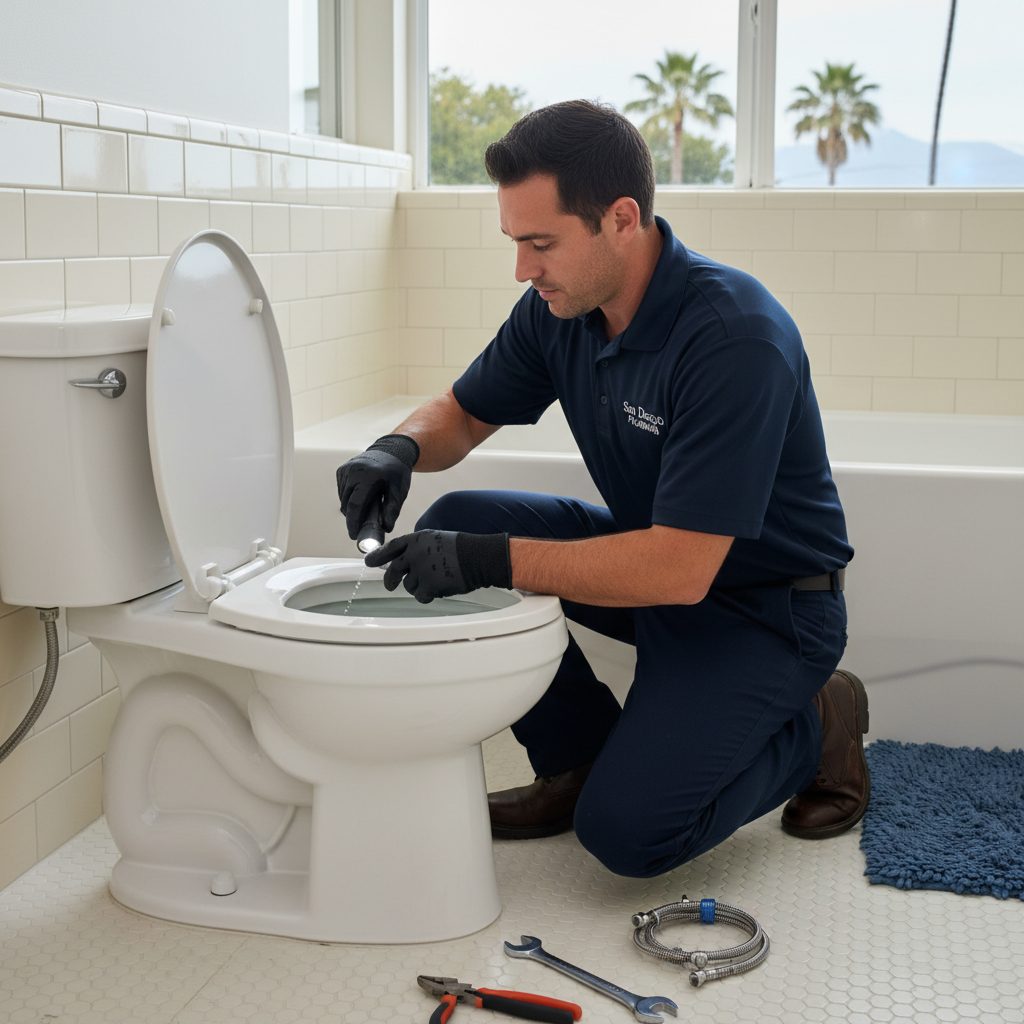
Toilet installation cost in San Diego (2026 guide)
What toilet installation costs in San Diego in 2026, including labor, rough-in size, flange repair, CalGreen 1.28 GPF rules, and water rebates.
The short answer
- A standard toilet installation in San Diego runs $325 to $725 in 2026 for labor, a new wax ring, supply line, and haul-away.
- The toilet itself adds $150 to $900; ADA comfort-height, wall-hung, or smart bidet upgrades push the all-in number past $1,200.
- Flange repair, if needed, adds $125 to $400; a flange extender for a raised tile floor is about $150 with labor.
- California requires 1.28 GPF or lower on any new install; a like-for-like swap needs no permit but relocating one does ($80 to $250).
- A standard swap takes 60 to 90 minutes. Call (858) 400-4417 for an install quote.
Most San Diego homeowners pay between $325 and $725 for a standard toilet installation in 2026. That covers labor, a new wax ring, a new supply line, and haul-away of the old toilet. The toilet itself runs $150 to $900 on top, depending on the model. ADA comfort-height, wall-hung, or smart bidet upgrades push the all-in number to $1,200 or more. Flange repair, if needed, adds $125 to $400.
If you’re trying to figure out whether to repair or replace, our toilet repair cost guide covers the math on that decision. This post is about new installs and replacements.
Toilet installation cost in San Diego (2026)
These are real numbers from San Diego plumbers in 2026, not national averages. SoCal labor runs higher than the rest of the country, and almost every install here triggers the 1.28 GPF rule we’ll cover in a minute.
| Install type | Labor only | All-in with toilet |
|---|---|---|
| Standard 2-piece swap | $250 to $400 | $400 to $850 |
| Standard 1-piece swap | $275 to $425 | $550 to $1,100 |
| ADA comfort-height swap | $275 to $425 | $475 to $1,000 |
| Wall-hung install (new) | $850 to $1,800 | $1,800 to $4,500 |
| Smart bidet seat add-on | $125 to $275 | $475 to $1,400 |
| Flange repair (added to any install) | $125 to $400 | included above |
Low-end toilets like the Glacier Bay or American Standard Cadet 3 run $150 to $250. Mid-range Toto Drake, Kohler Cimarron, and American Standard Champion sit at $300 to $500. Premium Toto Aquia, Kohler Veil, and any wall-hung Geberit or Duravit starts at $700 and climbs past $2,000.
Most installs take 1 to 2 hours. A flange repair adds 30 to 90 minutes. A wall-hung install on new construction or a full remodel takes most of a day because the carrier frame has to be set in the wall.
What’s in the install (and what costs extra)
A standard San Diego toilet install includes the labor, a new wax ring or wax-free seal, new closet bolts, and a new braided stainless supply line. Most plumbers haul the old toilet away at no extra charge.
Here’s what gets billed separately:
- New shutoff valve. Old multi-turn brass valves seize up. If yours won’t fully close, swap to a quarter-turn ball valve. Add $45 to $95 with parts.
- Wax-free seal upgrade. A Korky or Fluidmaster waxless seal costs $15 more than a traditional wax ring but lets the toilet be removed and reset without buying a new ring. Worth it.
- Flange repair. If the old flange is cracked, sunken, or rotted into the subfloor, it has to be fixed before the new toilet goes down. $125 to $400 depending on what’s underneath. More on this below.
- Closet bolts and washers. Usually included, but ask. Plastic bolt caps included.
- Haul-away. Almost always free. San Diego transfer stations charge $10 to $25 for a single toilet drop, which the plumber absorbs.
- Permits. A like-for-like swap usually doesn’t need one. New wall-hung installs, relocations, or remodels do. $80 to $250 through the City of San Diego DSD.
The supply line is the small detail most DIY installs get wrong. The old chrome-plated copper or plastic line is usually crimped, kinked, or undersized. A new 3/8” by 9” or 12” braided stainless line costs $8 and prevents 90% of post-install leaks. Always replace it.
California compliance: 1.28 GPF max
This is the rule that surprises people. Under California’s CalGreen building code and AB 715, every toilet installed or replaced in California has to use 1.28 gallons per flush or less. That’s been the law since 2014 for new construction and 2016 for replacements.
Your old 3.5 GPF or 5.0 GPF toilet from the 1980s or 1990s cannot be reinstalled. If a plumber removes it, the replacement has to meet the 1.28 GPF cap. There’s no grandfather clause for like-for-like swaps. That’s true whether you pull a permit or not.
Practically, this means three things in San Diego:
- Every new toilet sold in California is already 1.28 GPF or lower. You won’t find a non-compliant unit at Home Depot, Lowe’s, or Ferguson.
- If you bought a vintage toilet online, the plumber can refuse to install it. Most will.
- Dual-flush 1.28/0.8 GPF toilets count as compliant and qualify for the biggest rebates.
The MaP (Maximum Performance) score is the real spec to check. Anything 800 grams or higher will clear a normal-sized load without a double flush. The Toto Drake, Kohler Cimarron, and American Standard Champion 4 all score 1,000g. Cheap 1.28 GPF toilets sometimes score 350g, which is why they clog.
Rebates and credits that actually pay out
San Diego is one of the easiest metros in the country to stack toilet rebates because the SoCal Water$mart program and the City of San Diego Public Utilities Department both run active programs in 2026.
SoCal Water$mart (Metropolitan Water District). $40 rebate per HET toilet (1.28 GPF or lower). Up to two per single-family home. Apply online at socalwatersmart.com before you buy, get pre-approval, then submit the receipt within 90 days.
City of San Diego Public Utilities. $50 to $100 per ultra-high-efficiency toilet (0.8 to 1.1 GPF dual-flush). Stackable with the SoCal Water$mart rebate. Available to City of San Diego water customers.
Sweetwater Authority (Chula Vista, National City, Bonita). $75 per HET swap, up to two per home.
Helix Water District (La Mesa, El Cajon, Lemon Grove). $50 per HET, stacked with SoCal Water$mart.
Otay Water District. $50 per HET in addition to the MWD rebate.
Realistic stack for a City of San Diego homeowner installing one dual-flush toilet: $40 (MWD) + $100 (City) = $140 back. Stack two toilets and you’re at $280. The application is a 10-minute form plus a photo of the old toilet and the receipt for the new one.
Sweetwater customers in the South Bay routinely net $115 back per toilet because their authority rebate stacks on top of the MWD program. Check your last water bill for the agency name.
Rough-in size: 10, 12, or 14 inches
The rough-in is the distance from the finished wall behind the toilet to the center of the closet flange bolts in the floor. It’s the number that tells you which toilets actually fit.
- 12-inch rough-in. The standard. About 90% of San Diego homes built after 1960 have this.
- 10-inch rough-in. Common in older San Diego homes built before 1955. Bungalows in North Park, Kensington, Mission Hills, South Park, and parts of La Mesa often have 10” rough-ins.
- 14-inch rough-in. Rare. Some custom builds and a handful of pre-WWII houses.
Measure before you buy a toilet. Pull the lid off, find the bolts on either side of the base, and measure from the finished wall (not the baseboard) to the center of the bolt. If it’s a wall-mounted tank, measure to the bolt closer to the wall.
A 10-inch rough-in toilet costs $20 to $80 more than the equivalent 12-inch model and has fewer options. The Toto Drake 10” CST743SD and the Kohler Memoirs 10” are the two most common choices in San Diego. If you order a 12-inch toilet by mistake, it’ll sit 2 inches off the wall, which looks wrong and can violate the 21-inch front clearance rule in the California Plumbing Code.
A 14-inch rough-in can sometimes use a 12-inch toilet pushed back, with a longer supply line. It’s not ideal but it works. Don’t try to fit a 12-inch rough-in toilet into a 10-inch space. It won’t seal.
Flange repair: the hidden cost
The closet flange is the white or metal ring that bolts to the floor and connects the toilet to the drain line. In older San Diego homes, this is where most install jobs get expensive.
Three things go wrong:
- Cracked or broken flange ears. The plastic tabs that hold the closet bolts snap off. A flange spacer or repair ring fixes this for $30 in parts plus 20 minutes labor. Total: about $125.
- Sunken flange. When tile or LVP is laid over an existing floor, the flange ends up below the new floor surface. The wax ring won’t compress right and you get a slow leak. A flange extender ring fixes this for under $20 plus labor. Total: about $150.
- Rotted subfloor under the flange. San Diego homes with wood subfloors, especially in Pacific Beach, Ocean Beach, and Point Loma where humidity and old leaks combine, often have soft or rotted plywood under the toilet. The flange has nothing solid to bolt to. This is the expensive one: $250 to $400 if it’s a small patch, $600 to $1,500 if the joists are involved.
You can’t see the third one until the old toilet is up. Any honest plumber will stop the install, show you the rot, and price the repair before they keep going. If your house was built before 1980 and the toilet has ever rocked, budget for this possibility.
Bidet seat or smart toilet upgrade during install
Adding a bidet seat during a toilet install is the cheapest time to do it. The plumber is already on the supply line, the toilet is off, and adding a T-splitter or a dedicated cold-water line takes 15 minutes.
Two things to plan for:
- GFCI outlet. Electric bidet seats need a grounded outlet within reach. If your bathroom doesn’t have one near the toilet, an electrician adds it for $175 to $350 in San Diego. Non-electric bidet seats (like the Tushy or Luxe Neo) don’t need power but won’t heat the water or air-dry.
- Supply line splitter. A 3/8” T-fitting on the cold supply runs $12 in parts. Adds $35 to the labor.
A mid-range bidet seat (Toto C2, Kohler C3-155, Bio Bidet BB-1700) runs $300 to $550 installed during a toilet swap. A full smart toilet (Toto Washlet G450, Kohler Numi 2.0) runs $4,000 to $10,000 installed and almost always needs new wiring.
DIY vs hire a plumber
A toilet install isn’t hard, but it’s heavy and unforgiving. The two parts that go wrong for DIYers:
- Cracking the porcelain when tightening the bolts. Over-torque the closet bolts and the base of the bowl splits. New toilet ruined, water everywhere.
- Bad wax ring seal. Set the toilet down crooked, rock it to “fix” it, and the wax ring is now compromised. Leaks slowly into the subfloor for months before you notice.
DIY makes sense if: you’ve done it before, you have help to lift (a Toto Drake weighs 95 pounds), and you’re handy with shutoffs and wrenches. Skip the DIY if: the flange looks questionable, the floor isn’t level, the supply valve is seized, or you’re going from 12-inch to 10-inch rough-in.
For most homeowners, paying $300 for a 90-minute job by a plumber who warranties the seal is cheaper than a single subfloor repair from a slow leak.
Frequently asked questions
How long does a toilet installation take? About 60 to 90 minutes for a standard swap. Add 30 to 60 minutes for flange repair, and a full day for a wall-hung install on new framing.
Do I need a permit to replace a toilet in San Diego? A like-for-like swap doesn’t need a permit. Relocating the toilet to a different spot, adding a new bathroom, or doing it as part of a remodel does. The DSD permit runs $80 to $250.
Can I install a 1.6 GPF toilet I bought online? No. California requires 1.28 GPF or lower on any new install. Most plumbers won’t install a non-compliant unit.
What if my flange is below the new tile floor? You need a flange extender. It’s a thin plastic or metal ring that stacks on the old flange to bring it up to the right height. Cheap part, easy fix, about $150 with labor.
Are smart toilets worth it in San Diego? For most homes, a $400 bidet seat on a $300 toilet gets you 90% of the benefit at 10% of the cost. Full smart toilets make sense in primary baths during a remodel, not as a standalone upgrade.
Will my insurance cover a toilet leak that rots the subfloor? Usually only if the leak is sudden, not slow. Most policies exclude gradual leaks. That’s why catching a bad seal early matters.
Need a toilet installed in San Diego
The toilet repair and installation plumbers we connect you with work across San Diego County every week, from 10-inch rough-in bungalows in North Park to new wall-hung installs in Carmel Valley remodels. Standard swaps usually book within 48 hours.
Call Plumbing Pro San Diego at (858) 400-4417 for a quote, or read our bathroom remodel plumbing guide if this is part of a bigger project.
Related reading:
Areas this guide covers
We connect homeowners with licensed plumbers in these San Diego County communities.
Keep reading
Need a Plumber in San Diego?
Licensed, insured plumbers, ready across San Diego County. The plumber quotes you before any work starts.
Call (858) 400-4417Call any time, day or night, anywhere in San Diego County