
Last updated: April 23, 2026
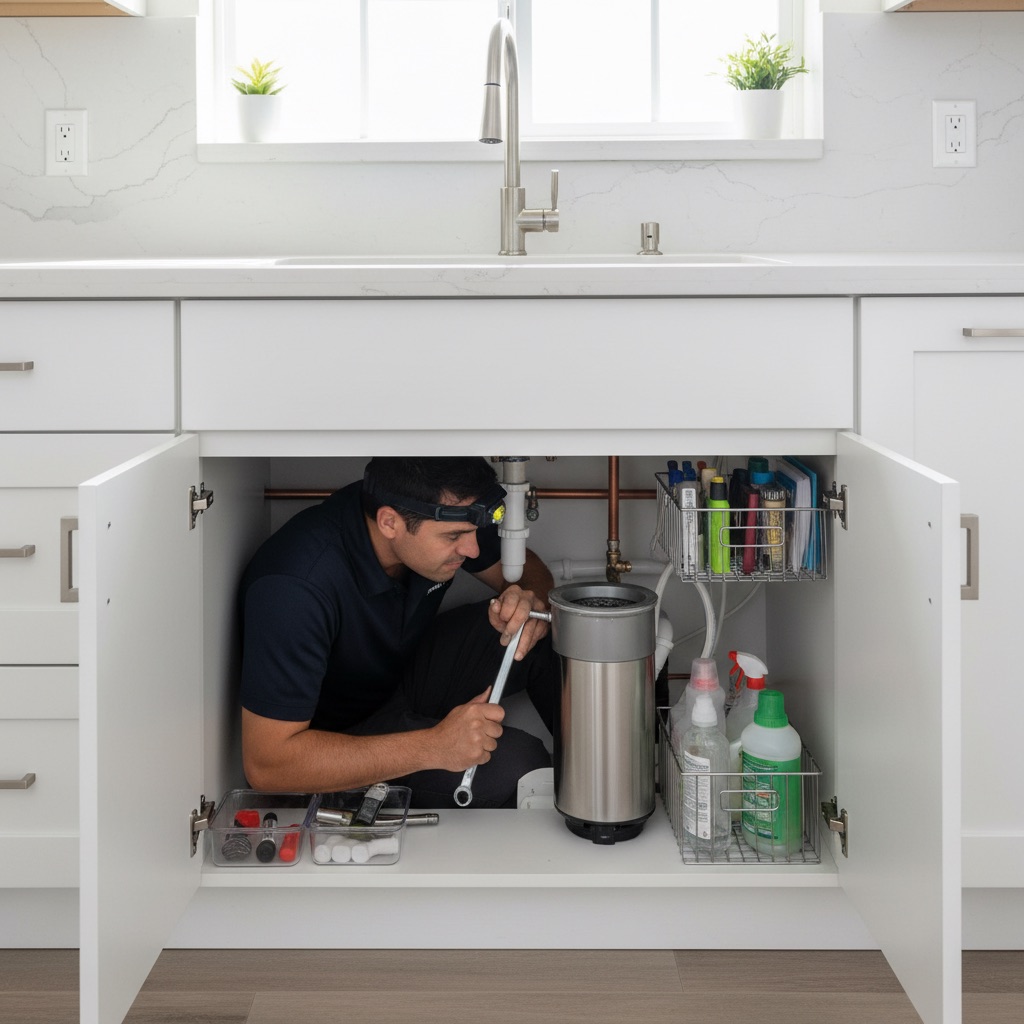
Garbage Disposal Maintenance and Repair in San Diego
Disposals last 8–12 years in SD hard water. Repairs run $75–$150, replacement $200–$450 installed. What to grind, what to avoid, and 5-minute DIY resets.
The short answer
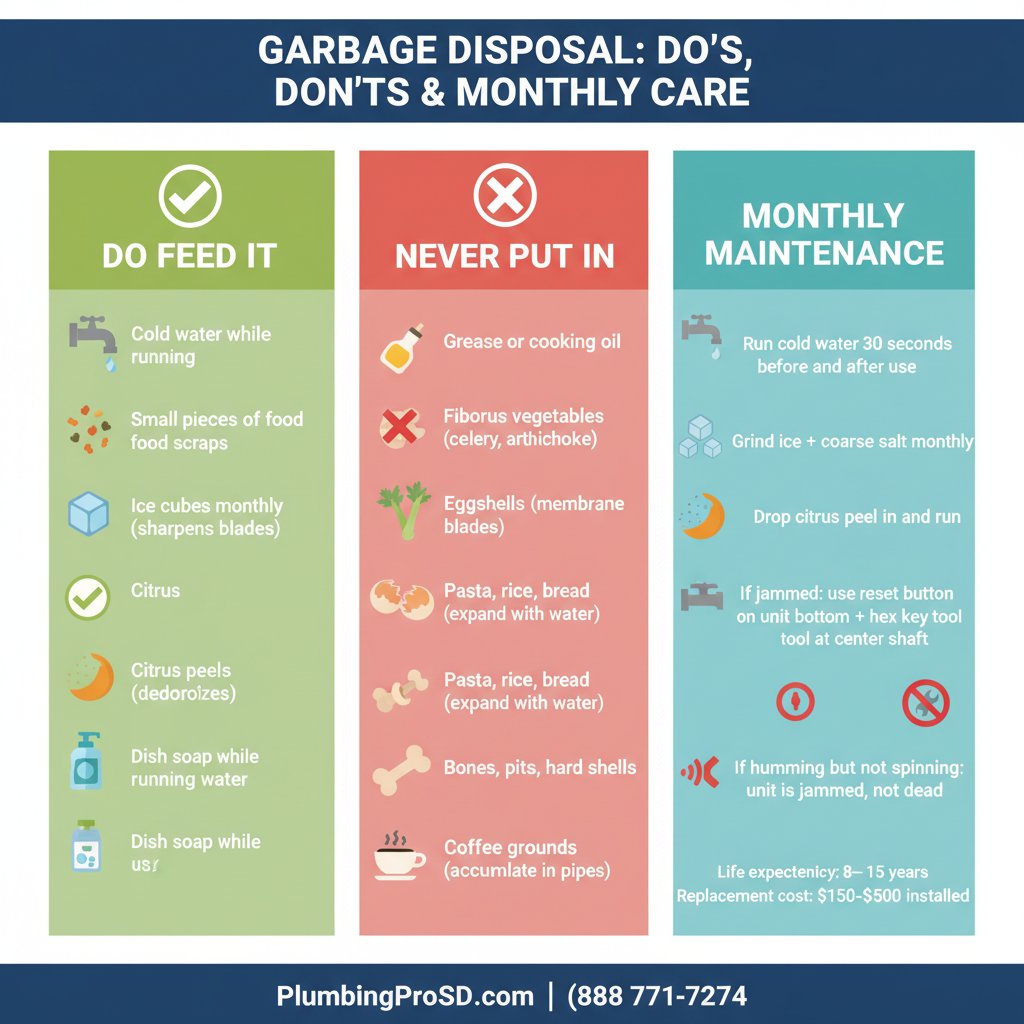
- Disposals last 8 to 12 years in San Diego hard water; repairs run $75 to $150 and full replacement $200 to $450 installed.
- If it hums but will not spin, the impeller is jammed; cut power, free it with a 1/4-inch hex key, then press reset.
- If it is dead silent, press the reset button on the bottom and check the breaker before assuming it is broken.
- Never grind grease, fibrous veggies, expandable starches, eggshells, coffee grounds, or fruit pits.
- Replace it for bottom-of-body leaks or worn-bearing rattle. Call (858) 400-4417 and we'll connect you with a licensed plumber.
A garbage disposal is one of those appliances that gets taken for granted until the day it stops working, and when it fails, it tends to fail at the worst possible time. A humming motor that will not spin, a leak under the kitchen sink, or a drain that backs up right before dinner guests arrive.
Most garbage disposal problems are preventable with basic maintenance and knowing what not to put down the drain. And many “broken” disposals can be reset and cleared in under five minutes with no tools. Here is everything San Diego homeowners need to know to keep their disposal running reliably for years.
How does a garbage disposal actually work?
Understanding the mechanics helps explain why certain foods damage disposals. Despite what many people assume, a garbage disposal does not have rotating blades like a blender. It has an impeller plate with small hardened metal lugs (sometimes called teeth or hammers) that spins at high speed and flings food waste against a stationary grind ring. The food is ground fine enough to be flushed through the drain with water.
This mechanism is powerful enough to handle most soft food waste but is not designed for hard, fibrous, or expandable materials. The impeller is not sharp, it works by force and friction, not cutting. This is why stringy vegetables, hard seeds, and starchy foods cause problems the mechanism cannot overcome.
What can and can’t you put in a garbage disposal?
Safe to Grind
- Most soft food scraps (cooked vegetables, soft fruit, bread, small amounts of pasta)
- Ice cubes (also good for cleaning, more on this below)
- Citrus peels, lemon, lime, orange (freshens the unit)
- Small chicken and fish bones (the grinding action handles small bones fine)
- Cold running water while operating
Never Put in a Disposal
Grease, oil, and liquid fats. This is the biggest mistake San Diego homeowners make. Liquid grease seems harmless but coats the drain pipe below the disposal and solidifies as it cools. Over weeks, it accumulates until the pipe is fully blocked, and that clog is often located several feet into the drain line, making it difficult and expensive to clear. Pour grease into a container and throw it in the trash.
Fibrous vegetables. Celery, artichoke hearts, asparagus, onion skins, leek tops, and corn husks have long stringy fibers that wrap around the impeller plate and motor shaft. The disposal cannot grind them effectively, and they can bind the entire mechanism.
Expandable starches. Rice, pasta, oatmeal, and potato peels absorb water and expand significantly. Even after being ground fine, these starches expand in the drain pipe, forming sticky, dense clogs that are difficult to clear.
Eggshells. There is a persistent myth that eggshells sharpen disposal blades. Disposals do not have blades, and eggshells do not help them. The thin membrane lining the inside of the shell wraps around the grinding mechanism just like fibrous vegetables. The shell itself grinds fine, the membrane causes the problem.
Coffee grounds. Coffee grounds seem harmless because they are already fine. The problem is they accumulate in the drain trap and pipe below the disposal, forming a dense, muddy sediment that progressively blocks flow.
Large bones, fruit pits, and seeds. Avocado pits, peach pits, cherry pits, mango seeds, and any bone you could not easily cut with a sharp knife will damage or jam the impeller. These materials are harder than the grind ring.
Pasta, potatoes, and starchy vegetables in large amounts. Small amounts of soft cooked pasta or potato are generally fine, but large volumes expand and can form clogs.
Chemical drain cleaners. Never pour liquid drain cleaners into a disposal. The chemicals are corrosive to the disposal’s rubber seals, gaskets, splash guard, and the plastic drain components below. If you have a slow drain, call a plumber for professional drain cleaning, chemical cleaners cause more long-term damage than the clog.
How does San Diego’s hard water affect your garbage disposal?
San Diego’s water averages about 16 grains per gallon of hardness, classified as “very hard.” This mineral-rich water affects your garbage disposal in two ways that are specific to the San Diego environment.
Internal mineral deposits. Hard water leaves calcium and magnesium deposits on the grinding ring, impeller plate, and interior surfaces of the disposal over time. These deposits reduce grinding efficiency and contribute to the gritty, chalky buildup that causes odors.
Drain line scale. The drain pipe below the disposal, and the longer drain lines running to the stack, accumulate mineral scale from hard water, gradually narrowing the pipe diameter. This is why disposal-related drain slowness can develop even with perfect usage habits. If your disposal drains sluggishly despite correct use and maintenance, the issue may be scale in the drain line rather than the disposal itself. A professional drain cleaning with hydro-jetting addresses this effectively.
Shortened lifespan. The combination of mineral deposits and the corrosive effect of San Diego’s water chemistry on metal components means San Diego disposals may need replacement closer to the 8–10 year mark rather than the 12–15 years common in softer water markets.
10 Maintenance Habits That Keep Disposals Running
1. Always Run Cold Water, Not Hot
Run cold water, not hot, while operating the disposal, and keep it running for 15–20 seconds after you turn the unit off. Cold water causes fats and grease to solidify so they are ground and flushed through rather than coating the drain line as liquid. Hot water liquefies grease, which then re-solidifies further down the pipe as a clog.
2. Clean the Grinding Chamber Monthly with Ice
Once a month, drop a dozen ice cubes into the disposal and run it (without water running) for about 30 seconds. The ice scrubs the impeller and grind ring without any chemicals, removing buildup and food residue that causes odors. Adding a handful of coarse salt makes the scrub more effective. This is the simplest and most effective disposal cleaning method.
3. Use Citrus Peels for Odor Control
Lemon, lime, or orange peels cut into smaller pieces run through the disposal leave the grinding chamber smelling fresh and help cut through grease film. Citrus rinds are one of the few items that genuinely benefit the disposal, the natural oils clean and deodorize the grinding surfaces.
4. Clean the Splash Guard Regularly
The rubber splash guard, the flap around the drain opening at the top of the disposal, traps food and grease on its underside and is often the primary source of disposal odors. Lift the rubber flaps back and scrub the underside with a small brush and dish soap every few weeks. This is frequently overlooked and makes a significant difference.
5. Baking Soda and Vinegar for Deep Deodorizing
Pour half a cup of baking soda into the disposal, followed by a cup of white vinegar. Let it fizz for 5–10 minutes, then flush with cold water. This neutralizes bacterial odors and helps break down grease film on interior surfaces. Use monthly or any time odors develop.
6. Run It Frequently, Even Empty
Run your disposal briefly with cold water every few days, even if you have not used it for food waste. This prevents the motor from seizing from disuse, prevents rust on the grind ring, and keeps the drain line flushed. Disposals that sit unused for weeks in vacation homes are notorious for seizing.
7. Feed Food Waste Gradually
Avoid dumping a large amount of food waste in at once and grinding it in a single burst. Feed waste gradually in smaller amounts with cold water running throughout. Overloading the impeller at once causes thermal overload (the unit shuts off) and accelerates wear.
8. Know Where the Reset Button Is
On the bottom of every garbage disposal is a small reset button (usually red or black). When the motor overloads from a jam or excessive food volume, the built-in thermal overload protection trips and the unit goes completely silent, it will not hum, it will not turn on at all.
Before assuming the disposal is broken, press the reset button firmly until you feel it click, wait 60 seconds, then try again. This fixes a significant percentage of “broken” disposal service calls. Do this step before calling anyone.
9. Use the Hex Wrench for Jams
If the disposal hums when turned on but will not spin (you can hear the motor trying but the impeller is not moving), the impeller is jammed by a foreign object or food that has locked the mechanism. Do not keep trying to run it, you will burn out the motor.
On the bottom center of the disposal body there is a hex (Allen) wrench socket, typically for a 1/4” hex key. Most disposals come with the wrench; if you have lost it, it costs $2 at any hardware store.
Insert the hex key into the socket and manually work it back and forth until the impeller frees up. Remove the obstruction (use tongs or a flashlight to look inside, never your hand), press the reset button, and try again.
10. Schedule an Annual Plumbing Check
Ask your plumber to inspect the disposal’s mounting assembly (a common crack point that causes under-sink leaks) and the drain connection annually. Catching a hairline crack in the mounting flange or a loose drain gasket before it causes a leak is far cheaper than repairing water damage under the sink.
What are common garbage disposal problems and how do you fix them?
The Disposal Hums But Does Not Spin
Cause: The impeller is jammed. The motor runs but the grinding plate is locked.
What to do: Turn off the disposal and unplug it (or flip the circuit breaker). Use the hex key on the bottom socket to manually free the impeller. Remove the obstruction with tongs. Press the reset button. Try again.
If the hex key approach does not work: A badly jammed or seized motor may need professional repair or replacement.
The Disposal Does Not Turn On At All (No Sound)
Cause: Thermal overload protector has tripped (most likely) or the circuit has tripped, or less commonly, an electrical failure.
What to do: Press the reset button on the bottom of the unit. Check your electrical panel for a tripped breaker on the circuit serving the disposal. If neither resolves it, the disposal may have an electrical problem requiring professional diagnosis.
Leaking Under the Sink
Disposal leaks come from three different locations with different causes:
- Leak at the top (sink flange): The plumber’s putty seal between the disposal and the sink drain has failed. The mounting assembly may also have a hairline crack. Usually repaired by re-seating and resealing the flange or replacing the mounting assembly.
- Leak from the side (discharge pipe or dishwasher drain connection): The drain gasket or connection has loosened or failed. Often a simple tightening or gasket replacement.
- Leak from the bottom of the disposal body: This indicates an internal seal has failed. The internal seals are not serviceable, this almost always means the disposal needs replacement.
Disposal Drains Slowly
Cause: Partial drain line blockage below the disposal, often from grease, expandable starch buildup, or in San Diego’s hard water environment, mineral scale accumulating in the drain pipe.
What to do: Try the ice cube and baking soda/vinegar cleaning methods first. If they do not resolve the slowness, the blockage is in the drain line rather than the disposal itself. Professional drain cleaning with a snake or hydro-jet is the right solution, not chemical cleaners, which damage disposal components.
Loud Grinding, Rattling, or Clanking
Cause: A hard foreign object (bottle cap, small utensil, pit, bone fragment) has gotten into the grinding chamber, or worn bearings are creating mechanical noise.
What to do: Turn off the disposal immediately. Use a flashlight to look into the grinding chamber and tongs to retrieve any visible foreign objects. If the noise returns with the chamber clear, the bearings or grinding components are worn, this typically indicates the disposal is approaching end of life.
Should you repair or replace your garbage disposal?
Most garbage disposal repairs, unjamming the impeller, reseating the mounting flange, replacing the drain gasket, or cleaning, cost $75–$150 in labor and minimal parts. These repairs make sense when:
- The unit is less than 6 years old
- The motor runs quietly when not jammed
- The problem is clearly isolated to a specific component
Consider replacing your disposal if:
- The motor hums but the hex key fix and reset do not work (seized motor)
- The unit leaks from the bottom body (internal seal failure, not repairable)
- It is 8+ years old and experiencing recurring problems
- You hear loud rattling or grinding when the chamber is empty (worn bearings)
- Repairs have been needed more than twice in two years
Garbage Disposal Brands and What They Cost in San Diego
InSinkErator is the most common brand in San Diego homes and the market leader. Models range from the basic Badger 5 (around $100–$130 unit cost, 1/2 HP) to the Evolution Excel (around $375–$425, 1 HP, very quiet). Motor power and sound insulation improve significantly with price.
Moen makes well-regarded mid-range disposals with a focus on quieter motor design, typically $120–$250 for the unit.
Waste King offers good value with high-speed motors, typically $80–$180 for the unit.
Total installed cost in San Diego for disposal replacement, including plumber labor, runs $200–$450 depending on the model selected and whether any drain line work is needed at the same time.
When should you call a plumber for your disposal?
- Will not respond at all after trying the reset button and circuit breaker
- Leaking under the sink from any location
- Drains slowly and cleaning methods have not resolved it
- New installation, the disposal needs to be correctly mounted and the drain connection properly made to the sink’s drain system
- Replacing alongside a new dishwasher, the dishwasher drain connection to the disposal needs to be coordinated correctly
The kitchen and bathroom plumbers we connect you with handle same-day garbage disposal repair and replacement throughout San Diego County. For help deciding whether to repair or replace your specific unit, they’ll give you an honest assessment rather than automatically recommending replacement.
Frequently Asked Questions
Q: How long should a garbage disposal last in San Diego?
In most markets, garbage disposals last 10–15 years with proper maintenance. San Diego’s hard water conditions mean you should realistically expect 8–12 years for a well-maintained unit. Lower-end units (under $100) often need replacement by 5–7 years. Higher-quality units with stainless steel grinding components hold up better to San Diego’s hard water than cheaper units with galvanized or plastic grinding components.
Q: Why does my garbage disposal smell bad even after cleaning?
The most common source of persistent disposal odors is the underside of the rubber splash guard (the flap at the top of the drain opening), which traps food and develops bacterial growth. Lift the rubber flaps and scrub thoroughly with dish soap and a brush. The second most common source is biofilm in the drain line below the disposal, which responds to baking soda and vinegar treatment followed by hot water flushing. If odors persist after addressing both, the disposal itself may have a crack or degraded seal allowing food to collect.
Q: Can I put avocado pits or mango seeds in my disposal?
No. Large fruit pits, avocado, mango, peach, nectarine, cherry, are too hard for a residential disposal to handle and will damage the impeller and grind ring. They can also cause severe jams. Compost them or discard in the trash.
Q: Why does my disposal work fine but drain slowly?
Slow draining with a functioning disposal usually indicates a partial blockage in the drain line below the disposal, often from accumulated grease, starch buildup, or in San Diego’s hard water environment, mineral scale inside the drain pipe. The problem is downstream of the disposal, not in the unit itself. A professional drain cleaning service, particularly hydro-jetting, will clear the line effectively. Chemical drain cleaners are not recommended because they damage disposal components.
Q: Do I need a plumber to replace a garbage disposal?
For a simple swap (same location, existing drain connections are in good condition), a handy homeowner can replace a disposal. The main tasks are disconnecting the old unit, mounting the new one on the existing flange assembly, and reconnecting the drain line. However, if you are also connecting a dishwasher drain, replacing old drain connections, or installing in a new location, a licensed plumber ensures the connections are code-compliant and properly sealed.
Related reading
A well-maintained disposal is only half the equation. Our guide on how to prevent clogged drains covers the kitchen drain line below the disposal, where grease and hard water scale cause most of the real damage. Planning a dishwasher installation at the same time? Our post on whether a plumber can install a dishwasher explains why coordinating both jobs in a single visit saves time and money.
Plumbing Pro San Diego connects homeowners with licensed pros for garbage disposal repair and replacement throughout San Diego County, from Oceanside to Chula Vista, from La Jolla to El Cajon. Whether you’re in Solana Beach, Del Mar, or Vista, call (858) 400-4417 and tell us what your disposal is doing. The plumbers we connect you with carry the most popular InSinkErator and Moen models on their trucks and can usually have you back in service quickly. Visit our kitchen and bathroom plumbing service page for more on what we cover.
Areas this guide covers
We connect homeowners with licensed plumbers in these San Diego County communities.
Keep reading
Need a Plumber in San Diego?
Licensed, insured plumbers, ready across San Diego County. The plumber quotes you before any work starts.
Call (858) 400-4417Call any time, day or night, anywhere in San Diego County