Last updated: May 3, 2026
Tankless Water Heater Repair in San Diego (2026)
Tankless repair runs $150–$800 in San Diego; full replacement $2,800–$4,200. Annual descaling is required in SD hard water. Error codes and diagnosis.
The short answer
- Tankless repairs in San Diego run $150 to $800 for most parts; a full replacement is $2,800 to $4,200.
- Annual descaling is required in San Diego hard water (every 6 months in East County) and runs $150 to $300; skipping it is the top cause of failure.
- Common fixes by cost: descale $150 to $300, igniter or flame sensor $200 to $450, gas valve $350 to $650, control board $400 to $800, heat exchanger $800 to $1,800.
- Replace instead of repair when the heat exchanger fails on an older unit or repair costs approach half the price of a new one.
- A whole-home water softener nearly eliminates descaling and extends unit life. Call (858) 400-4417.
Tankless water heaters are genuinely superior technology, they provide continuous hot water, last 20+ years, and use significantly less energy than tank heaters. But when a tankless unit fails, the diagnosis is less intuitive than checking a pilot light or flipping a breaker. Modern tankless units communicate through error codes, have multiple interacting systems (gas supply, combustion air, flow sensing, heat exchange), and have specific vulnerabilities in San Diego’s hard water environment.
San Diego Tankless Water Heater Repair Costs (2026)
Tankless giving you error codes or cold water? Plumbing Pro San Diego connects you with plumbers who diagnose and repair all major tankless brands and handle annual descaling for San Diego’s hard water. Tankless water heater service in San Diego or call (858) 400-4417.
This guide covers how to diagnose the most common tankless water heater problems in San Diego, what specific error codes from Navien, Rinnai, Noritz, and Takagi mean, the critical hard water maintenance San Diego units require, when repair makes sense vs. replacement, and what service costs.
How does a tankless water heater work?
Understanding the basic sequence helps you interpret error codes and diagnose problems. When you open a hot water tap:
- A flow sensor detects water movement (most units activate at 0.5–0.75 GPM)
- The unit opens the gas valve and activates the igniter (gas units) or energizes heating elements (electric units)
- Water passes through the heat exchanger, a dense coil of tubing exposed to the burner
- A temperature sensor modulates burner output to reach the set temperature
- A venting system removes combustion exhaust and supplies fresh combustion air
- When the tap closes, the unit shuts down completely
The efficiency of this system comes from its simplicity: energy is only used when hot water is actively needed. But each component in that sequence is a potential failure point, and the diagnostic process is about identifying which one has failed.
San Diego’s tankless landscape: Gas tankless units dominate San Diego residential installations, natural gas from SDG&E is available across most of the county, and gas heating is far more economical for high-demand households. The most common brands in San Diego are Navien, Rinnai, and Noritz, with Takagi, Rheem, and Bradford White also present.
Why is hard water scale the biggest threat to San Diego tankless units?
Before covering individual problems, it’s worth understanding the single biggest long-term threat to any tankless water heater in San Diego: mineral scale from hard water.
San Diego’s water supply comes primarily from the Colorado River via the State Water Project, handled by the San Diego County Water Authority. By the time it reaches your tap, it carries about 16 grains per gallon of dissolved calcium and magnesium, firmly in the “very hard” range and among the hardest water in any major California city.
When hard water is heated rapidly (as it is in a tankless heat exchanger), the minerals precipitate out of solution and adhere to the heat exchanger coils as calcium carbonate scale. The effects compound over time:
- Reduced heat transfer: Scale insulates the coils, forcing the burner to run longer and hotter to reach the set temperature
- Overheating error codes: The heat exchanger can’t shed heat efficiently, triggering thermal protection shutdowns
- Flow restriction: Heavy scale reduces the diameter of the water passages through the heat exchanger
- Heat exchanger failure: Eventually, severe scale causes permanent damage, pinhole leaks in the coils, warped tubing, or complete blockage
Annual descaling (also called a vinegar flush or acid wash) is not optional for San Diego tankless units, it’s a maintenance requirement, and most manufacturers require annual descaling to maintain warranty coverage in hard water regions.
If your unit has never been descaled and is more than 2 years old in San Diego, descaling should be your first maintenance priority regardless of current symptoms.
What are common tankless water heater problems?
Problem 1: No Hot Water, Unit Won’t Fire
The most alarming symptom. You open the hot tap, hear the unit click or attempt to start, but nothing happens. Check your error code display first (see error code sections below), then work through these checks:
Confirm gas supply is on:
- Do other gas appliances (stove, dryer, gas fireplace) operate normally?
- Is the gas shutoff valve directly behind or below the tankless unit fully open (handle parallel to pipe = open)?
- If gas service was recently interrupted or work was done, there may be air in the gas line, running a gas burner elsewhere for a minute or two purges it
Check the flow rate: Most tankless units require minimum flow of 0.5–0.75 GPM to activate. A partially closed supply valve, a clogged inlet filter screen, or a low-flow fixture can fail to hit this threshold.
- Check the cold water inlet valve to the unit is fully open
- Locate and clean the inlet filter screen (a small mesh filter where the cold supply enters the unit, sediment clogs it and the unit won’t sense enough flow)
Reset the unit: Turn off the power to the unit at the unit’s power switch (not the breaker), wait 30 seconds, and power back on. Many transient faults, especially in high-demand situations, clear on reset.
If none of the above: The fault is in the unit itself, igniter, flame sensor, gas valve, or control board. This requires a technician.
Problem 2: Error Codes, What They Mean by Brand
Every modern tankless unit displays an error code when it shuts down on a fault. Here are the most common codes by brand:
Navien Error Codes
Navien (Korean brand, the most popular in San Diego new construction) uses an E-series code system:
| Code | Meaning | First Step |
|---|---|---|
| E001 | Abnormal ignition (no ignition detected) | Check gas supply, reset |
| E003 | Ignition failure after multiple attempts | Check gas valve, call plumber |
| E004 | False flame detection | Call plumber (flame sensor issue) |
| E009 / E010 | Abnormal air supply / venting issue | Check vent termination for blockage |
| E011 | Exhaust blockage | Inspect exterior vent cap |
| E012 | Flame failure during operation | Check gas pressure, call plumber |
| E016 | Heat exchanger overheating | Descale immediately, this is a scale signal |
| E030 / E033 | Heat exchanger high temp | Shut down, call plumber, may indicate severe scale or flow restriction |
| E110 | Abnormal water flow | Clean inlet filter, check for low pressure |
Navien-specific note: Navien units include a built-in recirculation system on most models (NPE series). If you’re experiencing slow hot water delivery to distant fixtures, the recirculation settings may need adjustment, not a fault condition, but a configuration issue.
Rinnai Error Codes
Rinnai (Japanese brand, widely installed in San Diego from the 2000s through present):
| Code | Meaning | First Step |
|---|---|---|
| 11 | No ignition | Check gas, gas valve open, reset |
| 12 | Flame failure | Check gas supply, call plumber |
| 14 | Thermal fuse blown, overheat | Call plumber, potential scale or flow issue |
| 16 | Exhaust overheat | Check venting, inspect for blockage |
| 25 | Condensate neutralizer issue (condensing models) | Check condensate drain line |
| 52 | Outlet thermistor error | Call plumber |
| 61 | Combustion fan failure | Call plumber |
| 65 | Water flow control valve | Call plumber |
| 70 | Printed circuit board issue | Call plumber |
Rinnai-specific note: Rinnai units have a programming button on the controller that allows homeowners to check stored error codes, even faults that didn’t cause a shutdown. Pressing and holding the On/Off button (varies by model) typically cycles through stored codes. This is useful history to have when calling a plumber.
Noritz Error Codes
Noritz (Japanese brand, common in San Diego commercial and higher-end residential):
| Code | Meaning | First Step |
|---|---|---|
| 10 / 11 | Ignition failure | Check gas, reset |
| 16 | Exhaust overheat | Check venting |
| 29 | Heat exchanger scale buildup | Descale immediately |
| 52 | Outlet thermistor | Call plumber |
| 70 | Control board issue | Call plumber |
| 90 | Combustion abnormality | Call plumber, do not reset repeatedly |
| 99 | Fan motor issue | Call plumber |
Takagi Error Codes
Takagi (Japanese brand, common in older San Diego commercial and residential installations):
| Code | Meaning |
|---|---|
| 111 | No ignition |
| 121 | Ignition failure during operation |
| 161 | Overheating |
| 561 | Cold water inlet thermistor |
| 651 | Fan motor |
Problem 3: Inconsistent or Fluctuating Water Temperature
You’re getting hot water, but it fluctuates, cycling between hot and cold unexpectedly, or not reaching the set temperature consistently.
Cold water sandwich: This is the tankless unit’s signature quirk, not a malfunction. When you briefly turn off a tap and turn it back on, the hot water remaining in the supply lines reaches you first, then the cold water sitting in the pipes, then newly heated water from the unit restarting. The result is a brief burst of cold water “sandwiched” between hot. This is inherent to how tankless works.
Solutions: A recirculation system (pump + return line, or an integrated recirculation feature like Navien’s) keeps hot water circulating to eliminate the sandwich effect. A small buffer tank (2–5 gallons) provides a reservoir of pre-heated water for quick restarts.
Temperature fluctuating mid-flow: If temperature swings while you’re using hot water without interruption, the causes are:
- Flow rate variation, pressure fluctuations in your supply (especially common in San Diego’s hilly neighborhoods) cause the unit to modulate burner output in response to changing demand
- Inlet filter screen clogging, partial restriction causes inconsistent flow past the sensor
- Scale buildup in the heat exchanger, the unit can’t maintain stable temperature transfer
- Failing thermistor, the temperature sensor is giving the control board inaccurate readings
Problem 4: No Hot Water at High Demand (Multiple Fixtures Simultaneously)
The unit works fine for one shower but fails to keep up when the shower, dishwasher, and washing machine run simultaneously.
Most likely cause: Undersized unit.
Every tankless unit is rated by flow rate in gallons per minute (GPM) at a temperature rise. In San Diego, incoming cold water temperature ranges from about 60°F in winter to 72°F in summer. If your unit is rated for 8 GPM at a 35°F rise but you’re asking it to handle 8 GPM at a 50°F rise, it won’t make the target temperature.
If this problem developed gradually, the unit used to handle the load but no longer does, scale buildup is almost certainly the cause. A heavily scaled heat exchanger loses significant BTU capacity.
If the problem was present from installation or developed after adding household members or fixtures, the unit may simply be undersized for your actual demand.
Problem 5: Venting Problems
Gas tankless units require a venting system that removes combustion exhaust and supplies fresh combustion air. Two configurations are common:
Power vent: A fan forces combustion air through the unit and exhausts gases through a single pipe. Requires indoor air supply.
Direct vent (balanced flue): Two-pipe system, one pipe brings outdoor combustion air in, the other exhausts gases out. Preferred for airtight modern construction.
Common San Diego-specific venting issues:
- Bird and insect nesting at exterior terminations: San Diego’s year-round mild climate means birds nest at exterior vent caps throughout the year. Blocked exhaust or air intake causes ignition failure codes and combustion problems.
- Condensate drain blockage: High-efficiency (condensing) units cool exhaust enough to condense. The condensate drain can become clogged, particularly in units that aren’t serviced regularly.
- Disconnected vent joints: Vibration and thermal expansion can cause PVC vent joints to separate, allowing combustion gases to enter the home. Carbon monoxide risk. Never attempt to repair venting yourself.
What you can check: Look at the exterior vent termination for visible bird nests, debris, or crushed vent cap. Clear anything you can safely remove. Everything else, disconnected joints, configuration issues, condensate problems, needs a technician. If your tankless unit shares an exhaust chase or venting area with a gas furnace, both systems need to be checked together. An HVAC technician can inspect the HVAC side of shared venting configurations while a plumber handles the tankless unit.
What annual maintenance do San Diego tankless units need?
San Diego’s hard water makes annual maintenance non-negotiable. Here’s the full checklist:
1. Descale the heat exchanger (annually, or every 6 months for very hard water areas)
The descaling process circulates a weak acid solution, typically food-grade white vinegar or a commercial citric acid descaler, through the heat exchanger coils for 45–60 minutes, dissolving mineral deposits.
What you need for DIY descaling:
- Isolation service ports installed on the unit (most new units have them; older units may not)
- A submersible pump
- Two hoses
- A 5-gallon bucket
- White vinegar or commercial descaler (Calci-Free, EasySolv, or equivalent)
The process: Connect the pump to the cold inlet service port, run the discharge hose from the hot outlet port into the bucket, fill the bucket with the descaling solution, and run the pump for 45–60 minutes. Flush with fresh water for 5 minutes.
If your unit doesn’t have service ports, a plumber can install them during the first professional descale, a one-time addition that makes future maintenance much easier.
2. Clean the inlet filter screen (every 6 months)
Locate the cold water inlet at the bottom of the unit. There’s typically a small mesh screen just inside the connection that catches debris from the supply line. Remove, rinse, reinstall.
3. Inspect the exterior vent termination
Check for bird nests, wasp nests, debris, or damage at the exterior vent cap. Clear any obstruction.
4. Check the condensate drain (condensing models)
Confirm the drain line is clear and draining freely. A blocked condensate line can trigger shutdown codes.
5. Test the pressure relief valve
The T&P valve should operate freely. If it’s stuck or hasn’t been tested in years, have a plumber check it.
6. Check the error code log
Most modern tankless units store error history accessible through the controller. Review this for any stored codes that might indicate developing issues.
When should you stop repairing and replace your tankless unit?
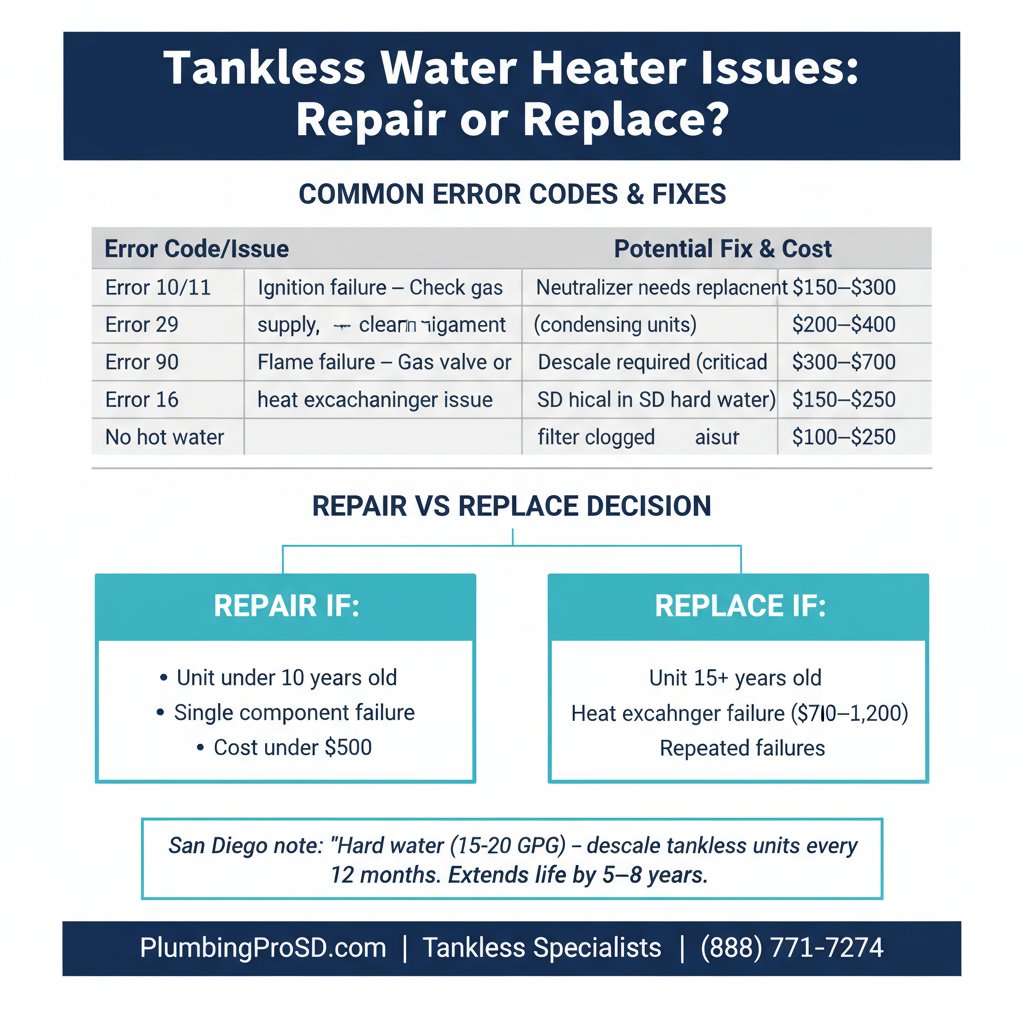
Tankless units are worth repairing when:
- The unit is under 10 years old
- Repairs involve sensors, igniters, or valves (discrete components, not the heat exchanger)
- The heat exchanger is in good condition
- Repair cost is under $600
Consider replacement when:
- The heat exchanger has failed, this is the core component of the unit. Replacement costs $500–$1,200 for the part, plus labor, often totaling $800–$1,800, approaching or exceeding 50% of a new unit’s installed cost
- The unit is 15+ years old with recurring problems, newer units are meaningfully more efficient (higher AFUE ratings) and have better scale-resistant designs
- Annual repairs on an aging unit, when you’re replacing sensors, igniters, or valves every year, the unit is in general decline
- The unit is undersized for current household demand, no amount of repair changes the fundamental BTU capacity
Repair and Replacement Costs in San Diego
| Service | Typical Cost |
|---|---|
| Diagnostic appointment | $100 – $200 |
| Descale service (professional) | $150 – $300 |
| Igniter / flame sensor replacement | $200 – $450 |
| Gas valve replacement | $350 – $650 |
| Thermistor (temp sensor) replacement | $150 – $350 |
| Control board replacement | $400 – $800 |
| Heat exchanger replacement | $800 – $1,800 installed |
| New Navien NPE unit (installed) | $2,800 – $4,200 |
| New Rinnai RU series (installed) | $2,600 – $4,000 |
| New Noritz unit (installed) | $2,500 – $3,800 |
| Add recirculation system to existing unit | $400 – $900 |
| Install service port valves | $150 – $300 |
All replacement installations require permits in San Diego, this cost is typically included in a plumber’s installation quote.
Frequently Asked Questions
Q: My Navien (or Rinnai) is showing an ignition error. Can I fix this myself?
You can try: confirm gas is on, confirm the gas shutoff valve to the unit is fully open, reset the unit. If the error clears and the unit operates normally, it may have been a transient fault (brief gas pressure drop, momentary flow issue). If the error code returns immediately or within a day, the fault is in a component, igniter, flame sensor, or gas valve, and needs a technician. Do not repeatedly reset without investigating.
Q: How often does a San Diego tankless unit really need descaling?
Annually for most San Diego locations. For homes in areas with particularly hard water (East County, El Cajon, Santee, Lakeside, tends to have harder water than coastal areas), every 6 months may be appropriate. If you install a whole-home water softener, you can extend the descaling interval significantly. Navien recommends annual maintenance in their warranty terms; Rinnai and Noritz have similar language.
Q: What’s the “cold water sandwich” and is it a problem with my unit?
The cold water sandwich, a brief burst of cold water when you turn the tap back on after a short pause, is an inherent characteristic of tankless heaters, not a malfunction. It’s caused by the cold water that was sitting in the supply pipes between the unit and the fixture. The unit shuts off when the tap closes, so when you turn it back on, you get whatever was in the pipes before newly heated water arrives. A recirculation system (pump + return line) eliminates this by keeping hot water circulating to fixtures when demand is low.
Q: My tankless unit works fine for one shower but not two simultaneously. Is it broken?
Not necessarily, it may be undersized. Check your unit’s flow rate rating (GPM) at the required temperature rise. If you’ve added household members or a bathroom since the unit was installed, demand may now exceed capacity. Scale buildup can also reduce effective BTU output significantly, causing a previously adequate unit to fail at high demand. Have a plumber descale the unit and assess whether its rated output matches your current demand.
Q: Is San Diego’s hard water going to ruin my tankless water heater?
Hard water accelerates scale buildup in the heat exchanger, which is the biggest threat to a San Diego tankless unit. But annual descaling keeps scale manageable, many well-maintained tankless units run 20+ years in hard water regions. The real risk is owners who skip descaling and let scale accumulate until it damages the heat exchanger. A whole-home water softener virtually eliminates the descaling need and extends unit life significantly. The EPA WaterSense program also has resources on water quality and fixture efficiency.
Related reading
If your tank water heater is failing and you’re weighing a tankless upgrade, our guide on water heater problems in San Diego covers the full range of tank heater symptoms and the repair-vs-replace decision. For an overview of what tankless installation and other plumbing jobs cost, see our San Diego plumbing pricing guide.
Plumbing Pro San Diego connects you with plumbers who service and repair all major tankless water heater brands throughout San Diego County, Navien, Rinnai, Noritz, Takagi, Rheem, and Bradford White. Hard water areas like San Marcos, Rancho San Diego, and Escondido especially benefit from regular descaling service. The plumbers we connect you with carry descaling equipment for same-day service calls and stock common parts for rapid repair. Call (858) 400-4417 to schedule service, or visit our water heater services page to learn more about tankless repair, maintenance, and installation.
Areas this guide covers
We connect homeowners with licensed plumbers in these San Diego County communities.
Keep reading
Need a Plumber in San Diego?
Licensed, insured plumbers, ready across San Diego County. The plumber quotes you before any work starts.
Call (858) 400-4417Call any time, day or night, anywhere in San Diego County