
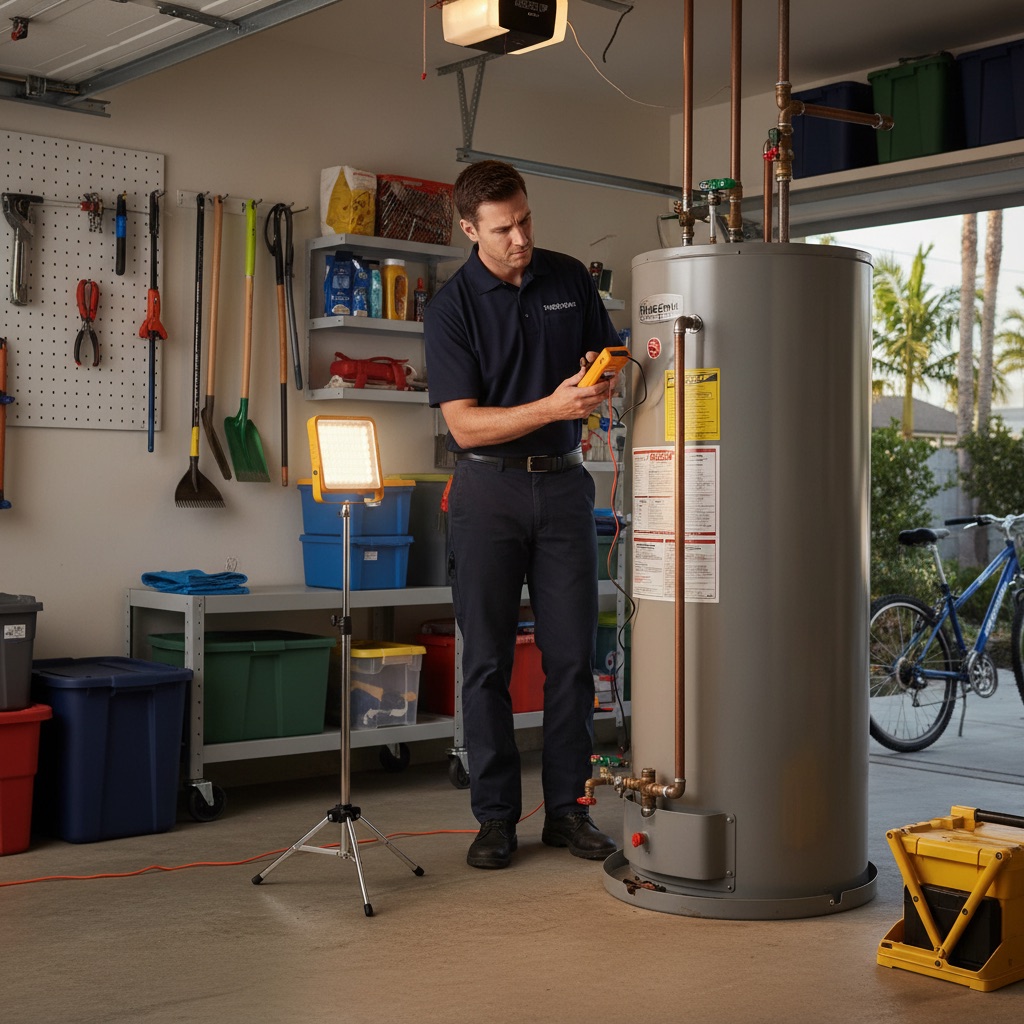
Last updated: April 20, 2026
Water Heater Not Working in San Diego? Fix Guide
No hot water? Could be a tripped breaker (free) or a dead tank ($900–$1,800 to replace). Step-by-step diagnosis for gas, electric, and tankless in SD.
The short answer
- First check utilities: a tripped breaker on an electric unit is the most common cause and a 10-second free fix.
- On gas units, a pilot that won't stay lit usually means a failed thermocouple, a low-cost repair.
- Common fixes run cheap: thermocouple $100 to $250, electric element $150 to $350, tank flush $100 to $200.
- A full tank replacement runs $900 to $1,800; a gas tankless install runs $2,500 to $4,500.
- Water heater replacement needs a permit in most San Diego jurisdictions, so it is a licensed-plumber job.
Stepping into a cold shower when you expected hot water is a universally terrible morning. But before assuming the worst, that your water heater is dead and you’re facing a $2,000 replacement, most water heater failures come down to a handful of known, diagnosable problems. Some you can address in 15 minutes; others need a licensed plumber.
San Diego Water Heater Repair vs. Replacement Costs (2026)
This guide walks through the most common reasons a water heater stops working in San Diego, organized by symptom. It covers gas and electric tank heaters, tankless units, what you can check yourself, what costs look like, and the repair-vs.-replace decision.
Is it a utility issue?
Before troubleshooting your water heater, confirm the problem is actually in your home:
For gas units: Check that other gas appliances are working, stove burners, gas dryer. If none of your gas appliances work, contact SDG&E (1-800-411-7343). An outage or service interruption isn’t a water heater problem.
For electric units: Check your circuit breaker panel. A tripped breaker is the single most common cause of an electric water heater suddenly producing no hot water. It’s a 10-second fix if that’s the issue.
If utilities are fine and you still have no hot water, work through the symptoms below.
What if you have no hot water at all?
This is the most alarming symptom and the one with the most distinct causes by heater type.
Gas Tank Heater: No Hot Water
Most likely cause: Pilot light out or thermocouple failure.
Older gas water heaters use a standing pilot light, a small, continuously burning flame that ignites the main burner. If that pilot goes out, you get no heat, period.
What to check:
- Open the access panel at the base of the unit and look for the pilot light. If there’s no visible flame, the pilot is out.
- Follow the relighting instructions printed on the unit, this typically involves turning the control knob to “pilot,” pressing and holding it down, and pressing the igniter button repeatedly until the pilot catches.
- Hold the knob down for 30–60 seconds after the pilot lights, then slowly release. The pilot should stay lit.
If the pilot won’t stay lit: The thermocouple has likely failed. The thermocouple is a safety sensor that detects the pilot flame and keeps the gas valve open. When it fails, the gas valve closes automatically. This is a $15–$30 part and an easy plumber repair, don’t attempt gas component work yourself.
Other possibilities: Gas valve failure (the valve itself is stuck or not opening), blocked burner orifice, or a draft that keeps extinguishing the pilot. If the draft is caused by negative pressure from your HVAC system pulling air through the water heater room, that’s an HVAC issue, an HVAC technician can evaluate your return air balance and combustion air supply.
Electric Tank Heater: No Hot Water
Most likely cause: Tripped breaker or failed upper heating element.
Check the breaker panel first, electric water heaters draw significant amperage and can trip a breaker, especially if the circuit is shared with other loads.
What to check:
- Locate the water heater’s breaker in the panel (usually labeled, typically 30-amp double-pole breaker).
- If it’s tripped (in the middle position), switch it fully off, then fully on.
- Wait 30–60 minutes and test for hot water.
If the breaker trips again immediately or within hours: Something is pulling more current than the breaker allows, usually a shorted heating element. Do not keep resetting. This needs a plumber.
If the breaker is fine: The upper heating element or its thermostat has likely failed. Electric tank heaters have two elements, upper and lower. The upper handles initial heating; when it fails completely, you get zero hot water, even with a functioning lower element. This is a straightforward part replacement.
Tankless Heater: No Hot Water
Tankless units display error codes when they fail, check the display screen on your unit. Common no-hot-water codes:
- Navien E003 / E012: Ignition failure
- Rinnai code 11 / 12: No ignition
- Noritz code 10 / 11: Ignition failure
For ignition failures, check that gas supply is on and that the gas shutoff valve to the unit is fully open. If other gas appliances work normally and the valve is open, the fault is in the unit itself, igniter, flame sensor, or gas valve. These require a technician.
See our detailed guide on tankless water heater repair in San Diego for full error code breakdowns by brand.
Why does your hot water run out so fast?
You’re getting hot water, but not much of it, or it runs out far faster than it used to.
Likely Causes
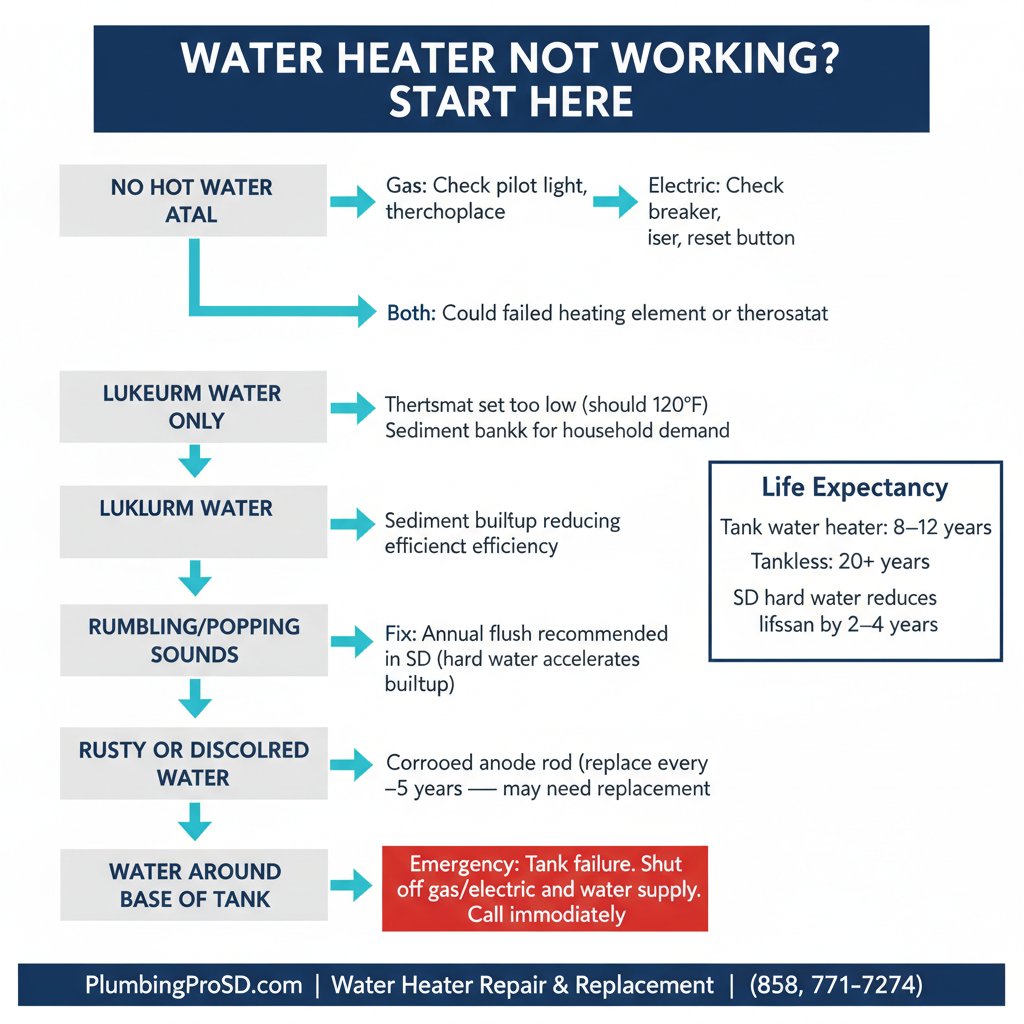
Sediment buildup (tank heaters). This is the number one cause in San Diego. Our water contains about 16 grains per gallon of dissolved minerals, calcium and magnesium primarily. Over years of operation, these minerals settle as sediment on the bottom of the tank and harden into a thick scale layer. The sediment insulates the water from the burner or lower heating element, drastically reducing efficiency.
A water heater with significant sediment produces less hot water and takes longer to recover between uses. Annual flushing slows accumulation; a professional flush can help if the buildup is moderate. If the unit is heavily scaled after years of neglect, efficiency is compromised enough that replacement may be more economical.
Failed lower heating element (electric). The lower element handles the bulk of the tank’s heating. When it fails, you get some hot water from whatever the upper element heated, but much less than normal, and recovery is very slow.
Undersized unit for current demand. If your household has grown, added family members, a new bathroom, a high-demand appliance, a water heater that was adequate before may now simply be undersized for demand. A 40-gallon tank that was fine for two people struggles with four.
Thermostat set too low. The factory default setting on many water heaters is 120°F, which can feel lukewarm in a large household with rapid back-to-back showers. Check the thermostat setting (on electric heaters, there’s usually one per element behind access panels). 120°F is appropriate for most households; 140°F is recommended if you have a dishwasher without its own booster heater.
What to do: Start by checking the thermostat setting. If that’s not the issue, sediment is the most likely culprit in San Diego. A plumber can perform a professional flush and assess whether the unit has life left in it.
What causes rumbling, banging, or popping sounds?
Noise from a water heater is almost always sediment. When the heating element or burner fires up, it heats water trapped beneath the sediment layer. That water percolates through the sediment, creating the characteristic rumbling, popping, or knocking sound.
San Diego context: This problem hits San Diego homeowners harder and sooner than most. The combination of hard water and the thermal cycling that any water heater goes through causes rapid mineral precipitation. A water heater in San Diego can develop significant sediment buildup within 3–5 years without annual flushing maintenance.
What to do: If you’ve never flushed the tank and the unit is making noise, have a plumber assess the scale severity. Mild-to-moderate buildup can be reduced with a flush. Heavy scale that’s been accumulating for years has already degraded efficiency significantly, at that point, whether to flush or replace is a cost analysis.
Prevention: Annual tank flushing (draining a few gallons to clear settled minerals) dramatically slows accumulation. A whole-home water softener or descaler is the most effective long-term solution.
Why is the water too hot?
Scalding hot water is a safety hazard and indicates a thermostat problem.
Most likely cause: On electric water heaters, a faulty thermostat that isn’t shutting off the element at the target temperature. On gas heaters, the thermostat dial on the control valve may have shifted or the valve may be malfunctioning.
What to check: First, confirm where the thermostat is set. If it’s at the correct setting (120°F) and water is coming out much hotter than that, the thermostat is not reading or controlling temperature correctly. This needs a plumber.
The T&P valve. If water is coming out of the temperature and pressure relief valve (the valve with a pipe pointing down the side of the unit), the tank temperature or pressure has exceeded safe limits. This is a serious safety situation, the T&P valve is the last line of defense before a tank failure. Turn off the heater and call a plumber immediately.
What causes rusty, discolored, or smelly hot water?
Rusty or reddish hot water (with clear cold water): The sacrificial anode rod inside the tank has been depleted and the tank itself is beginning to corrode. Anode rods are designed to corrode so the tank doesn’t, but they need replacement every 3–5 years. Once the tank is rusting, the water heater needs replacement.
If both hot and cold water are discolored: The issue is in your supply pipes, not the water heater. Older galvanized steel pipes corrode from the inside and color the water as it flows through. A plumber needs to assess whether repiping sections is warranted.
Rotten egg smell in hot water only: A reaction between the magnesium anode rod and naturally occurring sulfate bacteria in some water supplies. San Diego’s water occasionally produces this in homes with certain water chemistry. Solutions include flushing with diluted hydrogen peroxide, replacing the magnesium rod with an aluminum-zinc rod, or, for severe cases, a whole-home water treatment system. See our water filtration services for more information.
Why is water pooling around the base of your water heater?
Standing water at the base of a water heater warrants immediate attention.
T&P valve discharge pipe: A small amount of moisture at the drain pipe is occasionally normal during heating cycles. Sustained dripping or pooling from this pipe means the valve is faulty or tank pressure is dangerously elevated. Call a plumber.
Tank leak: If the tank body itself is leaking, you can see water coming directly from the tank shell, not from fittings or connections, the tank has corroded through and cannot be repaired. Shut off gas or electricity to the unit, close the cold water inlet valve, and call for emergency service. A compromised tank can fail catastrophically.
Connection leaks: Water at the inlet or outlet connections at the top of the tank (the pipe fittings at the very top) can sometimes be tightened or the connection replaced, often a manageable repair. But given the proximity to gas connections and the safety implications, have a plumber assess before attempting this.
Should you repair or replace your water heater?
The general rule: if the unit is under 8 years old and the repair cost is less than 40–50% of a new unit, repair makes sense. If the unit is over 10 years old or the repair involves the tank itself, replacement is usually the better investment.
Repair makes sense when:
- The unit is under 8 years old
- The problem is a thermocouple, heating element, or thermostat (straightforward parts)
- The tank is in good condition (no corrosion, anode rod replaced on schedule)
- Repair cost is under $400
Replace makes sense when:
- The unit is 10+ years old
- The tank itself is corroding or leaking
- You’ve been dealing with recurring sediment problems despite maintenance
- Repair cost is $500+ and the unit is aging
The repair-to-replace decision is also the right time to consider a tankless upgrade. A tankless water heater in San Diego costs $2,500–$4,500 installed but offers:
- 20+ year lifespan vs. 8–12 for a tank heater
- Continuous hot water (never runs out)
- 25–40% lower energy consumption
- No standby heat loss
- Much smaller footprint (wall-mounted)
For households with high hot water demand, large families, frequent use of multiple fixtures simultaneously, tankless is a strong investment in San Diego. See our detailed guide on tankless water heater repair and maintenance for more.
San Diego Water Heater Costs
| Service | Typical Cost Range |
|---|---|
| Thermocouple replacement | $100 – $250 |
| Heating element replacement (electric) | $150 – $350 |
| Thermostat replacement | $150 – $350 |
| Professional tank flush/descale | $100 – $200 |
| Anode rod replacement | $100 – $200 |
| T&P valve replacement | $100 – $250 |
| Tank water heater replacement (40 gal) | $900 – $1,800 installed |
| Tankless gas water heater (installed) | $2,500 – $4,500 |
Note: Replacement always requires a permit in San Diego, this cost is typically included in a plumber’s installation quote.
How does San Diego’s hard water affect your water heater’s lifespan?
San Diego draws its water primarily from the Colorado River via the State Water Project, managed by the San Diego County Water Authority. By the time it reaches residential taps, it carries significant dissolved mineral content, consistently in the “hard” to “very hard” range.
The practical impact on your water heater:
- Tank water heaters accumulate sediment 2–3x faster than in soft-water regions
- Anode rod depletion is faster, meaning more frequent replacement is needed to protect the tank
- Tankless heat exchangers scale up within 1–2 years without annual descaling
- Overall water heater lifespan in San Diego is typically shorter than manufacturer estimates unless maintenance is performed
The most effective protection: A whole-home water softener or salt-free descaling system upstream of the water heater. It protects the heater, all fixtures, and all appliances. See our water filtration services to discuss options.
Frequently Asked Questions
Q: Why does my hot water run out so quickly after a normal amount of use?
In San Diego, the most common cause is sediment insulating the bottom of the tank, the heating element or burner can’t efficiently transfer heat through the mineral layer, so recovery is slow and effective capacity is reduced. An undersized unit and a failed lower heating element are also possibilities. Have a plumber flush the tank and assess whether the element needs replacement.
Q: My pilot light keeps going out, is this dangerous?
A pilot that won’t stay lit usually means the thermocouple has failed. The thermocouple is a safety device, it keeps the gas valve open only when it detects a flame. When it fails, the gas valve closes automatically, which is exactly what it should do. This is safe (the gas is off), but you have no hot water. Have a plumber replace the thermocouple, it’s a low-cost repair.
Q: How long should a water heater last in San Diego?
With proper maintenance, annual flushing, anode rod replacement every 3–5 years, a tank water heater typically lasts 10–13 years in San Diego. Without maintenance, San Diego’s hard water can shorten that to 7–9 years. Tankless units last 18–25 years with annual descaling and proper maintenance.
Q: Can I install a water heater myself to save money?
In San Diego, water heater replacement requires a permit in most jurisdictions. Unpermitted installations create problems at resale (home inspectors find them), can void your homeowner’s insurance coverage for related damage, and in California must meet seismic strapping requirements. The permit-related risks and the gas or electrical connections involved make this a plumber job.
Q: Should I get a tankless water heater when my current tank heater is replaced?
For many San Diego homeowners, yes. If you have natural gas service, a gas tankless unit is a strong investment: it provides continuous hot water, uses 25–40% less gas than a tank heater, lasts 20+ years, and the annual descaling requirement in San Diego’s hard water is manageable. The higher upfront cost ($2,500–$4,500 installed vs. $900–$1,800 for a tank) is typically recovered in energy savings over the unit’s longer life.
Related reading
Considering a tankless upgrade as part of your replacement? Our detailed guide on tankless water heater repair and maintenance in San Diego covers error codes, descaling schedules, and the repair-vs-replace decision for every major brand. For a broader look at what any water heater job should cost, see our San Diego plumbing pricing guide.
If your water heater isn’t working and you’re in San Diego County, Plumbing Pro San Diego connects you with a plumber who can diagnose and repair, or replace, it. The plumbers we connect you with service all brands and types: Navien, Rinnai, Noritz, Rheem, Bradford White, and AO Smith, both tank and tankless. Whether you’re in Vista, Lakeside, or San Marcos, call (858) 400-4417 or visit our water heater services page to get connected with a licensed plumber.
Areas this guide covers
We connect homeowners with licensed plumbers in these San Diego County communities.
Keep reading
Need a Plumber in San Diego?
Licensed, insured plumbers, ready across San Diego County. The plumber quotes you before any work starts.
Call (858) 400-4417Call any time, day or night, anywhere in San Diego County