Last updated: April 19, 2026
Trenchless Sewer Repair in San Diego: A 2026 Guide
Pipe lining costs $4K-$12K, pipe bursting $5K-$15K, both skip the $8K-$30K excavation bill. How each method works and which fits your San Diego lateral.
The short answer
- Trenchless sewer repair fixes the line without digging up your yard, driveway, or street.
- Pipe lining (CIPP) runs $4,000 to $12,000 and pipe bursting $5,000 to $15,000, both well under the $8,000 to $30,000 cost of traditional excavation.
- Lining seals cracks inside the existing pipe; bursting replaces the pipe in one pass with new HDPE. Both last 50-plus years.
- Most jobs finish in one day, the line is out of service only 4 to 12 hours, and you can usually stay home.
- A camera inspection confirms which method fits; permits are required. Call (858) 400-4417.
The moment a plumber tells you your sewer line needs repair, most homeowners picture the same scene: a backhoe tearing through the yard, the driveway cracked open, weeks of disruption, and a bill that rivals a car payment. That picture was accurate 20 years ago. Today, it’s largely obsolete.
Sewer Repair Options: Cost Comparison (San Diego 2026)
Trenchless sewer repair has fundamentally changed how sewer lines get fixed. For most San Diego homeowners with damaged laterals, it’s faster, cleaner, and often less expensive than traditional excavation, and the results last as long or longer than digging up and replacing the pipe.
This guide explains exactly how both trenchless methods work, when each one applies, what the real costs look like, and what to ask before you commit to any sewer line contractor.
Have a damaged sewer line? Plumbing Pro San Diego connects you with plumbers offering pipe lining and pipe bursting for San Diego County homes. No yard destruction, no weeks of disruption. Trenchless sewer repair in San Diego or call (858) 400-4417.
What does “trenchless” actually mean?
Trenchless sewer repair is an umbrella term for methods that repair or replace damaged sewer pipe without requiring a continuous open trench across your property. Instead of excavating along the full pipe run, technicians access the sewer line at one or two small entry points, usually an existing cleanout, or a small access pit dug at the beginning and end of the repair section, and do the work from the inside.
There are two distinct trenchless methods: pipe lining (CIPP) and pipe bursting. They work differently, solve different problems, and have different cost profiles. Understanding both helps you evaluate what a contractor is proposing and why.
Method 1: Pipe Lining (CIPP, Cured-in-Place Pipe)
Pipe lining is the least invasive of all sewer repair options. It doesn’t remove or replace the damaged pipe, it creates a new pipe inside the existing one.
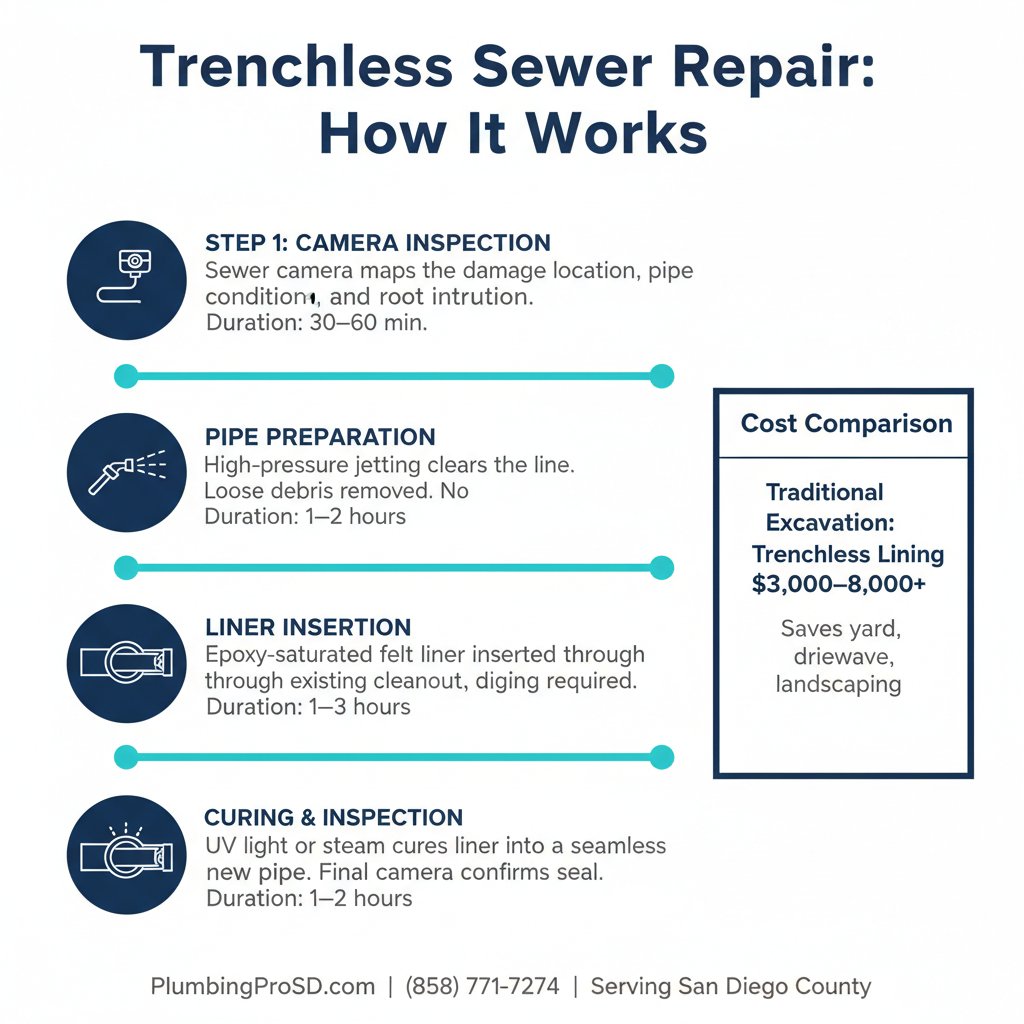
How Pipe Lining Works: Step by Step
Step 1: Camera inspection Before any lining begins, the entire sewer lateral is inspected with a CCTV camera. The technician records footage of the pipe’s interior to identify the type, location, and extent of damage. This footage determines whether lining is appropriate and what liner length is needed.
Step 2: Hydro-jetting The existing pipe is thoroughly cleaned with high-pressure water (typically 3,000–4,000 PSI) to remove roots, grease, mineral scale, and debris. Lining requires a clean interior surface for proper adhesion. If the pipe can’t be cleaned, lining isn’t possible.
Step 3: Liner preparation A flexible felt or fiberglass tube, sized to fit the pipe diameter, is saturated with an epoxy or resin compound. The liner is measured to the exact length of the repair section.
Step 4: Liner insertion and inflation The saturated liner is inverted (turned inside out as it’s pushed in) or pulled into position through the pipe. Once positioned, it’s inflated with air or water pressure, pressing it tightly against the interior of the existing pipe.
Step 5: Curing The resin cures into a hard, jointless shell. Depending on the resin system used, curing is accomplished with:
- Ambient air, Slowest method, takes several hours
- Hot water or steam, Faster, 1–4 hours
- UV light, Fastest and most controlled, can cure in 30–60 minutes; increasingly common in San Diego
Step 6: Post-inspection and reinstatement After curing, the liner is trimmed at each end and service connections (where branch pipes join the main lateral) are reopened with a robotic cutter. A final camera pass confirms the liner is smooth, fully adhered, and sealing all defects.
The result: a smooth, jointless epoxy pipe inside the old pipe. The inner diameter is reduced by approximately 6mm (about 1/4 inch), but flow is often actually improved because the new smooth surface has far less friction than the original corroded or scaled pipe.
What Pipe Lining Repairs
- Cracks and fractures in clay or cast-iron pipe
- Root intrusion at pipe joints
- Corrosion pitting and mineral scale damage on older pipes
- Minor joint offsets (where pipe sections have shifted slightly)
- Sections of pipe with multiple hairline cracks
Pipe Lining Limitations
- Cannot rehabilitate fully collapsed pipe sections
- Not suitable for severe pipe bellying (sections that have sunk and hold standing water)
- Cannot be used when the existing pipe has no structural integrity to hold the liner during installation
- Reduces interior diameter slightly, problematic on already-undersized lines
Pipe Lining Cost in San Diego
Typical cost: $150–$250 per linear foot, or $4,000–$12,000 for a standard residential sewer lateral (roughly 40–60 feet). Costs vary based on pipe diameter, depth, access difficulty, and the liner system used.
Quality CIPP installations carry manufacturer warranties of 10–50 years and have documented service lives exceeding 50 years in municipal sewer systems.
Method 2: Pipe Bursting
Pipe bursting is a different approach: instead of rehabilitating the existing pipe, it destroys and replaces it simultaneously.
How Pipe Bursting Works: Step by Step
Step 1: Camera inspection and measurement As with lining, the process starts with a full camera inspection to document the pipe’s condition and exact length. Access pits are marked at the entry (where the new pipe will be pulled in) and exit (where the bursting head will emerge).
Step 2: Access pit excavation Small pits, typically 3–5 feet square and deep enough to reach the pipe, are dug at each end of the repair section. This is the extent of excavation in most pipe bursting jobs.
Step 3: Bursting head installation A conical steel bursting head, slightly larger than the existing pipe’s outer diameter, is attached to a hydraulic pulling cable and threaded into the pipe at the entry pit.
Step 4: New pipe attachment High-density polyethylene (HDPE) pipe is attached behind the bursting head. As the head moves forward, the new pipe follows it through the ground.
Step 5: Pipe bursting A hydraulic machine in the exit pit pulls the cable, and the bursting head, through the old pipe. The conical head fractures the existing pipe outward into the surrounding soil as it advances, while simultaneously pulling the new HDPE pipe into position behind it.
Step 6: Connections and inspection The new pipe is connected to the house lateral and the city sewer at each end. Branch connections are tied in. A final camera inspection confirms alignment and watertight connections.
The result: the old pipe is destroyed and replaced in a single pass. The new HDPE pipe is continuous with fused joints, smooth, and won’t corrode, crack from roots, or scale. HDPE carries a 50+ year lifespan.
What Pipe Bursting Replaces
- Pipes too deteriorated to line (major fractures, severe corrosion)
- Orangeburg pipe (compressed wood fiber, used in San Diego homes built before 1970)
- Severely root-damaged pipes where lining won’t hold
- Situations where you want to upsize the pipe diameter (bursting allows replacing a 4-inch pipe with a 6-inch pipe)
- Fully collapsed pipe sections
Pipe Bursting Limitations
- Requires at least two access pits (larger disturbance than lining)
- Difficult when the pipe runs under existing structures, slabs, or through congested utility corridors
- The bursting process can occasionally disturb adjacent utilities in tight conditions, a good technician surveys for this before proceeding
- Not suitable when the old pipe is too close to adjacent structures that could be affected by outward fracturing
Pipe Bursting Cost in San Diego
Typical cost: $150–$200 per linear foot, or $5,000–$15,000 for a standard residential lateral. The cost is slightly higher than lining because of the material cost for HDPE pipe and the access pit excavation.
HDPE pipe comes with manufacturer warranties of 50+ years and carries a lifetime expectation in most applications.
How does trenchless compare to traditional excavation on cost?
Here’s where the math often surprises homeowners:
| Method | Typical Cost Range | Disruption |
|---|---|---|
| Pipe lining (CIPP) | $4,000–$12,000 | Minimal, no digging |
| Pipe bursting | $5,000–$15,000 | Two small access pits |
| Traditional excavation | $8,000–$30,000+ | Full trench, major disruption |
The excavation cost number deserves context. The dig itself is a fraction of the total, the real cost driver is restoration. Replacing a cracked concrete driveway runs $6–$12 per square foot. Restoring mature landscaping, irrigation systems, and hardscape adds thousands more. Permits for excavation in San Diego typically run $500–$1,500 and require traffic control if the work affects the street.
With trenchless repair, most yards look untouched within hours of the crew leaving. For a fuller side-by-side on trenchless vs traditional sewer repair, including timeline and restoration tradeoffs, see our dedicated comparison.
When traditional excavation still makes sense:
- The pipe has no structural integrity and can’t support a liner or bursting head
- The pipe run is under a structure that prevents access pit placement for pipe bursting
- Multiple lateral replacements are being done simultaneously and unit costs drop with scale
- The pipe requires significant regrading (changing the slope) to fix bellying, something trenchless can’t address
Why is trenchless especially well-suited to San Diego?
San Diego has a specific combination of factors that make trenchless repair a particularly good fit:
No freeze-thaw cycle. In cold-climate cities, pipe repair often has to work around ground movement from freezing soil. In San Diego, pipes sit in stable soil year-round, which means liner installations cure uniformly and HDPE pipe doesn’t face repeated thermal stress.
Aging clay pipe inventory. A large percentage of San Diego’s older residential neighborhoods, Hillcrest, North Park, South Park, Kensington, Golden Hill, Normal Heights, parts of La Mesa and El Cajon, were built before 1970 using vitrified clay tile sewer laterals. Clay pipe has a service life of roughly 50–75 years. Much of it is now at or past that lifespan. Pipe lining is the ideal solution for clay pipe that has cracked at joints or developed root intrusion, because it seals every joint and crack in a single pass without removing the host pipe.
Orangeburg pipe legacy. San Diego has a significant inventory of homes built decades ago that used Orangeburg pipe, a compressed wood fiber material that was never designed to last more than 50 years. When Orangeburg fails, it doesn’t crack cleanly; it softens and deforms into an oval or flat cross-section, causing collapse. Pipe bursting is the right solution for Orangeburg, because you’re pulling new HDPE pipe through a host pipe that has already partially collapsed.
Tree canopy and root pressure. San Diego’s mature trees, ficus, eucalyptus, jacaranda, Canary Island palms, are relentless at finding sewer moisture. Pipe lining seals root entry points and creates a root-resistant interior surface for the life of the repair.
Drought-stressed root systems. During drought years, root systems push harder and deeper toward consistent moisture sources. San Diego’s periodic severe droughts have accelerated sewer lateral deterioration in many neighborhoods where pipes were otherwise stable.
Valuable hardscape. San Diego homeowners tend to invest in outdoor living, concrete driveways, pavers, drought-tolerant landscaping, outdoor kitchens, mature plantings. Excavation destroys all of that. Trenchless protects it.
How do you determine if your home is a candidate for trenchless repair?
The only definitive answer comes from a sewer camera inspection. No contractor should quote trenchless repair without first running a camera through the full length of the lateral. The camera inspection will reveal:
- Pipe material, Clay, cast iron, Orangeburg, PVC, or a mix
- Type of damage, Root intrusion at joints, longitudinal cracks, pipe belly, collapsed sections, offset joints
- Pipe condition, Whether enough structural integrity remains to support a liner during installation
- Pipe diameter and grade, Confirms what size liner is needed and whether the slope is adequate
- Location of damage, Whether it’s the full length or a section that could be spot-repaired
Generally excellent candidates for pipe lining:
- Clay pipe with root intrusion at joints and minor to moderate cracking
- Cast-iron pipe with corrosion pitting but intact shape
- Pipe that is mostly intact but has multiple small defects along its length
Generally better served by pipe bursting:
- Orangeburg pipe (fully compromised material)
- Pipe with significant deformation or collapse
- Situations where increasing the pipe diameter is beneficial
Situations where traditional excavation may still be required:
- Fully collapsed pipe with no passage for equipment
- Severe bellying over a long section (requires regrading the pipe)
- Pipe that runs under an existing structure in a way that prevents access pit placement
What warranty and lifespan should you expect?
Quality trenchless work comes with meaningful warranty coverage:
- CIPP liner manufacturer warranty: Typically 10–50 years depending on liner type and resin system; some premium UV-cured systems carry 50-year warranties
- Workmanship warranty: Reputable contractors offer 1–5 year labor warranties covering the installation itself
- HDPE pipe (pipe bursting): Material carries 50+ year lifespan; pipe bursting contractors typically offer lifetime warranties on the pipe itself
Always get warranty terms in writing before work begins. Ask specifically whether the warranty covers root re-intrusion at connection points and what the claim process looks like.
How do you choose a trenchless sewer contractor in San Diego?
Trenchless repair requires specialized equipment and training. Not every plumber who offers it does it well. Here’s how to evaluate contractors:
Ask to see the camera inspection footage. A reputable contractor will show you the video that justifies the repair recommendation. If they won’t show you, walk away.
Verify licensing. California requires plumbers to be licensed by the Contractors State License Board (CSLB). Check that the license is active and covers the work being done (Classification C-36 for plumbing).
Get the scope in writing. The contract should specify: exact footage being repaired, pipe diameter, liner type and manufacturer, warranty terms, and whether a post-repair camera inspection is included.
Confirm post-repair camera inspection. Any reputable trenchless contractor will run a camera after the repair to document the result. This protects you and gives you proof the job was done correctly.
Compare at least two quotes. Prices vary significantly between contractors. A quote that’s dramatically lower often means a shorter liner length, lower-grade resin, or no camera verification.
Ask about branch connections. Where other drain lines connect to the main lateral (branch connections), the liner needs to be precisely cut open. Ask how branch reinstatement is handled and whether it’s included in the price.
Frequently Asked Questions
Q: Can I stay in my home during trenchless sewer repair?
In most cases, yes. Pipe lining requires the sewer line to be out of service for 4–12 hours during curing. Pipe bursting is typically complete in 6–8 hours. Most homeowners can plan around this with a single day’s notice. If the work extends over multiple days, temporary sewer arrangements can usually be made.
Q: How do I know if my home has Orangeburg pipe?
Orangeburg was used almost exclusively in homes built between 1945 and 1972. If your home was built during this period and has never had sewer work done, there’s a meaningful chance the original pipe is Orangeburg. A camera inspection is the only way to confirm, Orangeburg has a distinctive appearance on video, typically showing deformation and a compressed, oval cross-section rather than round.
Q: Does trenchless sewer repair require permits in San Diego?
Yes. Sewer line repair in San Diego requires a permit from the City of San Diego or the relevant jurisdiction (La Mesa, Chula Vista, El Cajon, etc.). A reputable contractor will pull this permit before starting work. If a contractor tells you permits aren’t needed for sewer line repair, that’s a red flag.
Q: How long does trenchless sewer repair last?
CIPP pipe lining installed with quality materials has documented service life exceeding 50 years in municipal infrastructure applications. HDPE pipe used in pipe bursting is similarly long-lived. With proper installation and post-repair camera verification, trenchless repairs are expected to outlast the remaining life of most older San Diego homes.
Q: What happens to my existing cleanout during trenchless repair?
The existing cleanout is typically used as one of the access points for the repair. After completion, the cleanout is restored to full function. If a cleanout doesn’t exist (common in older San Diego homes), one is often added as part of the repair project, which improves future maintenance access.
If you’re dealing with recurring sewer backups, sewage odors, or have been told your sewer line needs work, don’t let anyone start digging before you’ve explored trenchless options. Plumbing Pro San Diego connects you with plumbers who perform full camera inspections before any sewer line work and give you an honest assessment of whether pipe lining, pipe bursting, or traditional repair is the right solution for your home. Homeowners in Carlsbad, Lemon Grove, and National City can call (858) 400-4417 or visit our sewer line repair service page to schedule an inspection.
Areas this guide covers
We connect homeowners with licensed plumbers in these San Diego County communities.
Keep reading
Need a Plumber in San Diego?
Licensed, insured plumbers, ready across San Diego County. The plumber quotes you before any work starts.
Call (858) 400-4417Call any time, day or night, anywhere in San Diego County