
Last updated: September 12, 2026
What a sewer camera inspection shows in San Diego
Sewer camera inspections cost $150–$350 in San Diego and take 30–90 min. They can prevent $5K–$15K in surprise repairs. What they find and when to book.
The short answer
- A sewer camera inspection runs $150 to $350 in San Diego and takes 30 to 90 minutes for a standard residential lateral.
- It feeds a waterproof camera through your sewer line on video to find root intrusion, bellies, cracks, offsets, and Orangeburg deterioration.
- Highest-value use is before buying a home; standard inspections skip the sewer, and surprise sewer repairs run $5,000 to $15,000.
- Get one if you have recurring backups, whole-house slow drains, or before any sewer repair quote; older homes should inspect every 1 to 2 years.
- Always insist on the recorded video file with distance markers, not just a verbal report. Call (858) 400-4417 to book.
A sewer camera inspection is how you see the lateral on video before anyone digs. This page covers what the camera finds, when to book one, and what to keep from the recording. Parked San Diego ranges stay in the FAQs. For the service itself, use sewer camera inspection. Call (858) 400-4417.
For $150–$350, a plumber can feed a waterproof camera through your entire sewer lateral and show you, on video, exactly what’s happening inside your pipes. No guessing. No unnecessary excavation. No ordering expensive repairs based on symptoms alone.
A sewer camera inspection is one of the highest-value diagnostic services in residential plumbing, and one of the most overlooked. San Diego homeowners with older properties especially have everything to gain from knowing what’s in their sewer line before a problem forces the conversation.
This guide covers exactly how it works, what the camera reveals, when to get one, what it costs in San Diego, and what to do with the results.
Need to know what’s in your sewer line? Plumbing Pro San Diego connects you with plumbers who perform sewer camera inspections throughout San Diego County. You get video footage and a clear report. Sewer camera inspection in San Diego or call (858) 400-4417.
What is a sewer camera inspection?
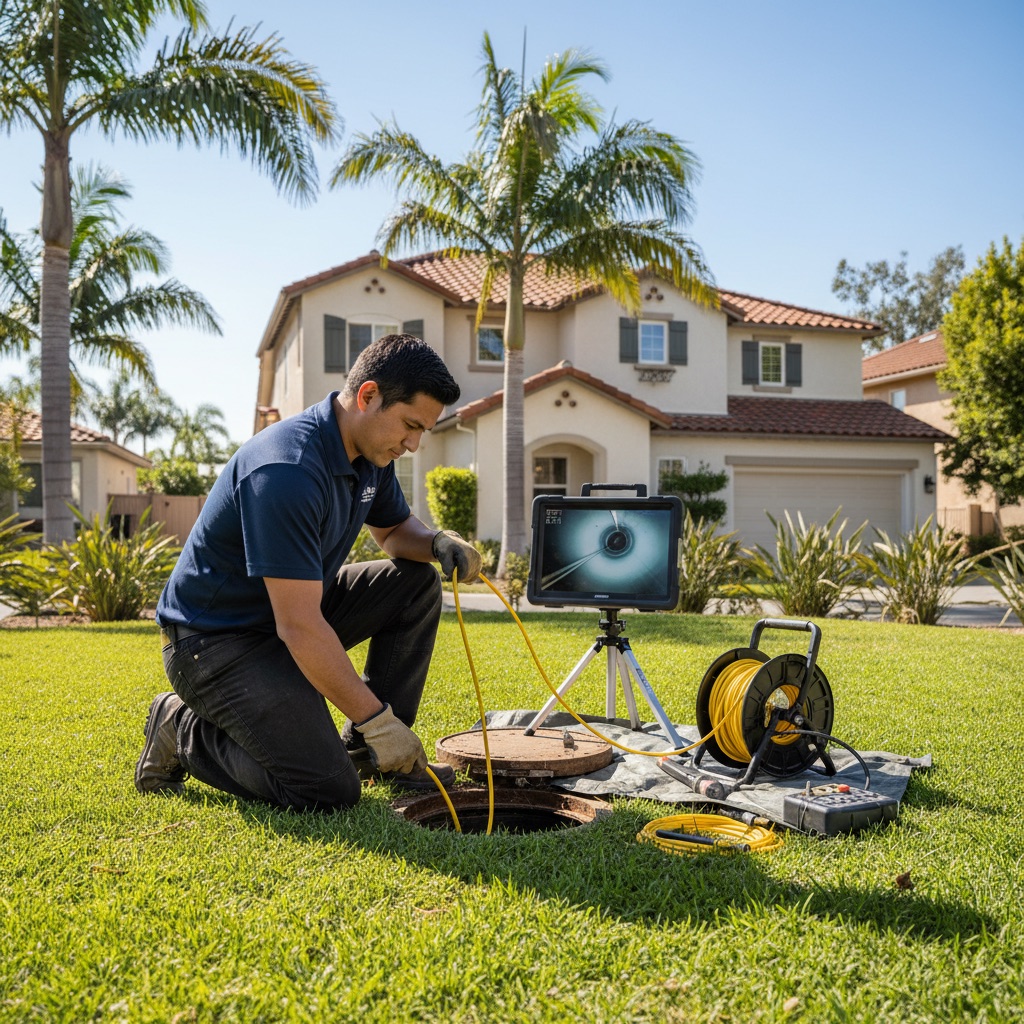
A sewer camera inspection, also called a sewer scope, drain camera inspection, or CCTV pipe inspection, uses a high-resolution waterproof camera mounted on the tip of a flexible push cable. The camera is inserted into the sewer system through a cleanout (the capped access point typically located near the foundation or in the yard) and fed through the pipe in real time.
As the camera advances, it transmits live video to a monitor. The plumber watches the footage as it records, narrating what they’re seeing and stopping to examine problem areas closely. A locator transmitter on the camera head sends a signal that can be detected above ground, allowing the technician to mark the exact surface location of any problem found underground, critical for planning repairs.
The recorded footage is yours to keep. A proper inspection provides a video file with timestamps and footage distance markers, so you have documentation of exactly what was found, where, and when.
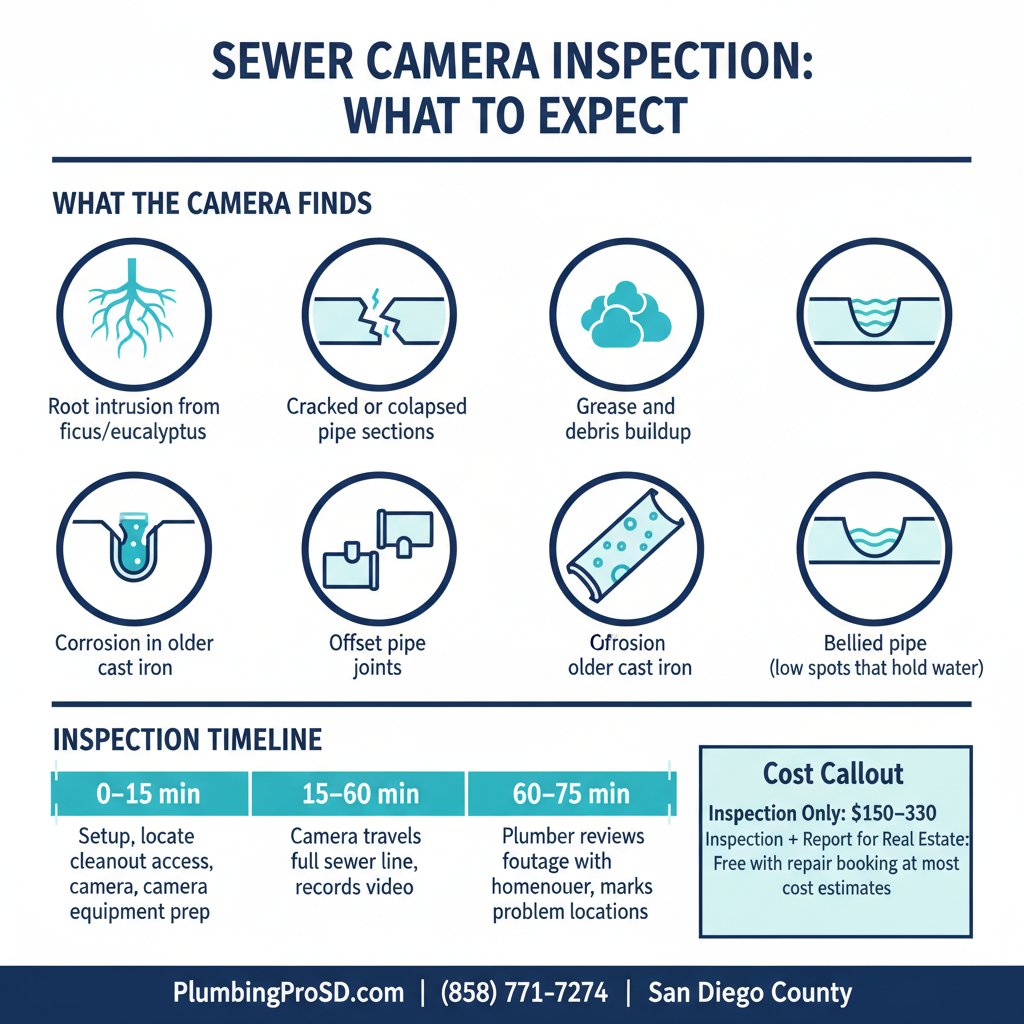
How long does it take? A standard residential sewer lateral inspection, from the house foundation to the city main at the street, takes 30–90 minutes depending on lateral length and condition. Lines with heavy root intrusion or debris that needs to be worked around take longer.
What does a sewer camera inspection reveal?
Camera inspections find problems that are completely invisible from the surface and impossible to accurately diagnose from drain symptoms alone. Here are the most common findings in San Diego sewer inspections:
Tree root intrusion
Root intrusion is the most frequently discovered serious problem in San Diego camera inspections, particularly in older neighborhoods. San Diego’s tree canopy, ficus, eucalyptus, jacaranda, pepper trees, Canary Island palms, and coastal live oaks, includes species with aggressive lateral root systems that actively seek underground moisture.
Clay and Orangeburg pipe joints are the primary entry points. A gap of less than a millimeter is enough for fine root tendrils to enter. Once inside, roots grow toward the center of flow (maximum moisture), and over time develop into root masses that range from a light haze of hairlike filaments (early intrusion) to dense root balls that fill 50–100% of the pipe cross-section.
Camera footage shows you exactly where intrusion is occurring and how severe it is, information that determines whether hydro-jetting can solve the problem or whether structural pipe repair is needed.
Pipe belly (sag) and low spots
A “belly” is a section of pipe that has settled below the surrounding grade, creating a low spot where water, waste, and debris pool rather than draining. Bellies are particularly common in San Diego’s hillside neighborhoods (parts of La Jolla, Point Loma, Mission Hills, Del Cerro) and in properties with expansive clay-heavy soils that shift with seasonal moisture changes.
On camera, a belly appears as a section where the bottom of the pipe holds standing water, sometimes just a puddle, sometimes enough to submerge the camera lens entirely. The camera also reveals the degree of pitch change that caused the problem.
Minor bellies may only cause slow drainage; severe bellies can trap enough organic material to create chronic blockages. Either way, no amount of cleaning fixes the underlying grade problem, only physical repair restores proper slope.
Cracked, fractured, and broken pipe
Cracks from age, root pressure, ground movement, or past impacts appear clearly on camera. The camera reveals:
- Longitudinal cracks, Running along the length of the pipe, often from root pressure or ground shifting
- Circumferential cracks, Wrapping around the pipe, from impact or excessive point load
- Shattered sections, Multiple interlocking fractures in one area
- Fractures with soil intrusion, Where surrounding soil has begun entering through the crack, creating partial collapse
Cracks that haven’t caused visible drain problems yet can still be leaking sewage into the surrounding soil, an environmental issue and a progressive deterioration problem.
Offset and separated joints
In clay pipe systems common in pre-1970 San Diego construction, pipe sections are connected with hub-and-spigot joints, a bell end that receives the plain end of the next section. Over decades of ground movement, these joints can shift laterally, creating gaps or step-misalignments.
Camera footage shows the offset clearly, the pipe cross-section appears off-center or stepped at the joint. Even minor offsets catch debris and toilet paper, creating recurring blockages. Significant offsets allow root entry and soil infiltration.
Orangeburg pipe deterioration
Thousands of San Diego homes built between 1945 and 1972 have Orangeburg sewer pipe, a material made from compressed layers of wood fiber and bituminous pitch. Orangeburg was designed with a 50-year service life. Most of it is now 60–80 years old.
On camera, deteriorating Orangeburg shows a distinctive pattern: the pipe is no longer round. It has deformed under the weight of soil above it, often into an oval or in extreme cases a nearly flat shape. The interior surface appears rough, soft, and corrugated. In late-stage deterioration, the walls show partial collapse.
Knowing whether your home has Orangeburg, and how far along its deterioration is, is critical for planning any sewer repair. Orangeburg generally cannot be rehabilitated with pipe lining once it has deformed significantly; pipe bursting or excavation is typically required.
Grease and mineral scale buildup
Camera inspections reveal the degree to which buildup is restricting pipe flow. A drain that appears functional can have 30–50% of its interior diameter coated with grease, soap scum, and mineral scale from San Diego’s hard water (about 16 grains per gallon from the Colorado River supply).
This information guides the recommendation: hydro-jetting restores flow without structural repair, but the camera reveals whether it’s sufficient or whether the pipe walls have been damaged by the scale accumulation.
Infiltration and exfiltration
Camera inspections can reveal groundwater infiltration (groundwater entering the sewer pipe through cracks, adding to sewage volume and treatment costs) and exfiltration (sewage leaking out through cracks into surrounding soil, a contamination issue). Both are problems even if they haven’t caused visible drain symptoms.
Pipe material identification
Many San Diego homeowners don’t know what their sewer lateral is made of. Camera inspection provides definitive answers. PVC, cast iron, clay tile, Orangeburg, and concrete each have a distinct appearance. In older San Diego homes, it’s common to find a combination of materials, original clay from the house to mid-yard, and a later PVC replacement from a previous repair to the street.
Knowing the material guides both repair method selection and maintenance planning.
When should you schedule a sewer camera inspection?
Before buying a home
This is the highest-value use case for a sewer camera inspection in San Diego. Standard home inspections do not include the sewer lateral, inspectors examine accessible interior plumbing and visible components, but underground pipe is outside their scope.
Sewer problems are consistently among the largest unexpected post-purchase repair costs, regularly running $5,000–$15,000. For any home built before 1990, a sewer scope during the inspection period is strongly recommended. For homes built before 1970, or homes with large trees in the yard, it should be considered essential.
If a seller refuses to permit a sewer inspection during escrow, take that as a meaningful red flag.
Recurring drain backups
If your main line has backed up and been cleared two or more times in a 12-month period, you don’t have a clog problem, you have an underlying structural or intrusion problem that clearing is temporarily masking. Recognizing the warning signs of a sewer line problem early is what separates a routine camera inspection from an emergency repair. Camera inspection identifies the root cause: is it root intrusion growing back? A belly that accumulates debris? A cracked pipe catching material? Each has a different solution.
Whole-house slow drains
When multiple fixtures are draining slowly, not just one sink or one shower, the problem is in the main sewer lateral, not in an individual fixture’s drain. Camera inspection diagnoses whether it’s accumulation that can be cleaned or a structural problem that requires repair.
Before any major sewer repair
No legitimate plumber should recommend or quote a sewer line repair, lining, bursting, spot repair, or full replacement, without first conducting a camera inspection. The inspection determines what method is appropriate, the footage length that needs to be addressed, and the access points required. Anyone recommending sewer repair without camera documentation is guessing at your expense.
Pre-renovation planning
If you’re planning a kitchen or bathroom remodel, adding a bathroom, or finishing a basement with drain-in fixtures, a camera inspection before construction reveals whether the existing lateral can handle additional load and whether any existing problems should be addressed before the renovation. If you’re unsure about septic vs. sewer in San Diego, clarify that first, since the inspection process differs depending on your system type.
Routine maintenance for older homes
San Diego homes with clay or Orangeburg laterals and mature trees nearby should schedule camera inspections every 1–2 years, even without symptoms. Catching early root intrusion before it causes a backup, or finding a developing crack before it collapses, is far cheaper than emergency repair.
What does a sewer camera inspection cost in San Diego?
Typical cost range: $150–$350 for a standard residential sewer lateral inspection with recorded video footage.
Several factors affect pricing:
- Cleanout access: Inspection through an existing cleanout is straightforward and fastest. If no cleanout exists (common in older San Diego homes), the camera must be accessed through a toilet or pulled through an existing drain opening, adding time and cost
- Lateral length: Standard San Diego residential laterals run 40–80 feet. Longer runs (some hillside properties with longer setbacks) cost more
- Depth: Standard depth pipe inspects normally; unusually deep laterals may require specialized equipment
- Recorded footage: Always insist on a video file you can keep, with timestamps and distance markers. Some budget operators provide only a verbal report, not acceptable for any serious diagnostic work
- Combination services: Many contractors will apply the inspection cost toward repairs if you proceed with their company; standalone inspection pricing is typically as quoted above
For context: a home inspector typically charges $300–$500 for the general inspection that doesn’t include the sewer scope. Adding a sewer camera for $150–$350 is a fraction of that, and for older San Diego properties, often reveals far more actionable information.
What are your options after the camera inspection?
Here is how to interpret common camera inspection findings and what typically follows:
Finding: Clear pipe, good condition No action required. Schedule follow-up inspection per maintenance timeline based on home age and landscaping.
Finding: Light scale buildup or minor debris accumulation Hydro-jetting restores flow. Consider enzymatic maintenance treatments between professional cleanings. For more detail, see our drain cleaning guide.
Finding: Early-stage root intrusion (hairline tendrils at 1–2 joints) Hydro-jetting with root cutting removes the intrusion. Annual monitoring recommended, if roots return within a year, pipe lining at the affected joints becomes the better long-term investment.
Finding: Moderate root intrusion (roots at multiple joints, partial blockage) Hydro-jetting plus pipe lining is typically the appropriate solution. Lining seals the entry points root-by-root, preventing regrowth.
Finding: Belly or pipe sag Physical repair at the bellied section. Depending on location and depth, this may be a spot excavation or potentially addressed with targeted pipe bursting through that section.
Finding: Offset joints, cracks, or early-stage deterioration Pipe lining covers most scenarios with intact host pipe. Multiple defects along the full length favor full-lateral CIPP lining over spot repairs.
Finding: Orangeburg pipe or severe deterioration Pipe bursting or excavation and replacement. The specific method depends on the degree of deformation and access conditions.
Finding: Fully collapsed section Emergency repair assessment. Camera footage determines how long the collapsed section is and what access options exist. Get the footage timestamped and request a written quote before committing.
How does camera inspection connect to trenchless repair?
Every trenchless repair, pipe lining or pipe bursting, requires a camera inspection before and after the work. Before: to confirm candidacy and plan the repair. After: to verify the liner has adhered correctly, service connections have been properly reinstated, and the pipe is clean and functional.
A trenchless sewer repair contractor who skips either camera pass is cutting corners. The post-repair inspection is your verification that the work was done correctly. Ask for the post-repair footage as part of your documentation.
Frequently asked questions
Q: What is the difference between a sewer camera inspection and a sewer scope inspection?
These terms are used interchangeably, they refer to the same service. Some home inspectors use “sewer scope” to distinguish it from a CCTV pipe inspection performed by a plumber, but the process is the same: a waterproof camera on a cable is fed through the sewer lateral with live video recording. The main difference is that plumbers typically have more powerful cameras, longer cables, and locator equipment, while home inspection sewer scopes may use lighter-duty equipment.
Q: Can a sewer camera inspection miss problems?
Camera inspection is highly reliable for the types of problems it’s designed to find, but there are limitations. If the pipe has standing water or heavy sludge buildup, camera visibility is reduced, this is why hydro-jetting before camera inspection sometimes reveals additional problems not visible on the initial pass. Camera also can’t diagnose pipe material age or detect very early-stage corrosion that hasn’t yet changed the pipe’s visual appearance. Overall, it’s the most accurate diagnostic tool available for sewer laterals.
Q: What if my home doesn’t have a cleanout?
Older San Diego homes frequently lack an accessible cleanout, the capped access fitting that makes camera inspection easy. Without one, the camera can be accessed through a toilet (the toilet is removed and reinstalled after the inspection) or in some cases pulled backward from a clean downstream access point. A plumber can also install a cleanout as part of the inspection or repair job, which improves maintenance access for years to come.
Q: Should I get a sewer scope when buying a home with a newer sewer line?
If the seller has documentation showing the sewer lateral was replaced with PVC within the last 20 years, the urgency is lower, though a camera inspection to verify the condition and rule out root intrusion at connection points is still reasonable due diligence for any purchase above a certain price point. For homes with original pipe (pre-1990 construction without documented replacement), the inspection is strongly recommended.
Q: How do I find the cleanout on my property?
San Diego home cleanouts are typically located: at the base of the exterior foundation wall near the main bathroom cluster, in the front yard within a few feet of the house, or in the floor of a garage near the bathroom wall. They look like a white or black ABS plastic cap or a metal cap flush with or slightly above the surface. If you can’t locate it before a plumber arrives, they can typically find it quickly.
A sewer camera inspection is the smartest $150–$350 you can spend on your San Diego home, whether you’re buying, planning repairs, or just maintaining a property with aging infrastructure. Plumbing Pro San Diego connects you with plumbers who perform full lateral camera inspections throughout San Diego County with recorded footage you keep. Homeowners in El Cajon, Encinitas, and La Mesa with older sewer laterals should consider this essential maintenance. If the plumber finds a problem, they’ll explain it clearly and give you repair options in writing before any work begins. Call (858) 400-4417 or visit our sewer line services page to schedule your inspection.
Areas this guide covers
We connect homeowners with licensed plumbers in these San Diego County communities.
Keep reading
Need a Plumber in San Diego?
Licensed, insured plumbers, ready across San Diego County. The plumber quotes you before any work starts.
Call (858) 400-4417Call any time, day or night, anywhere in San Diego County