Last updated: April 23, 2026
Drain Cleaning in San Diego: Hydro-Jetting vs. Snaking
Snaking runs $85–$300, hydro-jetting $250–$600 in San Diego. Which method fits your clog, why Drano damages pipes, and how SD hard water makes it worse.
The short answer
- Snaking ($85 to $300) punches through a single soft clog; hydro-jetting ($250 to $600) scours the whole pipe and holds far longer.
- Recurring clogs, multiple slow drains, grease lines, or root intrusion all call for hydro-jetting, not repeat snaking.
- San Diego hard water (about 16 grains), grease, and tree roots in older neighborhoods make drains clog faster here.
- Get a camera inspection before jetting older clay or cast-iron pipe, since high pressure can worsen existing cracks.
- Skip Drano and chemical cleaners; they damage pipes and mask the real problem. Call (858) 400-4417 for diagnosis.
Your drain is slow. Maybe the kitchen sink backs up after dinner, or the shower pools around your ankles every morning. Before you reach for Drano or call the first plumber you find, there’s a lot to understand, because the method used to clear your drain matters as much as clearing it in the first place.
San Diego Drain Cleaning Costs (2026)
This guide covers everything San Diego homeowners need to know about professional drain cleaning: how the two main methods work, what makes San Diego drains uniquely challenging, warning signs you can’t ignore, what professional service actually costs, and why chemical drain cleaners are a slow-motion disaster for your pipes.
What is the difference between drain snaking and hydro-jetting?
Professional plumbers use two fundamentally different tools to clear drains, and they solve different problems. Using the wrong one means either wasting money on a method that won’t work, or using overkill on a simple clog.
How drain snaking works
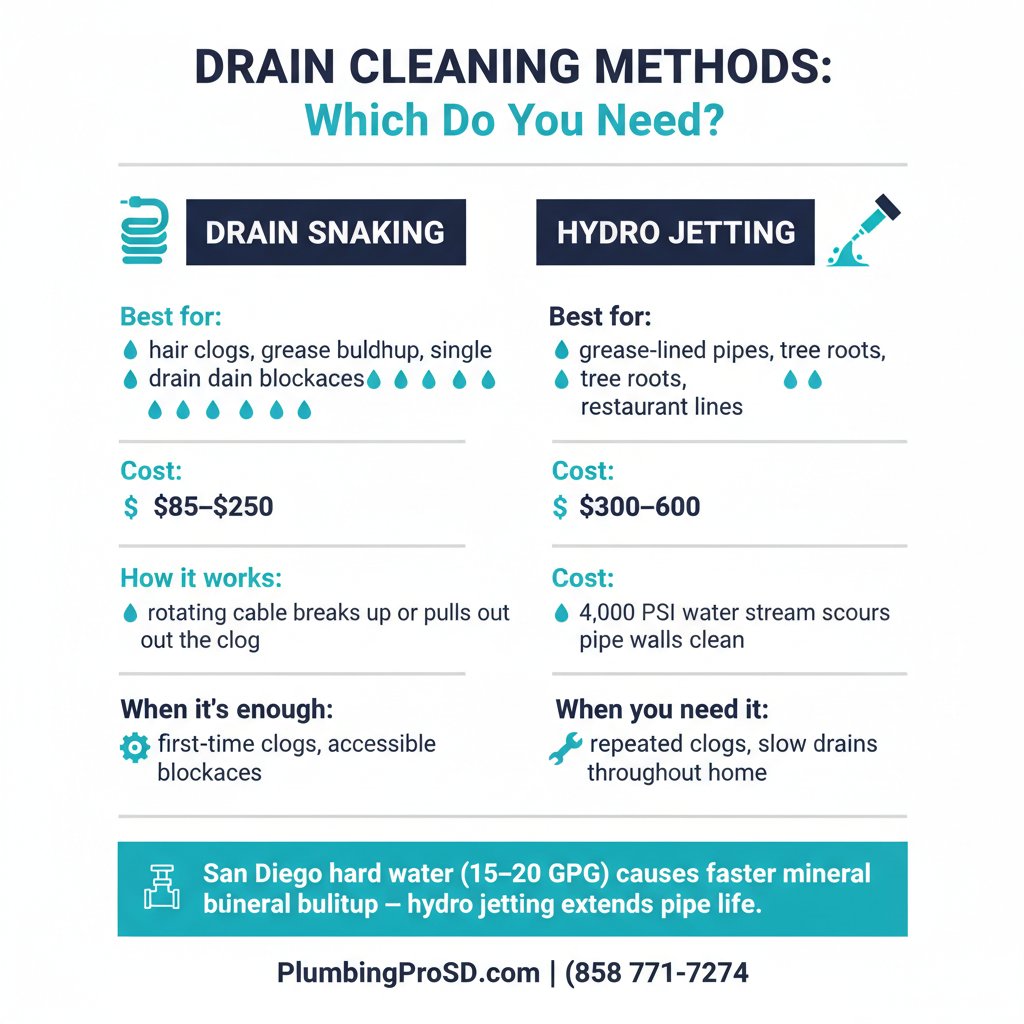
A drain snake (also called a plumber’s auger) is a flexible steel cable with a cutting or hooking head at the tip. The plumber feeds it into the pipe and rotates it, manually or with a motor, to break through a blockage or hook and pull it out.
Snaking is fast, minimally invasive, and relatively inexpensive. It’s the right tool when:
- A single fixture is clogged (one sink, one toilet, one shower)
- The clog is made of hair, paper, or foreign objects
- The blockage is recent and hasn’t hardened into scale
- You need a quick solution for a soft organic clog
The critical limitation: A snake punches a hole through a clog but doesn’t clean the pipe walls. Think of it like drilling through a blocked artery, flow is restored, but the buildup coating the vessel remains. This is why drained lines often re-clog within weeks or months. Snaking is a temporary fix for a localized problem, not a systemic clean.
Typical San Diego cost: $85–$200 depending on the drain location and access complexity.
How hydro-jetting works
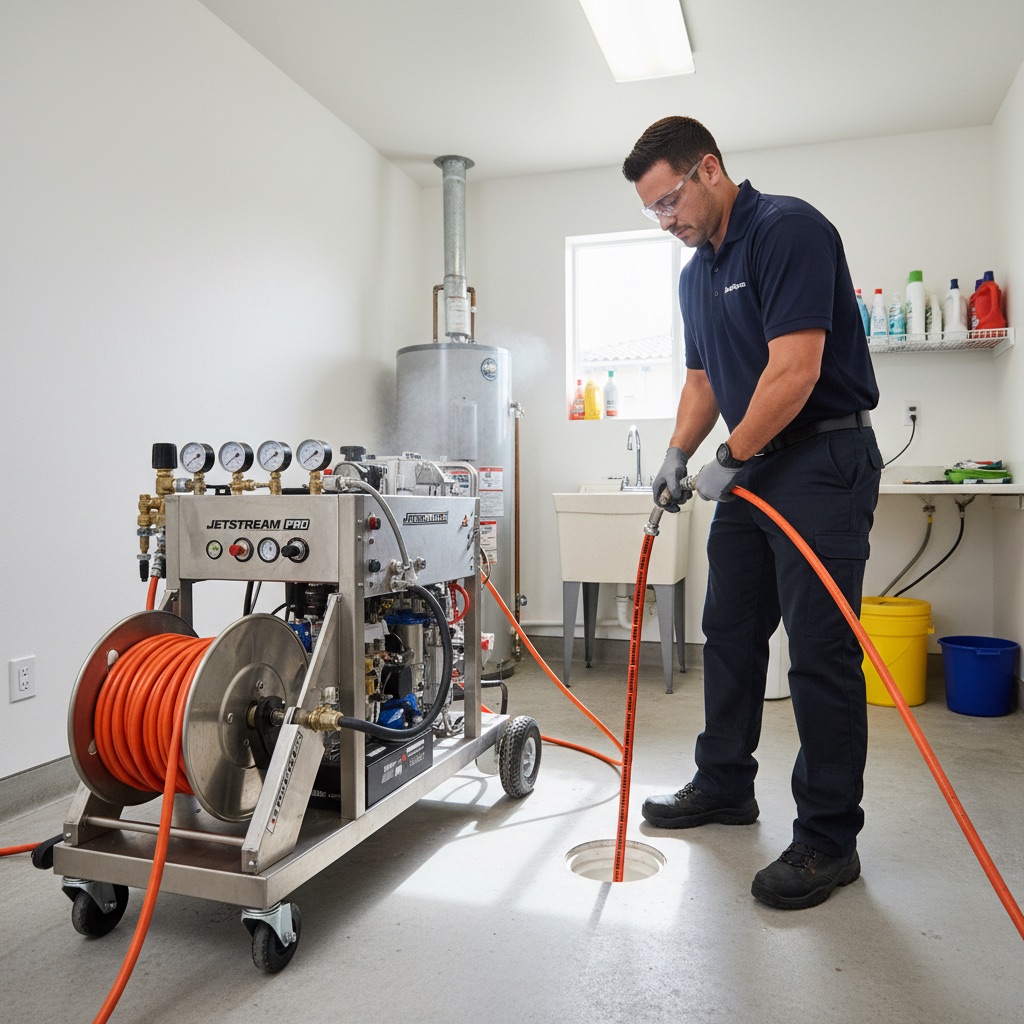
Hydro-jetting uses a specialized high-pressure hose connected to a truck-mounted or portable pump. Water is forced through the pipe at 3,000–4,000 PSI through a rotating nozzle that blasts in multiple directions simultaneously, forward to cut through blockages, backward to flush debris downstream, and sideways to scour the pipe walls.
The result isn’t just an open pipe, it’s a clean pipe. Grease, mineral scale, compacted debris, soap film, and even invasive tree roots are obliterated and flushed out. A properly hydro-jetted line looks close to new on a camera inspection.
Hydro-jetting is the right call when:
- You have recurring clogs that return within weeks of snaking
- Multiple drains in the house are slow simultaneously
- Kitchen lines have years of grease accumulation
- The home is older with decades of mineral scale inside the pipes
- Tree root infiltration has been found in main lines
- You’re doing pre-sale preparation or preventative maintenance
The critical limitation: Hydro-jetting is not appropriate for severely deteriorated or fragile pipe. High pressure on a compromised section of cast iron or old clay pipe can worsen cracks or cause a collapse. A reputable plumber will perform a sewer camera inspection before jetting any older pipe to confirm it can handle the pressure.
Typical San Diego cost: $250–$600 for residential hydro-jetting. Commercial lines or longer runs cost more.
When to choose which method
| Situation | Best Method |
|---|---|
| Single clogged fixture | Snaking |
| Hair or foreign object clog | Snaking |
| Recurring kitchen clogs | Hydro-jetting |
| Multiple slow drains at once | Hydro-jetting + camera |
| Known root intrusion in main line | Hydro-jetting (after camera) |
| Older home, first inspection | Camera first, then hydro-jetting |
| Pre-sale home preparation | Hydro-jetting |
Why are San Diego drains uniquely challenging?
San Diego plumbers deal with a combination of factors that you won’t find in most other California cities. Understanding these helps you know why your drains clog, how to prevent it, and why the right professional matters.
Hard water mineral scale
San Diego’s water supply, drawn primarily from the Colorado River and State Water Project, consistently ranks among the hardest municipal water in Southern California, typically running about 16 grains per gallon (roughly 250–350 parts per million). Over months and years, calcium and magnesium deposits build up inside every pipe in your home, just as they build up on your showerheads and faucet aerators.
Mineral scale causes four specific problems:
- Pipe diameter narrowing, Each layer of scale reduces the interior opening, slowing flow and pressure
- Rough pipe walls, Scale creates a textured interior surface that catches grease and debris, accelerating future buildup
- Corrosion acceleration, Scale traps moisture against metal pipe walls, speeding up corrosion in older iron pipes
- Masked damage, Heavy scale deposits can hide cracks and joint failures from camera inspection until a proper cleaning is done first
Hydro-jetting is the only drain cleaning method that effectively removes mineral scale. A snake can’t touch it. Chemical cleaners don’t affect it.
Grease buildup in residential kitchen lines
San Diego’s food culture is real, but so is its effect on kitchen drain lines. Even in purely residential homes, the combination of cooking oils, dish soap residue, and hard water minerals creates a particularly tenacious grease-soap-mineral compound that coats kitchen drain lines from the P-trap all the way to the main stack.
In neighborhoods like North Park, South Park, and Mission Hills, where older homes often have original galvanized or cast-iron kitchen drain lines, decades of this buildup can reduce a 2-inch pipe to a fraction of its designed capacity.
If your kitchen drain is slow or gurgling, the problem almost certainly extends beyond what a snake can reach. Hydro-jetting the full kitchen line is the correct solution.
Tree root intrusion in older neighborhoods
This is the big one for San Diego. The city’s mix of older residential neighborhoods and mature landscaping creates constant problems with tree roots infiltrating sewer laterals. Areas like North Park, Hillcrest, Kensington, Normal Heights, and Ocean Beach have housing stock dating from the 1920s through 1960s, with original clay or cast-iron sewer pipes that are now 60–100 years old.
The trees that grew up alongside those homes, ficus, eucalyptus, pepper trees, and Canary Island palms, have root systems that aggressively seek moisture. A hairline crack in a clay pipe joint is an open invitation. Roots infiltrate, expand, and eventually create blockages that become total backups.
San Diego’s periodic drought conditions make this worse: when surface soil is dry, roots push deeper and harder toward any moisture source, including your sewer lateral.
Hydro-jetting can cut through and clear root masses, but if the roots have cracked or offset the pipe itself, clearing the drain is only a temporary fix. A sewer camera inspection will reveal whether the pipe structure itself needs repair.
Drought-tolerant landscaping and newer root problems
Even in newer San Diego neighborhoods, drought-tolerant landscaping has created an unexpected drain problem. Deep-rooted drought-resistant plants like Agave, Bougainvillea, and certain native species send roots far and wide in search of consistent moisture, and sewer lines are a reliable source year-round. Post-drought replanting in communities like Scripps Ranch, Carmel Valley, and Rancho Bernardo has introduced root intrusion problems in homes that never had them before.
AC condensate drains, the clog you forget about
One drain that homeowners consistently overlook is the AC condensate line. Your air conditioning system produces condensation that exits through a small PVC drain, and San Diego’s mineral-rich water clogs these lines with algae and calcium just like any other drain. If water is pooling near your indoor air handler, that’s not a plumbing call, a licensed HVAC contractor handles condensate drain maintenance as part of routine HVAC service.
What are the warning signs you need professional drain cleaning?
Don’t wait until you have standing water. These symptoms indicate problems that won’t resolve on their own:
- Multiple slow drains simultaneously, A single slow drain is usually an isolated clog. Multiple slow drains across different fixtures points to the main sewer line
- Gurgling from toilets or drains when running water elsewhere, This is air being displaced by a partial or total blockage in the main line
- Sewage odors from drains or in the yard, A possible sewer line breach or severe blockage that’s creating gas backup
- Water backing up in unexpected places, Bathtub fills with water when you flush the toilet; kitchen sink backs up when the dishwasher runs. These cross-fixture backups mean a main line problem, and if you’re seeing sewage backing up into your tub or shower, that’s a clear sign the main line is blocked
- Recurring clogs that return within weeks, If snaking didn’t hold, something is wrong with the pipe itself, not just the clog
- Slow drains that gradually worsen over months, Gradual buildup that needs hydro-jetting, not a sudden blockage
Why are chemical drain cleaners a mistake?
Drano, Liquid-Plumr, and similar products are among the most widely misused plumbing products sold. Here’s what they actually do, and don’t do:
What they do: Generate an exothermic chemical reaction (heat) to dissolve organic matter, mainly hair and grease. If the clog is soft and close to the drain opening, they sometimes work.
What they don’t do: Remove mineral scale, clear root intrusion, fix bellied or broken pipes, or fully clean the pipe walls.
The damage they cause:
- PVC pipe softening, The heat generated can warp PVC fittings and trap arms, especially with repeated use
- Metal corrosion, Caustic chemicals accelerate corrosion in galvanized steel and cast-iron pipes
- Rubber seal damage, The chemicals attack rubber gaskets in P-traps and drain assemblies
- Safety hazards, If the drain is fully blocked, the caustic liquid pools in the pipe. Any plumber who opens that drain is exposed to chemical burns
- Delayed diagnosis, Repeated chemical treatments mask the real problem (root damage, bellied pipe, collapsing Orangeburg) until it becomes a major repair instead of a minor one
For a drain that won’t clear with a standard plunger, the right call is always a professional plumber.
What should you expect during professional drain cleaning?
A professional drain cleaning visit in San Diego typically follows this process:
- Symptom review, Which drains, how long, any odors, any recent changes to the home or yard
- Visual inspection, Check the cleanout, accessible trap, and drain openings
- Camera assessment, For main line issues or recurring problems, a camera inspection clarifies the cause before treatment
- Method selection, Snake for isolated, soft clogs; hydro-jet for systemic buildup, mineral scale, or recurring issues
- Cleaning, Typically 30–90 minutes depending on the scope
- Flow test, Water is run from multiple fixtures to confirm full restoration
- Findings report, A reputable plumber tells you if they found something unexpected, root damage, pipe deterioration, bellying, rather than just clearing the drain and leaving an undiagnosed problem
How can you prevent clogs between professional services?
These habits meaningfully reduce how often professional cleaning is needed:
Kitchen drains:
- Never pour cooking grease, oil, or fat down any drain, even “liquid” oils solidify in cool pipes
- Run cold water for 20 seconds before and after using the garbage disposal
- Use a fine-mesh strainer in kitchen sinks
- Avoid putting fibrous foods (celery, artichokes), starchy foods (pasta, potatoes), or coffee grounds in the disposal
Bathroom drains:
- Install mesh drain screens in all showers and bathtub drains
- Clean drain stoppers monthly, pull them out, remove accumulated hair and soap
- Brush hair before showering to reduce shedding
Monthly maintenance:
- Flush all drains with the hottest tap water for 60 seconds
- Treat kitchen drains monthly with 1/2 cup baking soda followed by 1/2 cup white vinegar; let it fizz 10 minutes, then flush with hot water
- Use enzymatic drain treatment products (not chemical cleaners) quarterly, they use bacteria to digest organic buildup without damaging pipes
Annual professional service:
- Homes with mature trees near the sewer line should have main line inspected annually
- Kitchen lines in cooking-heavy households benefit from annual hydro-jetting
- Pre-1970 homes with clay or cast-iron lines should have camera inspection every 2–3 years
How much does drain cleaning cost in San Diego?
| Service | Typical Range |
|---|---|
| Standard drain snake (single fixture) | $85–$200 |
| Main line snake | $150–$300 |
| Hydro-jetting (residential) | $250–$600 |
| Camera inspection + hydro-jetting | $400–$800 |
| Emergency same-day service | Add $75–$150 |
Prices vary based on access, drain location, line length, and severity of buildup. Be skeptical of prices significantly below these ranges, cutting corners on drain cleaning often means getting snaked when you needed hydro-jetting, leading to another service call within months.
Frequently asked questions
Q: How do I know if I need hydro-jetting or just a snake?
If a single drain is clogged and it hasn’t recurred before, snaking is usually the right starting point. If you have recurring clogs in the same drain, multiple slow drains across the house, a kitchen line with years of grease buildup, or root intrusion confirmed by camera, hydro-jetting is the appropriate method. A good plumber will assess and recommend the right tool rather than defaulting to the most expensive option.
Q: Is hydro-jetting safe for older pipes?
It depends on the pipe condition. Hydro-jetting at 3,000–4,000 PSI can worsen cracks in already-deteriorated cast iron or clay pipe. This is why a camera inspection should always precede hydro-jetting in older San Diego homes. A skilled plumber can also adjust the pressure, lower PSI for fragile lines, full pressure for well-maintained pipes.
Q: How often should San Diego homeowners have their drains cleaned professionally?
For most homes: every 1–2 years for main line hydro-jetting as preventative maintenance. Kitchen lines benefit from annual cleaning if the household cooks frequently. Homes with large trees (ficus, eucalyptus) near the sewer lateral should have annual camera inspection to catch root intrusion before it causes a backup.
Q: Why does my drain re-clog so quickly after snaking?
Snaking punches through a clog but doesn’t remove the buildup coating the pipe walls. If grease, mineral scale, or soap film is coating your pipes, the clog will reform in the same spot. Hydro-jetting removes the residue that snaking leaves behind, which is why it holds longer. Recurring clogs are almost always a signal that hydro-jetting, not repeated snaking, is the correct treatment.
Q: Can I prevent root intrusion from trees near my sewer line?
You can slow it down but not eliminate it. Copper sulfate root inhibitor treatments flushed through the cleanout can deter root growth near the sewer line and are safe for the pipe and septic system. Annual hydro-jetting removes roots before they can crack the pipe further. But if roots have already breached the pipe wall, camera inspection and potential trenchless sewer repair may be needed to address the underlying damage.
Related reading
Want to reduce how often you need professional drain cleaning? Our guide on how to prevent clogged drains covers weekly, monthly, and quarterly maintenance routines that actually work. For severe blockages that might need more than a standard snake, our post on hydro-jetting benefits in San Diego explains when high-pressure cleaning is the right call. If you’ve noticed small flies hovering near sinks or floor drains, buildup in the drain line is often the culprit. Our guide on drain flies covers identification, causes, and how to clear them out.
For persistent, recurring, or whole-house drain problems in San Diego, the right solution is professional diagnosis and cleaning, not chemical treatments that damage your pipes while masking the real issue. Plumbing Pro San Diego connects homeowners across San Diego County with licensed drain specialists. Whether you’re in El Cajon, La Mesa, or Encinitas, call us at (858) 400-4417 or visit our drain cleaning service page to schedule an assessment. The plumber we connect you with will tell you exactly what’s causing the problem and clear it the right way.
Areas this guide covers
We connect homeowners with licensed plumbers in these San Diego County communities.
Keep reading
Need a Plumber in San Diego?
Licensed, insured plumbers, ready across San Diego County. The plumber quotes you before any work starts.
Call (858) 400-4417Call any time, day or night, anywhere in San Diego County