
Water heater anode rod replacement: cost and when to do it
A water heater anode rod usually needs replacing every 3 to 5 years. Skip it and the tank rusts from the inside out. Cost, timing, and DIY vs. pro.
The short answer
- A water heater's anode rod sacrifices itself to corrosion so the steel tank doesn't rust through. It's the single cheapest thing you can do to extend tank life.
- Most manufacturers recommend checking it every 2 to 3 years and replacing it every 3 to 5, sooner in San Diego's hard water.
- A rod that's down to bare wire or under 50% thickness needs to be replaced now, not at the next scheduled check.
- Professional replacement runs $150 to $300 in San Diego; DIY parts alone run $20 to $80.
- Skipping it doesn't save money. It shortens a $1,200+ tank's life by years. Call (858) 400-4417 and we'll connect you with a plumber.
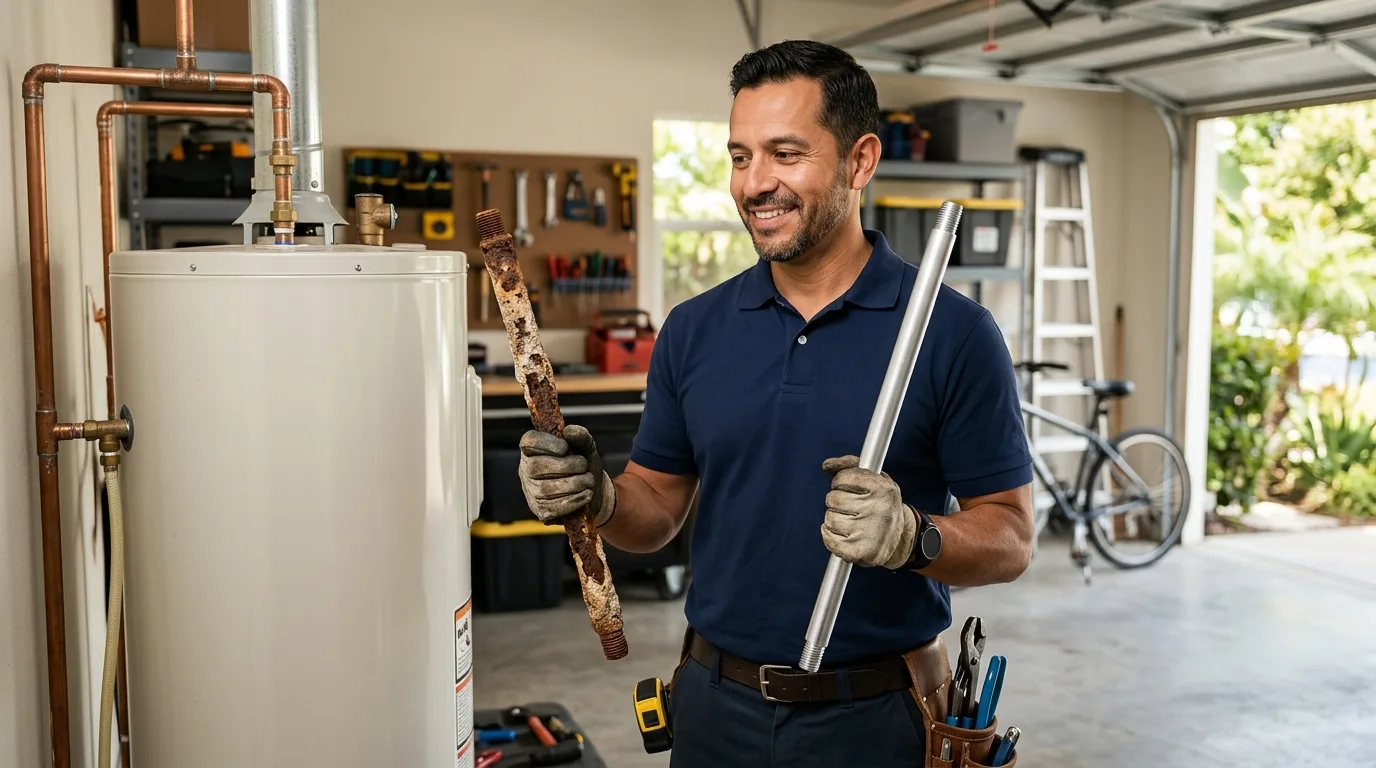
A water heater anode rod is a sacrificial metal rod that corrodes on purpose so the steel tank around it doesn’t. Replace it every 3 to 5 years and a tank easily reaches 10 to 12 years. Skip it, and the tank itself starts rusting from the inside once the rod is gone, usually ending the tank’s life years early.
This guide covers how to tell when yours needs replacing, what it costs in San Diego, and whether it’s worth doing yourself.
What does a water heater anode rod actually do?
Every tank-style water heater has a rod, usually magnesium or aluminum, that runs down the center of the tank screwed into a fitting on top. It works through a basic principle called sacrificial corrosion: the rod is a more reactive metal than the tank’s steel, so corrosion attacks the rod first and leaves the tank alone, for as long as the rod has material left to give up.
Once the rod is fully consumed, that protection is gone. The tank is now the least-reactive metal left in the system, and it becomes the next thing corrosion goes after. There’s no smell, no leak, and no warning light when this happens. The only way to know is to check the rod itself.
How often should you check and replace it?
Most manufacturers, including Rheem, A.O. Smith, and Bradford White, call for an inspection every 2 to 3 years and replacement every 3 to 5. Where you land in that range depends on your water. San Diego’s water runs hard across most of the county, hardest in East County communities like El Cajon and Santee, and hard water speeds up the reaction that consumes the rod, so homes there often need to replace on the shorter end of that window. A home with a water softener sees this even faster, since softened water accelerates the same reaction.
If your water heater has never had the rod checked and it’s already past 3 years old, that’s reason enough to have a plumber pull it at your next visit rather than waiting for a symptom to show up. The U.S. Department of Energy’s water heater maintenance guidance lists anode rod inspection among the handful of checks that meaningfully extend a tank’s service life.
How do you know when it’s time to replace it?
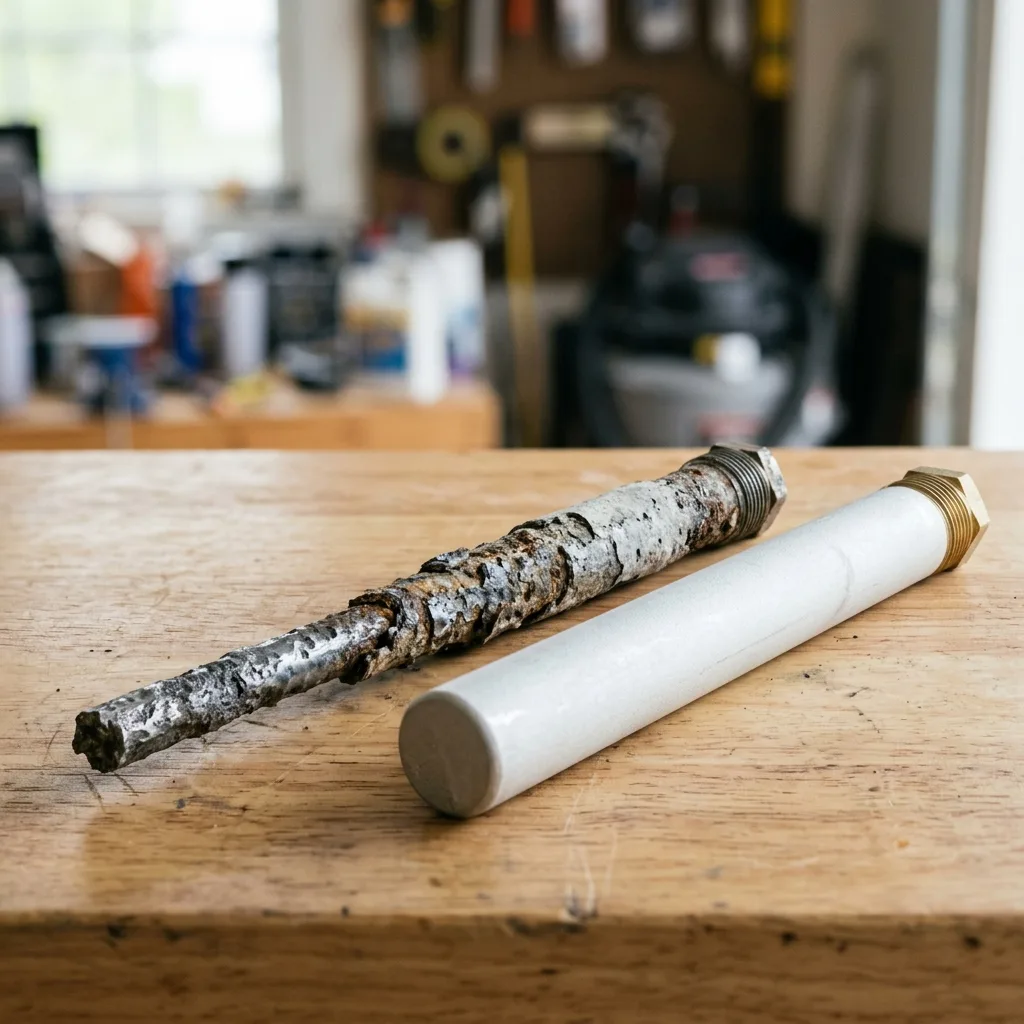
The only reliable check is to pull the rod and look at it. A healthy rod still has a visible layer of magnesium or aluminum coating along most of its length. Two signs mean it’s due:
- More than half the coating is gone. You’ll see bare steel core wire showing through in patches.
- Six or more inches of bare wire are exposed. At this point the rod is close to fully spent and offering little remaining protection.
A rod reduced to a thin, bumpy wire with almost no coating left has already stopped doing its job, sometimes for months before anyone noticed. If your water heater is also giving off a rotten-egg smell from the hot tap, that’s a related but separate issue, usually tied to a magnesium rod reacting with bacteria in the water. Our guide to that smell covers the fix, which is often an anode swap paired with a tank flush.
What does anode rod replacement cost in San Diego?
Professional replacement typically runs $150 to $300, depending on access to the rod and how stuck the old one is. A rod that’s corroded in place can take real effort to break loose, and a tank tucked in a closet or attic with limited overhead clearance sometimes needs a segmented or flexible rod instead of a standard straight one, which adds to the cost.
If you’re doing it yourself, the rod alone runs $20 for a basic magnesium rod up to $60 to $80 for a segmented or aluminum-zinc rod. Combined with a tank flush at the same visit, which is good practice anyway, professional service usually lands in the $200 to $400 range. Our water heater team can check the rod and give you a firm number on the spot.
Can you replace it yourself?
It’s a realistic DIY job for someone comfortable with basic tools. You’ll need a 1-1/16 inch socket (most rods use this size), a way to shut off the water and either the gas or breaker to the unit, and, most importantly, enough clearance above the tank to pull the old rod straight up and out. That clearance check is the step most homeowners skip and regret. Standard rods run about 44 inches; if your garage ceiling or closet doesn’t leave that much headroom, you need a segmented rod that can be fed in a few inches at a time, or a flexible rod, before you start.
The other common snag is a rod that’s rusted or mineral-locked into its fitting. Hard water in San Diego makes this more likely the longer a rod has gone unreplaced. If it won’t break loose with a breaker bar, that’s the point to call a plumber rather than risk damaging the tank’s top fitting.
Which type of anode rod is right for your home?
There are three common options, and San Diego’s water chemistry makes the choice more relevant than it is in a lot of markets.
Magnesium is the standard rod that most tanks ship with and gives the strongest corrosion protection. Its tradeoff is that it reacts more readily with sulfate-reducing bacteria that some water supplies carry, which is the usual cause of a rotten-egg smell at the hot tap.
Aluminum rods last longer than magnesium and cost less, but offer the weakest protection of the three. They’re a reasonable budget choice for a low-use secondary tank, less so for a primary water heater you’re counting on for a decade-plus.
Aluminum-zinc rods split the difference: protection close to magnesium, with a zinc component that reacts far less with the bacteria that cause odor. For a San Diego home with a water softener or one that’s already dealt with a sulfur smell, this is usually the better default over sticking with the original magnesium rod.
Does this affect your warranty?
Most manufacturer tank warranties, typically 6 to 12 years depending on the model, require the anode rod to remain in place and functional for corrosion coverage to apply. Letting a rod fully deplete and never replacing it can give a manufacturer grounds to deny a corrosion-related warranty claim later. Replacing it with a rod the manufacturer approves for your model keeps that coverage intact, which is one more reason this small, inexpensive part is worth staying on top of.
When to call a plumber instead of doing it yourself
Call it in if the old rod won’t break loose, if your tank doesn’t have the clearance for a standard rod and you’re not sure which alternative to buy, or if it’s simply been longer than 5 years since anyone checked. The plumber we connect you with can pull the rod, tell you straight whether it needs replacing yet, and do the swap the same visit if it does. Call (858) 400-4417 to get it checked.
Areas this guide covers
We connect homeowners with licensed plumbers in these San Diego County communities.
Keep reading
Need a Plumber in San Diego?
Licensed, insured plumbers, ready across San Diego County. The plumber quotes you before any work starts.
Call (858) 400-4417Call any time, day or night, anywhere in San Diego County