
Last updated: May 2, 2026
Why Is Plumbing So Expensive? A San Diego Breakdown
A C-36 license takes 4–5 years and 8,000+ hours. Workers' comp adds 15–25% on top. Where every dollar goes and what fair San Diego rates look like.
The short answer
- Plumbing is expensive because the price covers training, California licensing, truck overhead, and high insurance, not just wrench time.
- A C-36 license takes 4 to 5 years and 8,000-plus documented hours before a plumber can even hold it.
- Workers' comp adds 15 to 25 percent on top of wages, and a fully stocked service truck costs $50,000 to $80,000.
- A trip or diagnostic fee of $75 to $150 covers fuel, drive time, and dispatch; many companies credit it toward the repair.
- Expect San Diego rates 15 to 25 percent above national averages, since those averages include low-cost markets.
You called a plumber for what felt like a simple job. The quote came back at $350, $500, maybe more. Now you are staring at the number wondering: is this legitimate, or am I getting taken?
It is a fair question. Plumbing costs in San Diego genuinely are high, and understanding exactly why helps you distinguish a fair quote from an inflated one. The honest answer is that plumbing combines years of required training, expensive California licensing, significant equipment overhead, and substantial insurance costs in one of the most expensive labor markets in the country. Here is the actual breakdown of where every dollar goes.
What are you actually paying for?
When a plumber hands you a $400 quote for a job that looks simple, you are not paying $400 for two hours of turning a wrench. You are paying for everything required to have a licensed, insured professional with the right equipment show up at your door ready to solve your problem correctly, and stand behind the work.
Labor Is the Largest Line Item, and It Is Not What You Think
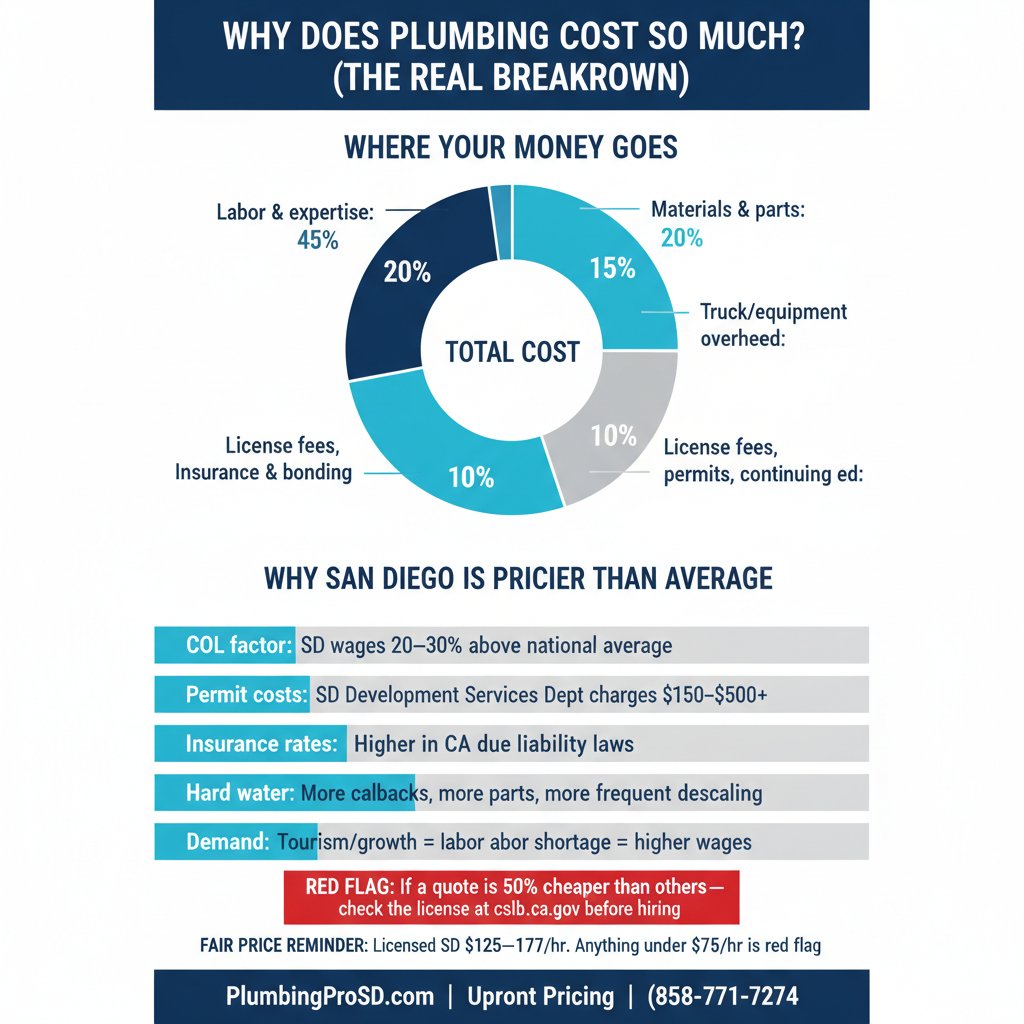
Journeyman plumbers in San Diego earn $75–$130 per hour in wages. In a high cost-of-living metro, this is competitive market rate. But wages are only part of what the plumbing company actually pays. Here is the full picture of what an employee costs:
- Payroll taxes: Federal and California combined add roughly 12–15% on top of wages
- Workers’ compensation insurance: California construction trades pay some of the highest workers’ comp premiums in the country, often 15–25% of payroll for plumbing work, because the physical risks are real
- Health insurance: California law requires employers of a certain size to provide health benefits; competitive companies offer them regardless
- Paid sick leave and vacation: California mandates paid sick leave; most companies that want to retain skilled tradespeople offer vacation on top
- Retirement contributions: Union contractors contribute to pension funds; non-union companies typically offer 401(k) matching
By the time you add the true cost of an employee in California, a plumber billing $100 per hour in labor is often costing the business $150–$175 per hour in total employment expense. That gap is not profit, it is the real cost of employing a person legally in California.
Licensing, Training, and Continuing Education
Becoming a licensed plumber in California requires years, not weeks. The path to a California C-36 plumbing contractor license involves:
- 4–5 years of apprenticeship: Through a union apprenticeship program or state-registered employer program, combining on-the-job training with required classroom instruction in California plumbing code, safety, and trade skills
- 8,000+ hours of documented work experience: The CSLB requires proof of journeyman-level experience before you can sit for the contractor exam
- State licensing exam: The California Contractors State License Board (CSLB) administers a rigorous exam, many candidates do not pass on the first attempt
- Continuing education: License renewal requires ongoing CE to stay current with California’s regularly updated plumbing codes and energy efficiency requirements
This is genuine expertise accumulated over years. When a licensed plumber diagnoses your problem correctly in 20 minutes and fixes it to code in 45, that speed and accuracy is a function of years of training. Paying for expertise is not paying too much.
You can verify any plumber’s California license, and confirm it is active and in good standing, at cslb.ca.gov. This takes 30 seconds and should always be your first step before hiring anyone.
Liability Insurance and Bonding: Protecting You, Not Just the Plumber
California requires licensed contractors to carry general liability insurance. For plumbing contractors, this typically means $1 million or more in coverage. Annual premiums for this level of coverage run $5,000–$20,000 depending on company size, specialties, and claims history.
This matters directly for you. If an unlicensed plumber causes water damage to your home, your homeowner’s insurance may deny the claim on the grounds that unauthorized, unlicensed work was performed. The California Insurance Commissioner strongly advises verifying contractor insurance and licensing before allowing work in your home, see guidance at insurance.ca.gov.
If a licensed, insured plumber makes an error and causes water damage, their liability policy covers the damage. That insurance premium is partly your protection.
Contractors in California are also required to be bonded (a $15,000 contractor’s bond is standard for CSLB licensing). The bond exists to provide recourse if a contractor fails to complete work or causes financial harm.
The Service Vehicle: A Rolling Parts Warehouse
A fully equipped plumbing service truck is not just transportation, it is a capital investment of $50,000–$80,000 or more. What a legitimate plumbing company invests in each vehicle:
- Truck purchase and financing: A properly outfitted service truck runs $40,000–$80,000
- Commercial vehicle insurance: Higher premiums than personal vehicle insurance, required for business use
- Fuel: San Diego fuel prices consistently run above national averages; a service truck covering 80–150 miles daily in traffic represents significant monthly fuel cost
- Ongoing maintenance: Commercial trucks with heavy tool loads need regular, rigorous maintenance
- Pipe and fitting inventory: Copper, PEX, CPVC, ABS pipe in multiple sizes; elbows, couplings, tees, shutoff valves, wax rings, flappers, pressure regulators, keeping a range stocked means most jobs can be completed in one visit
- Specialty tools: Drain snakes, hydro-jetting equipment ($3,000–$8,000 per unit), sewer camera systems ($5,000–$15,000), pipe cutters, soldering equipment, press-fit tools, acoustic leak detection equipment, thermal imaging cameras
That sewer camera a plumber uses to diagnose your lateral before recommending repair? That single piece of equipment cost more than many people’s cars. The ability to arrive with the right tool and the right part is what makes one-visit repairs possible, and the equipment investment behind that capability is real. The same is true across the trades, a licensed HVAC company carries refrigerant recovery equipment, combustion analyzers, and manifold gauge sets that represent a similar capital investment per truck.
Business Overhead: The Cost of Running a Legitimate Operation
Beyond labor and vehicles, a San Diego plumbing company carries overhead that gets distributed across every job:
- Dispatch and scheduling staff: Someone answering phones at 2 AM when your pipe bursts
- Office and storage space: Commercial real estate in San Diego is expensive
- Software and technology: Dispatch management, GPS tracking, scheduling, invoicing, and customer communication systems
- Marketing: How you find the plumber when you need one at 10 PM
- Accounting, legal, and administrative functions
- Workers’ comp and liability insurance (already covered above, but it is substantial)
When you hire a legitimate plumbing company, not a sole operator with no overhead, you are paying for the infrastructure that guarantees someone shows up, does the job correctly, and remains accountable if something goes wrong.
Why does San Diego specifically cost more than national averages?
San Diego homeowners consistently pay 15–25% above national average plumbing rates. Here is why that premium is real, not manufactured:
California’s labor market. The Bureau of Labor Statistics shows California plumbers among the highest-paid in the country. Cost of living, housing costs that affect where workers can afford to live, and competitive demand for skilled trades all drive wages upward. This is a genuine market condition.
California’s strict licensing requirements. California has among the most rigorous contractor licensing requirements in the country, which ultimately protects consumers but adds real compliance costs. CSLB licensing fees, insurance minimums above what other states require, and ongoing continuing education requirements all have price tags.
San Diego’s hard water. At about 16 grains per gallon, San Diego’s water supply (fed by the Colorado River and State Water Project via the San Diego County Water Authority) is classified as very hard. Mineral scale accelerates wear on pipe interiors, fixtures, and appliances. Many plumbing jobs in older San Diego homes take longer because of scale-related complications, and hard water dramatically shortens component lifespans.
Permit costs and San Diego Building Department requirements. Water heater replacements, repipes, and sewer work require permits from the San Diego Development Services Department, ranging from $100–$500. Required inspections add time and scheduling complexity. These are legitimate costs passed to the homeowner, but they also protect you.
San Diego County’s geography. Covering 4,200 square miles from the coast to the desert, San Diego County means significant drive time between jobs, fuel, time, and vehicle wear all factor into pricing.
Why do cheap bids usually cost more in the long run?
The $49 drain cleaning special or the $300 water heater replacement quote feels like winning. Here is what it almost always actually represents:
Unlicensed work. Unlicensed operators have zero licensing costs, no insurance premiums, no bonding, no CE requirements, their overhead is genuinely lower. But unlicensed work can void your homeowner’s insurance coverage for water damage. Under California law, homeowners can also be held liable for workplace injuries to unlicensed contractors working on their property. California’s contractor licensing laws exist precisely because unlicensed work causes disproportionate harm.
Bait-and-switch pricing. Some companies advertise a loss-leader price to get in the door, then escalate the bill with discoveries made once they are inside your home and you are committed. Reputable companies diagnose thoroughly upfront and give you the full price in writing before starting.
Inferior materials. Budget contractors sometimes use lower-grade fittings, valves, and pipe that fail sooner, require more service calls, and end up costing significantly more over their shorter lifespan.
No warranty protection. Licensed contractors who do permitted work stand behind it with a labor warranty. Unlicensed operators typically disappear or become unresponsive when problems develop after the job.
The relevant comparison is not “licensed plumber quote vs. unlicensed quote.” It is “licensed plumber quote vs. the full long-term cost of work done wrong.” That calculation usually favors the licensed contractor by a significant margin.
What do fair prices look like for common San Diego plumbing jobs?
Use these 2026 ranges as a reality check when evaluating quotes:
| Job | Realistic San Diego Range |
|---|---|
| Toilet flapper or fill valve repair | $100–$200 |
| Drain snaking (single fixture) | $100–$200 |
| Kitchen drain cleaning (hydro-jet) | $200–$400 |
| Faucet repair or replacement | $150–$350 |
| Water heater thermocouple replacement | $150–$250 |
| Pressure regulator replacement | $300–$600 |
| Garbage disposal replacement | $200–$450 |
| Water heater replacement (40–50 gal tank) | $900–$2,200 installed and permitted |
| Sewer camera inspection | $150–$350 |
| Slab leak detection and repair | $2,000–$6,000 |
| Whole-home repipe (PEX, average home) | $4,000–$10,000 |
For a complete breakdown by job type with additional detail, see our full San Diego plumbing pricing guide.
A quote significantly below these ranges warrants questions about license, insurance, and what exactly is included. A quote significantly above them warrants asking for an itemized breakdown or getting a second opinion.
How do you get value without getting overcharged?
Verify the license before the plumber arrives. Check the CSLB database at cslb.ca.gov. An active license confirms they have met California’s requirements. It takes 30 seconds.
Get written, itemized estimates. A reputable plumber will itemize labor, materials, and permit fees. Verbal quotes lead to disputes. If they refuse to put the price in writing before starting, walk away.
Ask about flat-rate pricing. Most reputable San Diego plumbers use flat-rate pricing for standard jobs, you know the full cost before they start. If they charge hourly, ask for an estimated time range in writing.
Get 2–3 quotes for major work. For any job over $500, competing quotes reveal the actual market rate and give you confidence you are paying fairly.
Ask what the quote includes. Does it cover permit fees? Materials? Cleanup? Patching drywall if they open a wall? Disposal of old equipment? Warranty on labor?
Schedule non-emergency work during business hours. Emergency and after-hours calls add 50–100% to base costs. If your situation allows waiting until a weekday morning, it is worth it.
Read reviews for the right signals. Look for reviews mentioning correct diagnosis on the first visit, upfront pricing, and no surprise charges, not just “great price.” A plumber who fixes things right the first time is more valuable than one who charges slightly less and requires return visits.
Frequently Asked Questions
Q: Why do plumbers charge so much just to show up?
Diagnostic or trip fees of $75–$150 cover fuel, commercial vehicle overhead, dispatching cost, and the plumber’s time driving to your location and diagnosing the problem before any repair begins. In San Diego traffic, a service call can involve 45–90 minutes of drive time round-trip. Many companies credit the trip fee toward the repair cost when you hire them for the job.
Q: Is plumbing more expensive in San Diego than other parts of the country?
Yes, consistently and significantly. California plumbers earn among the highest wages in the country. California’s strict licensing requirements add compliance costs. San Diego’s cost of living and hard water conditions add further pressure. Expect to pay 15–25% above national averages you see quoted in national publications, those figures are averages across the entire country, including low-cost markets.
Q: Why does a plumber charge $300 for a 30-minute job?
Because the 30-minute on-site job also involved 45–60 minutes of travel, years of training to diagnose and execute it correctly in 30 minutes, the right specialty tools on the truck to complete it in one visit, and the insurance and licensing infrastructure to protect you if something goes wrong. The on-site time is not the only input. You are also paying for expertise that prevents a 30-minute job from becoming a 3-hour one.
Q: Why do plumbers mark up parts?
Material markup of 25–50% above wholesale cost is standard practice in every trade, plumbing, HVAC, electrical. It covers the cost of stocking inventory on the truck (including items that sit for months), restocking trips to suppliers, dealing with warranty exchanges, and the capital tied up in carrying inventory. If they charge standard rates and use quality parts, the markup is normal and legitimate. Ask for an itemized quote if you want to see part costs separately.
Q: Is it worth paying more for a licensed plumber in San Diego?
For all but the most trivial tasks, yes. Licensed plumbing work is required to be permitted where applicable, which protects you at resale and with your insurance company. Licensed contractors carry insurance that protects your home if something goes wrong on-site. Licensed work may be a requirement for homeowner’s insurance claims to be honored. The cost difference between licensed and unlicensed work is often smaller than people expect, once you account for the real risks of unlicensed work going wrong.
Related reading
For specific dollar ranges on common jobs, see our complete San Diego plumbing cost guide with 2026 pricing by service type. If you’re trying to decide whether to call a pro or handle something yourself, our post on signs you need a professional plumber walks through the situations where licensed help is worth every dollar.
Plumbing Pro San Diego connects you with plumbers who give you upfront, flat-rate pricing on every job, so you know the exact cost before any work begins. Every plumber in the network is CSLB-licensed and fully insured. Whether you’re in Del Mar, La Presa, or Ramona, call us at (858) 400-4417 for honest estimates throughout San Diego County. We connect you with plumbers for everything from small leak detection jobs to full pipe repair and replacement projects, with no surprises on the final invoice.
Areas this guide covers
We connect homeowners with licensed plumbers in these San Diego County communities.
Keep reading
Need a Plumber in San Diego?
Licensed, insured plumbers, ready across San Diego County. The plumber quotes you before any work starts.
Call (858) 400-4417Call any time, day or night, anywhere in San Diego County