
Last updated: April 21, 2026
PEX vs. Copper Pipes: Which Is Better in San Diego?
PEX costs $0.40–$0.80/ft vs. copper at $2.50–$4.50/ft and handles SD hard water better. Full comparison on lifespan, code, and when copper still wins.
The short answer
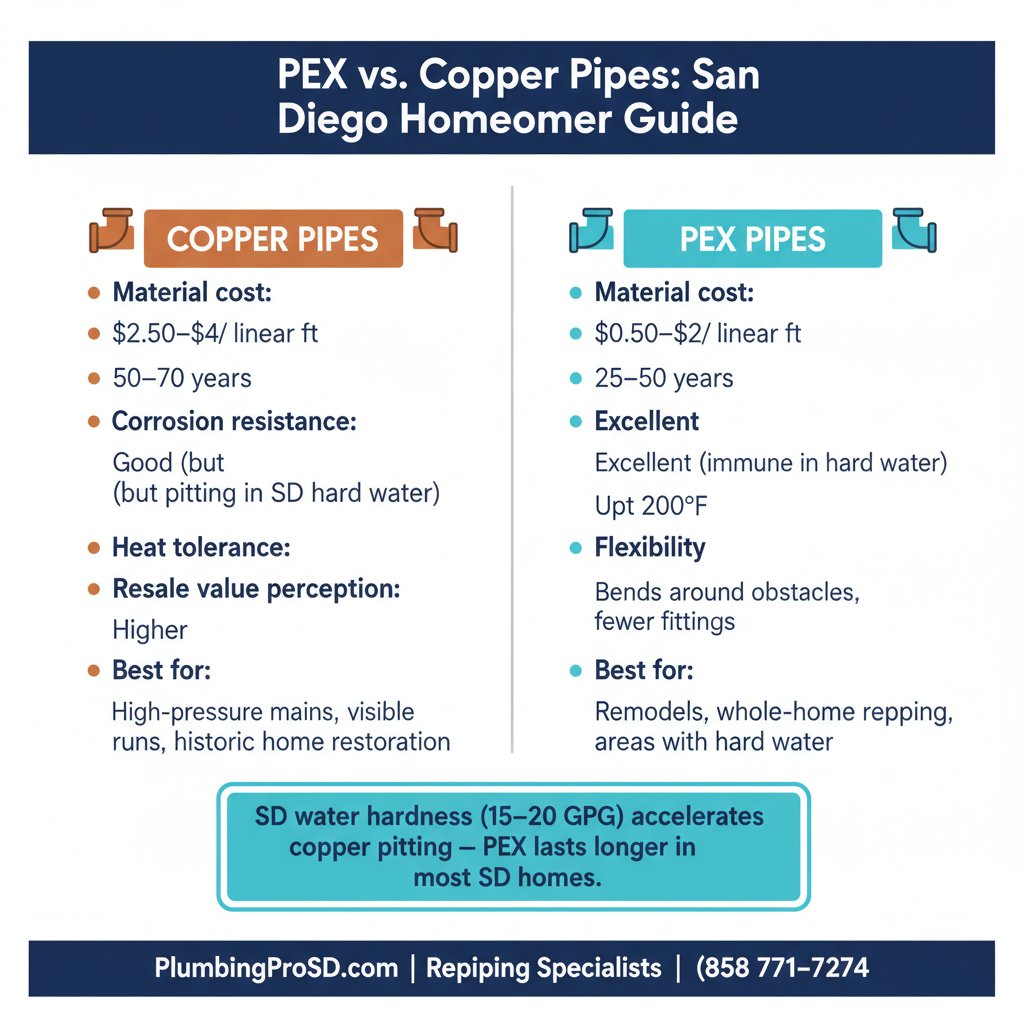
- For most San Diego homes, PEX is the smarter repipe choice; it costs less and resists the hard water and chloramines that corrode copper.
- PEX runs about $0.40 to $0.80 per foot vs copper at $2.50 to $4.50; a full PEX repipe is $4,000 to $10,000 vs $8,000 to $18,000 for copper.
- San Diego water causes pinhole leaks in copper systems as young as 20 to 30 years; PEX is chemically inert and does not pit or scale.
- Copper still wins for exposed outdoor runs (UV exposure) and the last 18 inches at the water heater, so most repipes are a PEX-copper hybrid.
- Both materials are code-compliant; any whole-home repipe needs a permit and inspection. Call (858) 400-4417 for an evaluation.
If you’re facing a repipe, or you’ve just been told your aging galvanized supply lines need to go, the first question your plumber will likely ask is: PEX or copper? Both materials are code-compliant in California. Both are installed every day in San Diego homes. But they perform very differently under San Diego’s specific water conditions, and for most homeowners in this region, one has a meaningful advantage over the other.
This guide breaks down every factor that actually matters: cost, lifespan, corrosion behavior, installation complexity, hard water performance, building code status, and the edge cases where copper still wins. By the end, you’ll be equipped to make an informed decision, or to evaluate what your plumber recommends.
What is PEX pipe?
PEX stands for cross-linked polyethylene. It’s a flexible plastic tubing that has become the dominant residential supply pipe material in new construction across the United States over the past two decades. The “cross-linked” refers to a manufacturing process that creates bonds between polyethylene molecules, giving PEX exceptional flexibility, temperature resistance, and chemical stability compared to standard plastic pipe.
PEX comes in three types:
- PEX-A, Made with the Engel process; most flexible and has the best burst resistance. Highest cost.
- PEX-B, Made by silane method; slightly stiffer, very common, good value
- PEX-C, Electron beam crosslinked; least flexible, less common in residential work
All three types are California Plumbing Code compliant and accepted by San Diego County Building and Safety. For most residential repipes, PEX-B is the workhorse material.
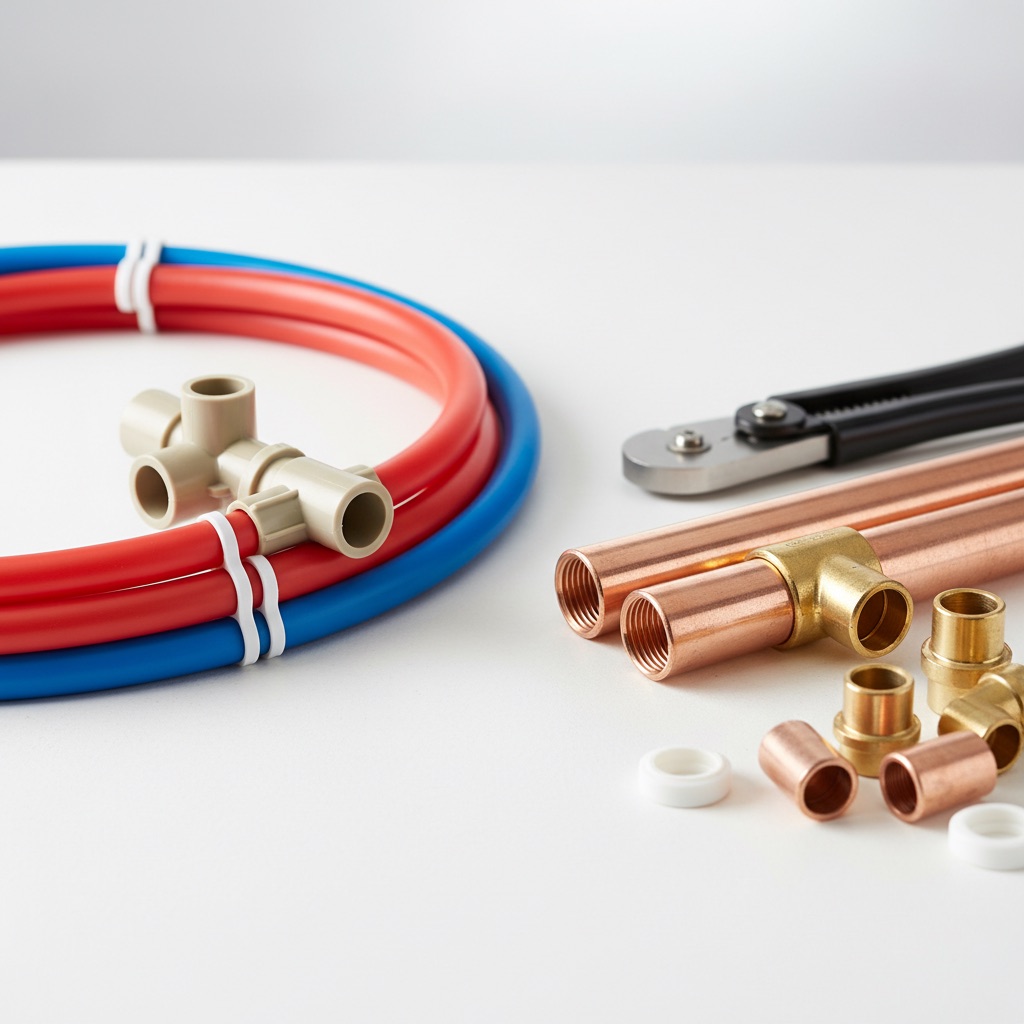
PEX connects with crimp rings, clamp rings, or push-fit fittings. It comes in red (hot), blue (cold), and white (either), and can be run in long continuous lengths from a central manifold without fittings at intermediate turns.
What is Type L copper pipe?
Type L copper has been the standard for residential plumbing supply lines in the United States for most of the 20th century. It’s a rigid metal pipe with well-documented long-term performance and a wall thickness suited for both hot and cold supply applications in homes.
Copper connects with soldered (sweated) joints using a torch and solder, or with press-fit or push-fit fittings. Every direction change requires a fitting, elbows, tees, and couplings, and every fitting is a potential future leak point.
San Diego homes built between approximately 1960 and 2010 are predominantly copper throughout. Homes built before 1960 typically have galvanized steel, which is a separate problem (and worse).
The Comprehensive Comparison
Cost: Material and Installation
PEX is significantly less expensive, both in material and installed cost.
Material cost comparison per linear foot:
- PEX-B: approximately $0.40–$0.80/ft
- Type L copper: approximately $2.50–$4.50/ft (copper prices fluctuate with commodity markets)
The labor differential is equally important. PEX’s flexibility means it can be routed through walls and joists with less cutting, bent around corners without fittings, and run in long continuous lengths that minimize the number of connections. A PEX repipe requires fewer fittings, less labor time, and causes less disruption to finished walls and ceilings than copper.
Full repipe cost comparison for a typical San Diego home (1,500–2,000 sq ft):
| Material | Estimated Installed Cost |
|---|---|
| PEX (full repipe) | $4,000–$10,000 |
| Copper (full repipe) | $8,000–$18,000 |
The difference often exceeds $5,000 for a typical San Diego home, primarily driven by copper’s material cost and the additional labor for soldering and fitting installation.
Lifespan and Durability
Comparable lifespan, with significant real-world caveats for San Diego.
Copper’s theoretical lifespan: 50–70 years under ideal conditions. PEX’s tested lifespan: 40–50 years, based on manufacturer testing and accelerated aging studies. Field data from the earliest PEX installations (European systems) supports 50+ year performance.
The critical qualifier: in San Diego’s specific water chemistry, copper’s actual lifespan is considerably shorter than its theoretical maximum. San Diego plumbers routinely encounter pinhole leaks in copper systems that are only 20–30 years old, well short of the 50-year benchmark. PEX systems installed in San Diego are showing no signs of comparable degradation.
Hard Water and Corrosion Resistance, The San Diego Factor
This is the most important comparison for San Diego homeowners, and PEX wins decisively.
San Diego’s municipal water supply, drawn primarily from the Colorado River and northern California via the State Water Project, is consistently among the hardest municipal water in Southern California, with total hardness typically ranging from 200–350 parts per million (12–20+ grains per gallon) depending on location and season. Areas served by the Helix Water District often experience the highest mineral content; coastal zones served partially by the Carlsbad Desalination Plant may see somewhat lower hardness.
Hard water causes two distinct problems for copper:
Mineral scale inside copper pipe: Calcium and magnesium deposits build up on the interior of copper supply lines over time, narrowing the pipe and reducing water pressure. The same scale that coats your showerheads coats your pipes, just inaccessibly, inside the walls.
Pinhole corrosion: This is the more serious problem. San Diego’s water is treated with chloramines (chlorine combined with ammonia) as a disinfectant, a common practice that is chemically harder on copper than traditional free-chlorine treatment. Combined with the water’s mineral content and occasional low pH ranges, chloramine treatment accelerates a pitting corrosion process inside copper pipe that ultimately creates pinhole leaks.
Pinhole leaks in copper supply lines are the most common plumbing failure type in San Diego homes built in the 1980s through 2000s. A single pinhole leak is inconvenient; a home where multiple pinholes are appearing in the same copper system is a home that needs repiping, not repeated spot repairs.
PEX is chemically inert to all of these factors. It does not corrode, does not develop pinhole leaks, and does not accumulate mineral scale on its interior surface. The smooth interior of PEX actually maintains water pressure better over time than copper that has been in service for decades. For a San Diego home expecting to be on the same supply pipes for the next 40 years, PEX offers substantially more reliable long-term performance in this specific water environment.
This is why the majority of plumbers working in San Diego now default to PEX for repipe projects: it simply performs better in local conditions.
According to the EPA’s WaterSense program, water efficiency and pipe longevity are closely linked, scale buildup that restricts flow wastes water and accelerates system degradation.
Installation Complexity
PEX is faster and less disruptive to install.
Copper installation requires:
- Torch and solder for all joints
- Fittings at every direction change
- Rigid pipe handling that requires more wall and ceiling access for routing
- More time per joint due to heat-up, solder flow, and cooling
PEX installation requires:
- No open flame
- Long continuous runs around obstacles without fittings
- Routing through walls with far less opening due to flexibility
- Push-fit or crimped connections that are fast and reliable
For a whole-home repipe, the installation difference translates directly into less drywall damage, faster completion, and lower labor cost.
Freeze Resistance
PEX wins, though this is minimally relevant in San Diego.
PEX can expand slightly when water freezes inside it and then contract as it thaws, significantly reducing the risk of burst pipe from a freeze. Copper has no give and will burst under freeze pressure.
San Diego outdoor temperatures rarely drop to freezing, so this distinction rarely matters for primary plumbing. However, homes with supply lines routed through unconditioned garages, attics, or exterior wall cavities that face cold snaps in inland areas (El Cajon, Santee, Ramona) have a marginal safety advantage with PEX.
UV Sensitivity
Copper wins outright.
PEX degrades under prolonged direct UV exposure and cannot be used on exposed exterior runs or in outdoor applications where it will see sunlight. Copper is completely UV-stable and can be used anywhere.
For San Diego homes, where outdoor plumbing exposure is common due to the climate and outdoor living culture, this is a real-world limitation. Exposed supply lines in uncovered outdoor showers, exterior hose bib connections on sunny walls, supply runs in open garages with skylights, or service connections in exposed utility areas should use copper or UV-resistant CPVC rather than PEX.
In most whole-home repipes, this means a hybrid approach: PEX for the concealed interior supply lines, with short copper sections for any exposed outdoor connections.
Noise and Water Hammer
PEX wins for quieter operation.
PEX’s flexibility absorbs pressure waves better than rigid copper, reducing the “banging” or knocking sound (called water hammer) that occurs when fast-closing valves suddenly stop water flow. Many San Diego homeowners with noisy copper pipes find the noise disappears after a repipe to PEX without requiring separate water hammer arrestor installation.
Repair Ease
PEX is easier to repair, for professionals and skilled DIYers.
A copper repair requires cutting out the damaged section, cleaning the pipe ends, and soldering in a replacement coupling and segment. This requires skill and equipment and is not straightforward in tight spaces.
A PEX repair uses push-fit or crimp connections that are achievable with basic tools in tight access conditions.
For homeowners who want the ability to handle minor repairs themselves, PEX has a meaningful advantage.
Resale Value and Buyer Perception
Essentially equal in the current market.
A decade ago, some home buyers or inspectors viewed PEX with skepticism as a “newer” material. That’s no longer accurate, PEX has been the standard in new construction nationwide for long enough that buyers, home inspectors, and appraisers treat it as equivalent to copper. What matters is that the system is functional, properly installed, and permitted.
A home repiped with PEX under permit, inspected by the city, and documented is a selling point, especially replacing galvanized steel or a copper system showing pinhole leaks.
California Building Code Compliance
Both materials are fully compliant.
PEX is approved under the California Plumbing Code (CPC) and has been for years. San Diego County Building and Safety accepts PEX repipe permit applications using ASTM F876/F877 (for PEX-A) or F1807/F2159 (for crimped connections).
All whole-home repipe work in San Diego requires a permit and inspected installation, regardless of material. DIY repipes that skip the permit create disclosure liability at resale and may not be covered by homeowner’s insurance in the event of a failure.
When is copper still the right choice in San Diego?
Despite PEX’s advantages in this market, there are situations where copper remains appropriate or preferable:
Exposed exterior pipe runs, Where UV exposure is unavoidable and copper or CPVC is required for the exposed sections.
Near water heaters and boilers, The connection between the water heater and the supply lines should use copper or flexible connectors rated for high-temperature exposure; most PEX repipes use copper for the last 18 inches at the water heater connection.
Matching an existing copper system, For a localized repair to an otherwise intact copper system, matching copper is usually the practical choice rather than introducing PEX fittings into a full copper system unnecessarily.
HOA or historic district requirements, Some San Diego HOAs or historic district guidelines specify plumbing materials. Check before committing to PEX in these situations.
Personal preference, Some homeowners simply prefer the track record and permanence of copper and are willing to pay the premium. That’s a legitimate choice.
How do you know if your San Diego home needs repiping?
Whether you choose PEX or copper, the decision often follows these warning signs:
- Discolored water, Orange or brown water from galvanized corrosion; blue-green water from copper oxidation
- Multiple pinhole leaks, One pinhole leak in a copper system over years is a repair; two or three in the same system in a short period is a repipe conversation
- Consistently low water pressure throughout the home (not just one fixture)
- Original galvanized pipe in a pre-1960 home, galvanized has a service life of 40–70 years and is well past it in most San Diego originals
- Original copper in homes built before 1990 where no plumbing work has been done, those pipes are 35+ years old and in San Diego’s water environment, increasingly at risk of pinhole failure
- Visible corrosion on supply line connections, angle stops, or at fittings
See our pipe repair service page for a full evaluation.
Frequently Asked Questions
Q: Is PEX approved by San Diego building codes?
Yes. PEX has been fully compliant with California Plumbing Code for many years and is accepted for permitted repipe work in all San Diego County jurisdictions. The permit and inspection process for PEX repipes is identical to copper, pull the permit, install the pipe, schedule the inspection, get sign-off.
Q: Can PEX be used for both hot and cold supply lines?
Yes. PEX is rated for hot and cold supply lines at standard residential operating temperatures and pressures. By convention, red PEX is used for hot supply and blue for cold, though functionally the pipe is identical. PEX-A specifically is rated for continuous use at up to 200°F at 80 PSI, well above any residential hot water temperature.
Q: Will repiping my home with PEX increase its value?
A properly permitted repipe with documented inspections is a genuine selling point, regardless of material. Buyers and their inspectors view a repiped home positively compared to one with aging galvanized or a copper system showing pinhole corrosion. The value of avoiding a buyer’s post-purchase surprise also shows up in smoother escrow closings.
Q: How long does a whole-home repipe take in San Diego?
Most whole-home repipes of standard-sized San Diego homes (1,500–2,500 sq ft) are completed in 1–3 days for the plumbing work. Drywall patching and painting, if needed, adds time. PEX repipes generally take less time than copper due to faster connection methods and less wall access required. The city inspection must be scheduled before walls are closed, which adds a scheduling step.
Q: Does PEX work with San Diego’s hard water better than copper?
Yes, this is the single most important practical advantage of PEX in San Diego. PEX is chemically inert, it does not react to the chloramines, mineral content, or pH variability in San Diego’s municipal water supply. Copper, by contrast, is susceptible to the pitting corrosion that San Diego’s water chemistry accelerates, leading to the pinhole leaks that are among the most common plumbing failures the region sees.
Related reading
If you’re already dealing with a failing pipe system, our post on fixing sewer lines in San Diego covers the repair options from spot fixes to full replacement. Trying to understand why repiping quotes are so high? Our breakdown of why plumbing is so expensive explains the labor, licensing, and material costs behind every estimate.
For most San Diego homes, PEX is the smarter long-term investment, lower cost, easier installation, and better resistance to the water conditions that are actively shortening copper pipe lifespans in this region. But every home is different, and the right answer depends on your specific pipes, your water source, and what you’re trying to accomplish. Plumbing Pro San Diego provides honest repipe evaluations throughout San Diego County, including homes in Lemon Grove, La Presa, and Crest. Call (858) 400-4417 or visit our pipe repair service page to schedule an assessment.
Areas this guide covers
We connect homeowners with licensed plumbers in these San Diego County communities.
Keep reading
Need a Plumber in San Diego?
Licensed, insured plumbers, ready across San Diego County. The plumber quotes you before any work starts.
Call (858) 400-4417Call any time, day or night, anywhere in San Diego County