Last updated: April 24, 2026
Sewer Line Repair in San Diego: Signs, Options, Costs
San Diego sewer line repair runs $1,500–$30,000 depending on method. Spot repair, CIPP lining, pipe bursting, and excavation compared. 8 warning signs.
The short answer
- San Diego sewer line repair runs $1,500 to $30,000 depending on method, from spot repair to full excavation.
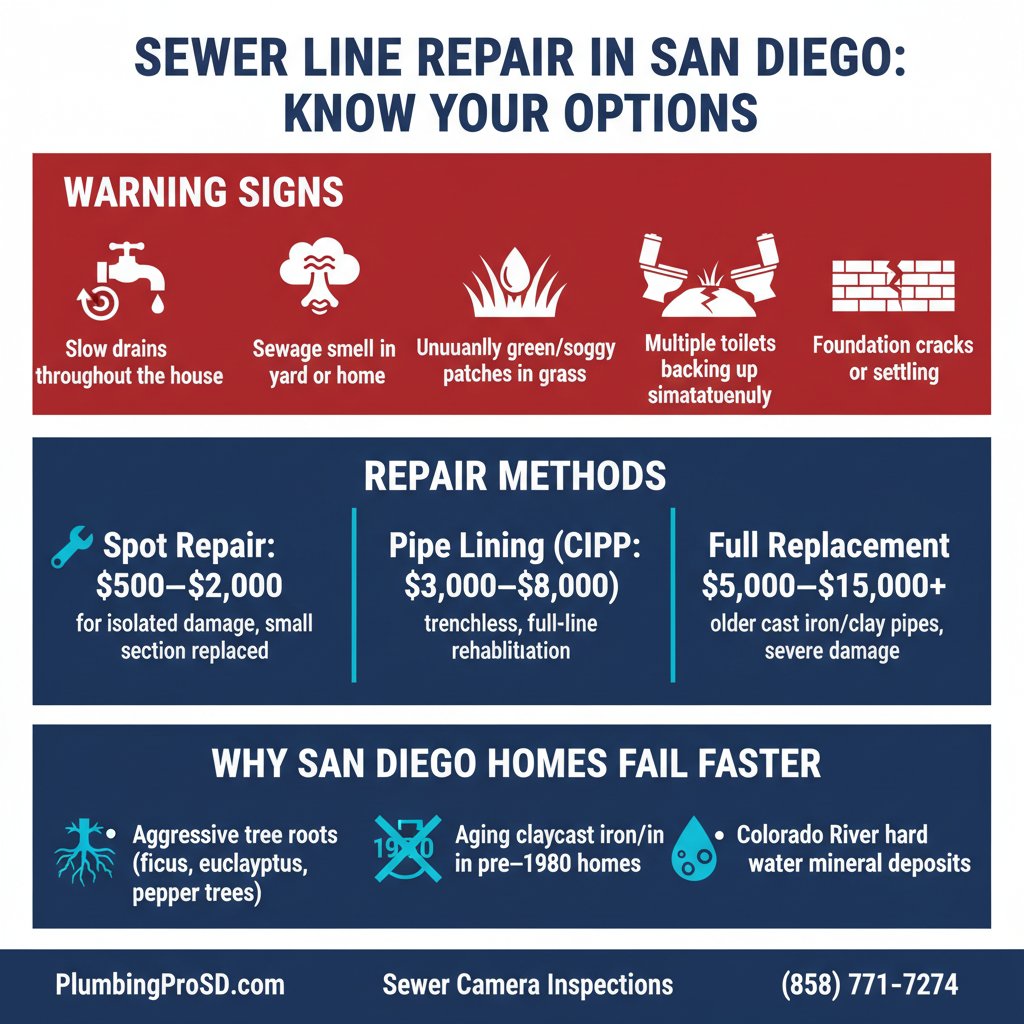
- Warning signs: multiple drains backing up, sewage odors, soggy or green yard patches, gurgling, and recurring clogs.
- Always get a camera inspection ($150 to $350) first; no repair method should be chosen before seeing the pipe condition.
- Trenchless options: CIPP pipe lining ($4,000 to $12,000) and pipe bursting ($5,000 to $15,000) avoid trenching your yard.
- Standard homeowners insurance usually excludes the pipe repair itself. Call (858) 400-4417 to get connected with a plumber.
Your sewer line is the single most critical pipe on your property, and the one most homeowners ignore until the day it fails completely. In San Diego, where a large percentage of residential sewer laterals were installed before 1970, sewer line failures are not just possible. They’re predictable.
San Diego Sewer Line Repair Options & Costs (2026)
The good news: caught before complete failure, most sewer line problems are fixable without tearing up your entire yard, and some can be addressed without digging at all. The bad news: ignored sewer problems escalate quickly and expensively, from a $400 cleaning job to a $20,000 repair plus biohazard remediation.
This guide covers everything you need to know: what the warning signs look like, why San Diego pipes fail when and how they do, what a proper diagnosis involves, what your repair options actually are, what things cost, and what your homeowner’s insurance will and won’t cover.
What are the warning signs your sewer line is failing?
Sewer line problems almost never appear without warning. There are usually symptoms for weeks or months before a full backup or collapse. Recognizing them early can be the difference between a manageable repair and a catastrophe.
1. Multiple drains backing up at once
A single slow drain is almost always a localized clog. When two or more fixtures are slow or backing up simultaneously, a toilet and a shower, or a sink and a bathtub, the problem is in the main sewer line, not the individual fixtures. This is the most reliable early indicator of main line failure.
2. Sewage odors inside or around the house
A properly functioning sewer system is sealed from end to end. If you’re smelling sulfur or sewage near floor drains, inside the bathroom, in the basement, or outdoors near the property line, something in that seal has broken. Sewer gas is not just unpleasant, hydrogen sulfide and methane can be health hazards at sustained exposures.
3. Soft, wet, or unusually green patches in the yard
A leaking sewer line provides nutrient-rich water to the soil above it. If one section of your lawn is noticeably greener or more lush than the surrounding area, particularly along a path from your house to the street, that pattern traces a leaking pipe. Soft, waterlogged ground without recent irrigation is another tell.
4. Gurgling sounds after flushing or running water
Gurgling from toilets, sinks, or floor drains when water is used elsewhere in the house means air is being pushed back through the system. That air displacement indicates a partial blockage or broken section downstream that’s interrupting normal drainage.
5. Sewage backing up into other fixtures
The clearest sign of a main line blockage: flushing the toilet causes water to bubble up in the shower or bathtub. Running the washing machine causes the toilet to overflow. Water is finding the path of least resistance back up through your plumbing because it cannot exit normally through the sewer.
6. Persistent pest problems
Rodents and cockroaches are sewer-line creatures, they live in pipes and emerge through breaks. If you’re seeing persistent rodent problems that don’t respond to standard treatments, or unexplained cockroach infestations, a cracked or open sewer line may be providing them entry into the home.
7. Sudden cracks in your foundation or walls
This is a late-stage warning sign. A leaking sewer line beneath a slab foundation erodes the soil that supports the slab. As soil washes away, voids form, and the slab eventually shifts or settles unevenly. New cracks in foundation walls, floors, or doorframes near bathrooms can indicate sewer-related subsidence. By this point, the damage extends well beyond the pipe itself.
8. Recurring clogs that keep coming back
If your main line backs up, gets cleared, and backs up again within weeks or months, despite snaking or hydro-jetting, the pipe structure itself is the problem, not just accumulated debris. Recurring clogs that don’t respond to cleaning almost always indicate root intrusion, pipe deformation, or structural failure.
What causes sewer line failure in San Diego?
San Diego has a specific combination of factors that makes sewer line failure more common here than in many other California cities.
Aging clay and Orangeburg pipe
The largest contributing factor. San Diego’s residential neighborhoods were developed extensively between the 1920s and the 1960s, North Park, Hillcrest, South Park, Kensington, Golden Hill, Normal Heights, City Heights, North Clairemont, and large portions of East San Diego all have significant housing stock from this era.
Vitrified clay tile (VCT) was the standard sewer material through most of this period. Clay pipe can last 50–80 years under favorable conditions, which puts the oldest San Diego installations squarely at end of service life now. Clay fails by becoming brittle over time, joints crack under root pressure, and the pipe sections themselves can fracture from ground movement or heavy equipment passing overhead.
Orangeburg pipe was used in homes built approximately 1945–1972, particularly in post-war residential developments. Orangeburg is made from layers of compressed wood fiber and bituminous pitch, it was never designed to last more than 50 years. When Orangeburg fails, it doesn’t crack. It absorbs water, softens, and deforms from circular to oval or flat, progressively collapsing under the weight of soil above it. By the time Orangeburg is causing problems, it has usually already deformed beyond what pipe lining can rehabilitate.
Tree root intrusion
Root intrusion is the leading active cause of sewer line blockages in San Diego. The city’s mature tree canopy, jacaranda, ficus, eucalyptus, liquid amber, Canary Island palm, coastal live oak, features species with aggressive lateral root systems that actively seek moisture. The gap between two sections of clay pipe, even sealed with original mortar, is all the opening roots need to enter.
Once inside, roots grow toward the center of flow, the path of maximum moisture. Over months and years, fine feeder roots become substantial masses that reduce the pipe’s effective diameter, hold debris that creates blockages, and exert enough pressure to crack or offset the pipe itself.
San Diego’s periodic drought conditions accelerate this process significantly. When surface soil moisture is depleted, root systems push deeper and more aggressively toward any reliable moisture source, and sewer laterals run with water year-round. The drought years of the early 2020s created a noticeable spike in root intrusion problems in neighborhoods that hadn’t seen them before.
Drought-tolerant landscaping
The shift toward drought-tolerant landscaping after San Diego’s drought mandates introduced new root intrusion vectors in some neighborhoods. Certain drought-resistant species, large bougainvillea, some agave relatives, and non-native plants with deep tap roots, can cause problems in newer developments where traditional landscaping previously wasn’t aggressive enough to intrude. Scripps Ranch, Carmel Valley, and Rancho Bernardo have seen cases of root intrusion in homes previously unaffected.
Ground movement and soil behavior
San Diego’s soils are varied and often expansive, meaning they swell when wet and contract when dry. This seasonal movement exerts stress on pipe joints and can cause sections of pipe to separate (creating “offset joints”) or create “bellied” sections where a portion of the pipe has dropped and holds standing water rather than draining toward the sewer main.
Seismic activity, while not always dramatic, creates cumulative micro-stresses on old brittle clay pipe over decades.
Grease and mineral buildup
San Diego’s hard water (about 16 grains per gallon from the Colorado River supply) creates mineral scale deposits inside sewer laterals over time, while cooking grease, soap scum, and non-flushable wipes narrow the effective pipe diameter. In already-compromised pipes, this buildup can accelerate the rate at which partial blockages become total backups.
Why must a camera inspection come first?
There is one rule in sewer line repair that every competent plumber follows: no repair method should be selected before a camera inspection. Period.
A sewer camera inspection uses a waterproof CCTV camera mounted on a flexible push cable, fed through the cleanout and run the full length of the lateral, typically from the house foundation to where the lateral connects to the city main at the street. The footage shows, in real time:
- Pipe material, clay, cast iron, Orangeburg, PVC, or transitions between them
- Type and location of damage, root intrusion at joints, longitudinal cracks, pipe belly or sag, collapsed sections, offset joints, corrosion
- Pipe condition overall, whether the pipe has remaining structural integrity or is at risk of imminent collapse
- Slope, whether the pipe drains correctly or has sag points where water pools
This footage determines which repair method is appropriate. It also determines whether a full-length repair is needed or just a spot repair on a specific damaged section.
A reputable contractor will show you the camera footage and explain what they’re seeing. If a contractor offers to skip the camera inspection or refuses to show you the footage, find someone else.
Cost of camera inspection in San Diego: $150–$350 as a standalone service. Many contractors apply the inspection cost toward the repair if you proceed with their company.
What are your sewer line repair options?
Once the camera tells you what you’re dealing with, the repair options break down this way:
Option 1: Hydro-jetting (cleaning, not repair)
If the pipe is structurally intact but has significant grease buildup, mineral scale, or moderate root intrusion, high-pressure hydro-jetting can restore full flow capacity. This is a maintenance solution, roots will regrow, usually within 1–3 years.
Best for: Pipes in good structural condition with debris accumulation or early-stage root intrusion. Not a solution for: Cracked, collapsed, offset, or deformed pipe.
Cost range: $250–$600
Option 2: Spot repair (excavation of a single problem section)
If the camera reveals damage in one specific section, say, a collapsed 3-foot section near the house foundation, with the rest of the lateral in good condition, a targeted spot repair may be the most efficient approach. The contractor excavates only the damaged section, replaces it, and restores the surface.
Best for: Isolated, localized damage on an otherwise healthy pipe. Not a solution for: Widespread damage, Orangeburg pipe (you’re really only delaying the full replacement), or pipes with multiple problem areas.
Cost range: $1,500–$4,000 depending on depth and access.
Option 3: Pipe lining (CIPP, cured-in-place pipe)
An epoxy-saturated flexible liner is inserted into the damaged pipe, inflated against the interior walls, and cured into a smooth new pipe inside the old one. Seals cracks, closes root entry points, and restores flow, without a trench. The liner typically reduces the inner diameter by about 6mm, but the smoother interior surface usually improves flow despite the slight size reduction.
Best for: Clay pipe with root intrusion and moderate cracking, cast iron with corrosion damage, pipes with multiple defects along their length. Not a solution for: Fully collapsed sections, severely deformed pipe (Orangeburg in late-stage failure), or sections where the pipe has lost structural integrity entirely.
Cost range: $4,000–$12,000 for a full residential lateral. Manufacturers warrant quality CIPP installations for 10–50 years.
Option 4: Pipe bursting
A conical bursting head is pulled through the old pipe, fracturing it outward into the surrounding soil while simultaneously pulling new HDPE pipe into position. The old pipe is destroyed and replaced in a single pass, accessed through small pits at each end.
Best for: Orangeburg pipe, severely deteriorated clay pipe, situations where you want to upsize pipe diameter, pipes with collapsed sections that can still allow a cable to pass through.
Cost range: $5,000–$15,000 for a full residential lateral. HDPE pipe carries a 50+ year design life.
Option 5: Full excavation and replacement
When the pipe is fully collapsed, inaccessible to trenchless methods, or requires significant regrading to correct bellying, open-cut excavation is necessary. The entire pipe run is excavated, removed, and replaced with new PVC.
Best for: Completely collapsed pipe, severe grade issues, pipes under structures where access pit placement for pipe bursting is impossible.
Cost range: $8,000–$30,000+, depending on lateral length, depth, whether the pipe runs under concrete or pavers, and what surface restoration is required afterward.
For a detailed comparison of trenchless versus traditional methods, see our trenchless sewer repair guide.
Does homeowner’s insurance cover sewer line repair?
This question comes up constantly, and the answer is frustrating: standard homeowner’s insurance typically does not cover sewer line repair.
Most policies exclude damage to underground pipes unless the damage was caused by a covered peril (like a tree falling on the pipe, and even then, coverage is contested). Gradual deterioration, root intrusion, and age-related failure are almost universally excluded.
What to do:
- Check your policy’s language around “service line coverage”, some newer policies include it as a rider
- Many utilities and municipalities offer optional “service line protection” programs for a few dollars per month
- Home warranty companies offer sewer line coverage, though typically with caps and exclusions
What insurance typically does cover: Water damage to the interior of your home caused by a sewer backup, if you have a “water backup” endorsement (a separate optional rider on most policies). This covers cleanup and damage to flooring, drywall, and belongings, not the pipe repair itself.
If you’re uncertain about your coverage, call your agent before you call a plumber, so you know exactly where you stand.
What happens if you ignore sewer line warning signs?
Sewer line problems do not stabilize on their own. They progress. The escalation path is predictable:
-
Stage 1: Slow drains, occasional gurgling, minor backup. Cost to address: $300–$600 (cleaning) or $4,000–$8,000 (pipe lining).
-
Stage 2: Frequent backups, sewage odors, wet yard spots. Cost to address: $5,000–$15,000 (pipe lining or bursting).
-
Stage 3: Complete blockage, sewage backup into the home. Cost: Pipe repair ($8,000–$25,000) PLUS biohazard cleanup ($2,000–$8,000) PLUS any interior water damage remediation.
-
Stage 4: Foundation damage from soil erosion below slab. Cost: The pipe repair plus foundation remediation, which can add $10,000–$50,000 depending on severity.
The math always favors early action.
San Diego permits and HOA considerations
Sewer lateral repair in San Diego requires a permit from the City of San Diego’s Development Services Department, or from the relevant municipality in unincorporated areas (La Mesa, El Cajon, Chula Vista, etc.). Reputable contractors pull this permit as part of the job.
If your property is in an HOA, check the CC&Rs before work begins. Some HOAs have specific rules about contractor access, working hours, and surface restoration requirements. Your plumber should be made aware of any restrictions before the work starts.
The City of San Diego’s Infrastructure Department has ongoing programs for sewer main replacement in older neighborhoods, it’s worth checking whether upcoming city work near your property might affect your lateral connection timing.
Frequently asked questions
Q: How do I know if the sewer problem is my responsibility or the city’s?
In San Diego, homeowners are responsible for the sewer lateral, the pipe that runs from their house to the city main in the street. The city is responsible for the main sewer lines in the street itself. Your lateral begins at the house foundation and ends at the connection point (called a wye or tap) at the city main. If the camera shows the blockage or damage is in the main line beyond the connection point, the city bears responsibility and should be notified.
Q: Can tree removal fix my sewer line problem?
Removing the tree stops new root growth from that tree, but doesn’t remove roots already inside the pipe, and doesn’t repair the damage those roots have already caused. Hydro-jetting can remove existing roots, but if roots have cracked or offset the pipe, structural repair is still needed. In most cases, addressing the pipe problem directly is more cost-effective than removing mature trees from your property, and you’d likely end up needing the pipe work anyway.
Q: How long does sewer line repair take?
Cleaning (hydro-jetting): 2–4 hours. Camera inspection: 1–2 hours. Pipe lining: 1–2 days, including cleaning, liner installation, and curing time. Pipe bursting: 1 day in most cases. Full excavation and replacement: 2–5 days depending on footage and restoration required.
Q: Should I get a sewer inspection before buying a home in San Diego?
Yes, strongly recommended, especially for any home built before 1975. A sewer scope inspection during the inspection period costs $150–$350 and can reveal pipe material, root intrusion, and structural issues that a standard home inspection won’t find. Discovering a $10,000 pipe lining job after close is far more painful than negotiating it during escrow. Many San Diego real estate agents now routinely recommend sewer scopes for older properties.
Q: What’s the difference between the sewer lateral and the main sewer line?
The sewer lateral (also called the sewer service line) is the private pipe that connects your house to the public sewer system. It runs from your foundation or crawlspace, under your yard and sidewalk, to the city’s sewer main in the street. Everything from your house to the connection point at the main is your responsibility. The city’s sewer main runs under the street and serves the entire block, that’s city infrastructure, not the homeowner’s problem to fix.
Related reading
Sewer line repair is one of the most expensive plumbing projects a homeowner can face. Before authorizing work, check whether your policy covers any of the damage. Our guide on whether homeowners insurance covers plumbing explains what’s typically covered and what’s excluded. For a broader look at what plumbing projects cost in San Diego, see our complete plumbing pricing guide.
If you’re seeing any of these warning signs, don’t wait for a complete backup to force your hand. Plumbing Pro San Diego connects homeowners with plumbers for camera inspections throughout San Diego County, including older neighborhoods like La Mesa, Spring Valley, and National City. The plumber will show you exactly what’s happening inside your sewer lateral, explain your repair options clearly, and quote you directly before any work begins. Call us at (858) 400-4417 or visit our sewer line repair service page to schedule an inspection.
Areas this guide covers
We connect homeowners with licensed plumbers in these San Diego County communities.
Keep reading
Need a Plumber in San Diego?
Licensed, insured plumbers, ready across San Diego County. The plumber quotes you before any work starts.
Call (858) 400-4417Call any time, day or night, anywhere in San Diego County