
Last updated: April 24, 2026
Does Homeowners Insurance Cover Plumbing Damage?
Sudden pipe bursts are covered; gradual leaks are denied. A $50–$150/yr sewer backup rider fills the biggest gap. What CA policies pay and exclude.
The short answer
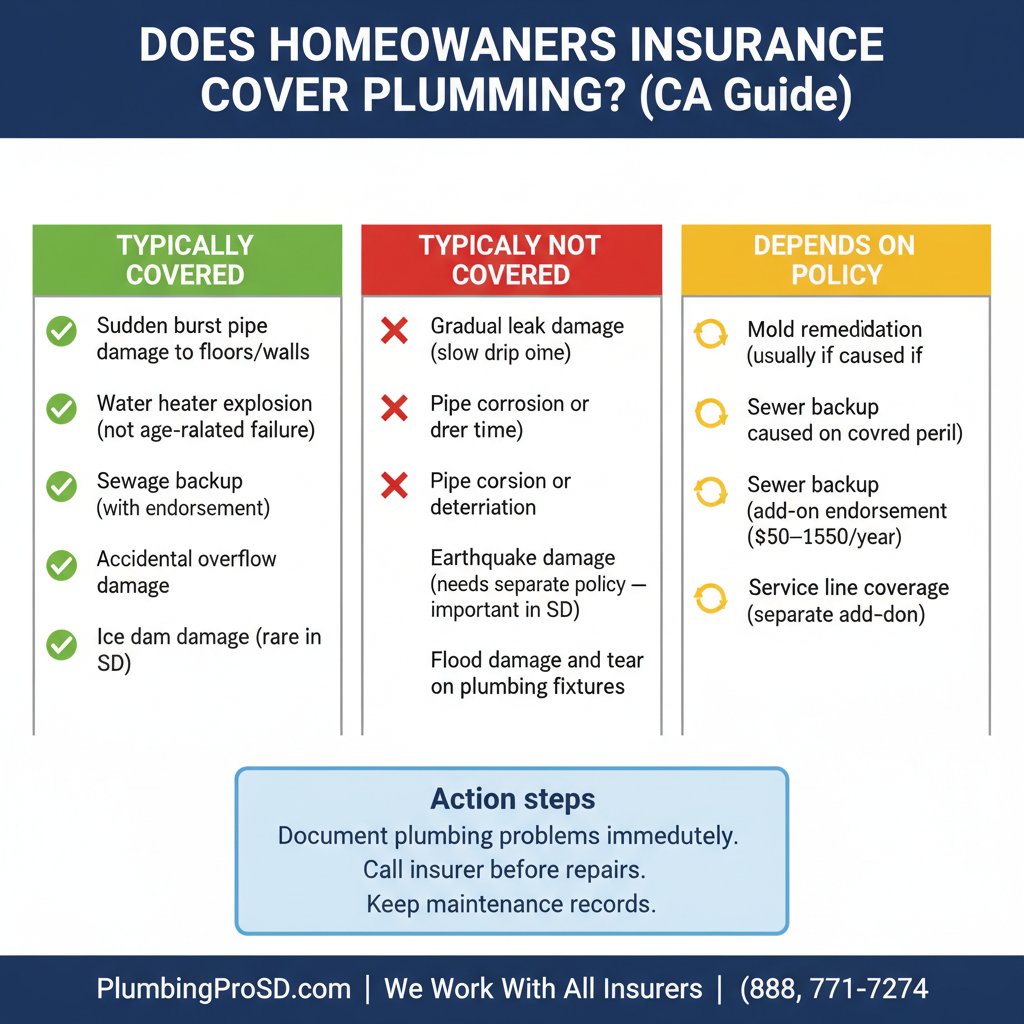
- Sudden, accidental damage (a burst pipe, a failed hose) is typically covered; gradual leaks are usually denied.
- Insurance pays for the water damage to your home and belongings, not for the plumbing repair itself.
- Standard policies do not cover sewer backup or outside flooding; a sewer backup rider runs $50 to $150 a year and is worth it.
- Call a plumber first to stop the water and get a written assessment, then open the claim; photograph everything before cleanup.
- San Diego hard water, galvanized pipe, and slab leaks invite gradual-damage disputes. Call (858) 400-4417 for documented work.
Water damage is the second most common homeowners insurance claim in the United States, right behind wind damage. But the coverage rules are complicated, full of critical exclusions, and widely misunderstood, usually discovered only after a leak has already destroyed floors, walls, and cabinetry.
If you are dealing with a plumbing problem in your San Diego home right now, or preparing yourself before disaster strikes, here is a complete, straight answer on what is covered, what is not, what you must do to protect your claim, and why the order in which you make your phone calls matters.
What is the core coverage rule for plumbing claims?
One principle governs almost every plumbing-related insurance decision. Homeowners insurance is designed to cover sudden, accidental damage, not slow deterioration that a homeowner should have noticed and addressed. This distinction determines whether your claim gets paid or denied.
Sudden and accidental damage is typically covered. A supply pipe bursts in the wall at 3 AM. A washing machine hose fails catastrophically. A dishwasher drain line suddenly disconnects and floods your kitchen floor. These are the scenarios insurance is designed for.
Gradual damage is typically not covered. A slow drip under the sink has been saturating the cabinet base for months. A pinhole leak in a copper pipe has been slowly wetting the wall framing behind drywall. A toilet that rocks slightly has been compromising the wax ring seal for years. Insurers argue, and adjusters document, that a homeowner exercising reasonable care would have discovered and addressed these issues before they escalated. Claims based on gradual damage are frequently denied entirely.
What does homeowners insurance typically cover?
Sudden pipe bursts
If a supply or drain pipe fails suddenly and unexpectedly, from a defective fitting, water hammer, freezing (rare in San Diego but not impossible in mountain communities like Alpine or Descanso), or physical impact, the resulting water damage to your home’s structure and contents is generally covered. This includes damage to flooring, walls, ceilings, cabinetry, and personal property.
Important nuance: the policy typically covers the resulting damage, not the cost of repairing the pipe itself. Your insurance pays to repair the water-damaged drywall and hardwood floor. The plumber’s bill to fix the burst pipe is typically your expense.
Appliance failures and overflow
If a washing machine, dishwasher, or water heater fails suddenly, a burst supply hose, an overflowing appliance, a sudden tank failure, the water damage that results is generally covered. The appliance itself is usually not covered under a standard homeowners policy (manufacturer warranty or separate appliance protection covers the unit), but the structural and personal property damage from the water event typically is.
Accidental discharge
Water that escapes suddenly and unexpectedly from your plumbing system, a toilet that overflows from a sudden, severe clog, a supply line that disconnects under pressure, a valve fitting that lets go, is covered under the “accidental discharge” provision found in most HO-3 policies (the standard homeowners policy).
What the claim actually pays for
When a covered water event occurs, a standard policy typically covers:
- Repair or replacement of damaged flooring (hardwood, tile, carpet)
- Repair or replacement of damaged drywall and structural materials
- Repair or replacement of damaged cabinetry and built-ins
- Mold remediation resulting from the covered event (subject to caps, see below)
- Personal property damaged by the water
- Additional living expenses if the home is uninhabitable during repairs
What does homeowners insurance NOT cover?
Gradual leaks and slow seepage
This is the most consequential exclusion. If an insurance adjuster can determine, based on the pattern of water staining, mold growth, wood deterioration, or the physical condition of failed components, that a leak was gradual and ongoing, your claim will likely be denied or heavily reduced. Adjusters are trained to identify indicators of gradual damage. Do not assume that because you just discovered the damage, it is sudden from the insurer’s perspective.
The plumbing repair itself
Homeowners insurance almost never covers the cost of repairing or replacing the plumbing that failed. The policy covers the collateral water damage to your home, not the pipe, fitting, valve, or appliance that caused it. Plumbing repair costs are your responsibility.
Flooding from outside the home
Standard homeowners insurance does not cover flood damage, water entering your home from outside, whether from storm surge, heavy rainfall runoff, or an overflowing drainage channel. San Diego’s periodic heavy El Niño rainfall events can generate exactly this kind of exterior flooding, particularly in lower-elevation neighborhoods near Mission Valley, the San Diego River corridor, or coastal communities. Flood insurance through FEMA’s National Flood Insurance Program (NFIP) or a private flood insurer is separate coverage and must be purchased independently.
Sewer and drain backup
If the municipal sewer line backs up and forces sewage into your home through floor drains, cleanouts, or toilets, that damage is NOT covered under a standard homeowners policy. Sewer backup coverage is available as an endorsement (add-on rider) to most policies for an additional annual premium, typically $50–$150 per year. Given the age of San Diego’s sewer infrastructure in neighborhoods like City Heights, Logan Heights, Barrio Logan, and parts of National City, this rider is worth having.
If you suspect your sewer lateral is deteriorating, a sewer camera inspection can identify problems before they become a sewage backup emergency.
Maintenance neglect
If the cause of damage is a plumbing system in obviously deteriorated condition, corroded galvanized pipes past their functional lifespan, a water heater 15 years old and visibly rusting, a toilet supply line with visible braided wire fraying, an insurer may deny the claim on grounds the homeowner failed their maintenance obligation. This is a judgment call that adjusters make, and the documentation you provide (or fail to provide) about routine maintenance matters.
Mold remediation: often limited or excluded
Mold resulting from a covered water event may be covered, but most policies cap mold coverage at $5,000–$10,000. Serious mold remediation in a San Diego home can cost $10,000–$30,000+, particularly if it involves wall cavities, subfloor, or HVAC ductwork. If mold has reached the HVAC system, you’ll need a licensed HVAC contractor to inspect and clean the ductwork in addition to your plumber handling the source leak. Read your policy’s mold coverage carefully, and if a water event occurs, prioritize fast drying and remediation to minimize mold growth before it exceeds your coverage cap.
How do you protect your insurance claim?
What you do in the first hours after discovering water damage directly determines your claim outcome. Most homeowners mishandle this phase and weaken claims that should have been paid.
Step 1: Stop the water immediately, call a plumber first
Your first obligation under almost every homeowners insurance policy is to “mitigate further damage.” This means you are required to take reasonable steps to stop damage from getting worse. Failing to shut off water or failing to call a plumber promptly can give an adjuster grounds to reduce or deny your claim, not just for the additional damage caused by delay, but potentially for the entire event.
For a burst pipe or active water emergency, find your main shutoff valve (typically in the garage, utility area, or at the water meter) and turn the water off immediately. Then call a 24/7 emergency plumber.
Stopping the water is both the right thing for your home and the right thing for your insurance claim.
Step 2: Photograph and video everything before cleanup
Before you move anything, mop up water, or begin any drying, document every inch of the damage with photos and video. Cover:
- The source and location of the failure
- All affected flooring, walls, ceilings, and cabinetry
- Personal property that was damaged
- The overall scope of water spread (wet areas of flooring, water marks on walls)
- Close-up shots of the failed pipe, fitting, or appliance
Video walkthrough narrating what you are seeing is more compelling claim documentation than photos alone. This documentation is your record, the adjuster was not there, and without it you are relying entirely on their interpretation of what they see later.
Step 3: Save all damaged materials
Do not throw away damaged flooring, drywall, or other materials before the adjuster has seen them. If you must begin emergency drying or cleanup for health reasons (sewage backup, standing water with mold risk), photograph and inventory everything removed and retain physical samples of flooring and drywall for the adjuster’s inspection.
Step 4: Create a written damage inventory
List every damaged item: furniture, electronics, clothing, appliances, personal property. Include estimated replacement values and purchase dates where possible. Check your receipts and bank records for appliance purchases. This inventory becomes the basis for personal property coverage.
Step 5: Contact your insurer promptly
Most policies require you to report claims within a “reasonable” time, some specify 24–72 hours for emergency events. Late reporting can complicate or void coverage. Call your insurer to open the claim even if you do not yet have a full damage assessment.
Step 6: Get the plumber’s written assessment
Ask your plumber to provide a written report documenting:
- The source and cause of the failure (sudden/accidental vs. showing signs of gradual deterioration)
- The extent of visible water intrusion
- Repairs performed and any additional work needed
- Photographic documentation from the plumber’s inspection
A licensed plumber’s professional assessment that a pipe or fitting failed suddenly due to a specific, identifiable cause carries real weight with an adjuster. If the cause of failure becomes disputed, the plumber’s report is your strongest evidence.
Working with your insurance adjuster
The adjuster works for the insurance company. This does not make them adversarial, but it means they are not your advocate.
Get every coverage determination in writing. Ask specifically whether the cause of damage is being characterized as sudden/accidental or gradual, and why. If they classify it as gradual, request the specific evidence supporting that determination.
Get your own contractor estimate. You are entitled to an independent estimate. If it differs significantly from the insurer’s, you have grounds to dispute and negotiate.
Do not sign final releases prematurely. Until all repair work is complete and all damage is identified, do not sign a final settlement release. Additional damage discovered behind walls during repairs can be added through a supplemental claim, but only if you have not already signed a final release.
Understand your deductible. For smaller water events, the insurance payout minus your deductible may be less than you expect. Know your deductible before deciding whether a claim makes sense for a given loss.
Consider a public adjuster for major losses. Public adjusters work for you rather than the insurance company and typically charge 10–15% of the settlement. For losses over $30,000–$50,000, they often recover significantly more than their fee in additional settlement value.
How do San Diego-specific factors affect coverage?
Hard water and copper pipe pinhole leaks. San Diego’s water averages about 16 grains per gallon of hardness, sourced primarily from the Colorado River and State Water Project. This mineral-rich water gradually corrodes copper pipe from the inside, causing pinhole leaks that are endemic in San Diego homes built from the 1950s through the 1980s. These leaks can be sudden (the pinhole pops fully open) or gradual (a slow seep that has been ongoing). Which characterization an adjuster applies can determine coverage.
Pre-1970 galvanized steel pipes. Galvanized pipes corrode from the inside and can fail suddenly after decades of internal rust accumulation. The failure mode looks sudden, but a sharp adjuster will note the age of the pipe and the condition of surrounding material as evidence of long-term deterioration.
Slab foundations. Many San Diego homes have slab foundations, which means supply pipes running under the concrete. Slab leaks are difficult to detect until significant damage has accumulated. If a slab leak has been ongoing for months before discovery, the gradual damage exclusion frequently applies.
If your home has older galvanized pipes or copper pipes in a hard water environment, a proactive pipe inspection and repiping evaluation can prevent a coverage dispute entirely by replacing vulnerable pipes before they fail.
Homeowners insurance vs. flood insurance: key differences
| Coverage Type | What It Covers | Typical Provider |
|---|---|---|
| Standard homeowners (HO-3) | Sudden/accidental internal water damage | State Farm, Farmers, Allstate, USAA, etc. |
| Sewer backup rider | Sewage backup from drain/sewer lines | Add-on to homeowners policy |
| Flood insurance | Water entering from outside the home | FEMA NFIP or private flood insurers |
| Appliance protection | Repair/replacement of failed appliances | Manufacturer warranty or home warranty |
Standard homeowners insurance does not cover flooding. Sewer backup requires a specific rider. If you live in or near a San Diego flood zone (Mission Valley, coastal low-lying areas, near creek drainages), FEMA flood insurance is worth investigating separately.
Frequently asked questions
Q: Does homeowners insurance cover a burst pipe in San Diego?
Yes, in most cases. A sudden, unexpected pipe burst is typically covered, the resulting water damage to your home’s structure and contents will generally be paid by your policy (minus your deductible). The cost to repair or replace the burst pipe itself is usually not covered. The key is that the failure must be sudden and accidental, not gradual deterioration that showed signs before it became a full break.
Q: What if a slow leak caused damage, is that covered?
Usually not. Gradual leaks are the most commonly excluded water damage scenario. If an adjuster determines that a leak was ongoing and a reasonable homeowner would have detected it, coverage is typically denied. The exact determination depends on how the damage pattern presents and how your plumber documents the failure, which is why calling a licensed plumber immediately and getting a written assessment is critical.
Q: Does homeowners insurance cover a plumber’s bill?
Almost never. Standard homeowners policies cover collateral water damage to your home, not the plumbing repair itself. The cost of the plumber fixing the failed pipe, valve, or appliance is your expense. Insurance pays for what the water did to your home and belongings, not for fixing the source.
Q: Do I need to call my insurer or my plumber first?
Call your plumber first to stop the water and mitigate further damage. Failing to do this can jeopardize your claim. Then call your insurer to open the claim and follow their reporting requirements. Stopping active water damage is your first legal obligation under most policies, and the right thing to do for your home regardless.
Q: Is sewer backup covered by homeowners insurance in San Diego?
Not by a standard homeowners policy, sewer backup requires a specific endorsement rider that you must add to your policy. Given San Diego’s aging sewer infrastructure in older neighborhoods, this rider (typically $50–$150 per year added to your premium) is worth having. If your sewer lateral is aging, a sewer camera inspection can identify deterioration before it results in a backup.
Related reading
Many insurance claims start with a sewer line or pipe failure. Our guide on fixing sewer lines in San Diego covers repair methods from spot fixes to trenchless lining, understanding the scope helps you evaluate what your policy should cover. If you suspect a leak is causing the damage, our post on water leak detection in San Diego explains how professionals find the source and what repairs typically cost.
The moment you have a plumbing emergency, your first call should be to a plumber to stop the water, and your second call to your insurance company. Plumbing Pro San Diego connects you with plumbers available 24/7 for water emergencies throughout San Diego County, from Rancho Bernardo to Coronado and Mission Valley. The plumbers we connect you with document their work thoroughly, provide written assessments that support insurance claims, and respond fast to protect both your home and your coverage. Call us at (858) 400-4417 and we’ll connect you with an emergency plumber when you need one most.
Areas this guide covers
We connect homeowners with licensed plumbers in these San Diego County communities.
Keep reading
Need a Plumber in San Diego?
Licensed, insured plumbers, ready across San Diego County. The plumber quotes you before any work starts.
Call (858) 400-4417Call any time, day or night, anywhere in San Diego County