
Last updated: April 22, 2026
Water Leak Detection and Repair in San Diego
A hidden leak wastes 250–1,000 gal/day and $20–$80/month. Detection costs $200–$450 in San Diego. Slab leaks, pinhole leaks, and what repairs run.

The short answer
- Hidden leaks are the dangerous kind: a single pinhole loses 250 to 1,000 gallons a day and $20 to $80 a month before you ever see it.
- Slab leaks are San Diego's signature risk, copper supply lines under slab-on-grade foundations, accelerated by 13 to 20 grain hard water.
- Fastest self-check: shut everything off and watch the meter's leak indicator; if it moves, you have an active leak. Warm floor spots signal a slab leak.
- Professional leak detection runs $200 to $450; repairs range from $150 for a supply line to $1,500 to $5,500 for a slab leak, far less than ignoring it.
- Detection is non-invasive and pinpoints a leak within 1 to 2 feet. Call (858) 400-4417 to schedule a detection appointment.
Water leaks come in two varieties: the obvious kind, a pipe spraying under the sink, water dripping from a ceiling, and the hidden kind, which can run for months or years before you realize they’re there. The hidden ones are more dangerous, because by the time they become visible, they’ve often caused significant structural damage.
San Diego has specific risk factors that make hidden water leaks more common here than in many other cities: slab-on-grade foundations, aging copper pipe, hard water that accelerates corrosion, and hilly terrain that creates high-pressure conditions. If you suspect a leak, or just want to understand what you’re dealing with, this guide covers everything from identifying signs to understanding how professional detection works to knowing what repairs will cost.
What types of water leaks affect San Diego homes?
Not all water leaks are the same. Understanding the categories helps you communicate with a plumber and understand why some are harder to find and more expensive to repair.
Visible supply line leaks
The most manageable category. These are leaks at connections, fittings, valves, or fixture supply lines that are accessible, under a sink, at a toilet’s supply connection, at the washing machine hoses. They’re visible or detectable without any special equipment, the repairs are generally straightforward, and they typically don’t cause major damage if caught and repaired promptly.
Common causes: worn supply line braiding, loose connections, corroded angle stop valves (the small shutoff valves under sinks and behind toilets), and degraded toilet supply hoses.
Hidden wall and ceiling leaks
Pipes run through wall cavities and above finished ceilings. When a fitting fails or a pipe corrodes through inside a wall, the water has nowhere to go except into the building material. You may not see visible water, instead, you’ll see staining, bubbling paint, warped baseboards, or eventually mold growth. By the time these signs appear, the wall cavity has been wet long enough for damage to accumulate. After we stop the leak and dry the cavity, the cosmetic side, patching the cut-open drywall and repainting, is handyman work that brings the wall back to finished.
Causes in San Diego: Corrosion in aging copper pipe (common in homes built between the 1950s and 1980s), failed fittings at tees and elbows, and construction damage from renovations that nicked a pipe.
Slab leaks
By far the most serious and most uniquely San Diego problem. A slab leak is a water supply or drain line failure that occurs beneath your home’s concrete foundation. Because San Diego residential construction is predominantly slab-on-grade, meaning the home sits directly on a concrete slab with supply lines running through or beneath it, nearly every home in the city is a slab leak candidate.
The water from a slab leak doesn’t vanish. It saturates the soil beneath the foundation, causing the concrete to shift, settle unevenly, and eventually crack. Over months or years, a neglected slab leak leads to foundation damage, door and window misalignment, floor cracking, and structural repair bills that dwarf what the plumbing repair would have cost.
What causes slab leaks in San Diego specifically:
- Copper pipe corrosion from the inside accelerated by hard water
- Abrasion where pipes contact concrete or aggregate, decades of the pipe expanding and contracting against rough concrete wears through the pipe wall
- High water pressure, San Diego’s hilly terrain creates zones of elevated pressure that stress pipe walls over years
- Seismic activity, small tremors cause micro-shifts that stress pipe joints
Under-slab drain leaks
Different from supply-side slab leaks. Drain lines also run under the foundation, and they can crack, separate at joints, or develop bellies (low spots where waste accumulates). These are harder to detect because drain pipes only carry water intermittently, the leak only occurs when you use a fixture. A sewer camera inspection combined with hydrostatic pressure testing can find these.
Exterior / underground supply line leaks
The supply line running from the water meter at the street to your home can develop leaks from corrosion, root intrusion, or soil movement. Signs include wet spots in the yard along the path from meter to house, reduced pressure throughout the home, and high water bills without an interior source identified. These are typically repaired by open excavation or directional boring.
How do you know if you have a hidden water leak?
Many hidden leaks are identified by their secondary effects long before they’re found directly. Watch for:
Unexplained water bill increase. The most common first signal. San Diego Water Authority bills are bi-monthly in most areas, a leak running for 60 days can represent thousands of gallons before you notice the change. A persistent increase of $30–$100+ per cycle with no change in usage habits is a strong indicator. Check the SDCWA’s leak tips for guidance on reading your bill.
Water meter moving with everything off. Locate your meter at the curb, ensure no water is running anywhere in the house (check irrigation, ice makers, running toilets), and watch the meter’s leak indicator, a small triangle or dial on the meter face. If it’s spinning, you have an active leak. Note the meter reading, wait 30 minutes, and check again. Any change confirms an active leak.
Warm or hot spots on the floor. In slab-foundation homes, a warm patch on tile or concrete flooring that doesn’t have radiant heat beneath it is a classic hot-side slab leak indicator. The leaking hot water warms the concrete above the pipe. It’s subtle, put the back of your hand on different sections of floor, but once you feel it, it’s distinctive.
Sound of running water with everything off. A faint hissing, trickling, or rushing inside walls or floors when every fixture is off and appliances are idle. Water is going somewhere.
Mold or mildew smell without visible source. Mold begins growing within 24–48 hours of water exposure. A persistent musty smell from a wall, floor, or room without visible moisture indicates hidden, ongoing water exposure. If the musty smell is strongest near air vents or when the AC runs, mold may have reached the HVAC ductwork, at that point you need both a plumber to fix the leak source and a licensed HVAC company to inspect and clean the ducts.
Discolored walls, bubbling paint, warped baseboards. Water migrating through a wall eventually reaches the finish surface. Yellowish staining, paint peeling from the wall (not ceiling), or baseboards that are swelling and separating signal water accumulating in the wall cavity.
Foundation cracks, sticking doors or windows. In a slab-foundation home, unexplained new cracks in the foundation or drywall, or doors and windows that have suddenly become hard to open or close, can indicate differential settlement from a slab leak that’s been running long enough to affect the soil beneath the foundation.
How does professional leak detection work?
Professional leak detection is a specialty service, not all plumbers offer it, and quality varies significantly. Here’s what proper detection looks like:
Acoustic / electronic detection
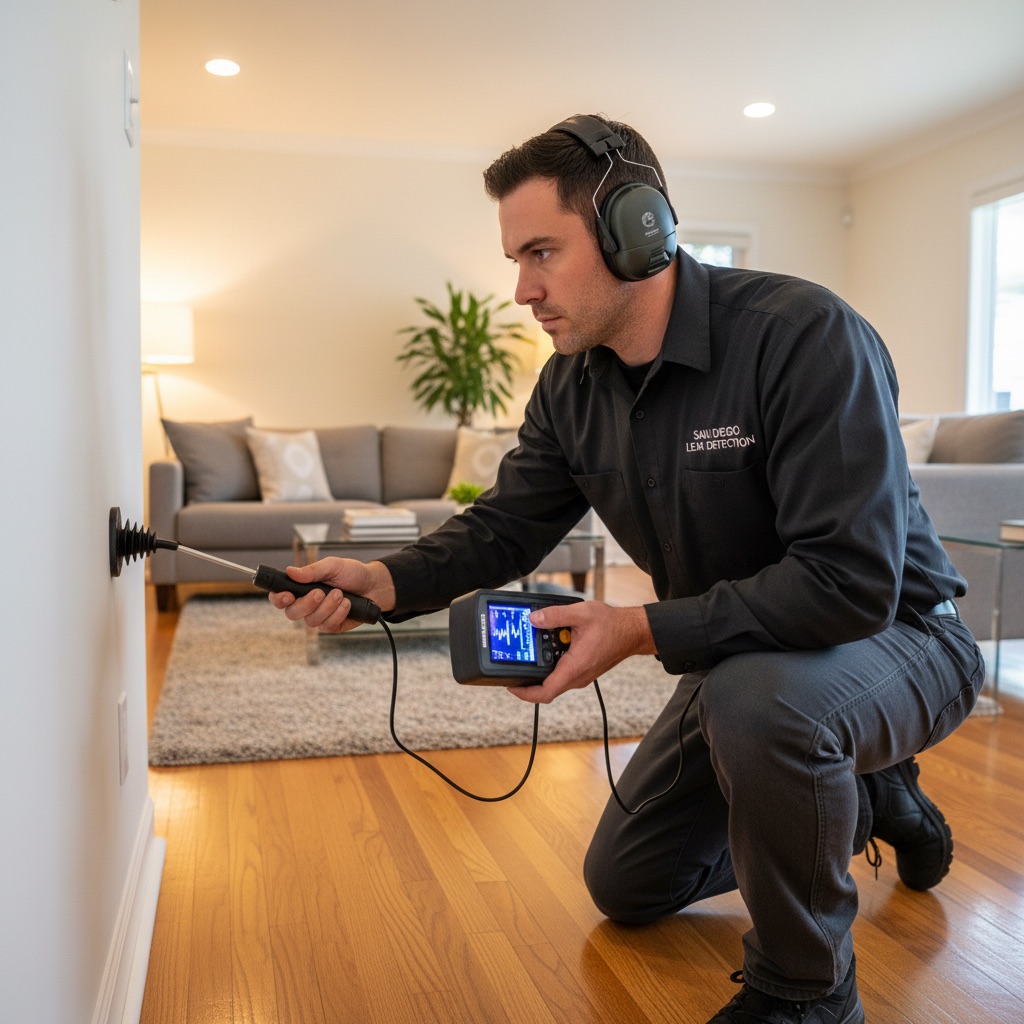
The most widely used method for slab leaks and underground leaks. A sensitive listening device, combining a ground microphone with electronic amplification, is placed against flooring, walls, or the ground surface. The escaping water under pressure creates a characteristic sound signature that trained technicians can distinguish from background noise.
Experienced technicians using quality equipment can pinpoint a slab leak to within 1–2 feet, minimizing the area that needs to be opened for repair. This is the difference between jackhammering a 2-square-foot access point and jackhammering a trench across your living room floor.
Thermal imaging
An infrared camera captures temperature differences in floors, walls, and ceilings. A hot-side slab leak shows up as a heat signature, a warm area that extends outward from the leak point. Thermal imaging is particularly useful for hot-water leaks and for mapping how far moisture has spread from a known leak point.
Cold-side leaks are harder to image thermally in San Diego’s mild climate, where the temperature differential between the leaking water and the surrounding material is smaller.
Pressure testing
The plumber isolates sections of your plumbing system and pressurizes them to identify where pressure loss occurs. This method is particularly useful for determining which zone of your system has the failure when other diagnostic methods haven’t narrowed it down. For under-slab drain leaks, hydrostatic testing, filling the drain system with water and measuring level drop, can confirm a drain line failure.
Tracer gas testing
In cases where acoustic and thermal methods aren’t definitive, typically in homes with thick slabs, complex plumbing configurations, or interfering background noise, a non-toxic gas (a nitrogen-helium mixture) is introduced into the pipe system. A sensitive surface detector finds where the gas is escaping, even through several inches of concrete.
What leak detection costs in San Diego
Standard residential leak detection: $200–$450 for a focused diagnostic appointment using acoustic and/or thermal equipment. Complex cases, suspected slab leak, large properties, multi-zone systems, may run $400–$600. Some companies offer detection at no charge when you hire them for the repair.
Why do San Diego slab foundations create unique leak risk?
San Diego’s construction history shapes its leak risk in ways that aren’t true everywhere.
Universal slab-on-grade construction. Unlike many cities where homes have basements or crawl spaces that allow visual inspection of supply lines, San Diego’s mild climate and building practices mean virtually all residential construction is slab-on-grade. Your pipes run through concrete and can’t be inspected visually.
Widespread aging copper. The post-WWII building boom produced hundreds of thousands of San Diego homes with copper plumbing. That copper was excellent quality, but it’s now 50–70 years old, and San Diego’s water chemistry accelerates its corrosion. The San Diego County Water Authority acknowledges water hardness levels that lead to accelerated copper degradation.
Hard water chemistry. San Diego water comes primarily from the Colorado River and carries about 16 grains per gallon of dissolved minerals. This hard water accelerates pinhole corrosion inside copper pipes through a combination of chemical reaction and turbulence at pipe bends, the inside of a copper elbow in a 1960s San Diego home may have less than a millimeter of pipe wall remaining.
Pressure variation from hilly terrain. San Diego’s topography creates significant pressure variation across the city. Homes in lower-elevation areas of neighborhoods like Mission Valley, El Cajon, or Chula Vista may experience supply pressures of 100 PSI or more, well above the 60–80 PSI ideal. High pressure stresses every pipe joint in the home continuously, accelerating fitting failures and slab leak development.
A pressure-reducing valve (PRV) set correctly can protect your entire plumbing system. If yours has never been tested or replaced, it’s worth adding to your plumbing maintenance list.
What do leak repairs cost in San Diego?
| Leak Type | Typical Repair Cost |
|---|---|
| Under-sink supply line or angle stop | $150 – $350 |
| Toilet supply line or valve | $100 – $300 |
| Wall supply line (with drywall access) | $350 – $800 |
| Exterior supply line to house | $600 – $2,800 |
| Slab leak, spot repair (open/repair/restore) | $1,500 – $5,000 |
| Slab leak, epoxy pipe lining (trenchless) | $2,000 – $5,500 |
| Slab leak, pipe rerouting through walls/attic | $1,800 – $4,500 |
| Full home repipe (aging copper) | $4,500 – $14,000 |
The wide range in slab leak repair costs reflects the repair method chosen:
Open-and-repair involves jackhammering the concrete above the leak, making the repair, and restoring the concrete. It’s the most direct approach but leaves a visible repair patch in the floor.
Epoxy pipe lining threads an epoxy-coated liner through the existing pipe, which cures in place and creates a new pipe wall inside the old one. This is a trenchless option that avoids breaking the slab. See our guide on trenchless sewer repair in San Diego for more on this technology.
Pipe rerouting abandons the failed underground segment and runs new pipe through the walls, attic, or crawl space (if applicable). For homes where multiple slab leaks have occurred or are expected, this is often the most practical long-term solution.
Does homeowner’s insurance cover water leaks?
Insurance coverage for water leaks depends on the cause and your specific policy:
Typically covered: Sudden and accidental water damage from a plumbing failure, a pipe that bursts without warning, an appliance that fails and floods the space. This includes slab leaks in many policies, though some carriers require documentation that the leak was sudden rather than gradual.
Typically not covered: Gradual leaks that were visible or knowable and ignored, a slow drip under the sink that was never addressed, staining that was present for years. Mold damage may be covered only up to a sublimit. Leak detection itself (finding the leak) is generally not covered; the repair may be.
What to do: Call your insurer when you discover the leak, before restoration begins. Adjusters need documentation of original conditions. Take extensive photos and video of all visible damage. See our detailed guide on homeowners insurance and plumbing coverage for more information.
How can you prevent water leaks in San Diego?
The most effective preventive measures for San Diego homeowners:
Know where your main shutoff is. The meter box is at the curb or sidewalk in front of most properties. Test it once a year to confirm it closes fully and easily.
Install an automatic water shutoff device. These whole-home devices monitor flow patterns and shut off water automatically if they detect abnormal flow, the kind that indicates a pipe failure. They’re particularly valuable in San Diego’s slab homes where a leak can run undetected for hours.
Have your supply pressure tested. A plumber can check the pressure at your hose bib with a simple gauge. If it’s over 80 PSI, a correctly functioning PRV can protect your entire plumbing system from the stress that causes slab leaks and fitting failures.
Run regular meter tests. Every few months, shut everything off and check whether your meter is moving. It takes 5 minutes and can catch a slow leak before it becomes a significant problem.
Consider a water softener. For San Diego homes with original copper plumbing, a whole-home water softener reduces the mineral content that drives internal pipe corrosion. It’s also the single most effective protection for water heaters, tankless units, dishwashers, and any appliance that processes hot water. Ask about our water filtration and softening services.
Frequently asked questions
Q: How do I know if I have a slab leak vs. some other type of leak?
The clearest indicators of a slab leak are: a warm or wet spot on a concrete or tile floor without a fixture above it, the sound of running water that seems to come from under the floor, a water bill increase with no interior leak visible, and in later stages, new cracks in flooring or drywall. The definitive confirmation is a meter test (meter running with everything off) combined with a plumber using acoustic detection equipment. A wall or ceiling leak would produce visible moisture or staining higher up.
Q: Can I find the leak myself before calling a plumber?
The water meter test is the most useful self-diagnostic: with everything off, watch the leak indicator on your meter. If it moves, you have a leak. You can narrow it down by closing the main shutoff inside (at the PRV or point of entry) and watching whether the meter stops, if it does, the leak is inside the house; if the meter continues to move, the leak is in the exterior supply line between the meter and the house. Beyond that, finding the exact source requires professional equipment.
Q: What happens if I ignore a small slab leak?
A slab leak that seems minor does not stay minor. The water saturates the soil beneath the foundation. In San Diego’s predominantly clay soils, wet clay expands and then contracts as it dries, causing differential movement under the slab. Over months to years, this creates foundation settlement, slab cracks, framing movement, and drywall cracking that costs far more to repair than the original plumbing repair would have. Mold can also develop in the affected flooring materials.
Q: Does detecting the leak damage my floors or walls?
Professional acoustic and thermal detection is non-invasive, the equipment detects through surfaces without any penetration. The only point at which your floor or wall is opened is for the actual repair, and good detection narrows the access area to the smallest possible footprint. A skilled technician using acoustic equipment can often locate a slab leak within 1–2 feet, meaning a very small jackhammer area.
Q: How much water can a hidden leak waste?
A pinhole leak in a pressurized supply line can lose 250–1,000 gallons per day depending on pipe size and pressure. At San Diego water rates (currently among the highest in California), that translates to $20–$80 per month in wasted water, and cumulative structural damage that grows every day the leak continues.
Related reading
A leak that reduces your water pressure can be hard to distinguish from other pressure problems. Our guide on low water pressure in San Diego walks through every common cause and how to diagnose each one. If a leak has already caused damage, understanding whether homeowners insurance covers plumbing can save you thousands on the repair bill.
Plumbing Pro San Diego provides professional leak detection using acoustic and thermal imaging equipment throughout San Diego County, from La Jolla and Pacific Beach to Chula Vista and El Cajon. Slab leak concerns are especially common in Rancho San Diego, Fallbrook, and Granite Hills. If you suspect a leak, call (858) 400-4417 to schedule a detection appointment. We’ll find the source, explain what you’re dealing with, and give you straightforward repair options before any work begins. Visit our leak detection services page for more information.
Areas this guide covers
We connect homeowners with licensed plumbers in these San Diego County communities.
Keep reading
Need a Plumber in San Diego?
Licensed, insured plumbers, ready across San Diego County. The plumber quotes you before any work starts.
Call (858) 400-4417Call any time, day or night, anywhere in San Diego County