
Last updated: April 22, 2026
Low Water Pressure in San Diego: Causes and Fixes
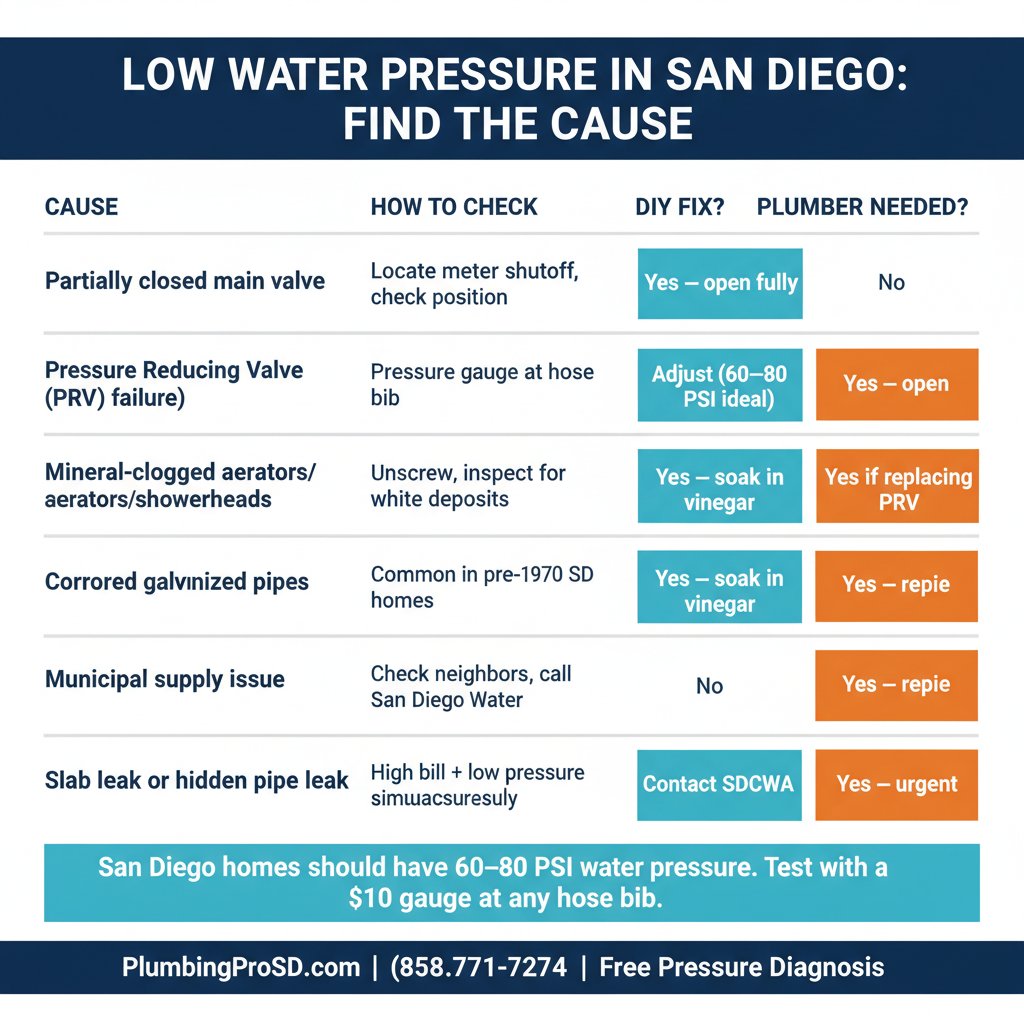
Normal is 60–80 PSI. Below 40 needs investigation. Could be a $10 aerator soak or a failing PRV. Every cause ranked from cheapest to most expensive fix.
The short answer
- Normal household water pressure is 60 to 80 PSI; below 40 is noticeably weak and worth investigating.
- Single-fixture weakness is usually a clogged aerator or showerhead; soak it in vinegar or replace it for a few dollars.
- Whole-house weakness points to a partially closed shutoff, a failing PRV ($300 to $600 to replace), pipe scale, or a main-line leak.
- Hot-water-only weakness usually means water heater sediment; flush the tank annually to clear it.
- Check your pressure with a $10 hose-bib gauge before calling; for PRV, leak, or repipe issues, call (858) 400-4417.
A trickle from the showerhead. A faucet that takes three minutes to fill a pot. Low water pressure is one of the most frustrating plumbing problems a homeowner can face, and it is also one of the most misdiagnosed.
The fix could be as simple as soaking an aerator in vinegar for 30 minutes. Or it could indicate a failing pressure regulator, corroded pipes throughout the house, or an active main line leak. Getting the diagnosis right is what separates a $10 fix from a $10,000 one.
Here is a complete guide to the causes of low water pressure in San Diego homes, how to tell them apart, and exactly what to do about each, including the San Diego-specific factors that make this problem more common here than in most U.S. cities.
What is normal water pressure?
Normal household water pressure falls between 60–80 PSI (pounds per square inch). Anything below 40 PSI will feel noticeably weak at fixtures. Anything above 80 PSI causes premature wear on fixtures, appliance hoses, and pipe fittings, and will eventually cause leaks or failures.
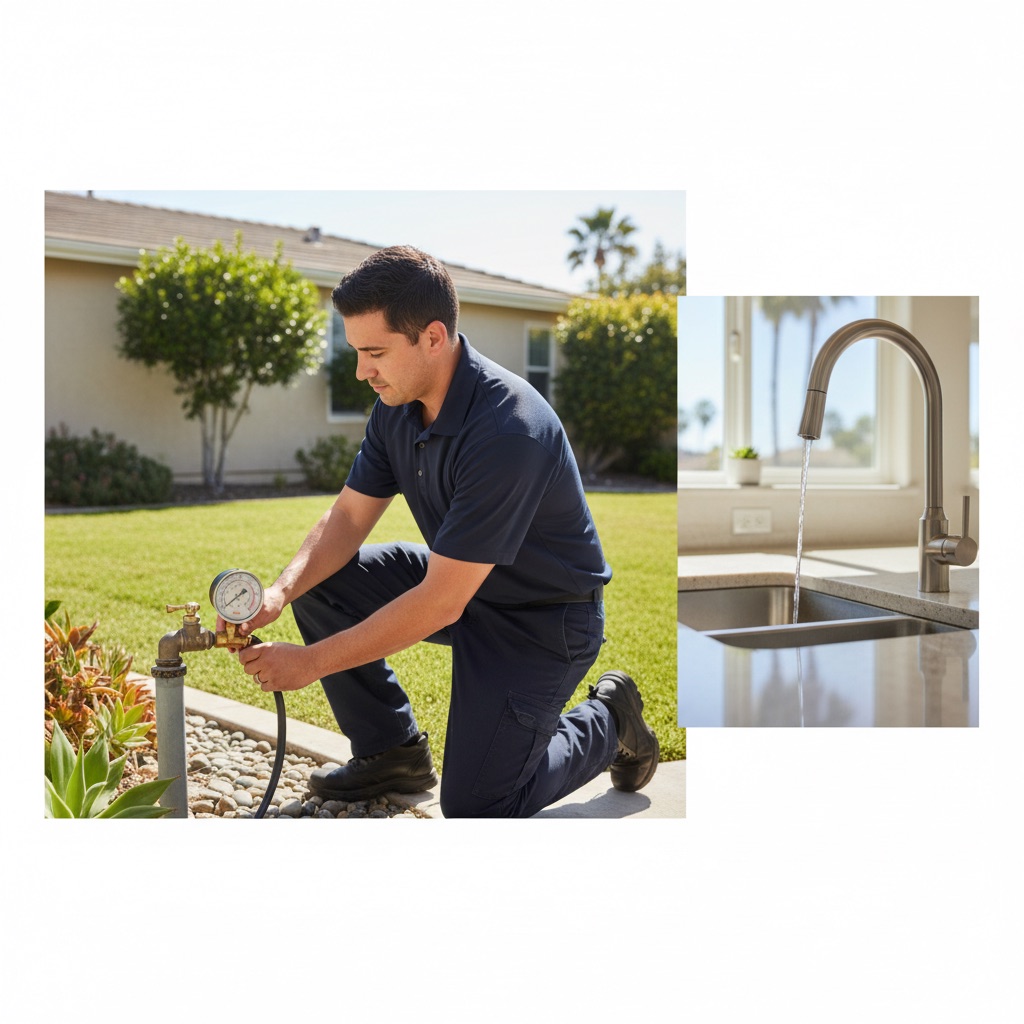
You can measure your home’s water pressure with a simple gauge (available at any hardware store for $10–$15) attached to an outdoor hose bib. Turn off all water inside the house, then read the static pressure. This is the most useful baseline diagnostic you can do before calling a plumber.
Normal: 60–80 PSI Marginal: 40–60 PSI (functional but noticeable) Low: Below 40 PSI (needs attention) High: Above 80 PSI (needs a PRV adjustment or replacement)
Is a clogged aerator or showerhead causing your low pressure?
This is the single most common cause of low pressure at individual fixtures in San Diego, and the most frequently overlooked. San Diego’s water is notoriously hard, with mineral content averaging about 16 grains per gallon sourced from the Colorado River and the State Water Project. That mineral load leaves calcium and magnesium deposits on every surface water touches, including the inside of aerators and showerhead nozzles.
Aerators, the small screen fitting at the tip of your faucet, can become nearly fully blocked by mineral buildup within 12–18 months in San Diego without cleaning or replacement.
How to tell if this is your problem: Only one faucet or showerhead has low pressure. Other fixtures in the house are normal. Low pressure appeared gradually, not suddenly.
DIY fix: Unscrew the aerator from the faucet tip (turn counterclockwise, may need pliers wrapped in a cloth to avoid scratching). Soak it in white vinegar for 30–60 minutes, then scrub with an old toothbrush. For showerheads, either unscrew them for soaking or fill a plastic bag with vinegar, wrap it around the showerhead, and secure it with a rubber band overnight. For the full walkthrough on the shower head specifically, see how to clean a clogged shower head in San Diego.
When to replace instead of clean: If the aerator screen is visibly corroded or deteriorated, replace it. Aerators cost $3–$12 at any hardware store. It takes two minutes.
San Diego note: Hard water is relentless. In La Mesa, El Cajon, Chula Vista, and the beach communities, plan to clean or replace aerators every 12–18 months as routine maintenance.
Could a failing pressure regulator be the problem?
Most San Diego homes built after 1970 have a pressure-reducing valve (PRV) installed on the main supply line where water enters the house, usually in the garage, utility room, or near the water meter. The PRV takes the city’s supply pressure (often 80–150 PSI) and reduces it to a safe household level.
When the PRV fails, and they typically last 10–15 years, it can drop your household pressure dramatically, cause pressure to fluctuate throughout the day, or allow pressure to swing unpredictably high. A PRV set too conservatively by a previous owner or plumber will also produce low pressure even when functioning correctly. If your gauge reads above 80 PSI instead, that is the opposite problem, and our guide to high water pressure in San Diego homes covers the signs and the fix.
How to tell if this is your problem: Whole-house low pressure (all fixtures affected simultaneously). Pressure fluctuates inconsistently throughout the day. Your pressure gauge reads below 40 PSI at the hose bib. Pressure was fine until recently and dropped suddenly.
DIY pressure check: Attach a gauge to a hose bib and measure static pressure. Below 40 PSI with everything off is the key indicator. If pressure varies significantly between morning and afternoon, PRV failure is likely.
Why this is a plumber job: PRV replacement requires shutting off the main supply line, cutting out the old valve, installing and soldering or press-fitting the new valve, and calibrating the pressure setting correctly. An incorrectly set PRV, too high or too low, can damage appliances and fixtures. This is not a DIY repair.
Cost in San Diego: PRV replacement typically runs $300–$600 including parts and labor.
Is mineral scale buildup narrowing your pipes?
San Diego’s 15–20 GPG hard water does not just affect fixtures, it gradually deposits mineral scale on the interior walls of pipes. Over years, that scale narrows the effective pipe diameter, increasing flow restriction and reducing pressure throughout the house or in specific supply branches.
This is a particularly significant problem in San Diego homes built before 1985 with copper pipes. Hard water accelerates a corrosion process in copper that leads to pinhole leaks and interior scale deposits. Galvanized steel pipes, common in homes built before 1970, corrode from the inside and can become severely restricted after 40–50 years of San Diego hard water exposure.
How to tell if this is your problem: Whole-house low pressure that has developed gradually over years. Orange or rust-tinged water from hot taps in the morning (galvanized). Home built before 1985 with original pipes. Pressure drops dramatically when multiple fixtures run simultaneously.
The fix: For moderate scale in copper pipes, hydro-jetting can clear deposits and restore flow. For heavily corroded or narrowed pipes, especially galvanized steel, whole-home repiping with PEX or copper is the long-term solution. There is no partial fix for widespread pipe deterioration.
Connecting hard water scale to reduced pressure is something the pipe repair and replacement plumbers we connect you with handle regularly across older San Diego neighborhoods, from North Park to Lemon Grove to Clairemont.
Cost in San Diego: Repiping a typical San Diego home runs $4,000–$15,000 depending on size, material (PEX is 20–40% less than copper), and accessibility.
Is a partially closed shutoff valve reducing your pressure?
This sounds obvious, but a partially closed main shutoff valve causes genuine service calls every week. There are two key shutoff points: the main shutoff where water enters the home, and the meter shutoff at the street. Either one that has been bumped, partially closed during a past repair, or stiffened with age can significantly reduce whole-house pressure.
How to tell if this is your problem: Whole-house low pressure that appeared after recent plumbing work, a home purchase, or a period of vacancy. Pressure dropped suddenly rather than gradually.
How to check: Find your main shutoff valve, typically inside the garage, in a utility closet, or at the water meter. Gate valves (round wheel handle) should be turned fully counterclockwise. Ball valves (lever handle) should have the lever parallel to the pipe.
DIY fix: If the valve is simply partially closed, open it fully. If the valve is stiff, corroded, or difficult to operate fully, call a plumber. Forcing a deteriorated valve can cause it to fail completely and flood.
Could a main water line leak be causing low pressure?
A leak in the underground supply pipe between the city’s meter connection and your home causes water, and pressure, to be lost before it reaches your fixtures. The supply pipe from the meter to the house is the homeowner’s responsibility to maintain and repair, not the city’s.
Main line leaks produce whole-house low pressure because supply is being bled off before reaching any fixture.
How to tell if this is your problem: Whole-house low pressure. Unexplained spike in your water bill. Soft, soggy, or unusually green patches in your yard between the house and the street (vegetation loves the constant water). The sound of water running when nothing is on.
The meter test: Turn off every water source inside the house, faucets, ice maker, irrigation, and then check your water meter. If the meter dial or digital flow indicator is still moving, water is escaping somewhere in the system.
Why this is a plumber job: Main line leak detection requires electronic acoustic equipment or pressure testing to locate the break without unnecessary excavation. Our leak detection service uses specialized equipment to pinpoint leaks precisely, minimizing the digging required.
Are peak demand pressure drops from the municipal supply affecting you?
San Diego’s older neighborhoods, particularly Hillcrest, North Park, Mission Hills, Barrio Logan, and parts of Chula Vista, have aging municipal water infrastructure that struggles with morning peak demand. Between 6–9 AM when households shower, make coffee, and run dishwashers simultaneously, pressure at homes on older mains can drop noticeably.
How to tell if this is your problem: Pressure is consistently normal during midday and evening but weak during morning peak hours (6–9 AM) or evening peak (5–8 PM). All fixtures in the house are equally affected during the low-pressure window.
What you can do: Report the issue to the San Diego County Water Authority and to San Diego Water (for city-maintained mains). A licensed plumber can also install a pressure-boosting pump system if the problem is chronic and persistent. For homes where this is a recurring issue, a booster pump ($800–$2,000 installed) can provide consistent pressure regardless of municipal fluctuations.
Is your water heater causing hot water pressure problems?
If low pressure affects hot water taps only while cold water pressure is normal, the problem is in or connected to your water heater, not the supply system.
San Diego’s hard water causes sediment (primarily calcium carbonate) to accumulate at the bottom of tank water heaters over time. This sediment can partially block the cold water inlet or hot water outlet, restrict the dip tube, or contribute to internal component failure that reduces flow.
How to tell if this is your problem: Normal pressure at cold water taps but weak pressure at hot water taps throughout the house. Water heater is more than 8–10 years old. You hear popping or rumbling from the water heater (classic sediment indicator).
DIY maintenance: Flushing the water heater tank annually removes accumulated sediment and extends unit life significantly. Attach a hose to the drain valve at the bottom of the tank, run it to a floor drain, and open the valve to flush sediment out.
When to call a plumber: If flushing does not restore hot water pressure, or the unit is aging, you may be looking at water heater replacement. Our guide on water heater problems in San Diego covers the full range of symptoms and solutions.
Could an individual fixture shutoff valve be partially closed?
Each sink, toilet, and appliance has its own local shutoff valve, typically located under the sink or behind the toilet. If one of these is partially closed or malfunctioning, only that fixture is affected.
How to tell if this is your problem: Exactly one fixture has low pressure and all others are normal. The low-pressure fixture had recent maintenance or a previous repair.
DIY fix: Check that the local shutoff valve is fully open. Gate valves turn counterclockwise to open fully. If the valve is difficult to operate, do not force it, call a plumber to replace it before it fails entirely.
San Diego-Specific Hard Water Context
San Diego’s water supply comes primarily from the Colorado River (via the Metropolitan Water District) and Northern California (via the State Water Project), delivered locally by the San Diego County Water Authority. By the time this water reaches your home, it carries substantial dissolved calcium and magnesium carbonate, the minerals that create scale.
At about 16 grains per gallon, San Diego’s water is classified as “very hard” on the standard scale. If you want the full picture on how hard San Diego’s water is and what it does to your plumbing, we break it down by district. This affects every water-using appliance and pipe in your home over time, including your HVAC system, where the same scale that clogs showerheads builds up inside heat exchangers and boiler coils. HVAC pros recommend annual descaling for any HVAC equipment connected to San Diego’s water supply. A whole-home water softener or filtration system addresses the root cause rather than treating the symptoms fixture by fixture, and it protects your water heater, pipes, and appliances from accelerated mineral wear.
How do you diagnose whole-house vs. single-fixture pressure problems?
Use this as a quick guide:
All fixtures in the house have low pressure at the same time: Check in this order: main shutoff valve position → pressure gauge reading at hose bib → PRV condition → main line leak (meter test) → municipal peak demand timing → pipe scale (older homes)
Only one fixture has low pressure: Check in this order: aerator or showerhead clog → local shutoff valve position → fixture supply line condition → the fixture itself
Only hot water has low pressure: Check: water heater sediment → water heater inlet/outlet condition → water heater age → isolation valve on water heater cold inlet
When should you call a plumber?
DIY-appropriate: cleaning or replacing aerators, cleaning showerheads, checking and fully opening shutoff valves.
Call a plumber for: PRV diagnosis and replacement, main line leak detection and repair, water heater sediment flush or replacement, repiping evaluation, pressure booster pump installation, or any case where the source of low pressure is unclear after basic checks.
Frequently Asked Questions
Q: What is normal water pressure in a San Diego home?
Normal household water pressure is 60–80 PSI. Most San Diego Water customers receive municipal supply pressure of 80–120 PSI or higher, which is why most homes have a PRV to reduce it to a safe household level. Below 40 PSI at your fixtures is noticeably weak and warrants investigation. You can check your pressure in 5 minutes with a $10 gauge from a hardware store attached to an outdoor hose bib.
Q: Why does San Diego have such a hard water problem?
San Diego’s water primarily comes from the Colorado River and the California State Water Project, transported hundreds of miles through rock and soil that contribute dissolved calcium and magnesium. By the time this water reaches San Diego homes via the San Diego County Water Authority infrastructure, it carries about 16 grains per gallon of hardness, classified as “very hard” nationally. This is a geological and geographic reality of Southern California’s water supply.
Q: Can I fix low water pressure myself?
For single-fixture low pressure caused by a clogged aerator or showerhead, yes, clean or replace the aerator and soak the showerhead in vinegar. For whole-house low pressure from a shutoff valve that is partially closed, you can check and open it. For PRV failure, pipe scale, main line leaks, or water heater issues, call a licensed plumber. Attempting PRV replacement without the right experience can leave you with dangerously high pressure that damages appliances.
Q: How much does it cost to fix low water pressure in San Diego?
Cost depends entirely on the cause. Replacing an aerator is $5. Flushing a water heater is $100–$200. PRV replacement runs $300–$600. Main line leak repair is $500–$2,500 depending on location and access. If the cause is corroded pipes throughout the house, repiping is $4,000–$15,000. This is why correct diagnosis matters, do the simple checks first before assuming the worst.
Q: Why is my water pressure fine in the morning but weak in the evening?
If pressure is consistently lower during peak household demand hours (mornings and evenings), the most likely causes are municipal supply pressure fluctuations during peak demand (common in older San Diego neighborhoods), PRV performance issues that appear under load, or a partial main line restriction that becomes more apparent when multiple fixtures run simultaneously. A plumber can test pressure under load conditions to identify which factor is responsible.
Related reading
If your pressure drop is sudden rather than gradual, an active leak may be the cause. Our guide on finding and fixing water leaks in San Diego covers detection methods from meter tests to thermal imaging. And if pipe corrosion is narrowing your lines, understanding the difference between PEX and copper pipes will help you evaluate whether repiping is the right long-term fix.
If you are dealing with persistent low water pressure anywhere in San Diego County and the basic checks have not resolved it, Plumbing Pro San Diego can connect you with a plumber who will diagnose the exact cause and give you a straight answer on what it takes to fix it. Homeowners in San Marcos, Escondido, and Ramona can call (858) 400-4417 to get connected with a licensed plumber. The network also covers leak detection, pipe repair and replacement, and water filtration systems to address the hard water root cause.
Areas this guide covers
We connect homeowners with licensed plumbers in these San Diego County communities.
Keep reading
Need a Plumber in San Diego?
Licensed, insured plumbers, ready across San Diego County. The plumber quotes you before any work starts.
Call (858) 400-4417Call any time, day or night, anywhere in San Diego County