Last updated: August 4, 2026
Planning a plumbing upgrade in Bonita: what to confirm first
A Bonita homeowner's guide to planning a tankless install, repipe, gas line, or kitchen remodel, and which permitting authority actually covers your parcel.
The short answer
- Emergency calls and planned upgrades need different scopes. Tankless installs, whole-house repipes, gas line work, and kitchen remodels each require their own planning.
- A tankless water heater install does not qualify for a simplified no-plan permit the way a standard tank swap does. It needs full plan-based review.
- A repipe and a kitchen remodel often make sense as one project when old piping already needs to be opened up.
- Adding a tankless unit or new gas appliances raises a capacity question that has to be answered before, not after, the work is bid.
- Bonita includes both unincorporated county land and areas near incorporated city limits, so confirm which jurisdiction actually permits your address before applying.
- Plumbing Pro San Diego connects Bonita homeowners with licensed and insured local plumbers who can scope a multi-part project correctly.
If you need an emergency plumber in Bonita, Plumbing Pro San Diego can connect you with a licensed and insured local plumber. For a planned project, tankless installation, whole-house repiping, gas line work, and kitchen remodel plumbing each raise different scoping questions. Bonita itself has larger lots along the Sweetwater River valley, some horse property, and enough unincorporated county land mixed with incorporated city limits nearby that even the permitting question isn’t the same for every address.
This piece is written for the planning stage, before a contract is signed, when the goal is figuring out what to confirm and in what order.
The four upgrades Bonita homeowners ask about
Four project types come up again and again in this area: tankless water heater installation, whole-house repipe, gas line work, and kitchen remodel plumbing. Each one has its own scoping questions, but they share a common trait: none of them are single-fixture repairs, so the planning conversation matters more than it would for a leaking faucet.
| Project | What has to be confirmed first |
|---|---|
| Tankless water heater installation | Full plan-based permit requirement, venting path, and existing gas line capacity |
| Whole-house repipe | Current pipe material, access points, and whether a remodel is already opening the same walls |
| Gas line addition or extension | Total connected load on the line, not just the new appliance’s rating |
| Kitchen remodel plumbing | Whether fixture relocation changes drain and vent routing, and whether old supply lines behind the walls need replacing anyway |
A tankless water heater installation or a whole-house repipe both start with an on-site assessment. Bring the questions in this table to that first visit and the bid will be more accurate the first time.
Tankless: what the permit actually requires
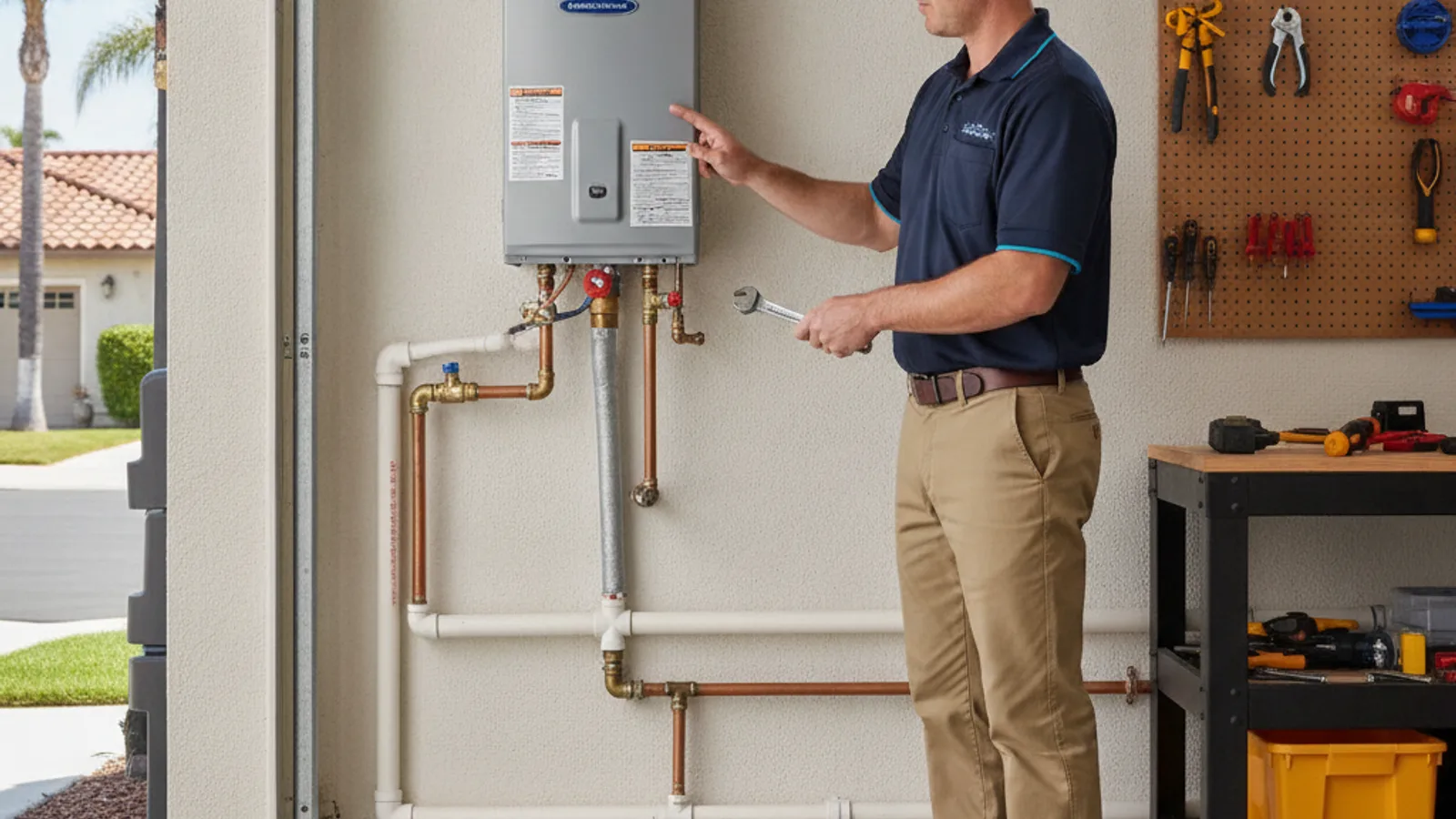
This is the detail that catches people off guard. A standard tank-style water heater swap often qualifies for a simplified, no-plan permitting process in many jurisdictions, seen in published city plumbing permit rules. A tankless installation does not. It requires full plan-based review instead, because venting, gas line sizing, and mounting all change with the equipment type.
California’s Title 24, Part 6 layers on additional statewide requirements. Hot water distribution piping has to be sized to California Plumbing Code Appendix M, and a HERS rating verification is required before final inspection can close the permit. If the household is considering a heat pump water heater instead of gas tankless, Title 24 also sets a minimum storage tank temperature setpoint and a compressor cutoff temperature standard, plus tank insulation minimums.
None of this is optional paperwork. Skipping the plan-based permit on a tankless install is the kind of shortcut that surfaces later, at resale or at insurance claim time, so build the permit timeline into the project schedule from the start rather than treating it as a formality to handle after installation. Our tankless versus tank water heater guide covers the tradeoffs worth weighing before you commit to either.
When a repipe belongs in the same project
A whole-house repipe and a kitchen remodel are sometimes planned as two separate projects when they’d be cheaper and less disruptive as one. If the remodel is already opening a wall or cutting into a slab near galvanized or aging copper supply lines, that’s the moment to replace them, not six months after the new cabinets and tile are in.
The reverse question matters too: if a repipe is already planned, ask whether it’s worth timing a kitchen or bathroom fixture change to the same access points. Reopening a finished wall a second time to fix supply lines you could have replaced the first time is the scenario worth avoiding.
This isn’t true for every remodel. A cosmetic refresh that doesn’t touch plumbing walls has no reason to trigger a repipe conversation. The point is to ask the question before the scope is locked, when a plumber can actually look at what’s behind the walls.
Gas capacity is the question nobody asks first
Adding a tankless water heater, a gas range, or an outdoor fire feature all draw from the same gas line, and that line has a finite capacity. A licensed plumber calculates the total connected load of everything on the line, existing and new, and confirms the line and meter can support it before any new appliance goes in.
Skipping this step is how a homeowner ends up with an installed appliance that can’t run at full output, or a line that needs to be upsized after the fact instead of before. A gas line repair or capacity assessment should happen at the planning stage of any project adding gas appliances, not as a troubleshooting step once something underperforms.
Getting the permitting authority right
This is the detail specific to Bonita that a generic guide would miss. Bonita sits partly in unincorporated county land along the Sweetwater River valley, and partly inside or near an incorporated city’s limits. That means the permitting authority for the exact same type of project can differ from one street to the next.
Confirm which jurisdiction, county or city, covers your parcel before applying for any permit, tankless, repipe, or gas line alike. A licensed plumber pulling permits regularly in the area should already know which agency to file with, but it’s worth confirming yourself before signing a contract, since the wrong permit application can delay a project by weeks. Our Bonita plumbing service page has more on the services covered here.
Frequently asked questions
Does a tankless installation need a permit in Bonita?
Yes, and it needs full plan-based review rather than the simplified no-plan process available for a standard tank swap. Confirm the exact process with whichever jurisdiction, county or city, covers your parcel.
Should a repipe and a kitchen remodel happen together?
Often, yes, if the remodel is already opening walls or a slab near old piping. Ask the plumber to evaluate the whole system before the remodel scope is finalized.
How is gas line capacity checked?
A plumber calculates the total connected load of every appliance on the line, current and proposed, then confirms the line and meter can support it. This should happen before any new appliance is purchased.
Who permits plumbing work in Bonita?
It depends on the parcel. Some of Bonita is unincorporated county land, and some sits within or near an incorporated city’s limits. Confirm the correct jurisdiction for your address before filing.
What does Title 24 require for water heaters?
Requirements vary by equipment type and include tank insulation minimums, temperature setpoint rules for heat pump units, and piping sizing standards. A HERS rating verification closes out the permit.
When to call us
A licensed plumber should assess venting, gas capacity, and permit requirements before any tankless install, repipe, or gas line addition is bid, and confirm which agency covers your parcel before filing. Call (858) 400-4417 with the project you’re planning and your address, and we’ll connect you with a licensed and insured local plumber.
Areas this guide covers
We connect homeowners with licensed plumbers in these San Diego County communities.
Keep reading
Need a Plumber in San Diego?
Licensed, insured plumbers, ready across San Diego County. The plumber quotes you before any work starts.
Call (858) 400-4417Call any time, day or night, anywhere in San Diego County