
Last updated: September 20, 2026
PEX plumbing installation in an existing San Diego home
Installing PEX in an existing occupied San Diego house means access, manifolds versus trunk, copper or galvanized tie-ins, and hard water. Call (858) 400-4417.
The short answer
- PEX in an occupied San Diego house is an access job: closets, attic, crawl, and garage cuts, not a gutted new-construction wall.
- On slab tracts, new PEX often runs overhead and in walls. Old copper in the concrete stays abandoned, not trenched through the living room.
- A manifold gives each fixture its own tube. A trunk-and-branch layout follows the old copper path with fewer holes.
- A listed transition onto copper is normal. A PEX coupling on rusted galvanized does not save the rest of that steel.
- City of San Diego drinking water averages about 16 grains per gallon, or 276 ppm. Scale still shows up on metal fittings and valves.
- We do not publish a price per foot. Get a written quote. Call (858) 400-4417 and we connect you with a licensed plumber.
Installing PEX in an existing occupied San Diego house is an access job, not a material shopping trip. The plumber you hire has to thread flexible supply tube through finished rooms, tie it into copper or galvanized that is already there, and leave you with water at night. People still sleep here. The PEX versus copper page is the shopping comparison. This page is the install.
City of San Diego drinking water averages about 16 grains per gallon, or 276 parts per million, with some variation by location and demand. That mineral load is what the fittings will live in. Call (858) 400-4417 and we connect you with a licensed plumber for a written quote on a whole-house repipe or a planned PEX run in the house you already occupy.
Access in an occupied San Diego house
New construction hangs PEX in open studs. An occupied house does not give you that. The plumber has to find a path through what is already finished.
That path changes by neighborhood. North Park, Kensington, Normal Heights, and South Park cottages often sit on a raised foundation with a tight crawl, plaster, and a water heater stuffed in a closet. Clairemont, Mira Mesa, Serra Mesa, and Allied Gardens tracts from the 1960s and 1970s often sit on slab, with the heater on a garage wall and copper still in the concrete. Pacific Beach and Ocean Beach add narrow lots, stucco, and almost no side-yard staging. El Cajon, Santee, and Poway add heat in the attic where a lot of the new tube will live.
On a slab house, the usual move is not a trench through the living room. New PEX runs through the attic and down the walls. The old copper in the slab gets abandoned in place. That is a reroute. Confirm that path on site before anyone talks about furniture.
On a raised house, the crawl is the highway. The plumber works under the floor, then punches up at fixtures. Two-story homes in Mission Hills, University Heights, and parts of Chula Vista add a second problem: the upstairs bath may only open from a downstairs ceiling or from a closet stack. Say how many stories, and whether anyone is working from home, when you request a referral.
Living in the house while the lines change
Find the shutoff that actually kills the building before the first cut. Some houses have a valve in the garage. Some only have the meter. If you cannot find it, start with how to find the main water shutoff. A live galvanized stub in a plaster wall is a flood, not a DIY moment.
Ask the plumber how they will stage the work. Water off in sections, then restored, is the occupied-house pattern. We will not invent a day count. The quote should say when water is off, which rooms open, and who patches the drywall. Pets, kids, and a home office change the sequence. So does parking on a Pacific Beach street.
If you are in a condo or an HOA, say so. Shared walls and shared meter banks are a different access plan. We will not invent the HOA rule. Confirm it with the association and the plumber.
Manifold versus trunk-and-branch
A manifold is a small panel of ports, usually near the water heater or on a garage wall. Each fixture gets its own PEX tube from that panel. You can shut the hall bath without killing the kitchen. In a Mira Mesa or Otay Ranch garage, that panel often hangs in plain sight. In a North Park closet, it may not fit. Then the plumber looks at a trunk.
A trunk-and-branch layout is closer to old copper. A larger line runs the length of the house. Tees feed each fixture. That can mean fewer holes through plates and a path that follows the existing pipe. It also means one shutoff may take down more than one room.
Neither layout is a personality test. Occupied-house constraints pick it. A garage wall with space favors a manifold. A tight cottage with a usable crawl may favor a trunk that follows what is already there. Ask the plumber to show you where the panel would hang, or where the trunk would run, before they order fittings.
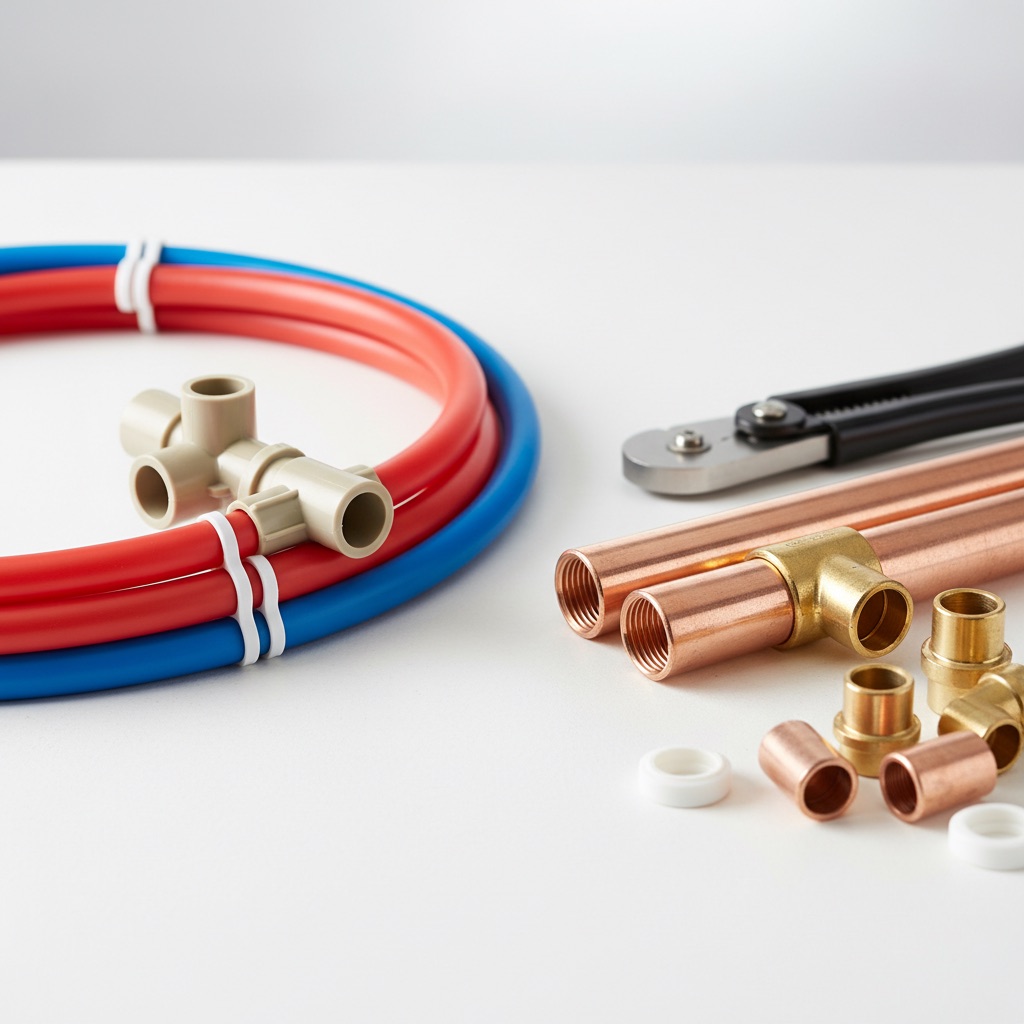
Do not treat a photo of a rainbow of red and blue tubes as a specification. Red and blue are conventions for hot and cold. The connection method has to match the tubing the plumber is listed to install. We will not name a crimp or expansion system as required. That is the plumber’s listing, not a blog SKU.
Tying PEX into copper or galvanized
Most existing San Diego houses are not a clean PEX grid. Mid-century homes mix materials. You may see copper at the heater, galvanized in the crawl, and a later repair in a bathroom wall. The plumber should see those joints before they promise a same-week hang.
PEX can join copper with a listed transition. That fitting has to be meant for potable water. California AB 1953 and the federal Safe Drinking Water Act both set “lead-free” at a 0.25 percent weighted average across wetted surfaces for pipes, fittings, and fixtures that convey water for drinking and cooking, and 0.2 percent lead for solder and flux. A hardware-store adapter that weeps in hard water is not a plan.
Galvanized is the trap. The steel looks fine from the outside while the inside rusts and narrows. A PEX coupling on a rusted trunk does not fix the rest of that run. If the house still has galvanized, read galvanized pipe replacement in San Diego and whether you need a repipe. The quote should say what steel stays in the wall. Leaving a failing trunk to feed new PEX branches is how the next leak shows up in a different room.
Do not assume a short PEX jump in one bath is the same job as a whole-house install. It is a smaller access plan. It is also a smaller result if the rest of the house is still the old pipe.
California’s C-36 plumbing classification covers water piping from the property owner’s meter side to the structure, plus repair and replacement of that piping. Forced warm-air heating units sit outside that classification. Individual contractor capabilities still vary. You want someone who actually repipes occupied houses, not a fixture-only stop.
Hard water and the fittings that still scale
PEX does not pit the way copper can in this water. That is the practical reason people choose it here. It is not a promise that the system stays clean.
Scale still forms on metal. Valves, manifolds, transition fittings, aerators, shower cartridges, and the water heater collect the same minerals the city already publishes. Inland heat in El Cajon, Lakeside, and Escondido cooks attics. Coastal salt in Imperial Beach, Ocean Beach, and La Jolla is harder on anything left in the sun. PEX itself does not belong on a long, exposed, sunny run. If a hose bibb or an outdoor shower is in the sun, ask what material they will use for that exposed piece. That is climate, not a warranty claim.
If you want hardness data for your tap, the City’s Water Quality Lab is at 619-668-3232, or DrinkingWaterQuality@sandiego.gov. The annual Drinking Water Quality Reports give more detail by service area. Hardness comes primarily from imported Colorado River water with dissolved limestone. It varies by location and demand.
A leaking joint during an install still hits the water bill. For City of San Diego single-family customers with a 3/4-inch meter, the monthly base fee is $35.53 as of January 1, 2026, and the first tier is $8.51 per hundred cubic feet. Other cities and meter sizes use different schedules. We do not have a verified gallons-per-drip figure, so we will not invent one.
Permits, license, and a written quote
A named, city-by-city permit rule for PEX in an existing house is not in our verified claims ledger. We will not invent one. Ask the building department that covers the address.
City of San Diego Development Services issues plumbing and gas permits for the alteration of a plumbing system. Unincorporated county addresses go through the County of San Diego. Chula Vista, Encinitas, Carlsbad, Oceanside, El Cajon, and the other cities run their own counters. The San Diego County Water Authority is the wholesaler for much of the county. It is not the permit desk.
Even work under California’s contractor license threshold can still need a plumbing permit. The license exemption in Business and Professions Code section 7048 is $1,000 for casual, minor work as of January 1, 2026. It does not apply if the job is part of a larger operation, if contracts are split to stay under the cap, if someone advertises as a contractor, or if they hire another person to do the work.
A licensed plumber often pulls the permit as part of the contract and schedules the inspection. A homeowner can apply. If you apply, you own the inspection. We do not set the fee. We do not publish a price per foot. Access, patching, and what old pipe stays all move the number. Get it in writing.
If you hire, verify the license at the CSLB license check. Search by license number, business name, or personnel name. The database is down Sundays 8 p.m. through Mondays 6 a.m. for maintenance. You want a current C-36 for potable piping, not a card that does not cover the work.
We connect you with independent licensed plumbers. We do not run the tubing. Every plumber in the network is licensed and insured. You still contract with that plumber directly.
Bring photos of the water heater, any exposed pipe, the crawl or attic hatch, and the garage wall. Name the city. Say whether the house is slab or raised, one story or two, and whether you will be living there during the work. That is enough to route the referral.
When to call us
Call when you want PEX installed in the house you already occupy, when you cannot tell copper from galvanized, or when a partial patch keeps leaking in a new spot. The licensed plumbers we send handle potable supply piping in existing homes. See whole-house repipe for the service hub. Call us at (858) 400-4417 and we’ll connect you with a licensed plumber.
Areas this guide covers
We connect homeowners with licensed plumbers in these San Diego County communities.
Keep reading
Need a Plumber in San Diego?
Licensed, insured plumbers, ready across San Diego County. The plumber quotes you before any work starts.
Call (858) 400-4417Call any time, day or night, anywhere in San Diego County