
Last updated: August 1, 2026
Repiping in Fallbrook: a planning checklist
Repiping comes up often on Fallbrook's grove and rural lots. Here's what a whole-house repipe actually replaces and what to confirm before you ever sign.
The short answer
- Fallbrook is largely unincorporated grove country in inland north county, and that rural setting is a real factor in repiping decisions.
- Long runs from the meter to the house, well water on some properties, and septic systems on others all change what a repipe involves.
- A whole-house repipe replaces the supply piping, not the drain or sewer lines, and not fixtures unless scoped in separately.
- New piping and fittings for potable water must meet lead-free standards under state and federal law.
- Confirm whether a contractor license is required for the job's scope before signing, and verify any license through CSLB.
Repiping comes up more often in Fallbrook than in a lot of San Diego County neighborhoods, and the reason is mostly the setting: rural lots, grove country, and supply lines that often run longer distances than a typical suburban lot. This piece is a planning checklist, not a sales pitch. It walks through what a repipe actually replaces, what parts of a Fallbrook property complicate the job, what to confirm on permits and licensing, and how the work tends to get sequenced.
Why repiping comes up so often out here
Fallbrook sits in inland north county and is largely unincorporated, with a mix of grove properties and larger rural lots spread across more acreage than a typical suburban parcel. That setting doesn’t establish which plumbing problem a property has. Repiping, leak detection, and slab leak concerns each need an on-site assessment.
Galvanized and copper supply lines both lose capacity and can develop leaks as they age, whatever a given house happens to have in the ground, and a longer run from the water meter to the house means more pipe exposed to that aging process either way. Some Fallbrook properties are on well water rather than a municipal connection, and some rely on septic systems instead of a sewer main. None of that changes the basic mechanics of a supply-side repipe, but it does mean a Fallbrook property often has more going on underground than a standard in-town lot, and a plumber assessing the job should confirm the actual pipe material and condition on site rather than assume it from the property’s age or setting.
What a whole-house repipe actually replaces
A whole-house repipe replaces the supply piping, the lines that carry pressurized water from where it enters the house to each fixture. It typically does not include drain, waste, or vent piping, and it doesn’t include the fixtures themselves, the toilets, sinks, and tubs, unless that work is scoped in as a separate line item.
That distinction matters when comparing bids. A repipe quote that only covers supply lines is not automatically incomplete, but you should know which system is being addressed before signing. If drain-side problems exist too, those get handled as pipe repair or sewer line work, and they’re worth raising separately rather than assuming they’re bundled in.
Any new piping, fittings, and fixtures used for drinking or cooking water must meet lead-free standards under California’s AB 1953 and the federal Safe Drinking Water Act, which define lead-free as a weighted average of no more than 0.25% lead across wetted surfaces for pipes and fixtures, and no more than 0.2% lead for solder and flux. That’s a materials standard the contractor should already be meeting as a matter of course, not something you need to specify, but it’s worth knowing the standard exists.
The parts of a Fallbrook property that complicate it
A few things show up more often on Fallbrook lots than on a typical in-town property, and each is worth confirming before a repipe is scoped.
Distance from meter to house. A longer supply run means more linear feet of pipe, which affects both material cost shape and how the work is sequenced. Ask how the plumber plans to route the new line relative to the old one.
Well water systems. If the property draws from a private well, that system, pump, pressure tank, and any treatment equipment, sits outside the scope of a standard repipe and has its own maintenance needs. Don’t assume well equipment is included unless it’s written into the scope.
Septic systems. Properties on septic have their own tank and leach field considerations separate from supply piping. A repipe doesn’t touch the septic system, but if the property has had drainage issues, it’s worth mentioning to the plumber so they can tell you whether that’s a separate conversation.
Grove and hillside terrain. Mature trees and root systems near supply lines, along with sloped or terraced grading on some rural lots, can affect how easily a line can be traced, accessed, or rerouted.
Permits and licensing you should confirm
California generally requires a contractor license for work where the aggregate cost of labor and materials is $1,000 or more, a threshold that increased from $500 to $1,000 effective January 1, 2026. A whole-house repipe is well above that line in almost every case. Verify any contractor’s license, classification, and standing through the CSLB license lookup before signing anything.
Permit requirements for repiping work should be confirmed with the county or local building department covering the property’s specific address, since Fallbrook’s unincorporated status means the applicable permitting authority isn’t always the same office a City of San Diego resident would use. Don’t assume; ask the plumber which office they’re pulling the permit through, and confirm it independently if the scope is large.
This is also a good point to ask about material choice, since a repipe is usually done in copper or PEX and the two behave differently underground and inside walls. Our PEX versus copper comparison lays out the tradeoffs without assigning a price to either, since actual material cost depends on the specific run and current market conditions, not a fixed number either way.
Sequencing the work
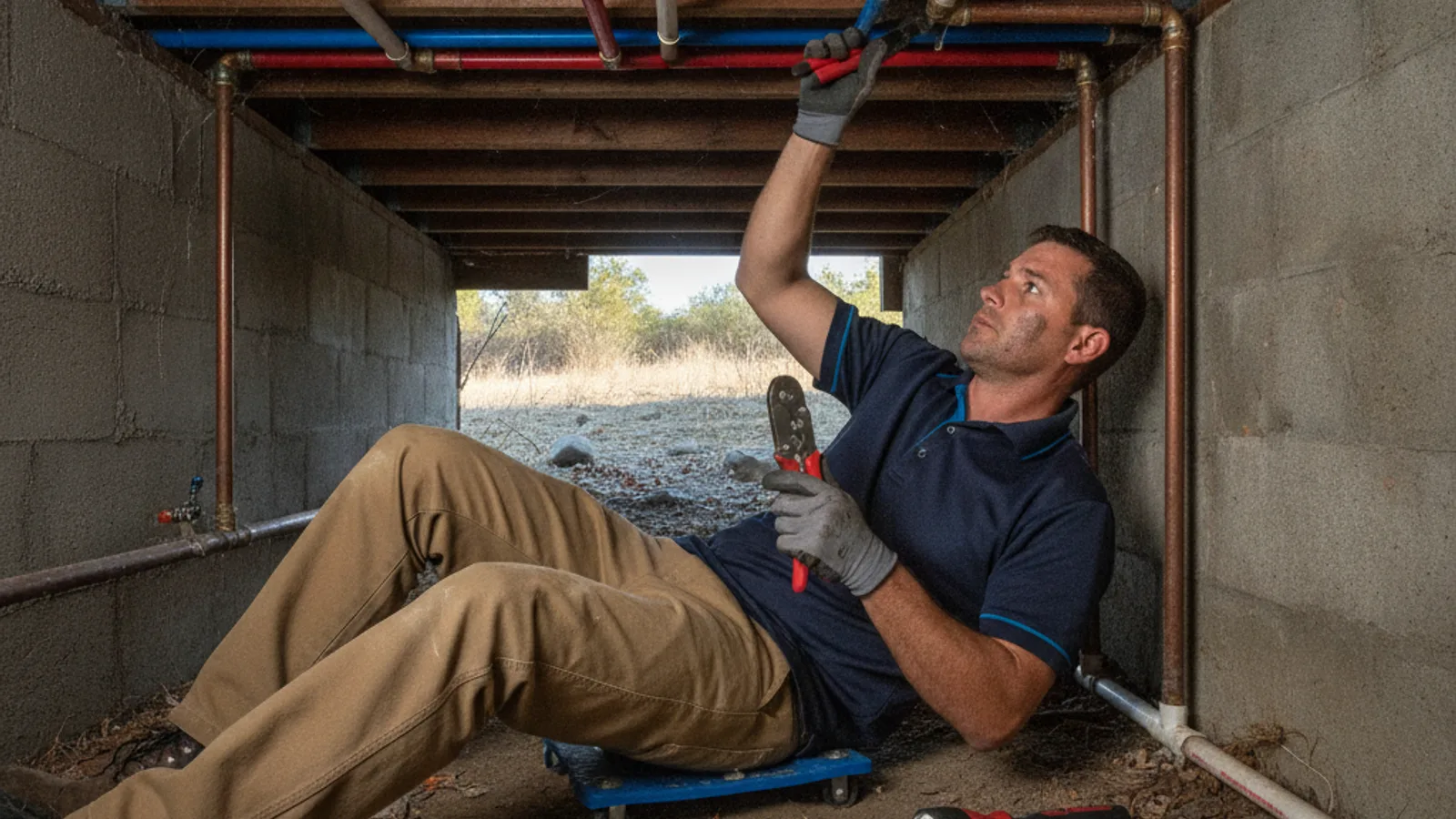
A repipe on an occupied home is usually sequenced by section, bathroom lines, kitchen lines, then remaining fixtures, so water isn’t out to the entire house at once for the full duration. Ask how the plumber plans to sequence the work on your property and what access they’ll need at each stage, including whether crawl space, attic, or exterior wall access is required.
On a rural lot, sequencing can also depend on outbuildings. Some Fallbrook properties have a detached garage, a barn, guest quarters, or irrigation lines feeding grove sections that tie into the same supply system as the house. Confirm up front whether those structures are included in the repipe scope or handled as a separate project, since assuming one way or the other is a common source of surprise change orders partway through the job.
Plan for the practical disruption too. Even a well-sequenced repipe means water is off to at least part of the house for stretches of the work day, and walls or ceilings may need to be opened and patched where old lines ran through them. Ask what the plumber’s patching scope includes and what’s left for you or a separate contractor to finish.
| To confirm before signing | Why it matters |
|---|---|
| Which piping is included (supply only, or supply and drain) | Sets the actual scope you’re paying for |
| Whether well or septic systems are touched | Those are separate systems with separate needs |
| Which permitting office the contractor will use | Fallbrook’s unincorporated status changes this from a typical in-town job |
| How the work is sequenced and what access is needed | Affects how long water service is interrupted in each area |
| Contractor license status and classification | Verify independently through CSLB rather than taking it on faith |
Slab leaks are a related but separate issue worth understanding on their own; our guide on whether you need a repipe walks through the signs that point toward a full repipe versus a localized pipe repair. For a look at copper against other material options, our copper repipe cost piece covers the comparison in more depth.
Frequently asked questions
Why does repiping come up so often in Fallbrook?
Rural and grove properties in this largely unincorporated area often have longer service runs and, in some cases, well or septic systems, and a plumber can confirm directly whether that’s contributing to age or pressure issues on a given property.
What does a whole-house repipe actually replace?
The supply piping carrying water through the house. It doesn’t typically include drain, waste, or sewer lines, or fixtures, unless those are scoped in separately.
Does a repipe on a well or septic property work differently?
The interior supply work is similar, but well and septic systems sit outside the repipe scope and have their own separate maintenance needs.
What permits or licensing should I confirm before a repipe?
Confirm the contractor’s license through CSLB, and confirm current permit requirements with the county or local building department covering the property’s address.
Do new pipes have to meet any specific standard?
Yes, a federal and state lead-free standard for any piping, fittings, or fixtures carrying drinking or cooking water.
When to call us
A whole-house repipe on a rural or grove property is licensed-plumber work from the first assessment, since the scope, materials, and permitting all depend on a proper on-site evaluation. Call (858) 400-4417 with your address and whether the property is on well or septic, and we’ll connect you with a licensed and insured local plumber.
Areas this guide covers
We connect homeowners with licensed plumbers in these San Diego County communities.
Keep reading
Need a Plumber in San Diego?
Licensed, insured plumbers, ready across San Diego County. The plumber quotes you before any work starts.
Call (858) 400-4417Call any time, day or night, anywhere in San Diego County