Last updated: August 9, 2026
Main sewer backups in Spring Valley: clear it or fix it
Why a Spring Valley sewer backup keeps returning after clearing, how a camera inspection guides the decision, and when trenchless repair replaces snaking.
The short answer
- A main-line backup that clears with snaking and returns months later usually points to a structural problem, not a dirty pipe.
- Spring Valley's hillside terrain means laterals often run downhill over distance, which affects how deep and how far a repair has to reach.
- A camera inspection should show the exact cause before you choose between clearing again and repairing the line.
- Trenchless repair needs a specific pipe condition and a clear access path; not every backup qualifies.
- There's a maintenance interval that keeps a marginal line working, but almost nobody quotes it up front.
A sewer backup that clears with a good snaking and then comes back three or four months later isn’t a dirty pipe problem. It’s usually a structural one, and clearing it again without a camera inspection just resets the clock. This piece focuses on the line that keeps clogging and the decision about what to actually do about it.
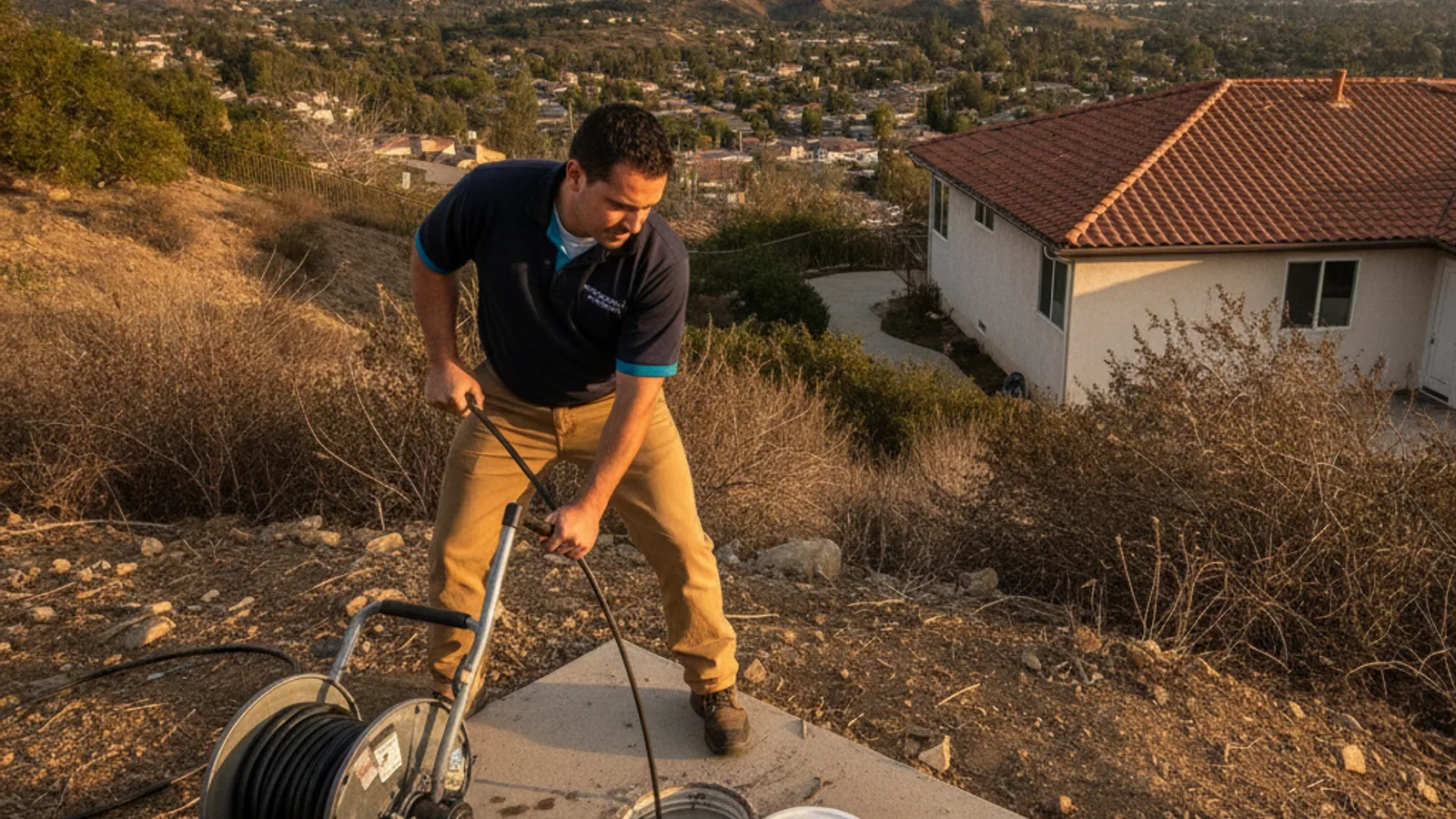
Spring Valley sits in unincorporated East County on hillside terrain, which means a lot of sewer laterals here run downhill over a meaningful distance before reaching the main connection, and some properties share a connection point that’s harder to reach than a flat-lot line would be. That geography shapes both why backups happen and what a repair has to account for.
The backup that comes back
The first backup usually gets cleared and forgotten. The second one, a few months later, is where the real question starts.
If snaking or jetting clears the line but the same symptoms return on a shrinking timeline, something in the pipe itself is causing debris to collect faster than normal use would explain. Roots growing into a joint, a low spot where solids pool instead of flowing through, or a partially separated joint all create the same pattern: clear, work for a while, clog again, and the interval between clogs gets shorter each time.
That shrinking interval is the signal worth paying attention to. A line that backs up once a year and stays there might tolerate periodic clearing indefinitely. A line that backed up in March, then June, then August is telling you the underlying problem is getting worse, not staying the same.
Drain cleaning handles the immediate backup either way. What it doesn’t do is tell you which of those two situations you’re actually in. That requires looking at the pipe, not just clearing what’s blocking it.
Clearing versus repairing, and the honest tradeoff
There’s a real tradeoff here. One answer isn’t always right.
Clearing the line each time it backs up costs less per visit and requires no excavation or pipe work. If the interval between backups is long and stable, that can be a reasonable ongoing choice, especially for a line that’s otherwise in decent condition.
Repairing the underlying cause costs more upfront but addresses why the line keeps failing in the first place. If a camera inspection shows a structural problem, root intrusion at a specific joint, or a section that’s settled out of alignment, clearing that section repeatedly is treating a symptom that will keep returning.
Neither choice is automatically correct. The honest version of this decision depends on what the pipe is actually doing, which is exactly what the next section covers.
What a camera has to show before you commit
Don’t decide between clearing and repairing based on the backup alone. A sewer camera inspection should answer three specific questions before either choice makes sense.
Where is the problem, measured from the cleanout or access point? What is the pipe material, since older clay or cast-iron sections behave differently than PVC? And what is the specific cause: roots, a crack, a low spot, or a joint that’s separated?
A report that says “there’s a blockage” without those details doesn’t give you enough to choose between clearing and repairing. A report that says “there’s root intrusion at 38 feet, at a joint in a clay section, with a visible offset” gives you and the plumber something to actually plan around.
What the site has to allow
Once a structural cause is confirmed, the repair method depends on what the site can physically support, and hillside lots don’t always support every option equally.
| Repair method | What the site has to allow |
|---|---|
| Spot repair at one section | Clear access to that one point without disturbing the full run |
| Pipe lining (trenchless) | A pipe condition stable enough to line, and access at both ends of the affected section |
| Pipe bursting (trenchless) | A workable path along the existing line’s route and enough room at entry and exit points |
| Traditional open excavation | Enough yard, slope, or hardscape access to dig the affected run |
Hillside terrain can complicate any of these. A lateral running downhill over a longer distance may have a harder-to-reach access point, and a shared connection near a property line adds a coordination question that a flat, single-access lot doesn’t have. Trenchless sewer repair is a real option on many East County properties, but it isn’t automatic. The camera inspection and a site walk-through are what determine whether it applies to your specific line.
Our trenchless sewer repair guide explains the method in more depth, and hydro jetting is often used to clear the line thoroughly before a camera run, so the footage shows the pipe wall clearly instead of through leftover debris.
The maintenance interval nobody quotes you
Here’s the part that rarely gets said out loud: a line with a known minor issue, one that isn’t bad enough to justify full repair yet, can often be managed on a maintenance schedule instead of waiting for the next surprise backup.
The right interval depends entirely on what the camera showed: how much root growth is present, how significant the low spot or offset is, and how the household uses the line. A plumber who’s actually looked at your pipe can recommend a realistic interval based on that specific condition. A generic “clean it every six months” number that applies to every property doesn’t reflect what’s actually happening in your line, and we won’t hand you one.
If you’re managing a marginal line on purpose while you decide about repair, ask for that interval explicitly and put it on a calendar, rather than waiting for the next backup to remind you. Our guide on how often sewer lines should be cleaned covers what shapes that interval in more detail.
Properties throughout the Spring Valley plumbing service area deal with this same hillside-lateral pattern, so you’re not managing an unusual situation, just one that needs an honest look before the next decision.
Frequently asked questions
Why does my Spring Valley sewer line keep backing up after it’s cleared?
Clearing removes the blockage but not the cause. If roots, a low spot, or a damaged section keep collecting debris, the line fills again over time. A camera inspection identifies whether a structural cause is driving the pattern.
How do I decide between clearing the line again and repairing it?
Watch the interval between backups. A long, stable interval may support continued clearing. A shrinking interval, or a camera inspection showing a structural problem, points toward repair.
What does a camera inspection need to show before repairing a line?
It should identify the distance from the access point, the pipe material, and the specific issue, such as root intrusion, a crack, or a low spot. That determines whether trenchless repair is realistic.
Can every sewer line be repaired with trenchless methods in Spring Valley?
No. It depends on the pipe’s condition, slope, and having workable access at both ends of the affected section. Hillside terrain can limit what’s realistic on a given lot.
How often should a marginal sewer line be cleared as maintenance?
There’s no single interval for every property. It depends on the pipe’s condition and root activity, and a plumber can recommend a specific interval based on what a camera inspection shows.
When to call us
A backup that returns on a shortening interval, or one a camera inspection has already tied to a structural cause, needs a licensed plumber to weigh the repair options with you. Have your address and what a prior inspection found, if any, ready when you call. Call (858) 400-4417 and we’ll connect you with a licensed and insured local plumber.
Areas this guide covers
We connect homeowners with licensed plumbers in these San Diego County communities.
Keep reading
Need a Plumber in San Diego?
Licensed, insured plumbers, ready across San Diego County. The plumber quotes you before any work starts.
Call (858) 400-4417Call any time, day or night, anywhere in San Diego County