
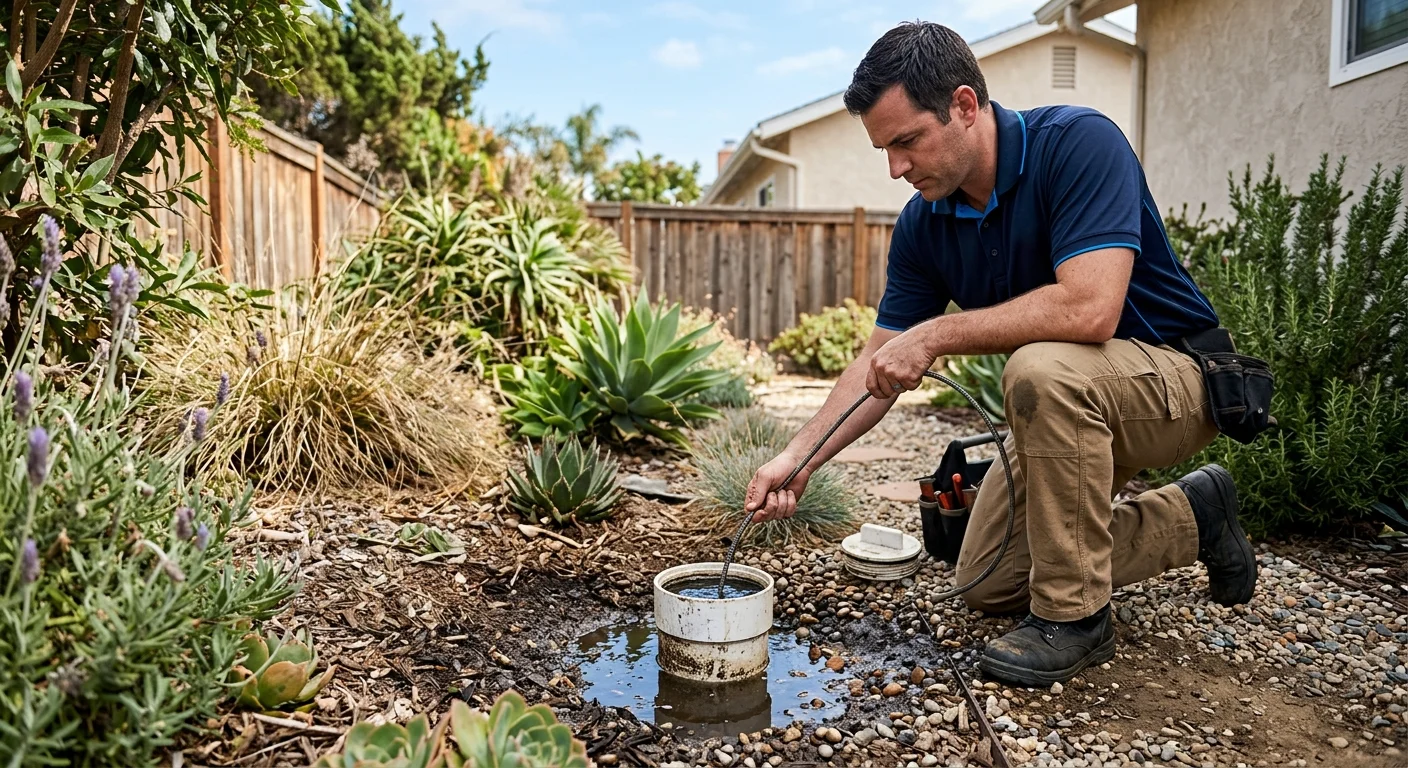
Sewer cleanout overflowing: what it means for the main line
An overflowing sewer cleanout can point to a main-line blockage. Learn what multiple slow drains mean and how to request a San Diego plumber referral.
Water rising from an outdoor cleanout points beyond an ordinary sink clog. The number and location of affected fixtures help show whether the restriction involves one branch or the main sewer line.
How a cleanout overflow differs from one clogged fixture
A sewer cleanout gives a plumber access to the building drain or sewer lateral. Its location varies by property. You might find one near an exterior wall, beside a driveway, or along the route toward the public sewer connection.
Water coming out of a sewer cleanout means flow has reached that opening. It isn’t moving through the system as intended. A blockage farther along the drainage path is one possible explanation. The cleanout alone can’t reveal the blockage’s exact location or cause.
A single slow sink presents a different pattern. That problem may stay within the fixture’s trap or branch drain. Other toilets, tubs, and sinks can continue draining normally. An overflowing cleanout involves a shared part of the drainage system, especially when water appears there as several fixtures operate.
The cleanout’s position also changes what the overflow tells you. Some properties have more than one access point. An upstream and downstream cleanout can give a plumber two different views of the line. The contractor must identify which pipes feed each opening before drawing a conclusion.
That distinction matters in San Diego. The City says a homeowner’s sewer lateral can extend from the property to a connection in the street, an easement, or a canyon. A visible overflow may therefore involve a line that continues beyond the obvious yard boundary.
The practical takeaway is simple. One clogged fixture may be a local drain problem. A sewer cleanout overflowing alongside problems throughout the house points toward the shared drainage route and calls for a main-line diagnosis.
What multiple slow drains add to the diagnosis
Multiple drains backing up provide context that one cleanout can’t. The pattern shows how much of the plumbing system may share the affected path.
Start with the locations. A slow sink and tub in one bathroom may share a nearby branch. Problems in separate bathrooms, the kitchen, and the laundry area involve a wider part of the system. If the outdoor cleanout also fills, the main sewer line becomes a stronger area for investigation.
Timing helps too. A plumber may ask which fixture showed trouble first. They may also ask whether one fixture affects another. Water appearing at the cleanout while indoor fixtures drain links those events, but it still doesn’t identify the obstruction by itself.
Elevation can add another clue. Drainage follows the installed pipe layout, and lower openings may show trouble before higher fixtures. That’s why the cleanout, a low shower, and an upstairs sink can behave differently during the same blockage. The contractor needs the property’s actual configuration before interpreting that order.
Keep the observations specific when requesting help. Note whether the issue affects one room or several. Mention any toilet movement, slow tubs, sink backups, or water at an exterior access point. These details help the matched contractor prepare for a shared-line problem instead of arriving with only a single-fixture description.
If wastewater is appearing inside a tub, our guide to sewage backing up into a bathtub addresses that separate symptom. This page focuses on the cleanout itself and what it suggests about the main line.
Multiple slow drains don’t prove that the sewer pipe is broken. They do show that the diagnosis should extend beyond whichever fixture first caught your attention.
Where a plumber may look for the blockage
A plumber usually begins by mapping the drainage path. The cleanout location, affected fixtures, and sewer connection direction help define the section that needs inspection.
The contractor may compare flow on both sides of an accessible cleanout. If the line is open toward the house but restricted toward the sewer connection, that narrows the search. A different result could point toward an interior branch or another section of the lateral. Properties with limited access may require a different approach.
Roots, grease, and debris are recognized sewer-lateral obstructions in the City of San Diego’s maintenance guidance. Breaks and cracks are also conditions that property owners must repair within their area of responsibility. None of these causes should be assumed from standing water alone.
The City’s responsibility rule is narrower than many homeowners expect. Within the City of San Diego, property owners maintain the lateral all the way to its connection with the sewer main. That connection may lie beyond the property line.
The City states that it will clear or repair a problem at no charge when the problem is beyond the property line, within the City right-of-way, and the homeowner has lost all sewer facilities. The City also says it doesn’t reimburse plumbing expenses. Those conditions should travel with any discussion of public responsibility.
That City of San Diego rule shouldn’t be applied automatically across the county. Homes in Oceanside, Chula Vista, El Cajon, and other communities may fall under different local providers. The contractor or homeowner should confirm the responsible agency before relying on any boundary assumption.
A plumber can then determine whether the issue calls for cleaning, visual inspection, repair planning, or another step. Our sewer line service referrals connect homeowners with independent licensed contractors who can evaluate that route.
What sewer cleaning and camera inspection can confirm
Sewer cleaning and camera inspection answer related but different questions. Cleaning addresses material restricting flow. A camera inspection shows visible conditions inside the accessible pipe.
A successful cleaning can confirm that an obstruction was present when flow improves. It doesn’t necessarily explain why the obstruction formed. It also doesn’t prove that every part of the lateral is free from damage or buildup.
A sewer camera may show where the pipe changes direction, where material remains, or where a visible defect interrupts the line. It can also help a contractor relate an interior finding to a point in the yard, driveway, street, easement, or canyon route.
Camera results depend on visibility. Standing water, remaining debris, or limited access can block the view. The contractor may need to restore flow before getting a useful image. That sequence is one reason a camera and cleaning aren’t interchangeable services.
Ask the plumber to explain what the recording shows. A useful review should separate direct observations from interpretation. “The camera stopped at this location” isn’t the same as identifying the material or pipe condition that stopped it. Likewise, an open section near the cleanout doesn’t establish that the entire lateral is clear.
The results should guide the next recommendation. An accessible obstruction may lead to a cleaning method chosen for that condition. A visible pipe defect may require a repair discussion. If the footage is inconclusive, the plumber should explain what prevented confirmation.
You can request a referral for a sewer camera inspection when the cleanout overflow keeps returning, the affected area is unclear, or the contractor needs a view inside the line. Individual contractors have different equipment and capabilities, so confirm the planned inspection directly with the plumber.
How to request a sewer service referral in San Diego County
Describe the visible problem first. Say that water is coming out of the sewer cleanout, then name every affected fixture. Include whether the cleanout is in the front yard, side yard, driveway area, or another accessible location.
Share the property’s city or community. Sewer responsibility isn’t uniform across San Diego County. A home within the City of San Diego may follow the City rule described above. Another jurisdiction may have a different utility, district, or process. If the responsible agency can’t be confirmed, ask the matched contractor or local sewer provider before assuming who handles the affected pipe section.
Plumbing Pro San Diego is a referral service. We connect homeowners with independent plumbers serving communities across the county. We don’t inspect the pipe, perform the cleaning, set the price, or contract for the repair. You’ll discuss the scope and payment directly with the plumber you hire.
Every plumber in the network is licensed and insured. California’s C-36 classification covers plumbing work involving safe water supply and proper fluid-waste disposal, among other listed work. Individual contractor capabilities vary.
You can independently check a contractor through the CSLB license lookup. The database provides license status, expiration dates, classifications, bond information, workers’ compensation information, and complaint history. It’s scheduled to be unavailable from Sunday at 8 p.m. through Monday at 6 a.m.
If the property is near Spring Valley, our Spring Valley plumber referral guide explains how to request local service. The same core details help anywhere in the county: the cleanout location, affected fixtures, when the overflow appears, and any prior sewer work you can document.
When to call us
An overflowing cleanout with multiple slow or backing-up drains needs evaluation by a licensed plumber. Call us at (858) 400-4417 and we’ll connect you with a licensed plumber.
Areas this guide covers
We connect homeowners with licensed plumbers in these San Diego County communities.
Keep reading
Need a Plumber in San Diego?
Licensed, insured plumbers, ready across San Diego County. The plumber quotes you before any work starts.
Call (858) 400-4417Call any time, day or night, anywhere in San Diego County