
Water softener maintenance in San Diego
A water softener isn't set-and-forget. Here's the real maintenance schedule for salt, resin, and the brine tank in San Diego's hard water.
The short answer
- Check the brine tank monthly at first to learn your usage rate, then settle into a refill schedule, typically every 4 to 6 weeks for a family of four.
- Salt bridging (a hard crust blocking water from reaching the salt) is the most common reason a softener looks fine but stops regenerating.
- Resin lasts 10 to 15 years normally, but iron, unfiltered chlorine, and running past rated capacity all shorten that.
- Clean the brine tank every 1 to 2 years to prevent sediment from clogging the injector, the part that actually draws brine into the resin tank.
- A power outage resets most control heads' internal clock, which throws off the regeneration schedule until you reset it manually.
Buying the right water softener for San Diego’s hard water is only half the job. A softener with no maintenance plan degrades quietly. You don’t get a warning light. You get spotty dishes again, a film on your skin after a shower, and scale creeping back into your water heater, usually months before anyone connects the dots back to the softener itself.
Salt: the maintenance most people already know about
Salt is the part of softener maintenance most homeowners have heard of, and it’s still the one people get wrong most often. San Diego water runs hard enough, about 16 grains per gallon depending on your water district, that a family of four typically burns through 8 to 12 forty-pound bags a year. Use evaporated salt pellets or solar salt specifically labeled for water softeners. Skip rock salt, which contains more insoluble impurities that build up as sludge at the bottom of the brine tank and eventually clog the injector.
Keep the tank at least a third full at all times. Letting it run empty means the unit can’t make brine for the next regeneration cycle, and hard water passes straight through the house until someone notices and refills it, sometimes for a week or more.
Salt bridging: the failure mode that hides in plain sight
A salt bridge forms when humidity or the wrong salt type causes a hard crust to form above the water line in the tank. From the outside, the tank still looks full. Underneath the crust, there’s an air gap, and the water sitting below can’t reach the salt to make brine. The softener keeps running its regeneration cycles on schedule, but they don’t actually soften anything, because there’s no brine to draw.
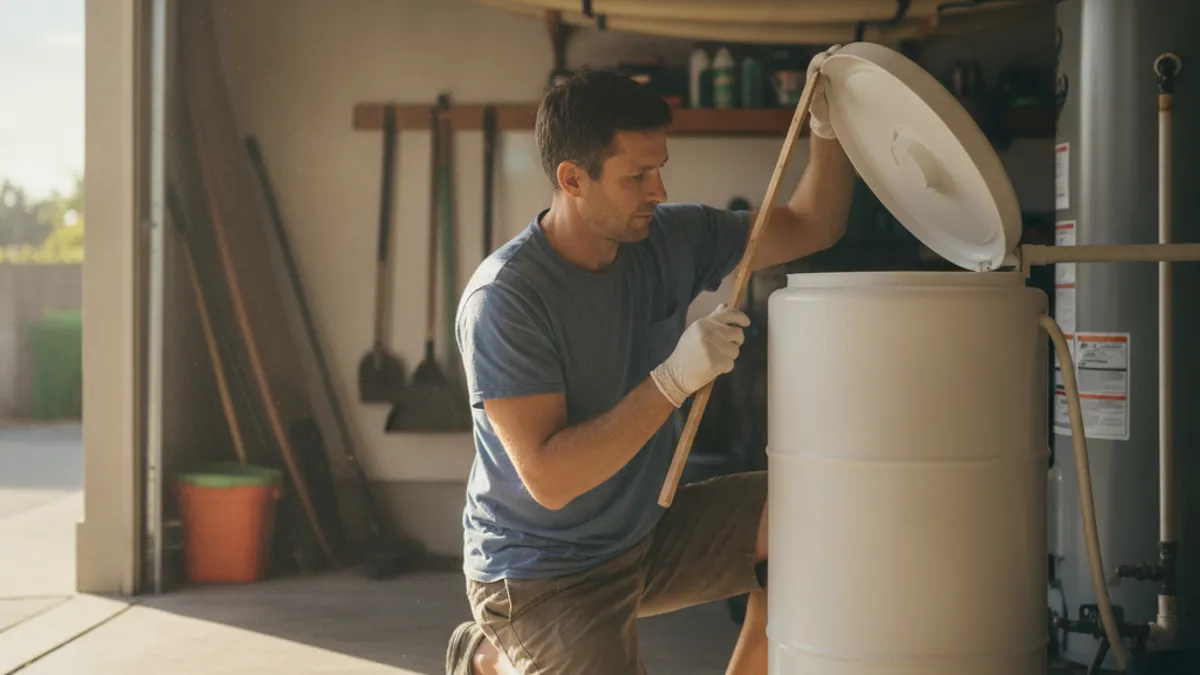
Check for a bridge by pushing gently on the salt with a broom handle or similar tool, not anything sharp that could puncture the tank liner. If you feel a hard crust with hollow space underneath, break it up carefully in a few spots to let the salt below fall and dissolve normally.
Resin: the part nobody thinks about until it’s exhausted
The resin bed is where the actual ion exchange happens, swapping calcium and magnesium for sodium as water passes through. Quality resin lasts 10 to 15 years under normal use. Three things shorten that life in San Diego specifically. Iron in well or older-pipe-sourced water fouls resin faster than straight calcium and magnesium. Unfiltered chlorine or chloramine from the municipal supply degrades resin beads over years, which is why a sediment or carbon pre-filter ahead of the softener extends resin life meaningfully. And running a unit past its rated grain capacity, common in larger households that never resized their system as the family grew, wears resin out faster than the manufacturer’s spec assumes.
The tell that resin is failing, versus just needing salt, is water that stays hard right after a regeneration cycle completes. If a fresh cycle doesn’t fix it, the resin bed itself is the problem, and no amount of salt refills will change that. At that point you’re looking at a resin replacement, typically $250 to $400 in parts plus $150 to $300 in labor if you don’t do it yourself, which is worth comparing against a full new softener install if your unit is already past 12 to 15 years old.
The brine tank cleaning most people skip entirely
Every 1 to 2 years, the brine tank benefits from a full clean, not just a salt top-off. Sediment, insoluble salt impurities, and the occasional sludge layer accumulate at the bottom over time. Left alone, this debris eventually reaches the injector, the small nozzle that draws brine solution into the resin tank during regeneration. A clogged injector is one of the most common reasons a softener stops regenerating properly even though the salt level looks fine. A full clean takes about 30 minutes: drain the tank, remove any remaining salt, scrub out sediment, and refill.
Checking the bypass valve and settings
Most softeners have a manual bypass valve used during service or vacation, and it’s worth confirming yours is fully seated in the “service” position, not accidentally left in bypass after a repair or a house sitter’s confusion. It’s also worth reviewing your regeneration settings once a year, especially if your household size changed. A unit programmed for two people that’s now serving five will regenerate too infrequently and run out of capacity mid-week, showing up as hard water toward the end of each cycle even though everything mechanically works fine.
What a power outage does to your softener
Most electromechanical and digital control heads keep their regeneration schedule using an internal clock that runs off house power. A power outage longer than a few minutes, not unusual during San Diego’s occasional Santa Ana wind events, resets that clock. The softener can end up regenerating in the middle of a shower or right when everyone’s home, cutting soft water off for the 60 to 90 minutes a cycle takes. Checking and resetting the time after any outage is a two-minute fix that avoids a confusing week of “why does my water feel hard sometimes.”
A simple annual schedule
Monthly: check salt level, top off if below a third. Every 4 to 6 weeks in practice for most families. Annually: check for salt bridging, test water hardness at the tap with a simple strip kit, verify the bypass valve position, and confirm the control head’s clock after any outage. Every 1 to 2 years: full brine tank clean. Every 10 to 15 years: expect a resin bed evaluation, and possibly a full unit replacement if the resin’s exhausted and the control head is original.
If your San Diego home also runs a tankless water heater, keeping your softener in good shape is doing double duty, since it’s protecting that unit’s heat exchanger from the scale buildup that shortens its life too.
When you’re ready
If your softener isn’t performing the way it used to and you’re not sure whether it’s a salt issue, a resin issue, or something mechanical, call us at (858) 400-4417. The plumber will test your water at the tap, check the resin bed’s actual condition, and tell you honestly whether it’s a cleaning, a resin swap, or time to replace the whole unit.
Areas this guide covers
We connect homeowners with licensed plumbers in these San Diego County communities.
Keep reading
Need a Plumber in San Diego?
Licensed, insured plumbers, ready across San Diego County. The plumber quotes you before any work starts.
Call (858) 400-4417Call any time, day or night, anywhere in San Diego County