
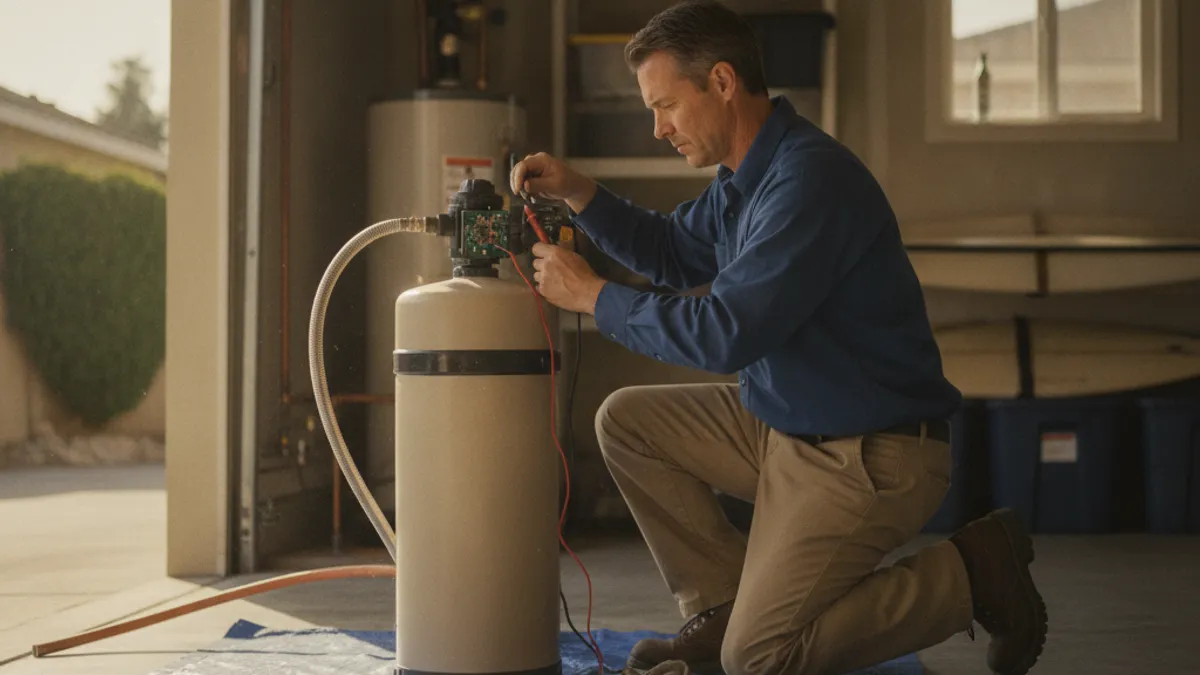
Water softener repair in San Diego: common problems
When water goes hard again, it's rarely just low salt. Here's how to diagnose the real reason your San Diego softener stopped working and what each fix runs.
The short answer
- Hard water despite a full salt tank usually points away from salt entirely, toward a salt bridge, fouled resin, a clogged injector, or a control valve issue.
- A softener stuck cycling or regenerating too often usually means a control valve, timer, or drive motor problem, not a salt issue.
- Resin beads showing up at faucets and showerheads (resin bleed) means a cracked distributor tube or failed screen, a mechanical repair, not a salt refill.
- Repairs run $150 to $400 for most control valve issues, versus $250 to $650 for resin bed or distributor tube replacement.
- Past 12 to 15 years old with resin already exhausted, replacement usually makes more financial sense than continued repair.
A softener that suddenly stops working, or one that’s been quietly underperforming for months, usually isn’t a salt problem, even though that’s the first thing most homeowners check. The real cause is almost always mechanical or in the resin bed itself, and figuring out which one determines whether you’re looking at a $150 repair or a full unit replacement.
Hard water despite a full salt tank
This is the complaint we hear most, and it points in several possible directions, none of them “add more salt.” First, check for a salt bridge, a hard crust that forms above the water line and blocks water from reaching the salt underneath, which we cover in detail in our softener maintenance guide. If there’s no bridge and the tank is genuinely dissolving salt normally, the next suspects are a fouled or exhausted resin bed (common past 10 to 15 years, or sooner if iron or unfiltered chlorine has been degrading it), a clogged injector preventing the unit from drawing brine into the resin tank during regeneration, or a control valve that’s simply stopped triggering the regeneration cycle on its programmed schedule.
A softener stuck in a cycling loop
If your softener seems to be regenerating constantly, using far more salt and water than it should, the control valve or timer is the likely culprit. Older electromechanical control heads have a drive motor and gear assembly that wears out over years, and a worn gear can cause the valve to cycle incorrectly or get stuck partway through a regeneration. Digital control heads can suffer a similar issue from a programming error, sometimes introduced after a power outage resets the internal clock without anyone noticing, causing the unit to regenerate at the wrong time or far more frequently than your household’s actual water use requires.
Resin showing up at your faucets
If you’re finding small yellow or tan beads clogging faucet aerators or showerheads, that’s resin escaping from the tank, often called resin bleed. It usually traces back to a cracked or worn distributor tube, the internal component that’s supposed to keep resin contained inside the tank while water flows through it, or a failed screen inside the control valve that’s supposed to catch any resin that does get loose. This is a mechanical repair, replacing the distributor tube or the affected valve component, not something a salt refill or resin top-off fixes.
The injector: a small part that causes big symptoms
The injector, sometimes called the venturi, is the small nozzle responsible for drawing brine solution out of the tank and into the resin bed during regeneration. Sediment, salt impurities, or general buildup over time can clog it, and when that happens, the unit goes through the motions of a regeneration cycle without actually pulling any brine, leaving the resin bed unrefreshed and hard water passing through as if the unit weren’t there at all. An injector cleaning is one of the simpler and cheaper repairs available, often resolving what looked like a much bigger problem.
A quick diagnostic order that saves a wasted service call
Working through these in order usually narrows the problem faster than guessing. Start with the brine tank itself: confirm there’s actually water in it (a dry or nearly dry tank with plenty of salt points straight to the injector) and check for a salt bridge. Next, listen to the unit during a manual regeneration cycle, most control heads have a manual regen button, and confirm you can hear water moving through each stage (fill, brine draw, backwash, rinse). A cycle that skips straight through without any brine draw sound usually confirms an injector clog. If the cycle sounds normal but water still tests hard afterward, the resin bed itself is the more likely culprit, especially on a unit already past the 10-year mark. Sharing what you observed with a technician ahead of a visit often means the right part shows up on the truck the first time instead of a second trip.
What repair costs generally run
A control valve or timer repair runs $150 to $400 depending on the specific part and whether the full head needs replacement or just an internal component. Injector or venturi cleaning is typically under $150 and often the first thing worth checking given how cheap and common a fix it is. A distributor tube replacement to stop resin bleed runs $150 to $350. A full resin bed replacement, when the media itself is exhausted or fouled beyond cleaning, runs $250 to $400 in parts plus $150 to $300 in labor.
Repair or replace
Age and resin condition drive this decision more than anything else. A unit under 10 years old with resin still testing in reasonable condition is almost always worth repairing, since $150 to $400 against a $3,200 to $4,500 new install is an easy call. Past 12 to 15 years, especially if the resin bed is already showing signs of exhaustion on top of a mechanical failure, the math shifts toward replacement, since you’d be paying repair costs on a unit that’s also due for a resin swap soon anyway, at which point a new install with a modern control head often makes more sense than stacking repairs on old equipment. If you’re weighing whether a salt-based system is even the right call going forward, our comparison of salt-based and salt-free options is worth a look before committing to another salt-based unit.
Diagnosing it yourself before calling
A few checks any homeowner can do before scheduling a service call: confirm the bypass valve is in the “service” position, not accidentally left in bypass. Test your water hardness at the tap with a basic strip kit to confirm the problem is real and not a perception issue. Check the brine tank for a salt bridge or unusually low water level in the tank itself, which points to an injector problem rather than a salt problem. These quick checks often narrow down which of the issues above you’re actually dealing with before a technician even arrives.
When you’re ready
If your softener’s stopped delivering soft water, seems to be cycling constantly, or you’re finding resin beads at your fixtures, call us at (858) 400-4417. The plumber will diagnose exactly which part failed, quote the real repair cost, and tell you straight whether it’s worth fixing or time to replace the unit.
Areas this guide covers
We connect homeowners with licensed plumbers in these San Diego County communities.
Keep reading
Need a Plumber in San Diego?
Licensed, insured plumbers, ready across San Diego County. The plumber quotes you before any work starts.
Call (858) 400-4417Call any time, day or night, anywhere in San Diego County