
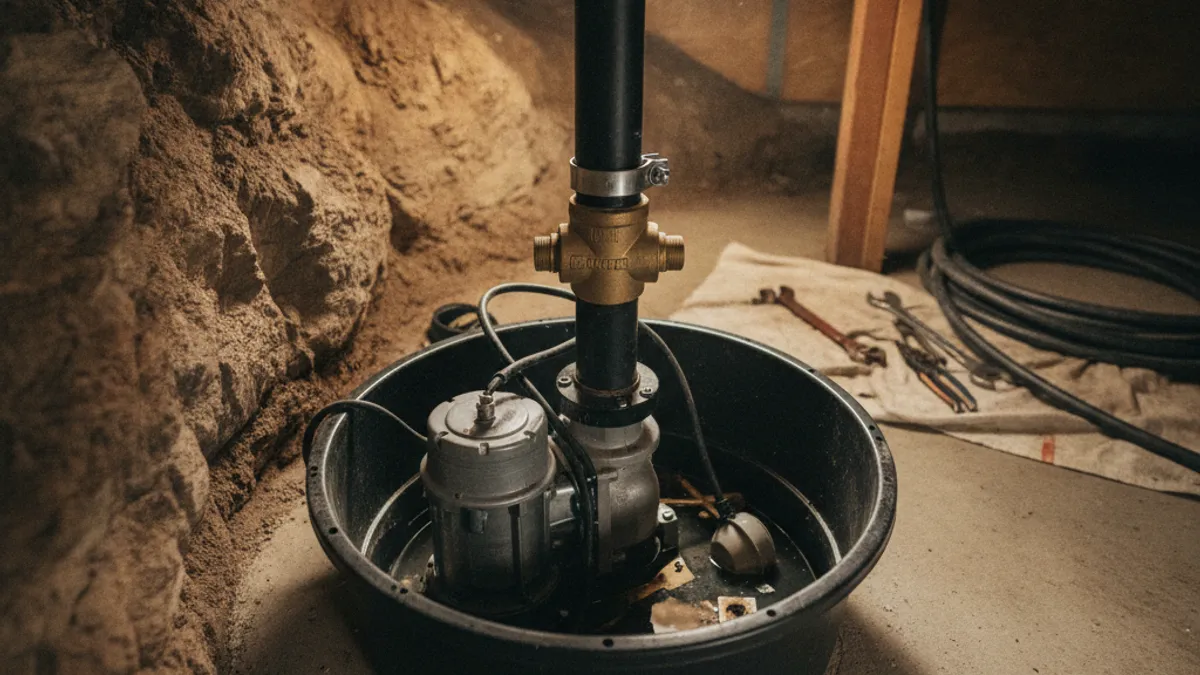
Sump pump repair in San Diego: common failures
Sump pumps aren't common in San Diego, but canyon-rim and hillside homes rely on them. Here's what fails, what it costs, and how to catch it early.
The short answer
- Sump pumps in San Diego mostly show up in canyon-rim homes with French drains, a few older basements, and crawl spaces graded toward a low collection point.
- A stuck or worn float switch is the most common failure, either preventing the pump from triggering or causing it to run continuously and burn out.
- A failed check valve forces the pump to re-pump the same water repeatedly, a cheap part ($50 to $120) that causes expensive motor wear if ignored.
- A battery backup matters because storms and power outages tend to happen together, exactly when the pump is needed most and least likely to have power.
- Full pump replacement runs $300 to $700. Catching a float switch or check valve issue early avoids that cost entirely.
Sump pumps aren’t standard equipment in most San Diego homes the way they are in rainier parts of the country, but they show up more than people expect once you look at canyon-rim properties, hillside lots with retaining walls, and the handful of older neighborhoods with basements. When one of these fails, it usually happens during exactly the storm it was installed to handle, which makes catching a problem early worth the effort.
Why San Diego homes have sump pumps at all
The most common setup we see is a hillside or canyon-adjacent property, common in areas like Tierrasanta, La Mesa’s Mt. Helix slopes, and parts of Clairemont near canyon rims, where a French drain system collects groundwater or hillside runoff behind a retaining wall and channels it to a collection basin. Without a pump, that water has nowhere to go but toward the foundation. A small number of older homes, particularly in North Park and Kensington, were built with basements and rely on a sump pump for the same reason any basement does elsewhere in the country. And some crawl-space setups on graded lots direct rainwater toward a low point during heavy rain years, especially properties that saw real water intrusion during a strong El Niño winter.
The float switch: the part that fails most
The float switch tells the pump when water has risen high enough in the basin to trigger. It’s a mechanical part, and mechanical parts wear out or get fouled by sediment and debris that settle in the basin over time. A failed float shows up two ways. Either the pump never triggers even as water rises, which is the dangerous failure mode since nothing alerts you until there’s already water where it shouldn’t be, or the switch sticks in the “on” position and the pump runs continuously, burning through the motor far faster than its rated life. Replacing a float switch runs $100 to $250 installed and is one of the more common repair calls we get after a storm exposes a problem that had been sitting unnoticed for months.
The check valve: cheap part, expensive consequence if ignored
The check valve sits in the discharge pipe and stops water from flowing back into the basin once the pump shuts off. When it fails, the pump has to move the same water over and over, short-cycling on and off far more often than it should. That short-cycling is hard on the motor and shortens its life significantly. A check valve replacement is one of the cheapest sump pump repairs available, usually $50 to $120 installed, which makes it worth checking any time a pump seems to be running more frequently than it used to, before the motor itself takes the damage.
Impeller clogs and motor burnout
Sediment, small debris, and occasionally roots or gravel that work their way into the basin can clog the impeller, the spinning component that actually moves water through the pump. A clogged impeller forces the motor to work harder against resistance, and if it’s severe enough, the motor overheats and burns out entirely. This is a common failure in basins that haven’t been cleaned in years, since sediment accumulates gradually and the effect on the pump isn’t obvious until it fails outright, usually during the storm that puts the most demand on the system.
Why a battery backup matters more than people think
San Diego doesn’t lose power often, but Santa Ana wind events and winter storms both create real conditions for outages, and those conditions are exactly when a sump pump has the most water to move. A pump with no battery backup is useless during a power outage, which is precisely the scenario a sump pump exists to handle in the first place. A battery backup system, which kicks in automatically when grid power drops, closes that gap and is worth adding to any sump pump that’s actually protecting something you care about, whether that’s a finished basement, a crawl space, or a foundation on a hillside lot.
Primary pump vs backup pump, and why some homes have both
A property with real consequences riding on the sump pump working, a finished basement, an expensive hillside retaining system, or a crawl space prone to standing water, often runs two pumps rather than one. The primary pump handles day-to-day duty, while a battery-backed secondary pump sits slightly higher in the basin and only activates if the primary fails or can’t keep up with an unusually heavy inflow. This setup catches both failure modes at once, a mechanical breakdown and a power outage, without relying on a single point of failure during the exact storm when the system matters most. It’s a bigger upfront cost than a single pump, but for a property where pump failure means real water damage, it’s a reasonable one.
What repair actually costs
A float switch replacement runs $100 to $250 installed. A check valve, $50 to $120. A full pump replacement, covering the motor and impeller assembly, runs $300 to $700 depending on the pump’s horsepower rating and whether the discharge piping needs rework to fit a new unit. Emergency service during an active storm, when a pump failure means water’s actively rising, carries an additional after-hours rate, similar to any emergency plumbing call in San Diego.
Catching it before the next storm
The best time to check a sump pump is before rain season, not during it. Pour a bucket of water into the basin and confirm the float triggers the pump and it shuts off cleanly once the water level drops. Listen for any grinding or straining sound, which usually points to impeller debris. And confirm the discharge line outside the house is clear and directing water well away from the foundation, not pooling right back where it started. If your property also has a French drain system feeding the basin, checking that the drain inlets aren’t clogged with leaves or debris is worth doing at the same time.
If you’re installing a sump pump for the first time rather than repairing an existing one, our guide to sump pump installation in San Diego covers sizing and setup in more detail.
When you’re ready
If your sump pump isn’t triggering reliably, seems to be running constantly, or you want it checked before the next storm rolls through, call us at (858) 400-4417. The plumber will test the float, check the valve and impeller, and tell you honestly whether it’s a quick repair or time for a new pump.
Areas this guide covers
We connect homeowners with licensed plumbers in these San Diego County communities.
Keep reading
Need a Plumber in San Diego?
Licensed, insured plumbers, ready across San Diego County. The plumber quotes you before any work starts.
Call (858) 400-4417Call any time, day or night, anywhere in San Diego County