Salt-free vs. salt-based water softeners in San Diego
Salt-free systems don't actually soften water the way salt-based ones do. Here's the real difference and which fits your San Diego sewer district.
The short answer
- Salt-based softeners actually remove hardness minerals through ion exchange. Salt-free systems convert minerals into a crystal form that resists sticking, without removing hardness at all.
- Some San Diego County sewer districts restrict or discourage salt-based softeners due to brine discharge and chloride limits, particularly near water reclamation programs.
- Salt-free costs less to run day to day (no salt, less electricity) but usually costs more upfront and needs a media cartridge swap every 6 to 8 years.
- Only a salt-based system delivers the classic slippery, soft-water shower feel, since it's the only one actually removing the minerals.
- Check your specific sewer agency's rules before buying either system. Neighborhood assumptions don't always match your actual district's requirements.
Every San Diego homeowner shopping for a softener eventually runs into the same fork in the road: salt-based or salt-free. The marketing on both sides tends to blur an important distinction, so here’s the plain version, what each system actually does, what it doesn’t, and which one fits your household and your sewer district.
The distinction that actually matters
A salt-based softener uses ion exchange. Resin beads swap calcium and magnesium ions for sodium ions as water passes through, then flush the captured hardness minerals out during a regeneration cycle, the brine discharge. This is a true softening process. Your water tests soft afterward, because the hardness minerals are genuinely gone.
A salt-free system, usually a template-assisted crystallization (TAC) unit, does something different. It converts dissolved calcium and magnesium into a stable crystal form that doesn’t readily bind to pipe walls, water heater elements, or fixtures. Your water will still test hard on a strip after passing through a TAC system, because the minerals are still there, just in a form that causes less scale buildup. This is the single most common point of confusion for homeowners comparing the two, and it’s worth being clear-eyed about before you spend money on either one.
Why some San Diego sewer districts complicate the salt-based choice
Brine discharge from a salt-based softener’s regeneration cycle adds chloride to residential wastewater. Several San Diego County sewer agencies operate water reclamation or advanced treatment programs, the City of San Diego’s Pure Water program among them, that are sensitive to chloride loading in the wastewater stream. Some districts actively discourage residential salt-based softeners as a result, though rules vary agency by agency and aren’t uniform across the county. This isn’t a decision to make based on what a neighbor installed. Call your specific sewer agency and ask directly whether residential ion-exchange softeners are permitted on your address before buying a salt-based system.
If your district restricts or discourages salt-based units, a TAC system becomes less of a preference and more of the practical option, with the tradeoff that you’re accepting scale protection without the shower-feel and lathering benefits a true softener provides.
What each system actually costs to own
A mid-range salt-based softener typically installs for $3,200 to $4,500, with ongoing salt costs of $90 to $180 a year for a typical San Diego household given our water hardness. Add occasional resin replacement around year 10 to 15, and a 10-year total cost of ownership lands around $4,800 to $6,500.
A salt-free TAC system typically installs for $2,800 to $4,200, with no ongoing salt or meaningful electricity cost, since there’s no regeneration cycle drawing power. The tradeoff is the media cartridge, which needs replacement roughly every 6 to 8 years, running $400 to $700 in parts plus installation if you don’t do it yourself. Over a 10-year span, total cost of ownership for a TAC system lands around $3,800 to $5,400, generally a bit less than salt-based, but the gap isn’t dramatic once you account for the media replacement.
What installation actually looks like for each
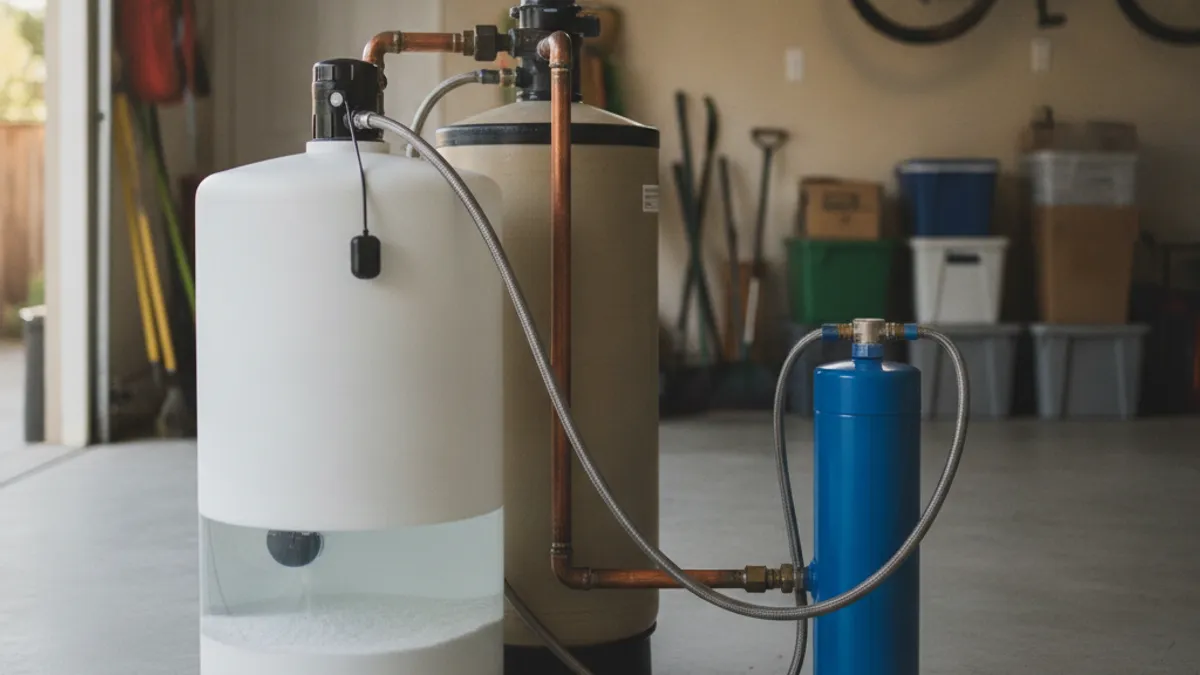
A salt-based system needs space for two tanks, the resin tank and the brine tank, plus a drain line for the regeneration discharge and, on most models, a nearby electrical outlet to power the control head. Garage installs are the most common in San Diego, since they offer both drain access and room for the brine tank without crowding a utility closet. A TAC system is more compact, typically a single tank with no brine reservoir needed, no electrical requirement on many models, and no drain line for backwash, which makes it a genuinely easier retrofit in a tight utility closet or a condo unit where floor space and drain access are both limited. This physical difference is worth factoring in alongside the sewer district question, since a cramped mechanical closet can rule out a salt-based system on space alone before the chloride discharge question even comes up.
The shower feel and lathering question
If the reason you want a softener is the slippery, soft feeling in the shower or better lathering with soap and shampoo, only a true salt-based system delivers that, because it’s the only one actually removing hardness minerals from the water. A TAC system protects your pipes and appliances from scale, but your test strip and your skin will both still register hard water. This is worth being honest with yourself about before choosing salt-free purely to avoid the salt, if the shower experience was the actual motivation behind wanting a softener in the first place.
Health and drinking water considerations
Neither system changes anything about the water beyond hardness minerals, so drinking water quality is largely equivalent between the two, aside from the small amount of sodium a salt-based system adds, typically 30 to 50 milligrams per liter for San Diego’s hardness range, which is a non-issue for most people but worth a conversation with a doctor for anyone on a strict low-sodium diet. Neither system addresses bacteria, chlorine taste, or anything a separate filtration setup would handle. If your goal includes better-tasting drinking water specifically, that’s a different system entirely from either softener option.
Which one to choose
If your sewer district has no restriction, you want the classic soft-water feel, and you’re comfortable with the salt and brine maintenance, a salt-based system is still the more complete solution for San Diego’s hardness levels. If your district restricts salt-based units, you want to avoid salt handling and brine discharge entirely, or you mainly care about protecting your water heater and appliances rather than the shower experience, a salt-free TAC system is a legitimate and increasingly common choice. Either way, keeping whichever system you choose properly maintained matters as much as the initial choice. We cover that in detail in our guide to water softener maintenance in San Diego, and if you already have a salt-based unit acting up, our water softener repair guide walks through the most common failures.
When you’re ready
If you’re trying to decide between salt-based and salt-free for your specific sewer district and household, call us at (858) 400-4417. The plumber we connect you with will check what your district allows, test your actual water hardness, and give you a straight recommendation instead of steering you toward whichever system happens to be in stock.
Areas this guide covers
We connect homeowners with licensed plumbers in these San Diego County communities.
Keep reading
Need a Plumber in San Diego?
Licensed, insured plumbers, ready across San Diego County. The plumber quotes you before any work starts.
Call (858) 400-4417Call any time, day or night, anywhere in San Diego County