
Last updated: August 15, 2026
Water main repair in San Diego: whose pipe is it?
Water main repair in San Diego explained: the public main, your service line, and the pipes inside the house are three jobs with three different owners.
The short answer
- The public water main in the street, your service line from the meter to the house, and your interior pipes are three separate systems with three separate owners.
- A wet patch or a green stripe in an otherwise dry yard, a spinning meter with everything off, or a sudden pressure drop at every fixture points to a service line failure.
- Unlike the sewer lateral, water service line responsibility is not uniform across San Diego County; confirm it with the agency named on your water bill.
- A plumber locates the failure before digging, usually with a pressure test and a listening device, so the repair targets the right few feet of pipe.
- Replacement can mean an open trench across the yard or a directional bore under a driveway or patio, and each comes with its own permit and restoration questions.
A water main break, a failed service line, and a leaking interior pipe are three different repairs, and knowing which one you have decides who you call first. Searches for water main repair in Poway, Vista, Carlsbad, and Oceanside show up often enough that it is worth untangling the three pipes homeowners lump together as “the water main,” because only one of them is ever actually the water agency’s problem to fix.
If you searched for water main repair or installation for your own address, there is a good chance what failed is not the main at all. It is the shorter run of pipe that belongs to your property, and the fix, the permit, and the bill all depend on which segment is involved.
Three different pipes, three different owners
Every home’s water supply runs through three distinct segments before it reaches a faucet. Mixing them up is the single most common reason a homeowner calls the wrong number first.
| Pipe segment | What it is | Who usually owns it |
|---|---|---|
| Public water main | The large pipe running under the street, serving an entire block | The water agency on your bill |
| Water service line (lateral) | The line from the main, through the meter, to the house | Typically the property owner, but confirm with your agency |
| Interior supply piping | Everything from the point of entry to your fixtures | The homeowner |
The public main is the agency’s infrastructure. A break there usually shows up as water surfacing in the street or a sudden loss of pressure across several homes, and the agency dispatches its own crew. That is not a homeowner repair and not something a residential plumber gets called to fix.
The service line is the segment in dispute. It runs from the main, through your meter, and up to where the pipe enters your house. Interior piping is unambiguously yours, running through walls and under floors to every fixture in the home.
Mature landscaping with deep roots, expansive soil that shifts with the season, and simply an older service line that has never been replaced can each cause a failure for a different reason, but the ownership question is the same one to answer first regardless of the cause.
The signs it might be your service line
A service line failure rarely looks like a burst pipe spraying water into the air. It is usually slower and easier to miss.
Watch for a wet or spongy patch of ground where nothing should be wet, especially if it appears without recent rain or irrigation. A single stripe of noticeably greener, faster-growing grass across an otherwise even lawn often traces the buried path of a leaking line, since the escaping water feeds the roots above it.
Check your water meter with every fixture in the house off, including the ice maker and any irrigation timer. If the meter’s low-flow indicator is still spinning, water is moving somewhere on your side of the meter. That single test, described in more depth in our guide to high water bills with no visible leak, separates a real leak from a billing error in a few hours.
A pressure drop that hits every fixture in the house simultaneously, rather than a single showerhead or faucet, points toward the line feeding the whole house rather than one fixture. Our guide to low water pressure in San Diego walks through how to tell a whole-house drop from a single-fixture problem. If you also notice other classic hidden-leak signs, our post on signs of a hidden water leak covers the broader list.
How a plumber confirms it before digging
Nobody should open a trench on a guess. A plumber confirms the failure’s location before touching a shovel.
The first step is usually isolating the service line at the meter, then pressure-testing it with the house side closed off. A line that holds pressure when isolated but drops it once opened to the house points to a failure somewhere between the meter and the structure.
From there, acoustic listening equipment traces the sound of escaping water along the buried path, narrowing the dig to a few feet instead of the whole yard. Where the account is unclear, the plumber may also recommend leak detection before committing to a repair method, since the location changes whether trenching or boring makes more sense.
Choosing between a trench, bore, or reroute
Once the failure is located, three approaches are usually on the table, and the right one depends on what sits above the pipe.
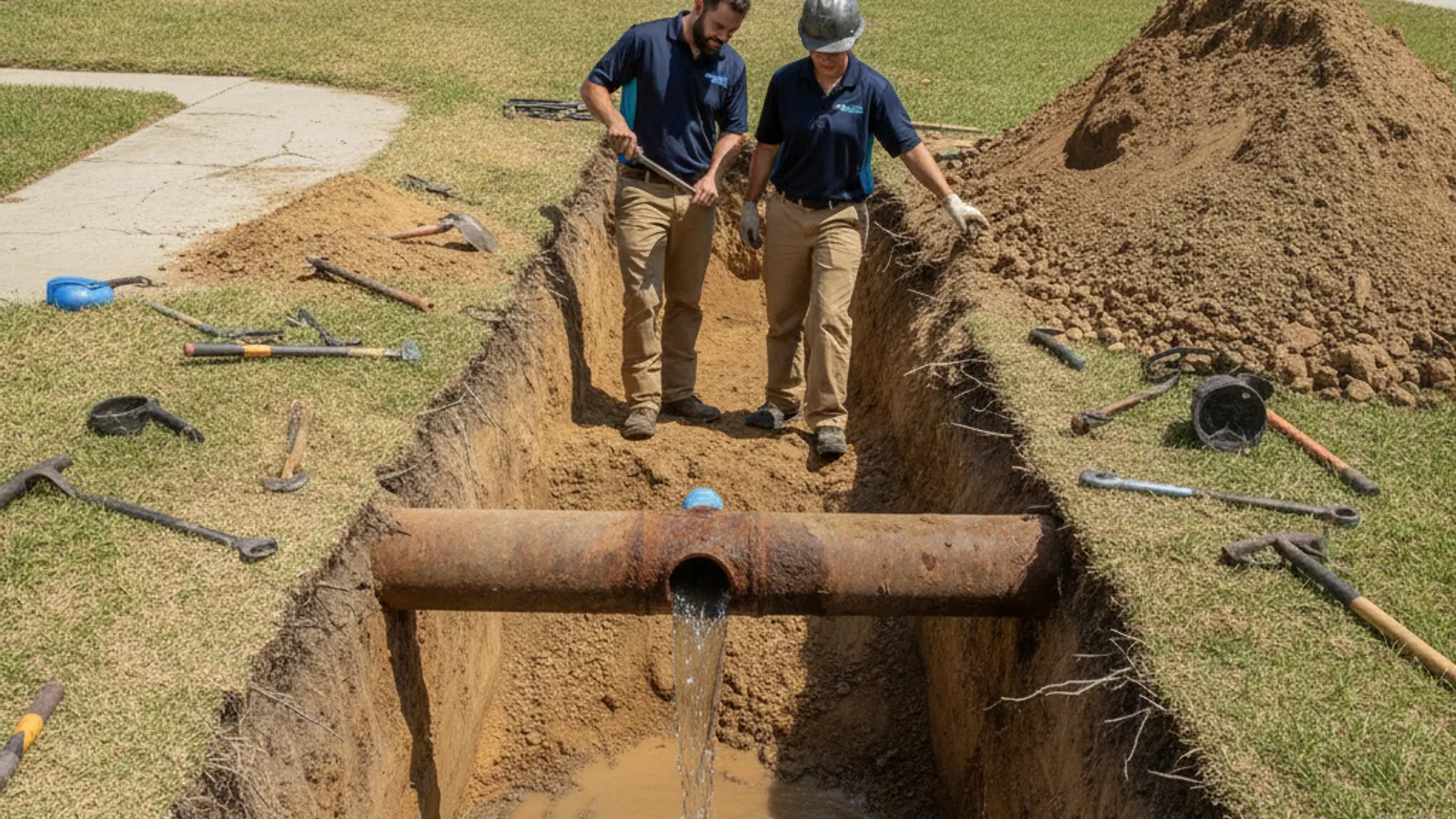
Open trenching digs a continuous channel along the pipe’s path. It is often the fastest and least expensive method where the route crosses open lawn or dirt, but every foot of hardscape it crosses, a driveway, a walkway, a patio slab, has to be cut and later restored.
Directional boring pushes a new line underground through a narrow bore path, entering and exiting through small pits rather than a continuous open cut. It costs more in setup but can save a driveway or mature landscaping from being torn out entirely.
A full reroute, running a new line along a different path instead of replacing the old one in place, sometimes makes sense when the original route runs under a structure or through soil that has already caused repeat failures. This is the kind of decision that belongs to the plumber assessing your yard, not a general rule, since the right call depends entirely on what sits between the meter and the house. A pipe repair assessment on site is the only way to know which method fits your property, and a service line failure on an old or already-patched run can be the moment to ask whether a broader whole-house repipe makes more sense than patching one more section.
Permits and putting the yard back
Work on the water service line typically requires a permit from the city or county building department covering your address, and the exact process depends on your jurisdiction. Ask the plumber who is pulling the permit and what inspection has to happen before the trench or bore pit gets closed up.
Restoration is its own line item. Sod, irrigation lines, a section of concrete or pavers, or a fence footing that sat in the path all need to go back, and that work is often separate from the pipe repair itself. Ask specifically what is included before you agree to a scope, so restoration does not show up later as a surprise.
Frequently asked questions
Who owns the water main in the street?
The water agency serving your address owns the public main. San Diego County has more than one water agency, and coverage is not uniform across the county. Check the agency named on your own water bill rather than assuming.
Who is responsible for the water service line?
It is not uniform across the county. San Diego has a documented rule making the homeowner responsible for the sewer lateral, but there is no equivalent single rule confirmed for the water service line in every jurisdiction. Ask your agency to state the boundary directly.
What are the signs a service line has failed?
A wet or unexplained soft patch of ground, a green stripe of unusually healthy grass tracing a path across the yard, a water meter that keeps moving with every fixture off, or a pressure drop across every faucet at once instead of just one.
How does a plumber find the problem before digging?
By pressure-testing the isolated line at the meter, then using acoustic equipment to trace the sound of the leak along its buried path. That narrows the dig before any trenching or boring begins.
What is the difference between trenching and boring?
Trenching opens a continuous channel along the pipe and usually costs less where there is no hardscape in the way. Boring pushes the new line through a narrow underground path and protects a driveway or established landscaping from being dug up.
Do I need a permit for this work?
Almost certainly, and the requirement comes from the building department covering your address. Ask the plumber who pulls the permit and what inspection is required before backfilling.
When to call us
A wet yard, a spinning meter, or a pressure drop across the whole house are not projects to diagnose with a shovel. This is licensed plumber work from the first pressure test to the final permit sign-off. Call (858) 400-4417 with your address, what you have noticed in the yard or on the meter, and how long it has been happening, and we’ll connect you with a licensed and insured local plumber who can locate the failure and walk you through the repair options.
Areas this guide covers
We connect homeowners with licensed plumbers in these San Diego County communities.
Keep reading
Need a Plumber in San Diego?
Licensed, insured plumbers, ready across San Diego County. The plumber quotes you before any work starts.
Call (858) 400-4417Call any time, day or night, anywhere in San Diego County