
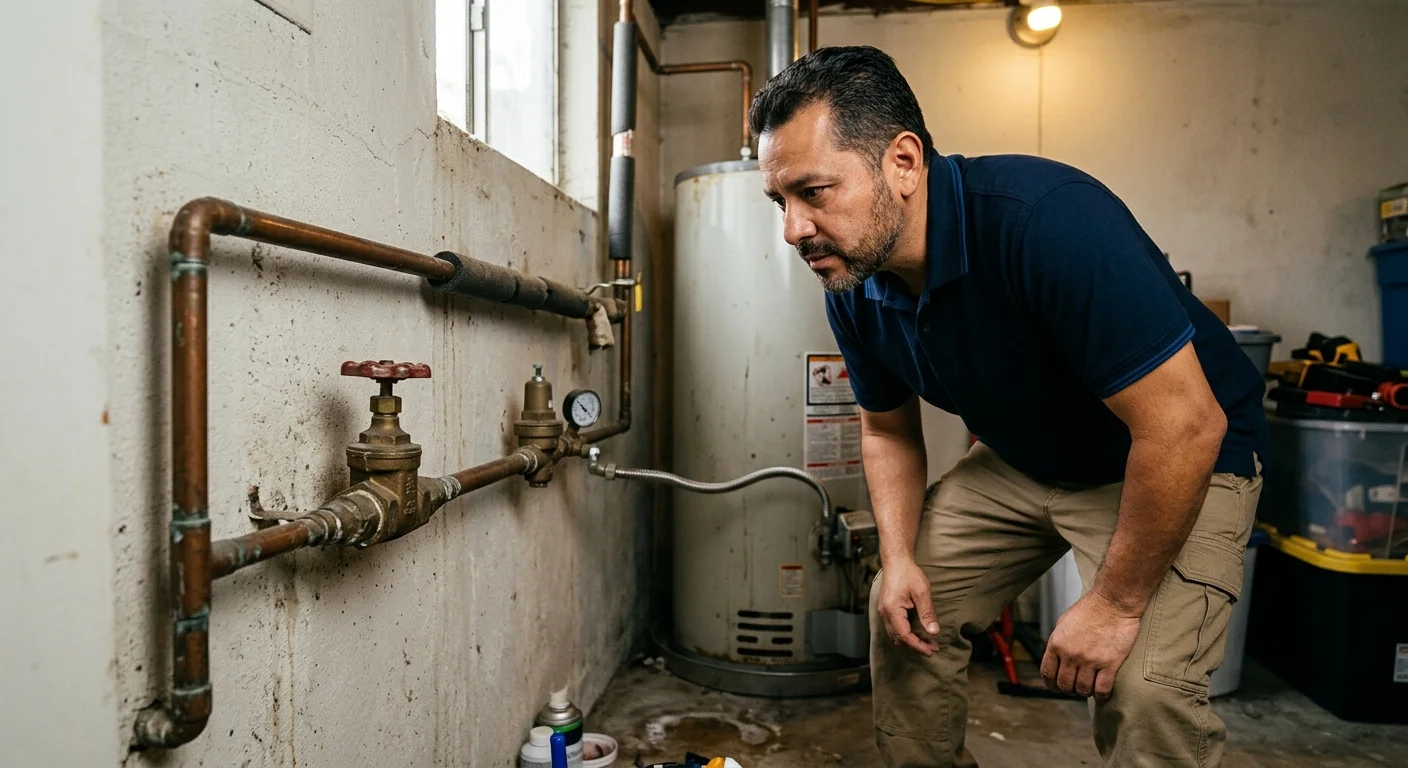
Main water shutoff valve won't close: what to do next
A main water shutoff that turns but won't stop flow needs careful identification. Learn what a licensed contractor may inspect and how to get help in San Diego.
A main shutoff that won’t close leaves two questions unresolved. You may have the wrong valve, or the valve may no longer control the flow as expected. Don’t force, loosen, dismantle, or replace it. A licensed plumber should identify the control point and determine the repair scope.
How to distinguish the home shutoff from other valves
A round handwheel often suggests a gate valve. A lever handle often suggests a different valve design. Handle shape alone doesn’t confirm that you’ve found the home’s main water shutoff.
Homes can have valves serving individual fixtures, irrigation piping, water heaters, and separate building areas. Multifamily properties may also have shared equipment. A valve beside exposed piping isn’t automatically the control for every fixture inside.
Start by identifying where the water service reaches the building. Look at property records, inspection reports, and labels left by prior owners. Our guide on how to find a main water shutoff valve explains the usual search areas without assuming every San Diego property has the same layout.
The water provider serving the address also matters. Don’t infer the provider from a San Diego mailing address. Check the current water bill for the agency name. If the bill isn’t available, use the San Diego County Water Authority as the starting point for finding the appropriate member agency.
This distinction matters across the county. A City Heights property, an Oceanside home, and a Santee address near SR-67 may not have matching service layouts. Even neighboring buildings can differ after additions or plumbing changes. Our Santee plumbing page offers more local context for properties in that part of East County.
Street-side or utility-side equipment also shouldn’t be assumed to be the homeowner’s valve. The water provider can confirm its current access rules and responsibilities for the address.
What a valve that turns without stopping flow may indicate
A gate valve uses internal parts to change the water passage. If its handle moves but water continues flowing, that observation doesn’t establish one specific failure.
The contractor may first verify whether the valve serves the entire home. A valve controlling one branch can appear ineffective when water remains available elsewhere. An unidentified second supply path or shared plumbing arrangement can also change what the test appears to show.
If the correct valve has been identified, the plumber may examine whether handle movement corresponds with movement inside the valve. A freely spinning handle, limited movement, or an unusual stopping point gives the contractor different information. None of those observations confirms the internal condition from the outside.
The plumber may also compare flow at appropriate fixtures and inspect the nearby supply piping. This separates a valve-control problem from a broader issue involving the service line or connected pipe. If the concern extends beyond the valve body, read our overview of water main repair in San Diego.
Mineral buildup may be considered during an inspection, but it shouldn’t be declared as the cause without evidence. The City of San Diego reports average drinking-water hardness of about 16 grains per gallon, or 276 parts per million. Levels can vary by location and demand. The city’s water-quality information can help residents confirm current data for their service area.
A valve that turns without stopping flow is therefore a symptom. The correct diagnosis depends on valve identity, internal condition, pipe layout, and observed flow.
What not to assume from a stuck or damaged handle
A stuck handle doesn’t prove the valve only needs more force. It also doesn’t prove that the valve body, nearby pipe, or service connection requires replacement.
Surface rust, discoloration, or an old-looking handle can be useful observations. They don’t reveal the condition of hidden internal parts. Likewise, a handle that looks clean may still fail to control water as expected.
Don’t assume the visible valve is the only shutoff involved. Renovations can leave unused valves or changed piping paths. Property additions can also complicate which valve serves which area. A plumber needs to trace the actual piping rather than relying on appearance.
Visible moisture deserves separate attention. Water near the valve might come from the stem area, a threaded or soldered connection, nearby pipe, condensation, or another source. The location must be inspected before anyone assigns a repair. If the piping itself appears involved, a pipe repair referral may be the appropriate next step.
The presence of a gate valve also doesn’t answer who owns or controls the equipment. That question depends on its location and the water provider’s rules. Confirm the serving agency through the water bill, then ask that agency about utility-side equipment.
Finally, don’t treat a stuck shutoff as proof of a quoted price, required replacement, or fixed repair time. Those details can’t be confirmed from the symptom alone. The independent contractor must inspect the property, identify the valve, and explain the proposed scope directly to the homeowner.
What the contractor you’re matched with may inspect
The contractor will need a clear description of what happened. Explain which valve was identified, what the handle did, and where water was still observed. Photos of the valve and surrounding pipe may help with the referral, but they don’t replace an onsite diagnosis.
During the inspection, the contractor may determine:
- Whether the valve controls the whole building or one branch
- Whether the handle, stem, and internal mechanism move together
- Whether moisture is coming from the valve or nearby piping
- Whether access is blocked by walls, landscaping, concrete, or a utility enclosure
- Whether connected pipe shows visible damage
- Whether the suspected problem reaches the service line
The contractor may also ask who supplies water to the address. Have the current bill available when possible. San Diego County includes multiple water providers, so the answer shouldn’t be guessed from the neighborhood name.
California’s C-36 classification covers water piping work and repair or replacement within the classification’s stated scope. Individual contractor capabilities still vary. Property owners can check license status, classification, bond information, complaint history, and workers’ compensation information through the CSLB license lookup. The database accepts searches by license number, business name, or personnel name. It’s unavailable during scheduled maintenance from Sunday at 8 p.m. through Monday at 6 a.m.
Plumbing Pro San Diego is a referral service. We don’t inspect valves, perform repairs, set prices, or determine the final scope. The homeowner contracts with and pays the independent plumber directly. Every plumber in the network is licensed and insured.
When valve repair and replacement become different scopes
A repair and a replacement aren’t interchangeable labels. The contractor decides which scope fits after identifying the valve and inspecting its condition.
A repair may focus on a specific accessible part or connection. Replacement involves removing the existing valve and installing another component within the connected piping. That can change the required access, materials, water coordination, and surrounding pipe work.
The valve’s location can shape the proposal. An exposed valve in an accessible utility area presents a different scope from one behind a finished wall or beside damaged pipe. A valve near a provider-controlled service point may also require coordination that an indoor branch valve doesn’t.
The contractor should explain whether the proposed work addresses only the valve or includes adjacent piping. Ask what was observed, which component is affected, and what conditions could change the scope after access begins. Those answers should be tied to your property, not presented as countywide averages.
No verified official price schedule establishes what San Diego contractors must charge for this work. Labor, access, materials, and existing conditions vary. Get the scope and price directly from the independent contractor before authorizing non-emergency work.
California requires a contractor license when the aggregate contract price for labor, materials, and all other items reaches $1,000 or more. The under-$1,000 exemption applies only to casual, minor, or inconsequential work that doesn’t require a building permit. It doesn’t apply when work is divided to evade licensing, forms part of a larger operation, involves employees, or is advertised as contractor work. Even work below the threshold may require a permit.
How to request an emergency plumbing referral
Request an emergency plumbing referral when a failed shutoff is connected to active water damage, uncontrolled flow, or another condition that can’t wait for routine scheduling. The matched contractor determines what can be inspected and what work is appropriate.
Give the referral service a short, factual description. Include the property city, building type, valve location, and what you observed. State whether water is actively escaping and which rooms or areas are affected. Don’t describe the valve as the confirmed main unless its role has been verified.
Mention access conditions that could affect the visit. Examples include a locked utility room, shared multifamily space, finished wall, crawlspace, exterior enclosure, or property gate. If the valve appears near a meter or utility box, identify the water provider from the bill.
Photos can document the visible condition. Capture the valve, nearby pipe, and wider surrounding area without dismantling anything. Avoid diagnosing the cause in the request. “The handle turns, but water remains available” is more useful than declaring that the gate or stem has failed.
We match homeowners with independent C-36 licensed plumbing contractors. The contractor you’re matched with evaluates the valve, proposes the scope, and discusses pricing directly with you. Plumbing Pro San Diego doesn’t perform the work or control contractor scheduling.
When to call us
A main shutoff that won’t control active water, has visible damage, or may involve nearby piping needs assessment by a licensed plumber. Call us at (858) 400-4417 and we’ll connect you with a licensed plumber.
Areas this guide covers
We connect homeowners with licensed plumbers in these San Diego County communities.
Keep reading
Need a Plumber in San Diego?
Licensed, insured plumbers, ready across San Diego County. The plumber quotes you before any work starts.
Call (858) 400-4417Call any time, day or night, anywhere in San Diego County