
Tankless water heater maintenance in San Diego
Tankless water heaters need one thing tank units don't: an annual descale. Here's the maintenance schedule for San Diego's hard water.
The short answer
- Tankless units need an annual descale flush, something tank water heaters don't require, because San Diego's 14 to 22 grain hardness coats the heat exchanger fast.
- A professional flush runs $150 to $250 and takes about an hour if your unit has isolation service valves; without them, expect a $150 to $300 retrofit first.
- Most manufacturer warranties (Rinnai, Navien, Noritz, Rheem) require documented annual maintenance in hard water areas like ours, or the warranty can be denied.
- A whole-house softener stretches the flush interval to 18 to 24 months but doesn't eliminate the need for one.
- Skipping maintenance doesn't show up right away. It shows up as reduced efficiency, then error codes, then a cracked heat exchanger.
San Diego homeowners switched to tankless water heaters in large numbers over the past decade, mostly for the endless hot water and the smaller footprint. What a lot of installers don’t spend enough time explaining is that tankless units trade one maintenance job for another. You lose the anode rod and sediment flush that tank units need. You gain an annual descale that tank units don’t need at all, and our water makes it non-negotiable.
Why tankless units feel San Diego’s hard water more than tank units do
A tank water heater stores 40 to 50 gallons and heats them slowly. Scale settles at the bottom of the tank, which is annoying but survivable for years. A tankless unit heats water on demand as it rushes past a compact heat exchanger, often at a flow rate high enough to hit 180°F surface temperatures inside the coil. Calcium and magnesium drop out of solution fastest at high heat, which means the exchanger scales up far quicker than a tank ever would, gallon for gallon.
City of San Diego water runs about 16 grains per gallon. Helix Water District, serving La Mesa, El Cajon, and Spring Valley, runs 16 to 18. Even the softer end of the county, around Sweetwater Authority’s 14 to 17 gpg, is well past the 10.5 gpg the U.S. Geological Survey calls “very hard.” None of it is friendly to a heat exchanger designed for national-average water closer to 7 to 10 gpg.
What an annual descale actually involves
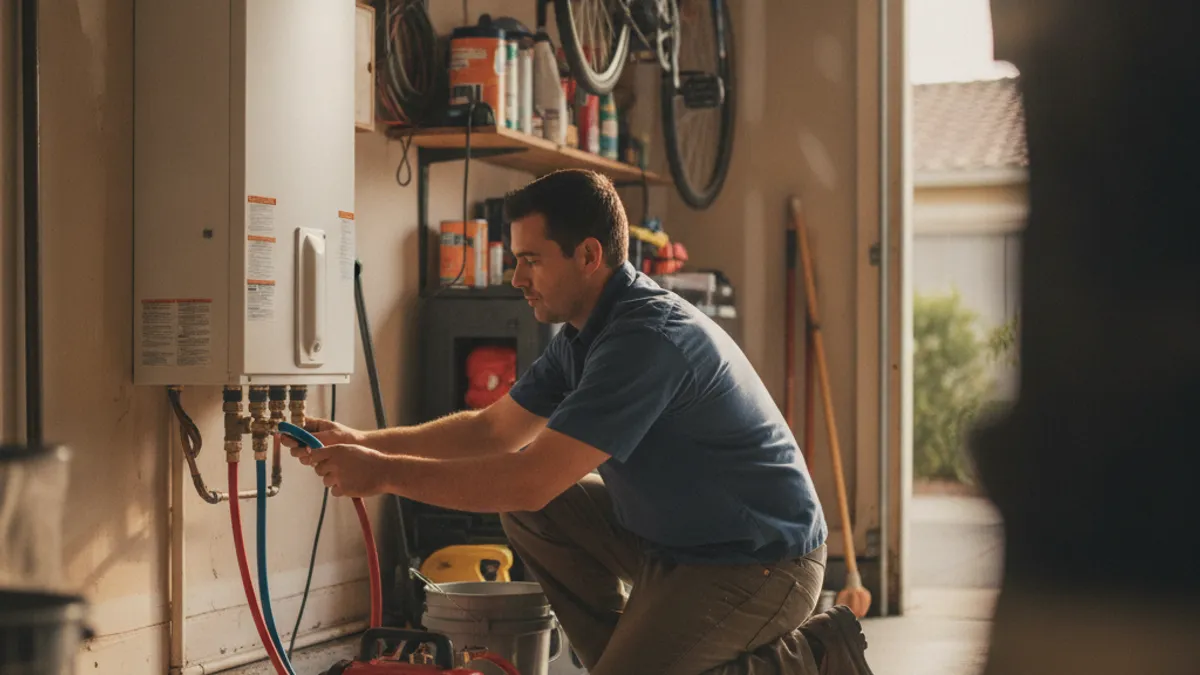
A proper flush isolates the unit from the house plumbing using two service valves, then circulates a mild acidic descaling solution (usually food-grade citric acid or white vinegar) through the heat exchanger with a small pump for 45 to 60 minutes. The solution dissolves the mineral scale without damaging the copper or stainless coil. After the circulation, the unit gets flushed with clean water to clear any residue, and the inline sediment filter, if your model has one, gets pulled and rinsed.
Done by a plumber, this runs $150 to $250 in San Diego, depending on access and whether the service valves are already in place. A DIY kit, a small submersible pump and two hoses, costs $50 to $90, and a comfortable DIY homeowner can do it in under an hour once the valves are installed.
The service valves most retrofits skip
Every tankless install should include an isolation valve kit, two ball valves with garden-hose threaded ports built into the cold and hot lines at the unit. Without them, there’s no clean way to isolate the unit and circulate descaling solution, and a technician has to cut into your copper or PEX lines just to attach temporary hoses. If your unit was installed without this kit, plan on a $150 to $300 retrofit before your first flush can even happen. It’s a one-time cost that pays for itself the first year.
How often to flush, realistically
Manufacturers generally recommend annual descaling for any water over 11 grains per gallon, which is every address in San Diego County. If you also run a properly maintained water softener, you can often stretch that to 18 to 24 months, since the softener is removing most of the scale-forming minerals before they ever reach the unit. Homes without a softener, or with one that’s fallen out of maintenance itself, should stay on the strict annual schedule. If you’re not sure how hard your specific tap water runs, see our breakdown of San Diego water hardness by district.
Signs your unit is already overdue
A few warning signs show up before a full failure. Longer wait times for hot water at the tap, since scale narrows the internal passages and slows flow. An error code related to overheating or flow restriction, which varies by brand but usually references temperature or flow sensor faults. A rattling or kettle-like sound during operation, caused by water boiling against scaled surfaces inside the coil. And a noticeable drop in the maximum flow rate the unit can sustain, which shows up as the unit “hunting” for temperature when two fixtures run at once.
What skipping maintenance actually costs
The failure path is predictable. Reduced efficiency first, which shows up as a slightly higher gas or electric bill and a few extra seconds of wait time. Error codes next, intermittent at first, then more frequent. Eventually the heat exchanger itself cracks under the accumulated scale stress, or the flow sensor fails from mineral buildup, and you’re looking at repair costs in the $600 to $1,200 range instead of a $150 to $250 flush. Compare that to a tankless repair we’ve written up in detail, and the math on annual maintenance is straightforward.
There’s a warranty angle too. Most manufacturers, Rinnai, Navien, Noritz, and Rheem included, write hard-water maintenance clauses into their tankless warranties. A claim in San Diego without a documented service history is a real risk of denial, since our whole county sits above the threshold every warranty department checks against.
DIY descale or hire it out
If your unit already has service valves, has been flushed before, and you’re comfortable working around water and a small pump, a DIY descale is genuinely doable. Buy a kit, follow the manufacturer’s specific circulation time, and you’ll save the labor cost every year. If your unit has never been flushed, doesn’t have service valves installed, or you’re just not confident working around the plumbing, hiring it out the first time is worth it. A plumber can also check the inlet filter, venting, and condensate line (on condensing models) while they’re in there, catching small issues before they become service calls.
When you’re ready
If you’re not sure whether your tankless unit has ever been descaled, or you want it added to a regular maintenance schedule instead of guessing, call us at (858) 400-4417. The plumber we connect you with will check for service valves, test your unit’s actual flow rate, and set a schedule that matches your specific water hardness, not a generic manufacturer default built for a softer part of the country.
Areas this guide covers
We connect homeowners with licensed plumbers in these San Diego County communities.
Keep reading
Need a Plumber in San Diego?
Licensed, insured plumbers, ready across San Diego County. The plumber quotes you before any work starts.
Call (858) 400-4417Call any time, day or night, anywhere in San Diego County