
Tankless Water Heater Installation in San Diego (2026)
Tankless install in San Diego runs $3,800–$7,500 for gas, more if you need a gas line resize, panel upgrade, or Cat IV venting. Real 2026 costs.
The short answer
- Tankless installation in San Diego runs $3,800 to $7,500 for a typical gas unit and $1,800 to $4,500 for electric in 2026.
- The unit is only about a third of the bill; the rest is gas line resizing, Cat IV venting, condensate routing, electrical work, and permits.
- Converting a gas tank to electric tankless usually adds a panel upgrade on top.
- California requires a plumbing permit and a licensed contractor for the gas, venting, and electrical work; self-install voids most warranties.
- Heat exchanger warranties run 12 to 15 years. Call (858) 400-4417 for a quote on your home.
A tankless water heater in San Diego costs $3,800 to $7,500 installed for a typical gas unit, and $1,800 to $4,500 for electric. The unit itself is only about a third of the bill. The rest is gas line resizing, Cat IV venting, condensate routing, electrical work, and permits. If you’re converting from a gas tank to electric tankless, expect a panel upgrade on top.
This guide covers what installation actually costs in San Diego, what California compliance requires, how the payback math works against SDG&E rates, and which brands hold up best in our hard water and coastal air.
If you already have a tankless unit and it’s failing, read the tankless water heater repair guide instead.
Tankless install cost in San Diego (2026)
San Diego Tankless Water Heater Installation Costs (2026)
The price spread is wide because every San Diego install has different starting conditions. A 1995 home with a 1/2-inch gas line to the garage and a 100A panel needs more work than a 2018 build with a 3/4-inch line already run. Get a real on-site quote. Phone bids without a site visit are guesses.
Gas tankless: real cost includes more than the unit
A Navien NPE-240A2 or Rinnai RX199i runs $1,400 to $2,200 for the unit alone. The rest of the install is where homeowners get surprised.
Gas line resize. Tank heaters draw 35,000 to 40,000 BTU. Tankless units fire at 180,000 to 199,000 BTU. A 1/2-inch gas supply line that worked fine for a tank will starve a tankless unit. Most San Diego homes built before 2010 have 1/2-inch runs to the water heater. Upsizing to 3/4-inch from the meter adds $400 to $1,200 depending on run length and access.
Cat IV venting. Modern condensing tankless units (Navien NPE, Rinnai RX, Noritz NRCP, Takagi T-H3) are Category IV appliances. They vent with sealed PVC or polypropylene because exhaust temps are low enough. Older non-condensing units need stainless steel Category III venting. PVC is cheaper. Stainless can run $30 to $60 per linear foot installed. Always confirm what your specific unit requires.
Condensate routing. Condensing units produce acidic condensate, roughly 1 to 1.5 gallons per hour of operation at peak. That needs a drain path with a neutralizer cartridge. If your install location has no nearby drain, you’re looking at $200 to $500 for a condensate pump and tubing.
Descaling isolation valves. Plumbing Pro and any decent installer adds isolation valves (sometimes called service valves) on the cold inlet and hot outlet. They make annual descaling possible without cutting pipe. Skip these and you’ve built in a future repair bill. Cost: $80 to $150 for the valve kit.
Recirculation pump. If you want hot water at the far bathroom in under 10 seconds, the unit needs a dedicated recirc loop or an on-demand pump. Navien NPE-A series and Rinnai RX series have built-in recirc pumps. Adding a return line if your house wasn’t plumbed for one is $400 to $1,500.
Electrical outlet. Even gas tankless units need a 120V outlet within 6 feet for the control board and fan. If there’s no outlet nearby, that’s a $200 to $400 add.
Add it up and a “$2,000 unit” easily turns into a $4,500 install with no surprises and $7,000 with several.
Electric tankless: panel reality
Electric whole-home tankless looks attractive on paper. No gas line, no venting, no condensate. But the electrical load is the catch.
A whole-home electric tankless that can handle 4 GPM at a 50-degree rise needs 24 to 27 kW. That’s three or four 40-amp double-pole breakers, depending on the unit. You’re pulling 100 to 120 amps of dedicated capacity just for hot water.
Most San Diego homes built before 1990 have 100A or 125A main service. A 1970s ranch in Clairemont or a 1980s tract in Mira Mesa cannot run a whole-home electric tankless without a service upgrade. Expect a 200A panel upgrade at $3,500 to $6,500, including the SDG&E coordination and permit. In some neighborhoods, SDG&E also has to upgrade the service drop, which adds weeks to the timeline.
Point-of-use electric tankless makes more sense in San Diego. A 7 kW unit under a bathroom sink for handwashing, or a 12 kW unit for a single shower in an addition where extending hot water is impractical. Those run on a single 30A or 40A double-pole breaker and don’t require a panel rebuild.
If your goal is electrification away from gas, a hybrid heat pump water heater is usually the smarter path in San Diego’s climate. Coastal temperatures rarely drop below 45 degrees, which is well within the efficient range for heat pumps. SDG&E and TECH Clean California rebates can knock $1,000 to $3,800 off the install.
Tank vs tankless: payback in SD
The energy savings claim on tankless is real but smaller than the marketing suggests.
Department of Energy testing shows tankless units use 24 to 34 percent less energy than tank units for homes using up to 41 gallons of hot water per day. Homes using 86 gallons per day see 8 to 14 percent savings because the standby loss advantage shrinks at high volume.
Run the math on a typical San Diego household of three to four people:
A gas tank water heater burns roughly 200 therms per year. SDG&E residential gas rates as of 2026 sit around $2.40 per therm including transportation and the Climate Credit offset. That’s $480 per year.
A condensing tankless cuts that by 25 to 30 percent. You save $120 to $145 per year.
If your install premium over a like-for-like gas tank replacement is $2,500 (typical), straight-line payback is 17 to 21 years. The unit will last that long. Tankless lifespan is 20 years vs. 10 to 12 for a tank, so the second tank you would have bought is part of the math too. Factor that in and effective payback drops to 9 to 13 years.
Don’t buy tankless purely for the energy savings. Buy it for endless hot water, the space recovery (a tankless unit is the size of a carry-on suitcase), and the longer lifespan. The energy savings are a bonus.
Top tankless brands installed in San Diego
Brand choice in San Diego comes down to parts availability, local rep support, and how well the unit handles hard water.
Navien (NPE-2 series). The most-installed tankless brand in San Diego for the last five years. Strong local parts network, built-in recirculation pump on A-series, and condensing efficiency rated at 0.95 UEF or higher. The NPE-240A2 covers most 3-bath homes. Field reliability is good if descaled annually.
Rinnai (RU and RX series). The other dominant brand here. RX199iN handles big homes (4+ bath) without strain. Rinnai’s stainless heat exchanger holds up well in hard water with annual service. Parts availability through local supply houses is solid.
Noritz (NRCP and NRCB). Smaller market share locally but a good unit. NRCP1112-DV has a built-in pump. Service techs familiar with Noritz are fewer than Navien or Rinnai, so confirm your installer knows the platform before you buy.
Takagi (T-H3 and T-KJr2). Industrial-grade build, often spec’d in light commercial. Parts and service are slower in San Diego than Navien or Rinnai. Good unit, less ideal if you want fast service calls.
Rheem (RTGH). Solid mid-tier option. Easier to find parts at big-box retailers, which matters for emergency repairs. UEF ratings are competitive with Navien and Rinnai.
For most San Diego homes, Navien NPE-240A2 or Rinnai RX160iN are the safest picks. Both have wide installer familiarity, strong parts pipelines, and field-proven hard water performance.
Indoor vs outdoor install in San Diego
San Diego’s mild climate makes outdoor tankless installs more practical here than in most US markets. A weatherproof-rated unit (most Navien and Rinnai exterior models) bolts to a garage exterior wall, vents to atmosphere with no Cat IV pipe needed, and frees up interior space. Outdoor installs run $300 to $700 less than indoor because you skip the vent run.
The tradeoff is salt-air corrosion. If you’re within roughly a mile of the coast (think La Jolla, Pacific Beach, Ocean Beach, Mission Beach, Coronado, Del Mar, Solana Beach, Cardiff, Encinitas, Leucadia, Carlsbad), exterior-mounted units corrode faster. Stainless steel heat exchangers handle it, but the fan motor and electronics still take a beating. For coastal homes, install indoors if you have the wall space, or accept a shorter lifespan on outdoor units (12 to 15 years vs. 20+).
Inland from the I-5/805 split (Mira Mesa, Tierrasanta, Rancho Bernardo, Poway, Santee, El Cajon), outdoor garage-wall installs are fine. Salt exposure is minimal and the savings on venting are real.
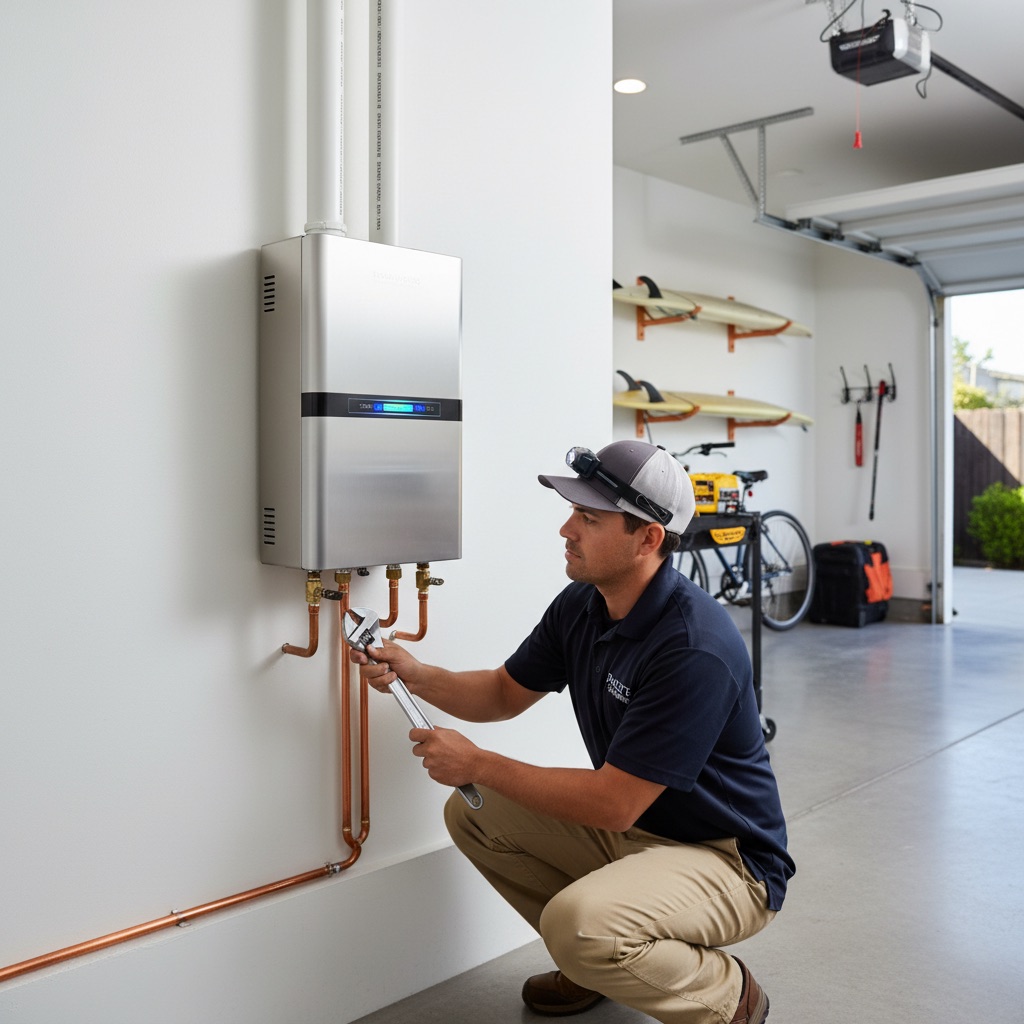
Garage interior installs are the most common compromise. Protected from weather, easy access for service, plenty of room for combustion air, and you skip the salt corrosion concern. Closet installs work but need fresh-air ducting and increase noise inside the house.
California compliance: Title 24, AQMD, venting
A San Diego tankless install must comply with three things your contractor pulls or handles:
Title 24 energy compliance. California’s Title 24 requires water heaters meet minimum efficiency thresholds. Tankless units installed in residential applications need a UEF of 0.81 or higher for natural gas, which every condensing tankless on the market easily exceeds. Pipe insulation on the first 5 feet of hot and cold lines from the heater is required and gets inspected.
SDAPCD permits. San Diego County is in the South Coast Air Quality jurisdiction for some appliance rules. Most residential tankless water heaters fall under SCAQMD Rule 1146.2 (or the SDAPCD equivalent for residential units), which sets NOx emission limits. Every name-brand tankless sold in California already meets the limits (typically 14 ng/J or lower), so this is rarely a hold-up, but your installer still needs to confirm the model is rule-compliant before submitting the permit.
Building permit and inspection. A water heater install in San Diego County requires a plumbing permit. If gas line work is involved, that’s added to the permit. If electrical work is involved (electric tankless or panel upgrade), an electrical permit and inspection too. Expect $150 to $400 in permit fees depending on scope.
Venting compliance. Cat IV venting must follow the manufacturer’s spec exactly. PVC vs. polypropylene, slope back to the unit for condensate drainage, termination clearances from windows and air intakes (typically 4 feet horizontal, 1 foot above). Concentric vent kits handle intake and exhaust through a single penetration and are common on sidewall installs. Skipping the concentric kit and using separate pipes is fine if clearances work out, but concentric is cleaner and reduces leak points.
A licensed plumber pulls all of this. An unlicensed installer skipping permits saves you $300 and exposes you to insurance denial, resale disclosure issues, and CSLB enforcement. Don’t.
Maintenance reality: annual descaling
San Diego water averages 17 grains per gallon of hardness, well above the 7 gpg threshold where scale buildup accelerates. Inside a tankless heat exchanger, scale insulates the copper or stainless surface from the gas flame, forces the unit to run longer to hit setpoint, drops efficiency, and eventually triggers overheating shutdowns.
Every tankless manufacturer requires annual descaling to honor the warranty. Skipping it doesn’t void the unit immediately, but it ages the heat exchanger fast. A unit that should last 20 years gives up at 8 to 10 if it’s never descaled.
Professional descaling runs $150 to $300 in San Diego, takes 60 to 90 minutes, and uses a circulation pump to flush food-grade descaler through the heat exchanger via the isolation valves. DIY descaling is possible if you have the isolation valves, a submersible pump, and 4 gallons of white vinegar or a commercial descaler.
If you install a whole-home water softener (typical install $1,800 to $3,200 in San Diego), descaling frequency drops to every 3 to 5 years and unit lifespan extends. For homeowners staying long-term, softener plus tankless is the right pairing. Read more on water softener installation.
When tankless is the right call
Tankless makes sense in San Diego if:
You have a household that runs hot water simultaneously across multiple fixtures and a tank can’t keep up. A properly sized tankless never runs out.
You’re planning to stay in the home 10+ years and want the longer lifespan.
You need the floor space a 50-gallon tank takes up.
You’re already replacing a failed tank water heater and the install premium is $1,500 to $2,500 over a like-for-like tank swap.
Tankless is the wrong call if you’re at the cost ceiling of a $3,500 tank swap and don’t want to spend more, if your home has electrical or gas infrastructure that needs expensive upgrades, or if you’re 2 to 3 years from selling. Recouping a tankless premium on resale is uncertain.
If you’re not sure what your current heater is costing you to run or whether replacement is even the right move yet, read the water heater replacement cost guide and how long water heaters last. For a head-to-head on the two formats, see our breakdown of tankless vs a traditional tank water heater.
Frequently asked questions
How long does a tankless install take in San Diego?
A straightforward gas-to-gas tankless swap in the same location runs 6 to 10 hours, single day. A new-location install with gas line resize, venting through a wall, and condensate routing runs 1.5 to 2 days. Electric tankless with a panel upgrade can stretch to 3 to 5 days because of the SDG&E coordination.
Do I need a permit to install a tankless water heater?
Yes. San Diego County requires a plumbing permit for any water heater swap, and electrical or mechanical permits if those trades are involved. A licensed contractor pulls them. Skipping permits causes problems at resale and can void insurance claims.
Will a tankless unit work during a power outage?
No. Even gas tankless units need 120V power for the control board, fan, and ignition. A small UPS or battery backup ($150 to $400) can keep the unit running for short outages, but most San Diego homeowners don’t bother. If you lose hot water for a day, it’s not catastrophic.
Can I install a tankless unit myself?
Legally in California, gas line work and venting on a Category IV appliance require a licensed contractor and pulled permits. The unit-mounting and water connections are within DIY scope, but the gas, vent, and electrical pieces are not. Self-install also voids most manufacturer warranties.
How loud is a tankless water heater?
Quieter than a furnace. The fan runs at 50 to 55 dB during operation, similar to a dishwasher. Outdoor and garage installs are essentially silent inside the house. Closet installs in living space can be heard but aren’t intrusive.
What’s the warranty on a tankless water heater?
Heat exchanger warranties run 12 to 15 years on residential units (Navien NPE: 15 years; Rinnai RX: 15 years; Noritz NRCP: 12 years). Parts warranty is typically 5 years. Labor warranty depends on the installer. Plumbing Pro stands behind installation workmanship for 1 year.
Talk to a real installer before you buy
Our tankless water heater installation pricing varies more than almost any other plumbing job because every house starts from a different place. The right answer for your home depends on your current gas line size, panel capacity, vent routing options, and what you want from the system. A site visit and an honest quote beats a phone estimate every time.
If you want a real number for your San Diego home, call (858) 400-4417. We’ll look at what’s there, tell you what the install actually needs, and price it without surprises. If a tank replacement makes more sense than tankless for your situation, we’ll tell you that too.
If you’re already past install and dealing with a unit that won’t fire, read no hot water in San Diego for the first round of diagnosis.
Areas this guide covers
We connect homeowners with licensed plumbers in these San Diego County communities.
Keep reading
Need a Plumber in San Diego?
Licensed, insured plumbers, ready across San Diego County. The plumber quotes you before any work starts.
Call (858) 400-4417Call any time, day or night, anywhere in San Diego County