Last updated: April 21, 2026
10 Signs You Need an Emergency Plumber (And What Can Wait)
Mold starts in 24–48 hrs after water damage. These 10 signs mean call now, not tomorrow. After-hours dispatch runs $150–$300 in SD. What qualifies.
The short answer
- Call an emergency plumber now if there is active water damage, a health or safety risk like sewage or gas, no water service, or a problem that will worsen overnight.
- Ten cannot-wait signs include a burst pipe, sewage backup, no water at all, a gas smell, a leaking water heater tank, and an overflowing toilet you cannot stop.
- Slow drips, a briefly running toilet, or mildly low pressure can wait for a scheduled appointment.
- Mold can start in wet drywall within 24 to 48 hours, so getting a plumber out quickly limits damage.
- After-hours dispatch in San Diego runs $150 to $300 plus the repair; verify a C-36 license before hiring. Call (858) 400-4417.
A dripping faucet at midnight doesn’t need to ruin your sleep. A sewage backup bubbling up through your shower drain absolutely does. Knowing the difference between a “call in the morning” problem and a “call right now” emergency can save you thousands of dollars in damage, and in some cases, protect your family’s health and safety.
This guide covers the 10 clearest signs you need an emergency plumber immediately, what can wait for a regular appointment, what to do in the minutes before a plumber arrives, and red flags to watch for when hiring someone under pressure.
What separates a true plumbing emergency from a problem that can wait?
Not all plumbing problems are created equal. A true emergency has one or more of these characteristics:
- Active water damage is occurring, water is flowing somewhere it shouldn’t be, right now
- There’s a health or safety risk, sewage exposure, gas involvement, contaminated water
- The problem will significantly worsen if left until morning or the next business day
- You have no water service and the disruption affects basic household function
A slow-dripping faucet, a toilet that runs for a few minutes after flushing, or a shower with mildly reduced pressure? Those are real problems, but they can wait for a scheduled appointment. The following 10 situations cannot.
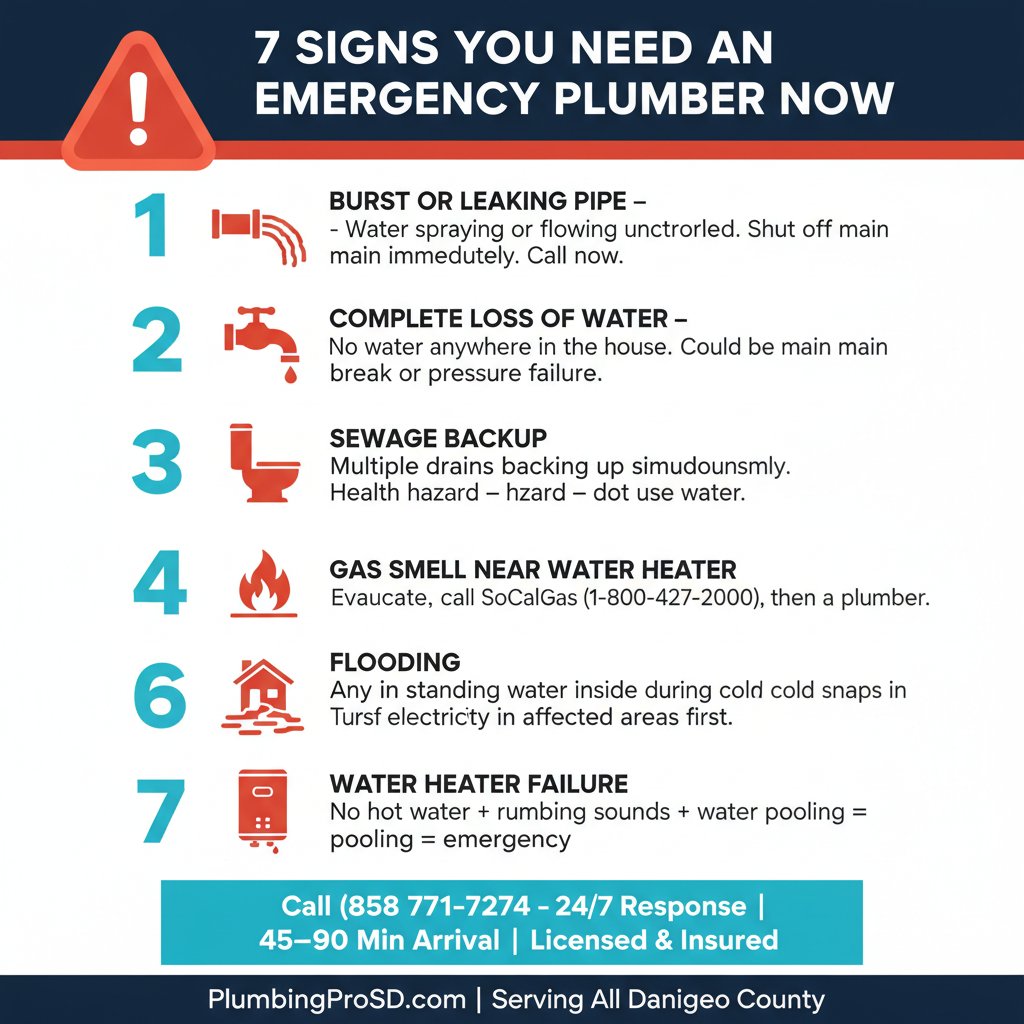
10 Signs You Need an Emergency Plumber Right Now
1. A Pipe Has Burst and Water Is Actively Flowing
This is the classic plumbing emergency. When a pipe fails, from age, corrosion, high pressure, or physical damage, water can pour into wall cavities, floors, and living spaces at rates of dozens of gallons per minute. In San Diego homes, burst pipes most commonly occur in older copper supply lines that have been weakened by the area’s hard, mineral-rich water over decades.
What to do first: Locate your main shutoff valve (typically at the curb in a meter box, or at the pressure regulator where the main line enters your home) and turn off your water supply. Then call immediately. Every minute of active flow means more water damage, more drying time, and a higher restoration bill.
2. Sewage Is Backing Up Into the House
Sewage reversing direction and coming up through floor drains, shower drains, or multiple toilets simultaneously is a plumbing emergency and a health hazard. Sewage contains bacteria, viruses, and other pathogens that create dangerous conditions in your home.
This typically signals a blockage or failure in the main sewer lateral, the pipe that carries all wastewater from your home to the city main. Common causes in San Diego include tree root intrusion (particularly in older North Park, Kensington, and Normal Heights neighborhoods with mature trees), grease accumulation in kitchen-heavy households, and deteriorated Orangeburg pipe in homes built before the 1970s.
Do not use any fixtures until the backup is cleared. Do not attempt to snake it yourself, without knowing the cause, you risk making the situation worse. Call an emergency plumber who can deploy a camera to diagnose the source before treating it.
3. You Smell Gas Near a Water Heater or Appliance
Natural gas has no odor in its natural state. Utility companies add a sulfur compound (mercaptan) specifically so people can detect leaks, that rotten egg or sulfur smell is the warning system. If you smell it near your water heater, stove, dryer, or along walls where gas lines run:
- Do not flip any switches, light anything, or use any electrical device
- Leave your home immediately, leaving doors open as you go
- Call SDG&E at 1-800-411-7343 from outside, they respond to gas emergencies around the clock
- Also call a licensed plumber from outside to inspect and repair the gas line or appliance connection
Gas leaks involving water heaters are specifically a plumbing issue, and a licensed plumber will coordinate with the gas company once the leak is confirmed safe to re-enter. If the gas smell is coming from your furnace or HVAC unit rather than the water heater, that’s an HVAC contractor’s scope, and a licensed HVAC contractor handles gas-fired heating equipment in San Diego.
4. You Have No Water at All
A complete loss of water pressure throughout the home, not just reduced pressure in one fixture, but zero water from any tap, points to a significant problem upstream of your fixtures. Check the San Diego County Water Authority’s service alerts to rule out a planned outage or main break in your neighborhood.
If it’s not a utility issue, the cause could be a failed pressure regulator, a shut main valve, or a significant supply line failure. A house without water cannot function, this warrants an emergency call.
5. Water Is Actively Coming Through a Ceiling or Wall
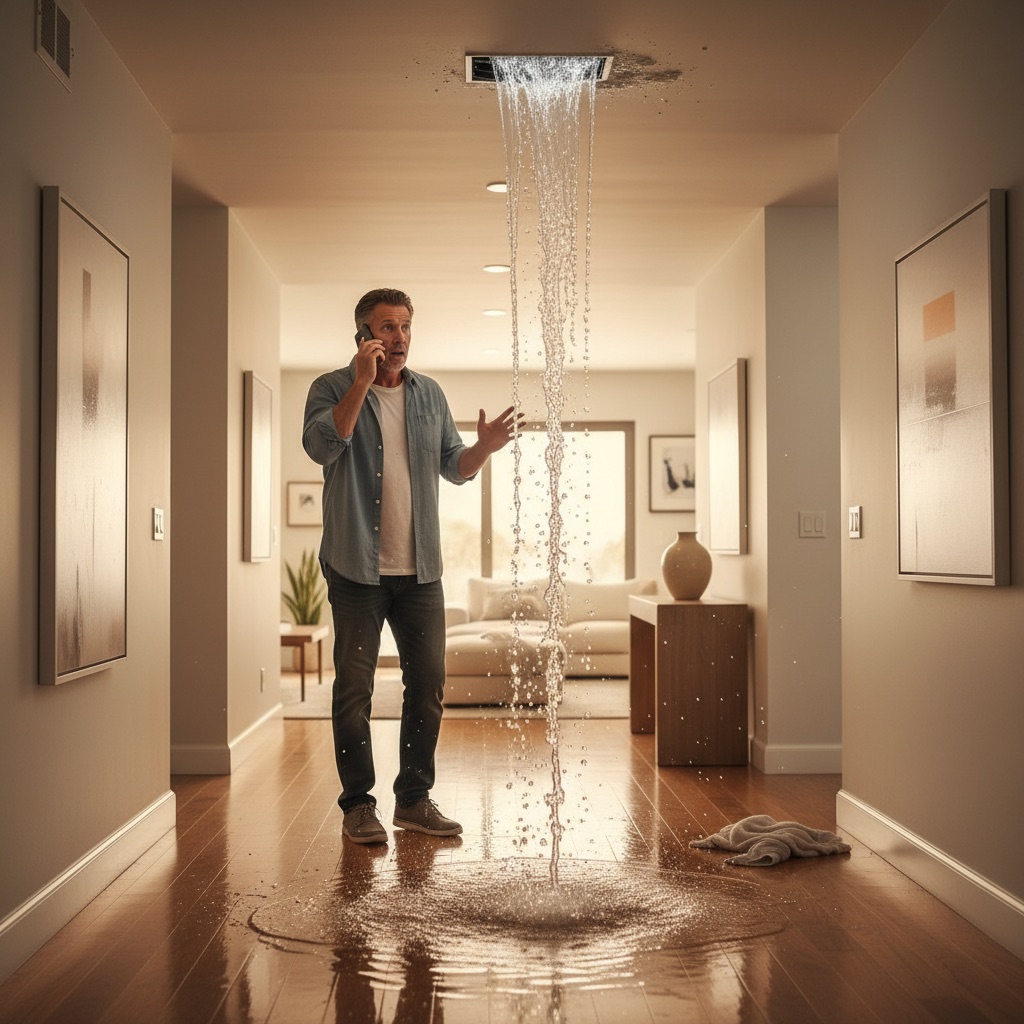
Water stains are worrying. Water actively dripping or flowing through a ceiling or wall is an emergency. There is a failing pipe somewhere above or behind that surface, and the water you can see is just what’s made it through, far more is accumulating in the wall cavity, floor structure, or ceiling material.
The longer this runs, the more building material becomes saturated. Mold begins growing within 24-48 hours of water exposure. Drywall, insulation, and wood framing that stay wet long enough require full replacement. Call now, not in the morning.
6. Your Water Heater Is Leaking From the Tank
A water heater leaking from the tank body, not from a connection or fitting at the top, but from the tank itself, means the tank has corroded through and cannot be repaired. A tank that is actively leaking can fail catastrophically if the structural integrity has been compromised.
Turn off the gas supply or circuit breaker to the unit, turn off the cold water inlet valve, and call an emergency plumber. An active tank leak will only worsen, and a failed tank can dump 40-80 gallons of scalding water.
If water is dripping from the temperature and pressure (T&P) relief valve, the valve with a pipe pointing down the side of the unit, this is also an emergency signal. That valve opens when tank pressure or temperature exceeds safe limits. It should not be running.
7. Multiple Drains Are Backing Up Simultaneously
A single slow drain is almost always a localized clog. When two or more drains back up at the same time, kitchen sink and laundry drain, or bathtub and toilet, that pattern points to the main sewer line, not individual branch clogs. This is the early warning stage before a full sewage backup. Act now, before the situation escalates.
8. You Have Flooding and Don’t Know the Source
Water on the floor with no obvious cause is an emergency. It could be a slab leak, a supply line failure beneath your concrete foundation, a dishwasher supply line, a failed refrigerator water line, or a slow leak that’s been accumulating under flooring and finally saturated through. The source needs to be found and stopped immediately.
San Diego homes are particularly susceptible to slab leaks. The city’s predominantly slab-on-grade construction means supply lines run under concrete, and the hard local water accelerates copper corrosion. If you notice a warm spot on a tiled or concrete floor, that’s often a hot-side slab leak before it becomes visible flooding.
9. A Toilet Is Overflowing and Won’t Stop
If your toilet is overflowing and the float mechanism isn’t stopping it, the flow valve is stuck open. Turn off the water supply valve at the base of the toilet, it’s a small oval valve behind and below the tank. If that doesn’t work, shut the main. If sewage is involved in the overflow, treat it as a sewage backup (see Sign 2 above) and call immediately.
10. You Hear Running Water With Everything Off
The sound of water moving inside walls, floors, or ceilings when every fixture in the house is off is never normal. It indicates water is flowing somewhere in your supply system that isn’t connected to a fixture, meaning it’s flowing into your building structure. This is a hidden leak that has found a path and is actively causing damage you can’t yet see.
Run your water meter test: locate your meter at the curb, note the reading, ensure nothing is running, and check again in 30 minutes. If the meter moved, you have an active leak. See our detailed guide on water leak detection in San Diego for more diagnostic steps.
What should you do before the plumber arrives?
Making the right moves in the minutes before a plumber arrives can significantly limit damage:
1. Shut off the water. Your main shutoff is typically in the meter box at the curb on San Diego residential properties, or at the pressure regulator inside. Know where it is before you need it.
2. Turn off your water heater. With the cold water supply shut off, your water heater is being fed nothing. Gas units: turn to “pilot.” Electric units: flip the circuit breaker. Running a heater dry damages the unit.
3. Move belongings and electronics out of affected areas. Water spreads faster and farther than it appears. Get items off the floor.
4. Document everything. Take photos and video of all visible damage before anything is cleaned up, dried, or repaired. Your homeowner’s insurance claim requires this documentation.
5. Call your insurer. Sudden water damage from plumbing failures, burst pipes, sewage backups, is typically covered under standard homeowner’s policies. Call to open a claim while you’re waiting for the plumber. Do not wait until the repair is done.
6. Ventilate if there’s a gas smell. Open windows and doors as you leave. Do not re-enter until both the gas company and a plumber have cleared the space.
What are the red flags when hiring an emergency plumber under pressure?
Plumbing emergencies create pressure, and some contractors exploit that. Watch for these warning signs:
No license offered or refused when asked. California requires plumbing contractors to hold a C-36 license from the CSLB. Any legitimate contractor will provide their license number on request. You can verify it instantly at the CSLB license lookup.
Vague pricing before work starts. You are entitled to a written estimate, or at minimum a clear verbal quote with a number, before authorizing any work, even at 2 AM. “We’ll figure out the price when we’re done” is not acceptable.
High-pressure approval tactics. A legitimate plumber explains what they found and what needs to be done. They give you time to ask questions. High-pressure tactics to approve extensive work immediately, especially walls, floors, or excavation, without a clear diagnosis are a red flag.
No answer after hours. A company that claims 24/7 emergency service but routes calls to voicemail after hours isn’t actually providing emergency service.
Demands for full cash payment upfront. Most reputable plumbing contractors accept standard payment methods and don’t require full cash payment before work is complete.
Frequently Asked Questions
Q: Is a clogged toilet a plumbing emergency?
A single clogged toilet in a home with multiple bathrooms is not typically an emergency, it’s inconvenient, but you have other options. If it’s your only toilet, if the clog is causing overflow you can’t control, or if multiple toilets are backing up simultaneously, call an emergency plumber. A plunger is always the first thing to try; if that doesn’t clear it, don’t repeatedly flush.
Q: Can I wait until morning for a water heater leak?
It depends on where the leak is. A small drip from a connection fitting at the top of the unit can wait, turn the cold water inlet down and place a towel. A leak from the tank body itself, or water discharging from the T&P relief valve, cannot wait. Turn off the unit and call an emergency plumber.
Q: What does an emergency plumbing call cost in San Diego?
Emergency plumbing in San Diego typically runs $150-$300 in after-hours dispatch fees, plus the cost of the repair itself. Expect to pay a premium over standard daytime rates, after-hours response involves real costs. Legitimate companies are upfront about this before starting work. Get a quote before authorizing anything.
Q: Should I try to fix a burst pipe myself while waiting for the plumber?
The only intervention that makes sense before the plumber arrives is shutting off the water supply. Attempting to patch a burst pipe with tape, clamps, or putty while the system is under pressure is unlikely to hold and can make the situation worse. Get the water off and let the plumber make a proper repair.
Q: How do I know if my emergency plumber is licensed in California?
Ask for their contractor license number and look it up at the CSLB website, this takes 30 seconds. California plumbing contractors need a C-36 license. The license lookup shows current status, insurance, and any disciplinary actions.
Related reading
If you’re in the middle of an active emergency, our full guide on emergency plumbing in San Diego covers exactly what happens when you call, what equipment arrives, and what the costs look like. Suspect a hidden leak is behind the problem? Our post on hiring a plumber for water leak detection explains the diagnostic process and repair options.
If you’re facing a plumbing emergency anywhere in San Diego County, Plumbing Pro San Diego takes calls any time, day or night. Whether you need an emergency plumber in Coronado, La Jolla, Oceanside, or Chula Vista, call (858) 400-4417, you’ll reach we, not voicemail, who will connect you with a licensed plumber. The plumber quotes you directly before any work begins. Learn more about our emergency plumbing services.
Areas this guide covers
We connect homeowners with licensed plumbers in these San Diego County communities.
Keep reading
Need a Plumber in San Diego?
Licensed, insured plumbers, ready across San Diego County. The plumber quotes you before any work starts.
Call (858) 400-4417Call any time, day or night, anywhere in San Diego County