Last updated: September 11, 2026
What to do in a San Diego plumbing emergency
San Diego emergency plumbers respond in 45–90 min, 24/7. Dispatch fee $75–$175, burst pipe repairs $300–$900. How to choose and what to expect.
The short answer
- Call a 24/7 plumber for active water damage, sewage backup, gas smell, no water, or a leaking water heater tank.
- Typical San Diego response is 45 to 90 minutes, and the line takes calls any time.
- Expect a $75 to $175 after-hours dispatch fee; burst pipe repairs run $300 to $900 and mainline jetting $350 to $700.
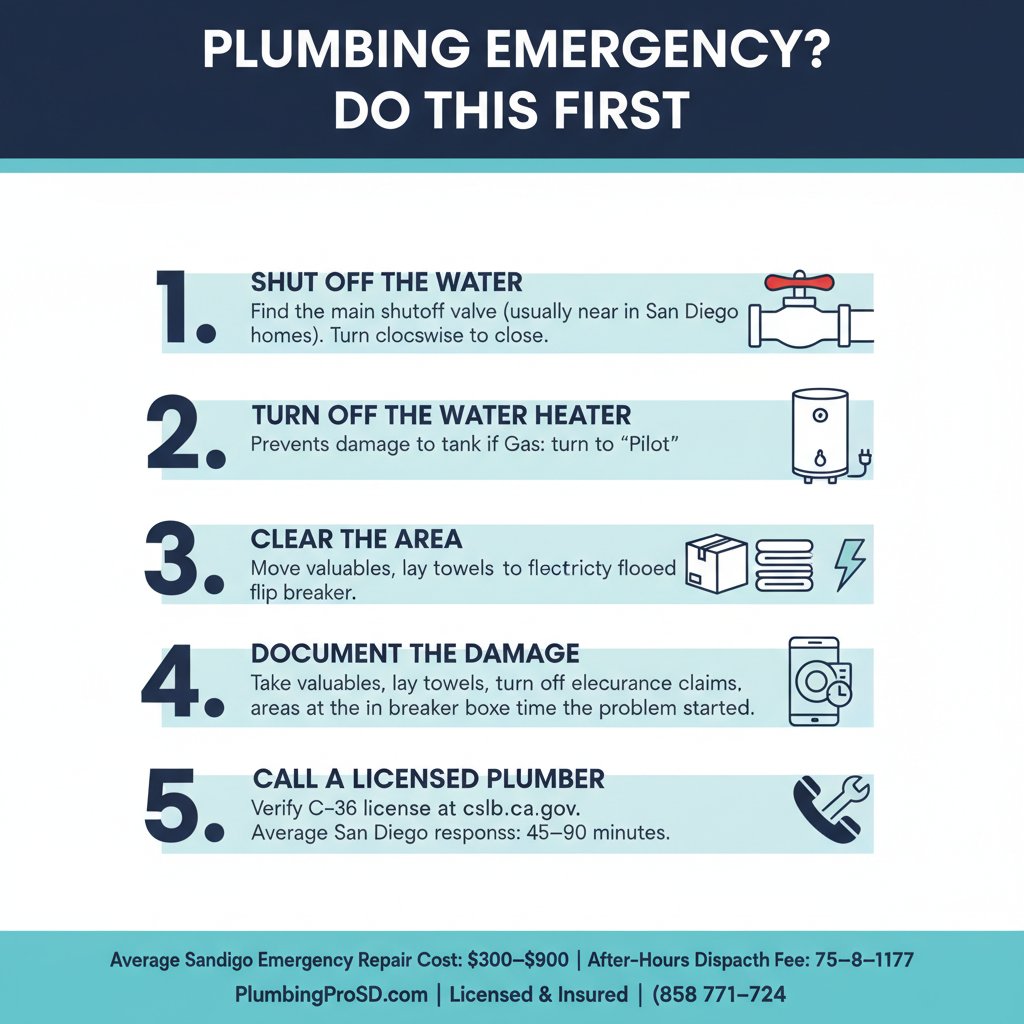
- While you wait: shut off the water, turn off the water heater, move valuables, and document everything for insurance.
- Verify the C-36 license on the CSLB site before hiring. Call (858) 400-4417 any time, day or night.
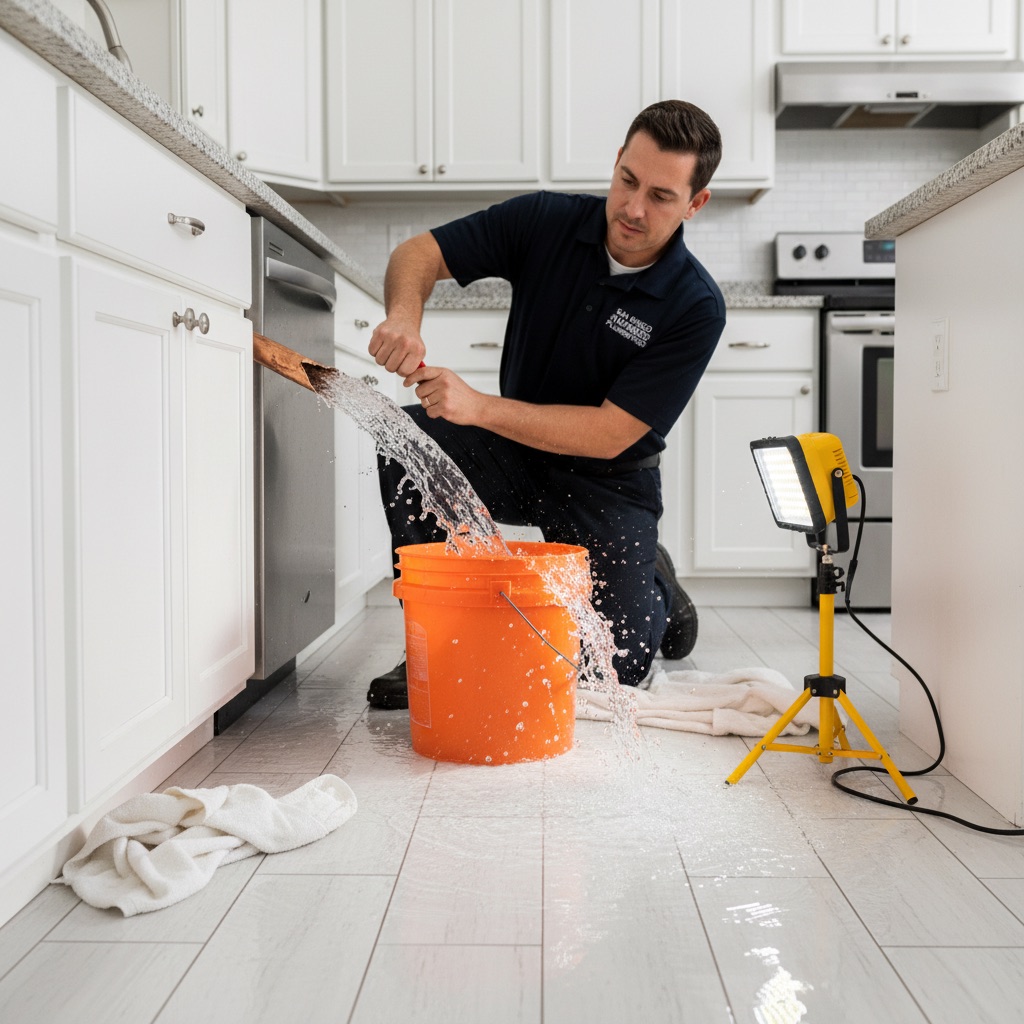
At 11 PM on a Tuesday, your bathroom ceiling starts dripping. Your main sewer line backs up Thanksgiving morning. A pipe under the kitchen sink lets go while you’re making dinner. Plumbing emergencies don’t follow business hours, and in a city of San Diego’s size and housing diversity, from 1950s ranch homes in Clairemont to 1920s Craftsmans in South Park to newer construction in Otay Ranch, the range of what can go wrong is enormous.
Need a plumber on the way, not a checklist? Call (858) 400-4417 or go to emergency plumber San Diego. This page is what to do before they arrive, and how to tell a real emergency from a morning appointment.
This guide covers what qualifies as a plumbing emergency in San Diego, who to call, what the response process actually looks like, what you’ll pay, how to protect yourself while you wait, and how to find a legitimate emergency plumber when you need one fast.
What counts as a plumbing emergency in San Diego?
Not everything that goes wrong at night warrants emergency rates. A true plumbing emergency has one or more of the following characteristics:
Active water damage is occurring. Water is flowing somewhere it shouldn’t be, right now, and can’t be stopped without professional intervention.
There’s a health or safety hazard. Sewage backup, suspected gas leak near a water heater, contaminated water supply.
The problem will significantly worsen overnight. A small drip inside a wall that’s been going on for a week can wait. An active slab leak wetting your foundation cannot.
You have no usable water. A complete loss of water pressure throughout the home makes the house non-functional. If there’s suddenly no water coming out of your faucets, that’s worth diagnosing fast.
Situations that typically warrant an immediate call:
- Burst pipe with active water flow
- Sewage backup through multiple drains or fixtures
- Gas smell near water heater or appliances
- No water throughout the entire home
- Water actively coming through a ceiling or wall
- Leaking tank on a water heater
- Flooding of unknown source
Situations that can usually wait until morning:
- A single dripping faucet
- One slow drain in a home with other working drains
- Toilet that runs briefly after flushing
- Reduced (but not absent) water pressure
- Water heater that’s producing less hot water than usual
When in doubt, call. A legitimate emergency plumber will tell you honestly whether it’s urgent or whether you can book a regular appointment.
San Diego Emergency Contacts You Need to Know
Keep these numbers accessible before you need them:
Gas emergencies (SDG&E): 1-800-411-7343, Available 24/7. If you smell gas or suspect a gas leak near any appliance, call SDG&E first and evacuate immediately. Do not call from inside the home.
Water service outages: San Diego County Water Authority, Check SDCWA’s website or call your retail water agency (City of San Diego, Otay Water District, Padre Dam, etc.) to confirm whether a loss of water pressure is a utility-side issue before calling a plumber.
City of San Diego after-hours utilities: (619) 515-3525, For issues with city water mains or sewer laterals at the property line.
Plumbing Pro San Diego: (858) 400-4417, calls taken any time, connects you with a licensed plumber across San Diego County.
How does 24/7 emergency plumbing service actually work?
The Call
A company that genuinely offers 24/7 emergency service answers the phone with a live person, not voicemail. When you call, the dispatcher will ask:
- What’s happening (burst pipe, backup, flooding, no water, etc.)
- Your address
- Whether you’ve been able to shut off the water supply
- How actively the situation is worsening
Based on your answers, they’ll dispatch a technician immediately or walk you through immediate steps while someone is en route. Give specific information, “sewage is coming up through my shower drain” gets a faster, better-prepared response than “I have a drain problem.”
Arrival and Equipment
A properly equipped emergency plumber arrives with a stocked service vehicle. For San Diego plumbing emergencies, a fully ready truck carries:
- Pipe repair fittings in multiple configurations (push-fit, compression, copper fittings for different repair scenarios)
- A drain snake (cable machine) and hydro-jetting equipment for sewer backups
- A sewer inspection camera for on-the-spot diagnosis
- Wet/dry vacuum for water extraction
- Acoustic leak detection equipment
- Thermal imaging camera for finding moisture in walls
- Water extraction pump
The first 10-15 minutes after arrival are diagnostic, finding the source and understanding the full scope before touching anything. This isn’t foot-dragging; a plumber who starts cutting drywall before understanding the problem is a red flag.
The Estimate
Before any work begins, you should receive a written estimate or a clear verbal quote with specific numbers. In California, you are legally entitled to a written estimate for work over $150 before it starts.
Expect a service/dispatch fee for the emergency call ($75–$175 is typical in San Diego for after-hours response), plus the cost of the actual repair quoted separately.
The Repair
What the repair involves depends on the problem:
Burst pipe: The damaged section is cut out and replaced. Modern push-fit fittings (SharkBite-style) allow repairs without soldering, reducing repair time significantly. A straightforward burst pipe in an accessible location typically takes 1–3 hours.
Sewer backup: A snake or hydro-jet clears the immediate blockage. If the main line is involved, a camera inspection identifies the cause, root intrusion, grease, collapsed pipe, or offset joint. The emergency visit clears the backup; underlying structural causes may need a follow-up.
Leaking water heater: The tank is drained, isolated, and the gas or electrical supply is shut off. Depending on tank condition and parts availability, repair or replacement may happen the same visit or the following day.
Slab leak: The leak is located with acoustic or thermal equipment, the immediate area is isolated (often by closing a zone valve), and a repair plan is developed. Full slab leak repairs are rarely completed in one emergency visit, the emergency call contains the damage; a scheduled repair addresses the pipe.
What does emergency plumbing cost in San Diego?
Emergency plumbing costs more than standard service, that’s a real and legitimate cost of 24/7 availability. Here’s what to expect:
| Service | Typical San Diego Cost |
|---|---|
| After-hours dispatch/service fee | $75 – $175 |
| Burst pipe repair (simple, accessible) | $300 – $900 |
| Main sewer line clearing (hydro-jet) | $350 – $700 |
| Water heater replacement (emergency same-day) | $1,200 – $2,800 |
| Slab leak detection + temporary repair | $500 – $1,500 |
| Emergency leak detection (acoustic/thermal) | $200 – $450 |
These are ranges, actual costs depend on the complexity, access difficulty, required materials, and time of night. A legitimate company gives you a number before starting, not after.
Insurance: Sudden, accidental water damage from plumbing failures is typically covered under standard homeowner’s insurance policies. Gradual leaks that were ignored, flooding from exterior sources, and earthquake damage typically are not. Call your insurer to open a claim as soon as the immediate situation is stable, don’t wait until after the repair.
What should you do while waiting for the plumber?
The 20–60 minutes between your call and the plumber’s arrival is your window to limit damage. Here’s what to do:
Shut off the water supply. In San Diego, the main shutoff is typically in the water meter box at the curb or sidewalk in front of the property. A meter key (an inexpensive T-shaped tool) opens the box; the valve inside shuts off supply to the house. You can also shut off individual fixture valves, the oval-handled valves behind toilets, under sinks, and behind appliances.
Turn off your water heater. Once the supply is off, shut down the heater. Gas units: turn to “pilot.” Electric units: flip the circuit breaker. Running a water heater with no water supply damages the heating elements and tank.
Move valuables and electronics. Water spreads faster than it appears. Get items off the floor in the affected area and in adjacent rooms.
Document everything. Photograph and video all visible damage before anything is touched, dried, or moved. This documentation is essential for your insurance claim.
Ventilate and leave if there’s a gas smell. Open doors and windows as you leave. Call from outside. Do not re-enter until both SDG&E and a licensed plumber have confirmed it’s safe. If the gas smell originates from a furnace or HVAC unit rather than a plumbing appliance, you’ll need an HVAC company, and a licensed HVAC contractor handles gas-fired heating systems across San Diego County.
Call your insurance company. Open a claim while you’re waiting. Adjusters want documentation of conditions before restoration starts, the more you document now, the smoother the claim process.
What plumbing emergency risks are specific to San Diego?
San Diego’s combination of building stock, water quality, and geography creates specific patterns of plumbing emergencies:
Older copper pipe. Homes built from the 1950s through the 1980s, common throughout Kensington, Normal Heights, University Heights, Serra Mesa, and much of the central and eastern parts of the county, used copper pipe throughout. San Diego’s water is among the hardest in California, with about 16 grains per gallon of mineral content. This hard water causes pinhole corrosion in copper from the inside, leading to small leaks that worsen into failures.
Slab foundations. Nearly all San Diego residential construction is slab-on-grade, meaning supply lines run under concrete. Slab leaks, pipe failures beneath the foundation, are one of the most common emergency calls in San Diego. A warm spot on a tile or concrete floor, unexplained water on the floor, or a rapidly climbing water bill are the early warning signs.
Tree root intrusion. San Diego’s older, tree-lined neighborhoods see consistent sewer backups from tree roots that infiltrate clay and Orangeburg sewer laterals over decades. The roots follow the moisture gradient directly into pipe joints and cracks. Neighborhoods like Hillcrest, Golden Hill, Bankers Hill, and North Park have the highest concentration of this issue.
Coastal humidity and pipe corrosion. Properties within a few miles of the coast, Ocean Beach, Pacific Beach, La Jolla, Del Mar, and Coronado, experience elevated humidity that accelerates external pipe corrosion, particularly at exposed fittings and transitions. Emergency calls related to corroded fittings in emergency plumbing in Coronado run consistently higher than inland neighborhoods.
How do you choose an emergency plumber in San Diego?
The worst time to evaluate a plumbing company is at midnight with water on your floor. Evaluate before you need them:
1. Verify the license. California requires plumbing contractors to hold a C-36 license. Check the CSLB license lookup, it shows current license status, insurance information, and any disciplinary history. This search is free and takes 30 seconds.
2. Read emergency-specific reviews. Look for Google or Yelp reviews that specifically mention emergency calls, after-hours response, and how pricing was handled under pressure. A company with great daytime reviews but no after-hours evidence is an unknown quantity.
3. Confirm actual 24/7 availability. Call the number at 9 PM on a weekend and see who answers. If it’s voicemail, they’re not actually 24/7.
4. Ask about upfront pricing policy. Any company unwilling to commit to providing an estimate before starting work is a risk.
5. Confirm insurance. Ask whether they carry general liability and workers’ compensation insurance. If a technician is injured on your property and there’s no workers’ comp, you may be exposed to liability.
6. Save the number before you need it. The most important step, program a trusted emergency plumber into your phone today.
Frequently Asked Questions
Q: How fast can an emergency plumber arrive in San Diego?
Response times vary by company and time of night, but most legitimate San Diego emergency plumbing services quote 45–90 minutes to most parts of the county. Response to central San Diego (Hillcrest, Mission Valley, North Park, Downtown) is typically faster than outer areas like Ramona, Alpine, or Fallbrook. Ask for an estimated arrival time when you call.
Q: Do I need to be home when the emergency plumber arrives?
Yes, a licensed plumber cannot legally access your property or begin work without homeowner authorization. Someone needs to be on-site to authorize the work and sign the estimate. If you’re not the homeowner but are the emergency contact, clarify this when you call so the company understands who has authorization.
Q: Will homeowner’s insurance cover my emergency plumbing repair?
It depends on the cause and your specific policy. Sudden and accidental damage, a pipe that fails without warning, is typically covered under the dwelling coverage section. Gradual leaks that were known about or visible damage that was ignored are typically excluded. Call your insurer immediately and before restoration begins, not after. See our post on whether homeowners insurance covers plumbing for a detailed breakdown.
Q: What if I can’t find the main water shutoff?
San Diego residential meters are typically in a small concrete box flush with the sidewalk or curb in front of the property. The lid is marked “water” and lifts with a screwdriver or meter key. The shutoff valve is inside, it may be a gate valve (round handle) or ball valve (flat handle perpendicular to pipe = off). If you cannot find it, tell the dispatcher when you call, a plumber can guide you through locating it or handle it on arrival.
Q: Is it worth calling an emergency plumber for a slow drain?
Generally no, unless the slow drain is combined with other symptoms, sewage smell, backup in other fixtures, or gurgling sounds from multiple drains. A single slow drain that you’ve been meaning to address is not an emergency. If you have a main-line backup with multiple affected drains, that’s an emergency. See our drain cleaning guide for more on diagnosing drain problems.
Related reading
Not sure whether your situation is a true emergency? Our guide to the 10 signs you need an emergency plumber can help you decide. For city-specific emergency response patterns, see our posts on emergency plumber in La Mesa and emergency plumber in Oceanside. And when the crisis is resolved, understanding how much plumbers cost in San Diego will help you evaluate whether the bill you received was fair.
Plumbing Pro San Diego connects homeowners with emergency plumbers throughout San Diego County, from La Jolla and Pacific Beach to Chula Vista, El Cajon, and Santee. We also connect homeowners with plumbers for emergencies in Carlsbad, Poway, and Chula Vista. Call (858) 400-4417 any time, day or night. We take calls any time and connect you with a licensed plumber, who will quote you directly before any work begins. Visit our emergency plumbing services page to learn more about what’s covered.
Areas this guide covers
We connect homeowners with licensed plumbers in these San Diego County communities.
Keep reading
Need a Plumber in San Diego?
Licensed, insured plumbers, ready across San Diego County. The plumber quotes you before any work starts.
Call (858) 400-4417Call any time, day or night, anywhere in San Diego County