Who pays for plumbing repairs in a San Diego condo or HOA
How California's Davis-Stirling Act splits condo plumbing repair costs between HOA and owner, and how to tell which side of the wall a leak falls on.
The short answer
- California's Davis-Stirling Act sets the default rule: the HOA repairs common area plumbing, and you repair the pipes and fixtures inside your own unit, but your CC&Rs can and often do change that split.
- A pipe serving only your unit isn't automatically your responsibility just because it's yours alone; under state law it can still count as HOA-repaired exclusive use common area, depending on your CC&Rs.
- A 2025 law, Senate Bill 900, now requires HOAs to start repairing utility leaks that begin in the common area within 14 days, even when the damage shows up inside a unit.
- Who pays for the repair and who pays for the water damage it caused are often two separate questions with two separate answers.
- Call your HOA management company first for anything behind a wall or in a shared riser; call a plumber directly for anything inside your own fixtures, like a toilet, sink, or in-unit water heater.
Under California’s Davis-Stirling Act, the default rule is that your HOA repairs common area plumbing and you’re responsible for what’s inside your own unit, but your CC&Rs almost always have the final say.
If you own a condo in downtown San Diego, La Jolla, Mission Valley, or Hillcrest, you’ll eventually run into this question, usually at the worst possible moment, with water already on the floor. Here’s how the split actually works, where the gray areas are, and who to call first. For the separate question of what your insurance covers once damage happens, see our guide on whether homeowners insurance covers plumbing.
The default rule under the Davis-Stirling Act
California’s Davis-Stirling Common Interest Development Act governs how condo and HOA communities operate statewide, including who maintains what. Civil Code Section 4775 sets the default allocation: unless your community’s CC&Rs say otherwise, the association is responsible for repairing, replacing, and maintaining the common areas, and each owner is responsible for maintaining their own separate interest, meaning the space inside their unit.
That sounds simple until you try to apply it to an actual pipe. Here’s the general breakdown:
| Plumbing element | Typically whose responsibility | Why |
|---|---|---|
| Main shared riser serving multiple units | HOA | Classic common area, part of the building’s shared system |
| Pipe embedded in a shared or structural wall | HOA (usually) | Common area even if it only feeds your unit |
| Supply line under your bathroom sink | Owner | Inside your separate interest |
| Your toilet, dishwasher, in-unit water heater | Owner | Fixtures belong to the unit |
| Pipe serving only your unit but part of a shared system | Depends on CC&Rs | Can be exclusive use common area |
The one word that matters most in that table is “typically.” This is a default rule, not a fixed law. Civil Code 4775 explicitly allows your CC&Rs to reassign responsibility differently, and in a lot of San Diego HOAs, they do exactly that.
Why “it only serves my unit” doesn’t settle the question
A common misconception is that if a pipe only feeds your unit, it must be your responsibility to fix. California case law says otherwise. A pipe serving a single unit can still count as common area, and specifically as exclusive use common area, if your CC&Rs classify it that way or if it’s genuinely part of a larger interconnected system rather than a standalone line.
Exclusive use common area has its own quirky rule under Civil Code 4775: unless your CC&Rs say otherwise, the HOA repairs it, but the owner maintains it day to day. Repair and maintenance are treated as two different things. A slow drip that needs periodic upkeep might be on you. A pipe that bursts and needs replacement might be on the association. This distinction gets litigated more than you’d think, which is exactly why reading your CC&Rs before a crisis matters more than guessing based on which unit the pipe happens to run through.
Read your CC&Rs before you need them
Every HOA’s governing documents are a little different, and the CC&Rs are the document that actually controls, not the general Davis-Stirling default. Most well-run associations also maintain a maintenance matrix or responsibility chart that spells out plumbing, electrical, and structural splits item by item. If yours doesn’t have one, ask your management company for the section of the CC&Rs covering maintenance and repair obligations, and read it before you’re standing in an inch of water at 11pm trying to figure out who to call.
If you manage a rental in a San Diego condo building, keep a copy of this section with your unit file. It saves real time during an active leak.
A 2025 law changed how fast HOAs have to move
Senate Bill 900, effective January 1, 2025, added a real deadline to this picture. It requires associations to begin repairing utility services, plumbing included, that originate in the common area, even when the visible damage shows up inside an individual unit, within 14 days of the disruption. Before this law, some associations slow-walked repairs by pointing to interior damage and arguing it was the owner’s problem, even when the source was clearly a shared line. If your HOA is dragging its feet on a common-area leak that’s damaging your unit, SB 900 gives you a concrete timeline to point to.
Repair responsibility and damage responsibility are different questions
This trips up a lot of San Diego condo owners. Who fixes the pipe and who pays for the water damage it caused are often two separate answers, not one.
Some CC&Rs make the association responsible for both the pipe and the resulting interior damage. Others split it cleanly: the association’s master policy covers the building and common systems, while your own HO-6 condo insurance policy covers your unit’s interior, personal property, and any upgrades you made beyond the builder-grade finish. This is why condo owners in San Diego’s denser buildings, downtown high-rises especially, are strongly advised to carry an HO-6 policy even though the building itself is insured by the association. Our guide on whether homeowners insurance covers plumbing walks through what a typical policy does and doesn’t cover.
Who to call first when a leak happens
Call your HOA management company immediately if the water is coming from behind a wall, from above your unit, from a shared riser, or from anywhere you genuinely can’t trace to your own fixtures. Fast reporting matters both for containing damage and for establishing the timeline SB 900 now requires.
Call a plumber directly if the source is obvious and clearly inside your unit, like a supply line under a sink, a running toilet, or an in-unit water heater. You don’t need HOA sign-off to fix your own fixtures.
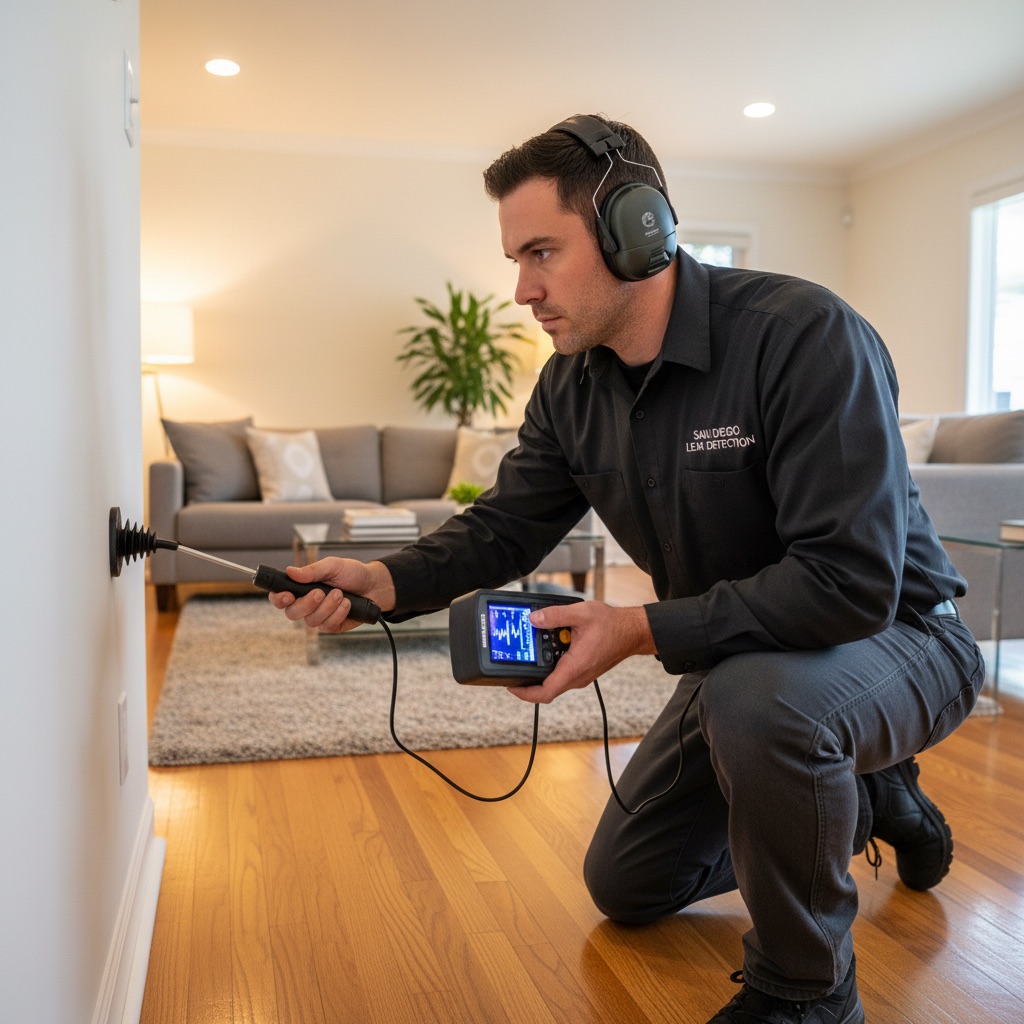
When you can’t tell, do both at once. Water spreads fast through shared walls and flooring in condo buildings, and a few hours of delay while everyone argues over whose problem it is almost always costs more than getting a plumber on-site to diagnose it. A licensed plumber can also tell you, on the spot, whether what they’re looking at is likely common area or your own line, which gives you something concrete to bring to the HOA if there’s a dispute.
If you’re dealing with an active leak in a slab-built condo and you’re not sure yet whether it’s a full repipe situation or a single-line fix, our slab leak repair guide covers how we diagnose and locate leaks before any wall or floor gets opened.
Get a straight answer before the argument starts
None of this is legal advice, and your specific CC&Rs control over any general rule described here. What we can do is tell you, quickly, where a leak is actually coming from and whether it looks like common area or an in-unit line, so you walk into the HOA conversation with facts instead of guesses. Call Plumbing Pro San Diego at (858) 400-4417 for leak detection and diagnosis in your condo or townhome. Full detection details are on our leak detection service page.
Need a Plumber in San Diego?
Licensed, insured plumbers, available 24/7 across San Diego County. Upfront pricing, no surprises.
Call (858) 400-4417Available 24/7, no voicemail, no answering service