Backflow preventer leaking: what to verify before repair
Learn what to document when a backflow preventer leaks in San Diego, who confirms local requirements, and what a licensed plumber may inspect before repair.
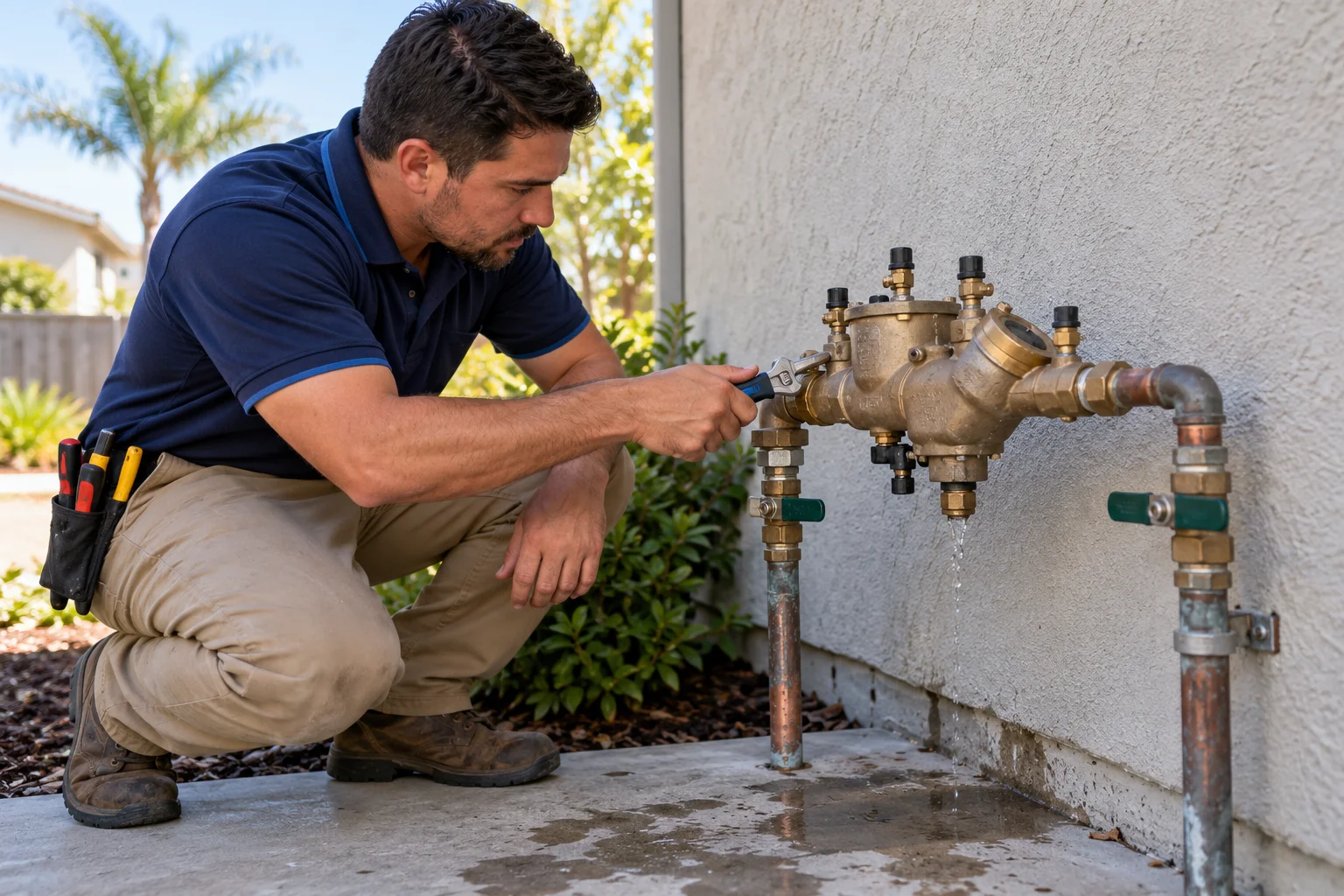
Visible dripping or pooling around an exterior backflow device needs a closer look. Before requesting backflow valve repair, document where the water appears and identify your water provider.
Where water can appear around a backflow device
Start by locating the exact source of the visible water. Don’t assume every wet spot beside the assembly comes from the backflow preventer.
Water may be visible at the device body, a connection, or nearby piping. It may also collect on the concrete or soil beneath the assembly. From there, it can spread beyond the original drip point. Dry weather makes this easier to document than rain or active irrigation.
Take clear photos before touching any valve or fitting. Include one wide photo showing the entire assembly. Then take closer images of the wet area and each visible connection. A short video can show whether the water drips, sprays, or runs continuously.
Note what was happening when you saw the leak. Record whether irrigation was operating or water was being used inside. Don’t take apart the device to investigate. Photos and operating details give the contractor useful context without disturbing the assembly.
A backflow valve is often outside and may sit near other water components. If you can’t identify the assembly, don’t rely on appearance alone. A licensed plumber can determine what device is present and where the water originates.
A backflow preventer also isn’t the same as a sewer backwater valve. Our guide to a backwater valve versus a backflow preventer explains that distinction. That difference matters because each device belongs to a different part of the plumbing system.
If water is spreading toward the building, electrical equipment, or a walking area, describe that when requesting help. Avoid claiming the device itself has failed until an independent contractor inspects it.
How a leaking device differs from a testing issue
A visible leak and a backflow test are related service concerns, but they aren’t interchangeable. A leak is an observed symptom. Testing is an evaluation of the assembly by a qualified professional.
A device may need inspection because water is visibly escaping. A property owner may also receive a testing notice without seeing any water. One situation doesn’t establish the result of the other. Only the person evaluating the assembly can report what the inspection or test shows.
Don’t label the problem as a failed relief valve, seal, check component, or shutoff based only on where water appears. Those descriptions imply a diagnosis that hasn’t been confirmed. Tell the contractor exactly what you can observe instead.
Useful details include:
- The point where water first becomes visible
- Whether the area stays wet between water-use periods
- Whether the condition changes during irrigation
- Any recent test notice or written test result
- Any tag, label, or identifier attached to the assembly
- Whether someone recently adjusted nearby plumbing
Keep any agency notice available. It may identify the assembly, service address, or requested action. That paperwork can help the contractor understand why service was requested.
If your concern began with a notice rather than a leak, read our local guide to backflow testing in San Diego. You can also review our backflow testing and prevention referral service when you need a licensed professional.
Testing schedules, accepted procedures, and repair duties couldn’t be confirmed for every San Diego County jurisdiction from the approved claims ledger. Ask the water agency serving the property for its current instructions. Then give those instructions to the contractor you’re matched with.
What the serving water agency may need to confirm
San Diego County has multiple water agencies. The correct contact depends on the property, so a countywide answer may send you to the wrong office.
Check the water bill before calling anyone. Look for the provider’s name, account information, and service address. If a landlord, property manager, or association handles the bill, ask that person for the provider’s name.
The San Diego County Water Authority can provide regional water information. However, don’t assume that it sets the specific service instructions for your property. The serving agency listed on the bill is the better starting point for account-specific questions.
Ask that agency to confirm:
- Whether it has records identifying the assembly
- Whether a current notice applies to the property
- What documentation it expects after service
- Whether it maintains a list of accepted testers
- Whether approval is needed before changing the assembly
- Which office should receive completed paperwork
These are questions, not statements about a universal process. No countywide testing schedule, device requirement, repair deadline, or permit rule was confirmed in the approved claims ledger. The serving agency should provide its current requirements in writing.
Location alone doesn’t settle jurisdiction. A property near Poway Road, Interstate 15, the coast, or the South Bay may not follow the same account process as another San Diego County address. Use the provider shown on the actual bill.
Property owners in inland North County can also review the local Poway plumber referral guide for help preparing service details. The independent plumber still needs the exact address, device information, and agency notice.
Save the name of the agency representative you contact. Also save any email, form, or written direction provided. That record helps prevent confusion between agency requirements and the contractor’s repair recommendation.
What the contractor you’re matched with may inspect
The contractor may begin by confirming what kind of assembly is installed. The contractor may then trace the visible water to its source and review the surrounding piping, connections, valves, and accessible components.
The inspection should stay specific to your property. Photos alone may help with preparation, but they don’t replace an on-site diagnosis. Conditions can differ between coastal properties, inland neighborhoods, commercial sites, and irrigation systems.
Give the contractor room to inspect the complete assembly. Remove movable storage, planters, or other belongings that block access. Don’t alter piping, operate unfamiliar shutoffs, or cover the leak before the visit. If you already moved something, explain what changed.
California’s C-36 plumbing contractor classification includes repair and replacement of backflow preventers. It also covers other plumbing work described by that classification. Individual contractor capabilities still vary, so confirm that the matched contractor handles your device and requested service.
You can verify a contractor by license number, business name, or personnel name through the CSLB license lookup. The database provides license status, classifications, bond information, workers’ compensation information, expiration details, and complaint history. It has scheduled maintenance from Sunday evening through Monday morning.
Don’t approve a repair based only on an unconfirmed diagnosis. Ask the contractor to identify the observed problem, proposed work, and parts involved. If agency paperwork applies, confirm who will complete it and who will submit it.
No verified standard price for backflow valve repair or installation appears in the approved claims ledger. Pricing depends on the property-specific scope set by the independent contractor. Request a written description of the proposed work and cost before authorizing it.
How to request a backflow service referral
A useful referral request starts with facts, not a guessed diagnosis. Say that water is visible around an exterior backflow device and describe its exact location.
Include the property address and the water provider named on the bill. Mention whether the property is residential, commercial, or managed by an association. If you have an agency notice, say what action it requests without paraphrasing technical language.
Send or prepare:
- A full photo of the assembly and surrounding area
- Close photos showing where water becomes visible
- A video if the leak changes over time
- The provider’s name from the water bill
- Any notice, test report, tag, or assembly identifier
- Notes about when the condition appears
- Access instructions for the independent contractor
Explain whether you need an inspection, testing, repair, or help interpreting a notice. If you aren’t sure, say that plainly. The contractor can inspect the assembly before recommending a service.
Plumbing Pro San Diego is a referral service. We connect property owners with independent plumbing contractors. The contractor performs the inspection, testing, and repair, then contracts with and receives payment directly from the customer.
Every plumber in the network is licensed and insured. Still, confirm that the contractor handles the specific assembly and agency process involved. Individual capabilities vary, and the serving water agency controls its own current paperwork requirements.
Don’t discard damp cardboard, temporary containers, or other evidence before taking photos. Also note whether the leak has affected nearby surfaces or access. Clear documentation helps the contractor prepare without turning your observations into an unsupported diagnosis.
When to call us
Call when a backflow device is visibly leaking, agency paperwork requests service, or you need a licensed plumber to identify the problem. Call us at (858) 400-4417 and we’ll connect you with a licensed plumber.
Areas this guide covers
We connect homeowners with licensed plumbers in these San Diego County communities.
Keep reading
Need a Plumber in San Diego?
Licensed, insured plumbers, ready across San Diego County. The plumber quotes you before any work starts.
Call (858) 400-4417Call any time, day or night, anywhere in San Diego County