
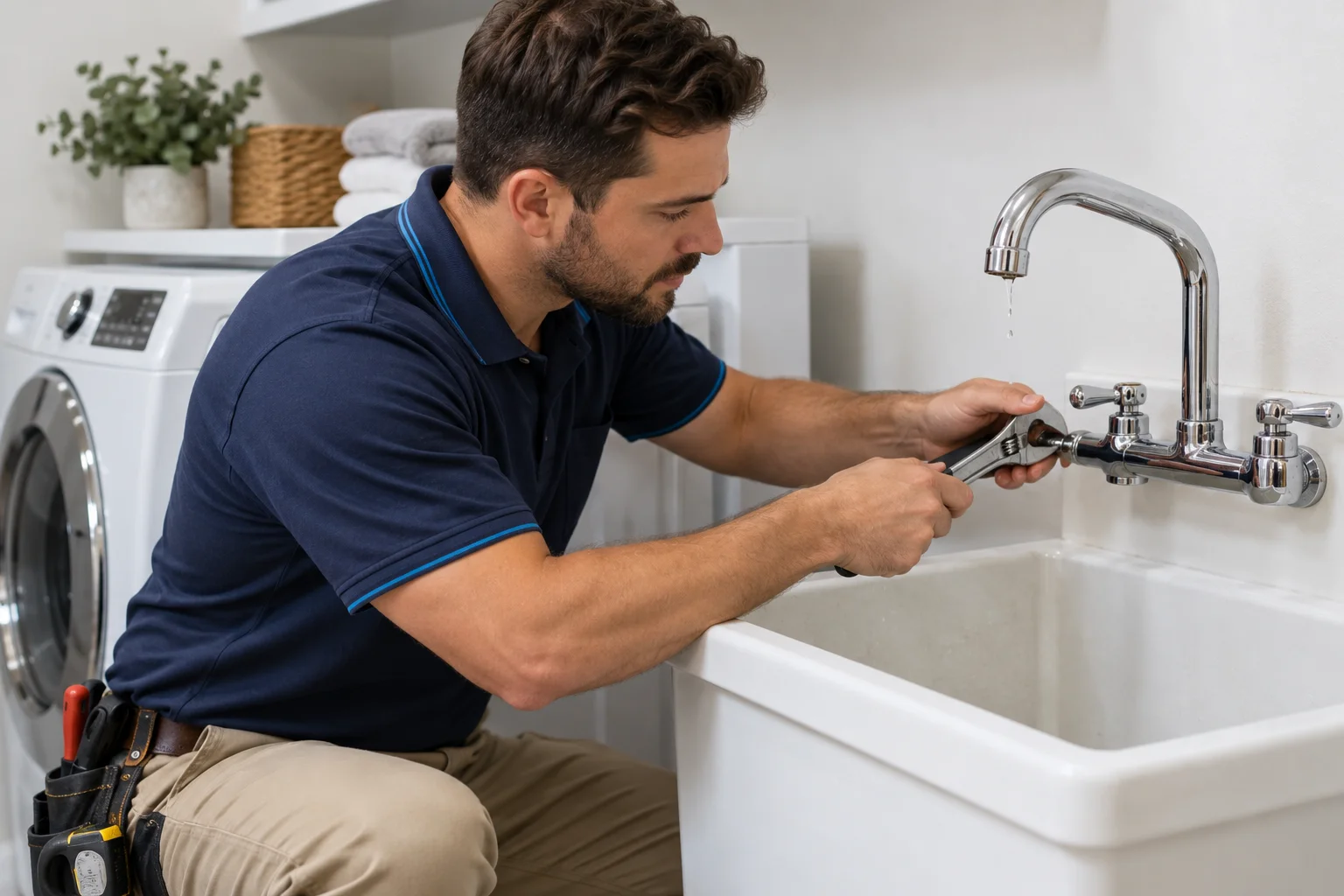
Utility sink faucet leaking: repair or replace
A leaking utility sink faucet may drip at the spout or below the basin. Learn what to check and when to request a licensed plumber in San Diego County.
A drip at a laundry, garage, or utility sink needs a closer look. Repair may make sense for one isolated fault, while replacement may suit a faucet with several damaged areas.
Where a utility sink faucet can show a leak
Start by finding the highest visible wet spot. Water can move along the faucet body, basin, pipes, or cabinet before dripping. The puddle’s location may not reveal where the leak began.
Dry the faucet and surrounding area. Then operate each handle separately while watching the fixture. Check the spout outlet, handle bases, faucet base, and any side sprayer. Look beneath the sink with a light while the water runs.
A utility sink faucet may show water in several places:
- The end of the spout after both handles are closed
- Around a handle while that handle is open
- Where the spout meets the faucet body
- Around the faucet base on the sink deck
- Along a pull-out hose or side-sprayer hose
- At a hot or cold supply connection
- Near the shutoff valves beneath the basin
Don’t assume every puddle comes from the faucet. Fill the basin, then let it drain while keeping the faucet off. Water appearing only during drainage points away from the faucet. Our guide to a P-trap that keeps leaking explains that separate problem.
Laundry rooms can add another source. Check that the moisture isn’t traveling from nearby washer connections. A damaged washing-machine hose is outside this article’s narrow faucet focus.
If water continues spreading, close the fixture’s shutoff valves when they operate normally. Stop using the sink until the source is identified. That limits continued wetting while you request help.
How a spout drip differs from water below the sink
A spout drip appears after the faucet handles are closed. It points the inspection toward parts that control flow inside the faucet. The exact part depends on the fixture’s design, so the drip alone doesn’t identify what must be replaced.
Watch the spout for several moments after closing both handles. A small amount of water already inside a tall spout can leave the outlet. A recurring drip is different from that brief release. Note whether changing one handle’s position affects it.
Water below the sink calls for another inspection path. First, dry the supply connections, faucet mounting area, and basin underside. Place separate dry paper towels beneath each connection. Operate the hot and cold sides individually. The first towel showing moisture can help narrow the source.
Water around a supply connection may involve the connection, the supply line, or water running down from above. Moisture at the faucet’s mounting hardware can begin at the faucet base. A hose may leak only when a pull-out head or sprayer is used.
Drain components deserve their own test. Run water directly into the basin without splashing the rim. Then inspect the drain body and trap. If the area stays dry while the faucet runs but becomes wet as the basin drains, the faucet may not be the source.
Don’t tighten an unidentified connection simply because it’s wet. The visible fitting may only be catching water from higher up. Finding the first wet point gives the contractor better information and avoids confusing faucet work with drain repair.
For broader fixture symptoms, see the San Diego faucet repair guide.
What age and condition can and cannot confirm
A faucet’s age can’t confirm whether repair or replacement is the right choice. No verified, universal service-life figure applies to every utility sink faucet. Product design, use, installation, water conditions, and available parts all affect the decision.
Condition provides better clues, but it still isn’t a diagnosis. Tell the contractor if you notice a loose body, stiff handles, a damaged hose, corrosion, or several leak points. Also mention previous repairs and whether the same symptom returned.
San Diego drinking water averages about 16 grains per gallon, or 276 parts per million, according to the City’s published water-quality information. The level can vary by location and demand. Visible mineral deposits may therefore be relevant context, but their appearance doesn’t confirm which internal part has failed.
Repair may remain an option when the contractor identifies one serviceable component and can obtain a compatible replacement. Full faucet repair and installation may include discussing both repair and replacement after inspection.
Replacement may enter the conversation when damage affects several areas, mounting stability is poor, or compatible parts can’t be confirmed. Those observations aren’t automatic rules. The contractor must inspect the actual fixture and sink.
If you’re replacing the faucet, describe how the sink is used. A laundry basin, garage cleanup sink, and workshop sink may need different reach or handle clearance. The faucet must also fit the existing mounting arrangement. Product listings alone can’t confirm that fit.
What the contractor you’re matched with may inspect
The contractor you hire may begin by reproducing the leak. Share when it appears, which handle was used, and whether the basin was draining. Photos taken before the area was dried can also help.
The inspection may cover the faucet above and below the sink. That can include the handles, spout, faucet base, mounting hardware, hoses, supply lines, connections, and shutoff valves. The contractor may test hot and cold flow separately to isolate the symptom.
Access matters at utility sinks. Storage bins, shelving, washer hoses, and deep basins can obscure the underside. Clear removable items from the work area, but don’t disconnect plumbing to create access. Tell the contractor about any connection that won’t close or feels unstable.
The contractor may also separate faucet leakage from nearby drain leakage. If the moisture appears while the basin empties, the drain body or trap may need attention instead. If water appears only while a sprayer operates, its hose and connections deserve focused inspection.
For a possible replacement, the contractor may check the sink’s mounting holes, spacing, basin depth, and nearby clearance. A faucet that looks suitable online may not match the existing sink. Ask the contractor to confirm compatibility before a product is installed.
California’s C-36 plumbing classification covers work involving water supply and fluid-waste systems, including repair and replacement within that scope. Individual contractor capabilities still vary. Every plumber in our network is licensed and insured, and you’ll hire and pay that independent contractor directly.
You can verify a contractor’s status, classification, bond information, and complaint history through the CSLB license lookup. The database accepts searches by license number, business name, or personnel name.
How to request a faucet repair referral
When requesting a referral, identify the fixture as a utility sink faucet. Mention whether it’s in a laundry room, garage, workshop, or another space. San Diego County referrals can cover communities from Oceanside to Chula Vista, as well as inland and coastal areas.
Describe the leak by location and timing. “The spout drips after both handles close” is more useful than “the sink leaks.” If water appears below the basin, say whether it happens during faucet use, drainage, or both.
Include a few practical details:
- The number of faucet handles
- Whether there’s a sprayer or pull-out hose
- The first place moisture appears
- Whether hot or cold use changes the leak
- Whether the faucet body moves at the sink
- Whether nearby shutoff valves operate normally
- Any model information visible on the fixture
Tell us whether you want repair assessed first or already prefer replacement. The contractor can still explain what the inspection supports. Plumbing Pro San Diego doesn’t set the contractor’s price, select products, or perform the work.
If replacement is likely, the fixture installation service explains the matching process for installed plumbing fixtures. Keep product receipts and packaging if you’ve already purchased a faucet. Ask the contractor to confirm fit before installation begins.
Homeowners near central San Diego can also review the local Mission Valley plumber referral page. The same referral model applies across the county: we connect you with an independent licensed plumber, and you decide whether to hire that contractor.
When to call us
Call when the leak continues, water reaches the area below the sink, or repair versus replacement remains unclear. A licensed plumber can inspect the fixture, identify the leak point, and discuss suitable options.
Call us at (858) 400-4417 and we’ll connect you with a licensed plumber.
Areas this guide covers
We connect homeowners with licensed plumbers in these San Diego County communities.
Keep reading
Need a Plumber in San Diego?
Licensed, insured plumbers, ready across San Diego County. The plumber quotes you before any work starts.
Call (858) 400-4417Call any time, day or night, anywhere in San Diego County