
Last updated: August 8, 2026
Leak detection in Mission Valley: who to call first
In a Mission Valley condo, apartment, or townhome, a leak may not be your pipe. Here's how to figure out who investigates and who pays before calling a plumber.
The short answer
- If you own a condo, rent an apartment, or sit on an HOA board in Mission Valley, a leak often crosses into shared or common-area plumbing that a single-family home doesn't have to deal with.
- The first question after finding a leak isn't which plumber, it's which document governs your unit and who you notify first.
- Owner-occupied condos, rentals, and common-area lines each point to a different document and a different first call.
- Leak detection behind a shared wall or under a slab needs acoustic or thermal tools, not guessing from where the stain shows up.
- Document what you see, when you saw it, and who you told, starting the moment you notice it.
If you find a leak in a Mission Valley condo, apartment, or townhome, the first question isn’t which plumber to call. It’s which document tells you who’s responsible before the plumber even shows up. Mission Valley sits on the floor of the San Diego River valley, and if you own a condo, rent an apartment, or sit on an HOA board there, a leak crosses into shared-plumbing questions that a detached single-family house down the road doesn’t have to answer. That changes how a leak actually gets handled.
In a single-family home, a leak is yours and the decision is simple: call a plumber. In a shared building, the pipe behind your wall might serve only your unit, or it might be a common-area line that serves several units, and the answer to which one it is usually determines who pays and who has to authorize the investigation. This is written for a condo owner, a renter, and an HOA board member, because all three end up asking the same question from different sides.
The leak you can hear but not see
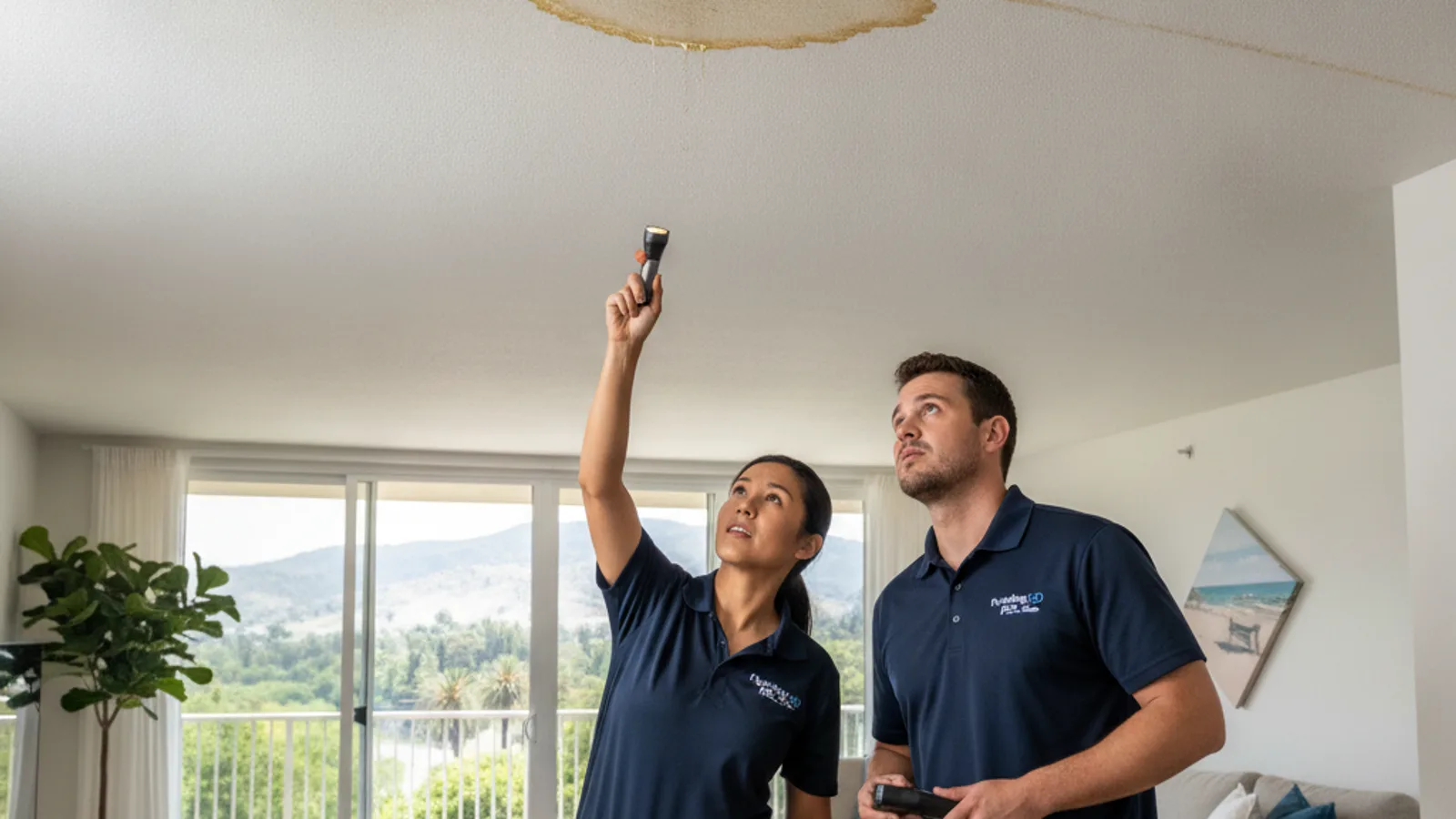
A leak in a multi-unit building often shows up as evidence before it shows up as an obvious source. A ceiling stain that grows slowly. A damp patch on carpet near an interior wall. A hissing or dripping sound from inside a wall that shares a plumbing chase with the unit next door.
Because units in a condo or apartment building often share plumbing walls and stacked risers, the leak you’re hearing may not even be in your unit. It could be traveling from a line one floor up or from a shared riser that serves several units on the same stack. That’s worth saying out loud when you report it, because it changes who needs to be involved from the start.
Don’t wait to see if it dries up. A slow leak inside a shared wall or under a shared slab can affect more than one unit before anyone traces the source, and the longer it runs, the messier the question of who’s responsible becomes.
The first question is not which plumber
Before anyone schedules a repair, the real first question is which document governs the situation and who needs to know about it.
If you own your unit, that document is usually your HOA’s CC&Rs, or Covenants, Conditions, and Restrictions, along with the association’s governing bylaws. These typically distinguish between what’s inside your unit boundary, which is usually your responsibility, and common-area or shared lines, which are usually the association’s. We can’t tell you what your specific CC&Rs say. Only your document and your HOA board or management company can.
If you rent, that document is your lease. Most leases spell out who handles repairs and who to contact first, and many require written notice within a set timeframe. Read that section before assuming either way.
If the leak is coming from a shared riser or a common-area line that clearly serves more than your unit, the HOA or property manager is the first call regardless of ownership, because that line likely isn’t any one resident’s responsibility to fix alone.
None of this is legal advice, and none of it substitutes for reading your own document. What follows is a map of where to look and who to ask, not a ruling on your specific situation.
| Your situation | Document that answers it | Who to notify first |
|---|---|---|
| Owner-occupied condo, leak inside your unit’s walls | CC&Rs and HOA bylaws | HOA board or management company |
| Owner-occupied condo, leak from a shared riser or common wall | CC&Rs, common-area provisions | HOA board or management company |
| Renter, leak anywhere in the unit | Lease agreement | Landlord or property manager, in writing |
| Owner renting out the unit, tenant reports a leak | Lease you issued, plus your CC&Rs | You, then the HOA if the source is a common-area line |
How leak detection works when you cannot open the wall
In a shared building, tearing into a wall or a floor slab to chase a sound is rarely acceptable, even before anyone settles who’s paying. Leak detection tools exist specifically to avoid that first.
Acoustic listening equipment picks up the sound a pressurized leak makes traveling through pipe and structure, letting a plumber narrow the likely location without demolition. Thermal imaging can spot a temperature difference on a wall or floor surface caused by a hot-water leak moving heat through the material. Neither tool guarantees a pinpoint location on the first pass, but both narrow the search dramatically compared to guessing.
For a suspected slab leak in particular, this matters even more in a multi-unit building, because the slab may be shared between the unit below and the unit above. Locating the source precisely before opening anything protects everyone involved, including whichever party ends up responsible for the access and repair.
The leak detection services offered by the pros we connect you with and our signs of a hidden water leak guide cover the signs and the general process in more depth. If the location is uncertain even after detection work, a sewer camera inspection can rule out a shared drain line as the source rather than a supply line.
What to document from minute one
Whoever ends up responsible, a clear record helps the conversation move faster instead of turning into a dispute.
Write down the date and time you first noticed the leak, and take photos of the stain, drip, or wet area as soon as you see it. Note any sound, and where in the unit it seems loudest. If the leak might be affecting a neighboring unit, mention that when you report it, since it changes who else needs to be looped in.
Keep a record of who you notified and when, whether that’s the HOA management company, your landlord, or both. If you send an email or text, that timestamp becomes part of the record. A phone call alone is harder to document later, so follow up in writing even if you called first.
This isn’t about building a legal case. It’s about making sure the right person gets the information fast enough to act on it, and having a clear timeline if the source of the leak turns out to be genuinely disputed between units or between owner and tenant.
Frequently asked questions
I found a leak in my Mission Valley condo. Who do I call first?
Check your CC&Rs or HOA governing documents to see whether the affected area is your responsibility or a common-area line. If you’re unsure, notify the HOA board or management company first.
Is my landlord responsible for a leak in my rental?
That depends on your lease and where the leak originates. Read the maintenance section of your lease and notify your landlord or property manager in writing as soon as you notice the problem.
Can a plumber find a leak without opening the wall?
Often, yes. Acoustic listening equipment and thermal imaging can locate a leak inside a wall or under a slab, and a plumber can mark the likely area before any targeted opening happens.
What should I document if I find a leak in a shared building?
Note the date and time, photograph the affected area, and record who you notified and when. If a neighboring unit might be affected, note that too.
Does a slab leak work differently in a multi-unit building?
The leak itself works the same way, but locating and accessing it can be more involved when the slab is shared between units. A plumber experienced in multi-unit buildings can usually pinpoint the source before anyone plans the access work.
When to call us
Once you know which document applies and who else needs to be notified, a licensed plumber is the right call to locate the leak precisely and explain what the repair involves. Have your address, the HOA or landlord contact you’ve already reached, and what you’ve observed ready when you call. Call (858) 400-4417 and we’ll connect you with a licensed and insured local plumber.
Areas this guide covers
We connect homeowners with licensed plumbers in these San Diego County communities.
Keep reading
Need a Plumber in San Diego?
Licensed, insured plumbers, ready across San Diego County. The plumber quotes you before any work starts.
Call (858) 400-4417Call any time, day or night, anywhere in San Diego County