
Last updated: September 19, 2026
Bathroom sink won't drain: what to check first
One bathroom sink that will not drain is usually the stopper, tailpiece, or P-trap. See what to check in San Diego and when other fixtures mean a main line.
The short answer
- One bathroom sink that will not drain, while the toilet and shower still empty, is a local clog at that basin.
- Check the pop-up stopper, the tailpiece under the bowl, and the P-trap in the cabinet before anyone opens a wall.
- Hair, toothpaste, floss, and hard-water scale load a bathroom drain. Grease and a disposal belong to the kitchen, not this fixture.
- If the tub, shower, or another sink rises when you run this one, stop and read the multi-drain post. That is a shared line.
- We connect you with licensed plumbers for drain cleaning. We do not clear the line or set the price. Call (858) 400-4417.
A bathroom sink that will not drain, while the toilet and shower still empty, is a local clog at that basin. The usual spots are the pop-up stopper, the tailpiece under the bowl, and the P-trap in the cabinet. If the tub or another sink starts to rise when you run this one, stop. That is a shared-line problem, not this job.
What a stopped bathroom sink can and cannot confirm
Standing water in one bathroom bowl tells you that water cannot leave that fixture. It does not tell you the house sewer is blocked. It does not tell you the shower is next. It does not tell you the trap is leaking. Those are different symptoms.
Watch the rest of the bath before you touch a nut. Flush the toilet. Run the shower for a few seconds. If those empty and this sink does not, the restriction is on this basin’s path. If another fixture gurgles or rises, you have left this page. Read multiple drains backing up at once and stop adding water.
A bathroom sink is not a kitchen sink. There is no disposal. There is no dishwasher hose. There is usually no grease. Hair, toothpaste, dental floss, cotton swabs, and soap catch on the stopper and in the trap. Food scraps and a second basin belong on kitchen sink backs up into the other basin. Do not treat this clog as that one.
A slow shower with water around your ankles is a floor drain, not a vanity. Use clogged shower drain in San Diego. A tub that holds a bath after you pull the stopper is bathtub drains slowly. This page stays on one lavatory.
Water on the cabinet floor is a leak, not a clog. If the bowl holds water and the wood under it is wet, you may have both a restriction and a loose joint. The leak side is P-trap keeps leaking under the sink. Name both when you call. Do not assume tightening every slip nut will open a hair dam.
City of San Diego drinking water averages about 16 grains per gallon of hardness, or 276 parts per million, with variation by location and demand. That mineral load crusts a pop-up linkage faster than people expect. We do not have a verified neighborhood ranking of bathroom-sink clogs, so none is stated here. Older baths in National City, Chula Vista, El Cajon, and La Mesa often still have the original chrome pop-up. That hardware collects hair on the pivot rod. Newer plastic stoppers clog too. The cabinet layout is the useful local detail, not a city-wide statistic.
How the stopper, tailpiece, and P-trap differ
The stopper is the first gate. Many San Diego vanities use a pop-up: a lift rod behind the faucet, a horizontal pivot rod through the drain, and a plug in the bowl. Hair wraps on that rod. Toothpaste and hard-water scale glue it in place. A push-button stopper hides the same mess in a cartridge. A grid strainer has no plug, so hair sits in the tailpiece instead.
Look before you pull. Does the plug sit crooked. Does it still lift. Can you see a dark ring of hair around the opening. Lift the stopper if it comes out by hand. Do not force a seized pivot. Do not drop the rod into the drain. A flashlight in the opening is enough for a referral description.
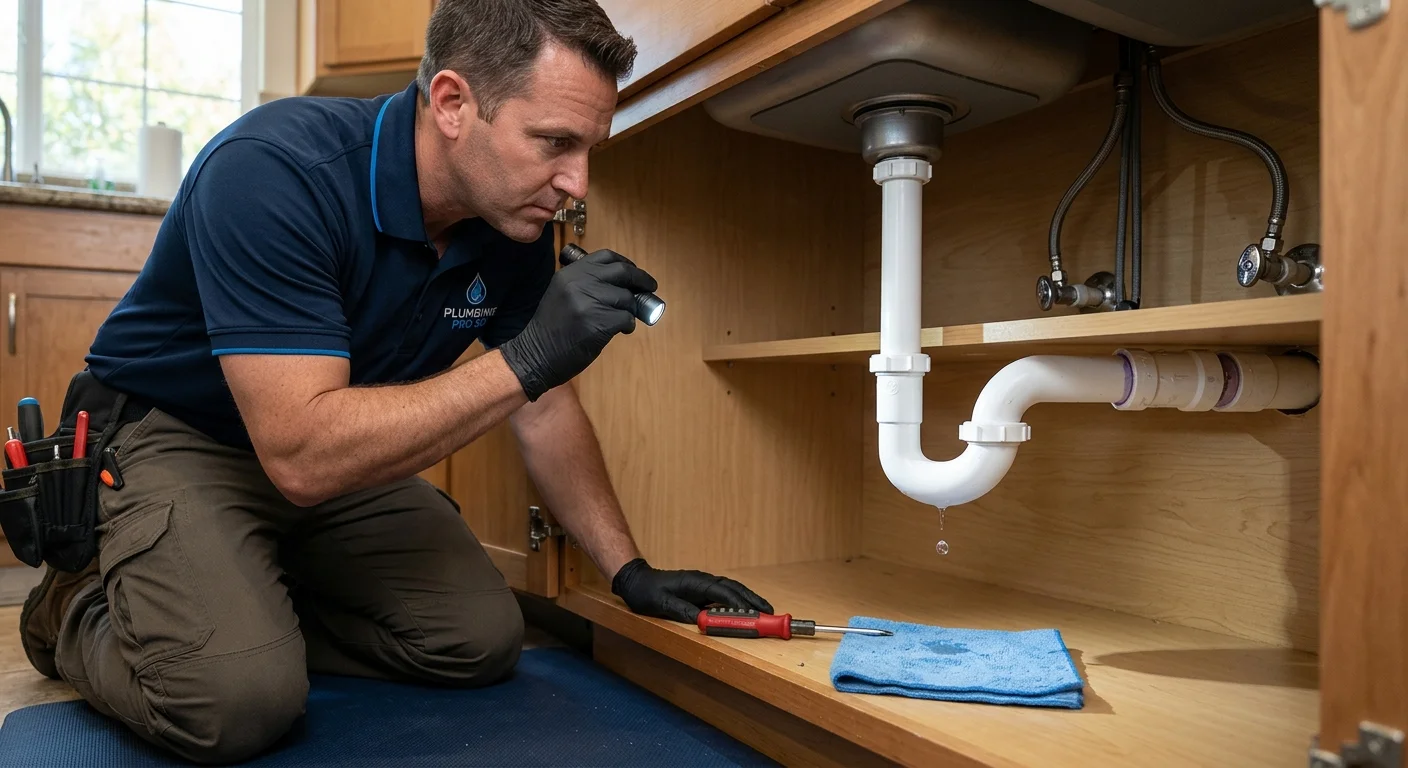
The tailpiece is the straight pipe under the bowl. It starts at the drain flange and drops to the trap. If the stopper is clear and the bowl still holds water, the restriction may be in that drop, at the flange, or at the first slip nut. You can see most of it by opening the cabinet. You cannot see inside the pipe.
The P-trap is the U-shaped bend that holds a water seal and sends waste toward the wall. Hair and paste settle in the bottom of the U. The trap arm then runs into the wall fitting. A clog in the trap stays a fixture job. A clog past the wall is a branch-line job. You will not know which from the bowl alone.
Do not take the trap apart as a first move. A full trap dumps dirty water into the cabinet. Slip-joint washers that are disturbed and not reseated start a leak on a drain that was only slow. If you already opened it, say so. The plumber you hire needs that history.
Do not pour chemical opener into a standing basin. It sits on the clog. It does not reliably cut hair off a pivot rod. Older metal traps in mid-century East County and South Bay baths do not need a caustic bath. Leave the water where it is.
A screen on the drain is prevention, not a diagnosis. If you want habits after this sink is open again, how to prevent clogged drains is the upkeep page. This page is the stopped basin in front of you.
When other fixtures change the diagnosis
One slow lavatory is this job. Two fixtures is not.
Run a short test, once. Fill this sink a little, then pull the stopper. Watch the tub, the shower, and the toilet. If they stay quiet and this bowl still holds, stay on the stopper and trap. If the tub rises, the shower gurgles, or the toilet bubbles, the restriction is downstream of the point those drains join. Stop the test. Do not keep filling the sink to “see how bad it is.”
That shared-line pattern is multiple drains backing up at once. A plunger on this sink will not open a clog past the wall. A store snake that only reaches the trap will not either.
Keep the fixture names straight when you call. A bathroom sink is a vanity. A shower is a floor drain with hair and soap. A tub has its own overflow and stopper. Mixing those three on the phone is how the wrong tool shows up.
If the only other symptom is a wet cabinet, that is still this fixture, plus a joint. If the only other symptom is a kitchen double bowl acting up, that kitchen has its own shared trap. Do not bundle them into one “all the sinks” story unless they actually fail together.
Condos and upstairs baths add a limit you cannot see. A Mira Mesa two-story and a National City one-story ranch do not share one wall layout. The plumber on site follows the pipe, not the city name. Say upstairs or downstairs. Say whether a tub sits on the same wall.
Sink repair in San Diego is the wider map: basin, faucet, drain, disposal. This post is the drain on one bathroom bowl. If the faucet drips or the bowl is loose on the deck, say that too so the referral can include bathroom and kitchen plumbing. Do not assume a drain cleaning visit includes a new faucet.
What the plumber you hire may inspect
The contractor you are matched with may start at the stopper, then the tailpiece, then the trap, then the wall. That order matches the water’s path. Individual capabilities still vary. Ask what they will open before they open it.
They may pull the pop-up and show you the hair on the pivot rod. They may open the trap over a pan. They may cable from the wall if the trap is already clear and the bowl still will not empty. A camera on a 1-1/4-inch lavatory line is not always possible. The plumber should say what the pipe will accept.
California’s C-36 plumbing classification covers providing a means for the proper disposal of fluid waste, including fixture drains and the piping that carries that waste. Forced warm-air heating units sit outside that classification. You want a current C-36 who actually clears drains, not a handyman with a bottle of opener.
Check the license yourself at the CSLB license check. Search by license number, business name, or personnel name. The database is down Sundays 8 p.m. through Mondays 6 a.m. for maintenance.
No official drain-cleaning price schedule is in our claims ledger. Do not use a blog figure. Ask the plumber you hire for a written quote that names the fixture, the access point, and whether the plan stops at the trap or continues into the wall.
Even work under California’s contractor license threshold can still need a plumbing permit. The license exemption in Business and Professions Code section 7048 is $1,000 for casual, minor work as of January 1, 2026. It does not apply if the job is part of a larger operation, if contracts are split to stay under the cap, if someone advertises as a contractor, or if they hire another person to do the work. A stopped sink is not automatically “under the cap.”
If the plumber finds the wall line is the problem, that is still drain cleaning, not three separate fixture calls. If they find the toilet and tub are in it too, you are already on the multi-drain path.
How to request a drain cleaning referral
Tell us the pattern in one pass. One bathroom sink. Will not drain, or drains as a trickle. Toilet and shower still work, or they do not. Stopper type if you know it: pop-up, push-button, or grid. City or unincorporated county. Upstairs or downstairs.
That is enough to route you to a C-36 plumber who clears fixture drains, not a sewer crew and not a kitchen-disposal call.
We connect you with independent licensed plumbers. We do not pull the stopper, own the cable, or set the price. You contract with the plumber you hire. Every plumber in the network is licensed and insured.
Bring a photo of the bowl and an open-cabinet shot of the trap if you can get one. A tight East County vanity and a wide South Bay cabinet are different access problems. Say which one you have.
Name what you already tried. Hair pulled from the opening. A plunger. A store snake. A chemical bottle. Do not present those as proof the line is clear. They are history.
If other fixtures are involved, say so in the first sentence. That one detail changes the referral from a vanity trap to a shared line.
When to call us
Call when one bathroom sink will not drain, the stopper and trap are not an obvious hair ball you can lift out, or another fixture starts to complain when this basin is used. The licensed plumbers we send handle fixture drains and the choice between a trap and a wall line. Call us at (858) 400-4417 and we’ll connect you with a licensed plumber.
Areas this guide covers
We connect homeowners with licensed plumbers in these San Diego County communities.
Keep reading
Need a Plumber in San Diego?
Licensed, insured plumbers, ready across San Diego County. The plumber quotes you before any work starts.
Call (858) 400-4417Call any time, day or night, anywhere in San Diego County