
Last updated: August 24, 2026
Shower diverter won't switch: what a plumber may check
Learn why a shower diverter won't switch, what water from both outlets may mean, and what a San Diego plumber may inspect before suggesting the right repair.
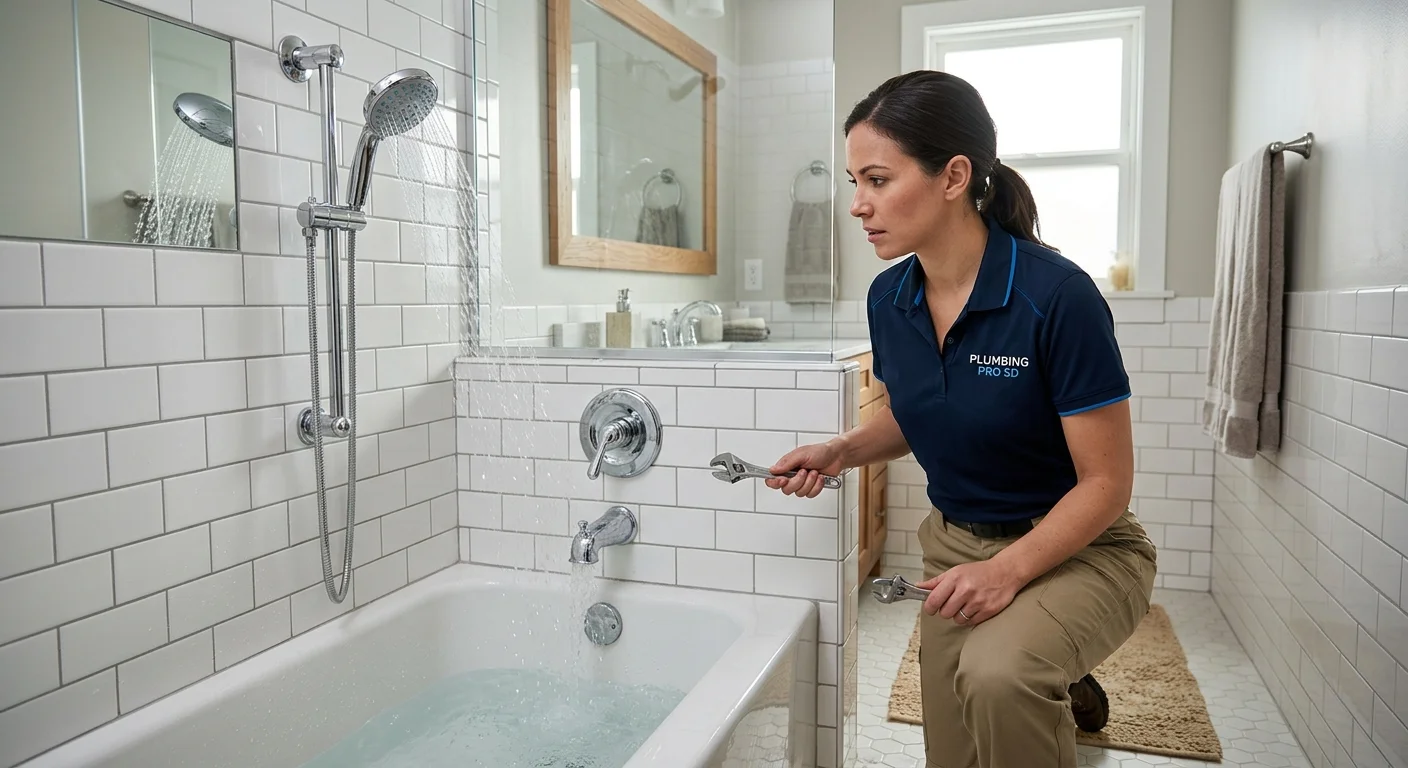
Water stays at the tub spout when you pull the diverter. It may also keep pouring below while the showerhead runs. That points to a routing problem, but it doesn’t identify the cause.
How tub-spout and shower-valve diverters differ
The term diverter valve can describe several fixture arrangements. Identifying yours is the first step toward a useful diagnosis.
Many tub and shower combinations have a pull-up knob on the tub spout. Moving that knob changes the water path inside the spout. The plumber may inspect the spout and its internal moving parts first.
Other bathrooms have a separate knob, lever, or selector near the main shower controls. That diverter may direct water between a showerhead, tub outlet, or handheld fixture. Its working parts can sit behind the finished trim.
Some controls combine several functions within one assembly. The visible handle may control temperature, water volume, outlet selection, or some combination. That makes the fixture’s model and configuration important.
A diverter problem also isn’t automatically a mixing-valve problem. The diverter chooses an outlet. The main shower control may perform a different job. If the trouble involves temperature control, shutoff, or leakage at the main handle, our shower valve replacement guide covers that separate service path.
Before describing the problem, look at the fixture without taking it apart. Note whether the diverter is on the spout or wall. Check whether there’s one showerhead, multiple outlets, or a handheld fixture. Those details help the independent plumber prepare for the correct type of assembly.
Why water may keep flowing from both outlets
Water coming from the tub spout and showerhead means the fixture isn’t fully directing flow during that test. It doesn’t reveal which component is responsible.
With a tub-spout diverter, the plumber may check whether the control moves through its expected range. They may also inspect whether the internal gate seats correctly. Wear, deposits, damaged parts, or a mismatched spout may be considered after inspection.
A wall-mounted diverter presents different possibilities. The visible handle could move without fully operating the internal component. A cartridge or related part may need closer examination. The plumber must identify the actual assembly before recommending anything.
Describe exactly what happens when you test it. A brief drip after switching isn’t the same observation as steady flow. Tell the contractor whether the showerhead receives a weak stream or normal flow. Also mention whether the selector feels loose, stiff, stuck, or unable to hold its position.
Timing can offer useful context without proving the cause. Note whether the symptom appeared suddenly or changed gradually. Tell the plumber if anyone recently replaced a spout, showerhead, handle, or trim piece. A recent change may affect which connections and parts deserve attention first.
Don’t order a generic diverter valve based only on the symptom. Similar-looking fixtures can use different internal parts. Photos, model markings, and the contractor’s inspection can reduce the chance of choosing an incompatible component.
What mineral buildup can and can’t explain
Mineral buildup deserves attention in San Diego, but it isn’t a complete diagnosis. The City of San Diego reports average drinking-water hardness of about 16 grains per gallon, or 276 parts per million. The city says hardness varies with location and demand.
San Diego’s Public Utilities Department also attributes much of that hardness to imported Colorado River water containing dissolved limestone. Property-specific information is available through the city’s water quality resources.
Deposits may be visible around a tub-spout knob, showerhead, or trim. A plumber may check whether deposits are affecting accessible moving surfaces. They may also look for residue after exposing a serviceable component.
Visible crust doesn’t prove that a concealed part has failed. It also doesn’t show whether cleaning will restore proper movement. The condition of the internal surfaces matters, as does the fixture design.
Mineral buildup can’t explain every diverter complaint. A plumber may still need to consider fit, wear, movement, and part compatibility. Several conditions can create a similar symptom at the outlets.
Avoid treating the local hardness figure as a prediction for one bathroom. Water sources and hardness can vary across the service area. Fixture age, maintenance, and specific materials also differ from property to property.
The useful question is whether deposits are interfering with this assembly now. The independent contractor can inspect the fixture and explain whether cleaning, a replaceable part, or a different repair makes sense. That recommendation should follow identification of the diverter, not the presence of surface residue alone.
What a plumber may inspect before recommending repair
A plumber will first need to reproduce the symptom. They may operate each control and observe flow at every outlet. This helps separate a stuck control from incomplete water routing.
For a tub-spout diverter, the inspection may focus on the spout’s movement, fit, and internal condition. The plumber may check how the spout connects to the supply stub. They can then determine whether the diverter is serviceable or whether the spout is treated as one assembly.
For a wall control, the plumber may inspect the handle and trim before reaching the working component. They may look for model markings or compare the assembly with manufacturer information. Existing access and fixture condition can affect what’s visible.
The contractor may also check for movement, moisture, or damage around accessible connections. If another plumbing problem appears, it should be identified separately. A diverter complaint shouldn’t become an automatic recommendation for broad valve replacement.
Ask the plumber to name the suspected component and demonstrate the failed function. A clear recommendation should distinguish among a spout issue, a diverter component, and the main shower valve. Those repairs can involve different parts and access needs.
Our bathroom and kitchen plumbing referral service can connect you with a contractor for a broader fixture assessment. For a focused outlet-control problem, faucet repair and installation referrals provide the closest service match.
No verified standard price or labor time applies to every diverter repair. Access, fixture type, available parts, and the confirmed scope can differ. The independent contractor sets the price and should explain it before you authorize work.
California’s C-36 classification includes repair and replacement within its defined plumbing scope, though individual contractor capabilities vary. You can verify a contractor through the state’s license database. It lists status, classifications, bond information, complaint history, expiration dates, and workers’ compensation information. The database is unavailable from Sunday at 8 p.m. through Monday at 6 a.m. for scheduled maintenance.
How to request a faucet and shower referral
Start with the symptom, not your diagnosis. Say that the shower diverter won’t switch, water remains at the tub spout, or both outlets run together. That gives the referral service a clear service category.
Next, describe the controls. Mention a pull-up tub-spout knob, wall selector, single handle, or separate diverter lever. Include every connected outlet, such as a tub spout, fixed showerhead, or handheld fixture.
Photos can help the contractor recognize the fixture family. Capture the entire control layout, the tub spout, and any visible brand or model marking. Don’t remove trim solely to take a picture.
Share when the problem began and whether it changed after other fixture work. Tell the contractor if the handle is stuck, loose, or difficult to turn. Explain whether water stays entirely below or continues from both outlets.
Include the property location and any access details. San Diego County includes coastal, inland, central, East County, and South Bay communities. Water hardness can vary by location and demand, so the plumber should inspect the actual fixture. Homeowners in the area can also review our Mira Mesa plumber referral page for local service information.
Plumbing Pro San Diego provides the connection. The homeowner contracts with and pays the independent plumber directly. The contractor confirms the diagnosis, available parts, repair scope, and price.
When to call us
Request a licensed plumber when the diverter won’t move, won’t hold, or keeps sending steady water through both outlets. Every plumber in our network is licensed and insured, and you contract with the independent plumber directly. Call us at (858) 400-4417 and we’ll connect you with a licensed plumber.
Areas this guide covers
We connect homeowners with licensed plumbers in these San Diego County communities.
Keep reading
Need a Plumber in San Diego?
Licensed, insured plumbers, ready across San Diego County. The plumber quotes you before any work starts.
Call (858) 400-4417Call any time, day or night, anywhere in San Diego County