
Last updated: August 21, 2026
Sink repair in San Diego: which of the four jobs is yours
Sink repair covers four different jobs: the basin, the faucet, the drain, and the disposal. Find which one is wet or blocked before you call anyone.
The short answer
- Sink repair is not one job. It's four separate zones: the basin and its seal to the counter, the faucet and supply lines, the drain and trap, and the disposal.
- Where water shows up, on the counter edge, in the cabinet floor, only when the disposal runs, only when the dishwasher drains, points to a different zone.
- Naming the right zone before you call gets you the right plumber and lets a quote actually match the job.
- Homeowners can reasonably handle a loose slip nut, a cleared P-trap, or a jammed disposal reset. Anything soldered, anything in the wall, or a leak you cannot pinpoint is a plumber's job.
- San Diego's hard water speeds up scale on aerators, strainers, and disposal components, which shows up as slow drips or reduced flow well before an actual leak.
In San Diego, “sink repair” can mean four different jobs. Naming the right one helps you describe the problem clearly. A counter-edge leak and a clog under the disposal are different problems. So are a wobbly faucet and a dishwasher-related puddle. Yet all may appear in searches as “sink repair” or “sink disposal repair.”
This guide helps you locate the affected zone. It isn’t a full repair manual for every problem. Once you identify the zone, use our deeper guides. They cover kitchen plumbing, faucet repair, and garbage disposal repair.
Open the cabinet first
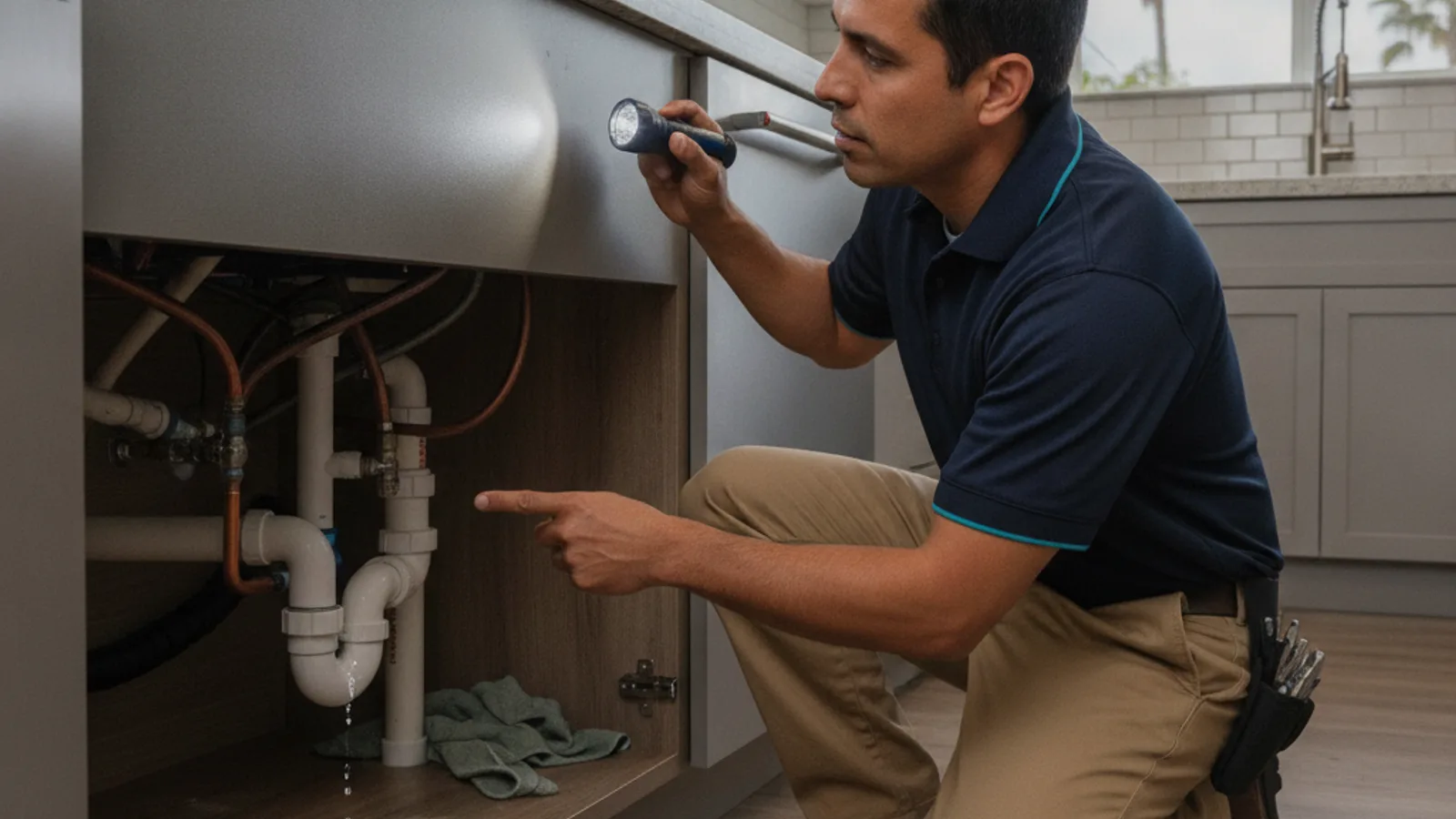
Before doing anything else, open the cabinet doors under the sink and look, and feel, with a flashlight if the space is dark. Run the faucet, run the disposal if you have one, and run the dishwasher if that is a factor, checking after each one rather than all at once.
Note exactly where water shows up and when:
| Where the water shows up | Likely zone | Who should touch it |
|---|---|---|
| On the countertop, at the edge of the sink basin | Deck and basin seal | Often DIY-reseal, sometimes a plumber if the counter substrate is already damaged |
| In the cabinet, dripping steadily regardless of use | Faucet supply lines or shutoff valves | A plumber, since these connections are under constant water pressure |
| In the cabinet, only right after the faucet runs | Drain and trap | Often a homeowner fix if it is a loose slip nut |
| In the cabinet, only when the disposal runs | Disposal housing or its drain connection | A plumber if the housing itself is cracked or leaking |
| In the cabinet, only when the dishwasher drains | Dishwasher branch line or air gap | A plumber, since this involves the drain and vent system |
This single check is the fastest way to turn a vague “my sink is leaking” into a specific, answerable problem. Skipping it is how a homeowner ends up paying for a service call that finds nothing wrong with the drain when the actual leak was at the faucet supply line the whole time.
The deck and basin
This is the sink itself and the seal holding it to the counter. A sink can be top-mounted, sitting in a cutout with a bead of plumber’s putty or silicone sealing the rim, or undermounted, held by clips and adhesive from below.
Signs this is your zone: water collecting on the countertop right at the sink’s edge, a basin that rocks or feels loose when you press on it, or a soft, swollen spot in the counter or cabinet top directly around the cutout. That softness means water has already been seeping past a failed seal for a while, not just today.
A homeowner can often reseal a top-mounted sink: remove the old sealant, clean the surface, and apply new silicone or putty. An undermounted sink coming loose, or counter material that has already started to deteriorate, is a job for a plumber or, if the counter substrate itself needs replacing, a countertop specialist. If you are replacing the basin entirely rather than resealing it, that falls under fixture installation.
The faucet and supply lines
This zone covers everything above the deck: the faucet body, its handle and cartridge, and the flexible supply lines running from the shutoff valves up to the faucet.
Signs this is your zone: a drip from the spout itself, water seeping from around the base of the faucet where it meets the counter, or a puddle in the cabinet that shows up steadily, not tied to any one activity, because the supply lines are pressurized all the time.
A dripping spout is almost always a worn cartridge or O-ring inside the faucet, a parts-level repair. A leak at the supply line fittings themselves, where they thread onto the shutoff valves or the faucet, involves pressurized connections and is worth a plumber’s attention, especially if the fitting is corroded or the valve itself will not fully shut off. No verified local figure establishes how water hardness changes a faucet’s lifespan, so check the fixture manufacturer’s care guidance for your model.
The drain and trap
This is everything below the basin’s drain opening: the tailpiece, the P-trap, and the branch line running to the wall or floor.
Signs this is your zone: water in the cabinet that appears specifically after the sink drains, a slow-draining basin, or a sour smell coming from under the sink. A P-trap is designed to be a serviceable joint, connected with slip nuts rather than glue, specifically so a homeowner or plumber can open it to clear a clog or replace a worn washer.
A loose slip nut is a genuinely reasonable DIY fix: hand-tighten it, or replace the plastic washer inside if tightening does not stop a slow drip. Clearing a simple clog in the trap itself, hair, food debris, a buildup of grease and soap film, is also within reach for most homeowners with a bucket and a wrench. A crack in the trap or a leak further back in the wall, where the branch line meets the home’s drain system, is where it becomes a plumber’s job.
The disposal
If your sink has a garbage disposal, it introduces its own set of failure points separate from the drain and trap above it: the mounting connection to the sink, the discharge pipe leading to the trap, and the unit’s housing itself.
Signs this is your zone: water pooling directly under the disposal unit, a humming sound with no grinding, or a disposal that will not run at all. A leak specifically at the bottom of the disposal housing usually means a failed internal seal, which is a sign the unit itself, not just a fitting, needs attention.
A disposal that hums but does not grind is often a simple jam, cleared by cutting power and using the manual turning tool at the base if the model has one, then pressing the reset button. A disposal leaking from the housing, making grinding or clanking noises from worn components, or one that trips its reset repeatedly, has moved past a DIY fix. Our garbage disposal repair guide covers that decision in more depth.
What you can do and where to stop
A few sink problems are genuinely within reach for most homeowners: hand-tightening a slip nut, clearing a P-trap clog, resetting a jammed disposal, or resealing a top-mounted basin with new silicone.
The line to stop and call a plumber is just as clear: anything soldered or glued rather than mechanically connected, anything inside a wall rather than under the sink, a leak you have checked for but still cannot pinpoint, or any work involving the home’s gas or electrical connections near the disposal. A leak you cannot locate after checking each zone in turn is itself a reason to call, since a plumber has tools, dye tests and moisture meters among them, that go beyond what a flashlight and a dry paper towel can tell you.
Frequently asked questions
Why does my kitchen sink leak only when the dishwasher runs?
That points to the drain and trap zone, specifically the branch line the dishwasher drains into, not the sink basin itself. A loose dishwasher drain hose clamp or a failing air gap fitting are common causes.
Is it normal for water to collect under my sink cabinet after washing dishes?
No. It usually traces to a loosened slip nut, a cracked trap, or a P-trap joint that has come apart. Water appearing during or right after normal sink use, rather than only during disposal or dishwasher operation, points there first.
Can I tighten a leaking sink faucet myself?
Tightening the faucet’s mounting nuts can stop a wobble, but a drip from the spout or handle is almost always a worn cartridge or O-ring inside the faucet body, which tightening will not fix.
What does it mean if the sink basin itself feels loose or the counter around it is soft?
That points to the deck and basin zone. The seal between the sink and countertop has likely failed, and soft or swelling material around the cutout means water has already been getting in.
Should I try to fix a garbage disposal that hums but does not grind before calling a plumber?
Checking for a jam is reasonable to try: cut power, then use the reset button and manual turning tool to free an obstruction. If it still will not grind, or it is leaking from the housing, that is a plumber’s or replacement decision.
When to call us
Once you have narrowed the leak or clog to a specific zone and it involves anything soldered, anything inside a wall, or a source you still cannot pin down, that is the point to bring in a licensed plumber rather than keep guessing. Call (858) 400-4417 with which zone you found wet or blocked and when the water shows up, and we’ll connect you with a licensed and insured local plumber.
Areas this guide covers
We connect homeowners with licensed plumbers in these San Diego County communities.
Keep reading
Need a Plumber in San Diego?
Licensed, insured plumbers, ready across San Diego County. The plumber quotes you before any work starts.
Call (858) 400-4417Call any time, day or night, anywhere in San Diego County