
Kitchen plumbing in San Diego: full guide for 2026
Kitchen plumbing in San Diego: anatomy, CA air-gap code, 2026 cost ranges, hard water effects, RO systems, remodel adds, and common fixes from local plumbers.
The short answer
- Kitchen plumbing covers hot and cold supply, the drain and vent, the dishwasher branch, the disposal, the ice maker line, and often a gas line.
- California code requires a physical dishwasher air gap; a high loop alone fails inspection.
- 2026 San Diego labor ranges: faucet swap $200 to $400, sink replace $250 to $500, under-sink RO $350 to $700, pot filler $600 to $1,400.
- San Diego's hard water (17 to 20 gpg) fouls ice makers, films dishwashers, and shortens RO membranes; a whole-house softener is the source fix.
- Permits are needed when work moves drains, vents, or gas lines; for remodels or stubborn under-sink leaks, call (858) 400-4417.
Kitchen plumbing covers more than the sink. It’s the hot and cold supply, the drain and vent, the dishwasher branch, the disposal, the ice maker line, and often a gas line for the range. In San Diego, two things shape every kitchen: hard water from the Colorado River and State Water Project, and California’s strict dishwasher air-gap code. Both change how the job gets built.
Anatomy of kitchen plumbing
A kitchen is the busiest plumbing room in the house. More fixtures, more connections, more code points than a bathroom. Here’s what sits behind the cabinets.
Supply lines. Hot and cold half-inch copper or PEX run from the main lines to angle stops under the sink. From there, flexible braided supplies feed the faucet, the dishwasher (hot only), the ice maker (cold), and any filtered water tap.
Drain and P-trap. The sink drain ties into a P-trap, then runs to a branch drain inside the wall. The P-trap holds water to block sewer gas. Double-bowl sinks use a center tee and a single trap. Disposal-side drains tee in below the basket strainer.
Vent. Every kitchen drain needs a vent. It lets air in so water can leave. Most San Diego kitchens use a wall-mounted vent that ties into the main stack. Island sinks use an air admittance valve (AAV) or a loop vent because they can’t run a vent up through open space.
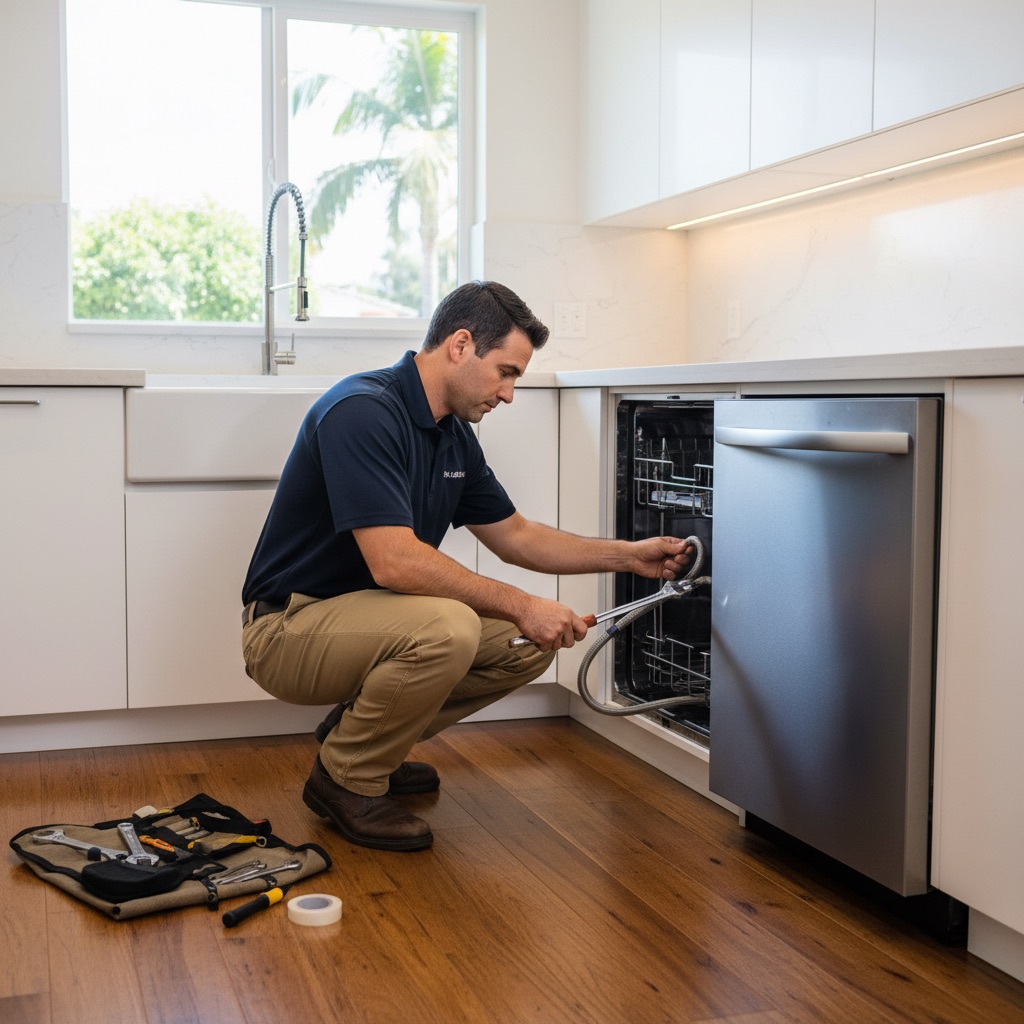
Dishwasher branch. Hot supply tees off the kitchen sink hot line. Drain hose runs up to a code-required air gap on the counter or sink deck, then down to the disposal or a drain tailpiece.
Disposal. Wired to a switch, plumbed to the sink drain. Needs its own dedicated tee if a dishwasher drains through it.
Ice maker line. Quarter-inch tubing branches off the cold supply, runs through the cabinet and wall to the fridge.
Gas line for the range. Black iron or CSST from the meter to a flex connector behind the range, with a shutoff in the cabinet next to the appliance.
That’s the system. Every remodel touches at least three of these.
California air-gap requirement for dishwashers
This one trips up homeowners and out-of-state contractors all the time.
California Plumbing Code requires a physical air gap on every dishwasher drain. It’s the small chrome cylinder you see on the back of the sink or on the countertop next to the faucet. The dishwasher drain hose runs up to the air gap, then a second hose drops down to the disposal or drain tailpiece.
The air gap prevents dirty sink water from being siphoned back into the dishwasher if the drain ever backs up. It’s a backflow device.
What about the “high loop”? In some states, you can substitute a high loop, where the drain hose just gets strapped up under the counter as high as it can go. That doesn’t fly in California. Code requires the physical air gap. A high loop alone won’t pass inspection. If you’re remodeling and your inspector sees no air gap, the dishwasher install fails.
Two practical notes. First, if your air gap sputters or leaks onto the counter, the line downstream of it is partially clogged. That’s a real plumbing problem, not a defect in the air gap. Second, some homeowners hide the air gap by routing it through a discreet chrome cap or a soap-dispenser-style cover. That’s fine. Removing it is not.
Kitchen plumbing project cost in San Diego (2026)
Labor only, materials not included. Real ranges from active San Diego jobs.
Kitchen plumbing cost ranges in San Diego (2026)
A few things that move the number up. Old galvanized supply behind the sink. A drain that’s the wrong height after a counter change. Anything inside a wall that wasn’t planned for. Coastal homes north of Carlsbad often have copper that’s pinhole-leaking from chloramine and need supply line replacement during the work.
Hard water and your kitchen
San Diego water averages about 16 grains per gallon. That’s hard. Anything past 7 is considered hard, and 20 is rough on appliances that boil, freeze, or filter water.
What it does inside a kitchen:
Ice makers foul. Scale builds up on the inlet valve and the freezer mold. You’ll see cloudy ice, then small ice, then no ice. Most ice makers in San Diego need a descale every 6 months and full replacement around year 5 to 7 instead of the usual 10.
Dishwashers get film. That cloudy haze on glassware isn’t soap residue. It’s calcium deposits etched into the surface. Once it etches, it’s permanent. Soft water or a rinse aid with citric acid prevents it.
Coffee and espresso lines scale fast. Plumbed-in espresso machines and coffee makers need descaling every 4 to 6 weeks here. Most manufacturers void warranties for scale damage, and espresso boilers commonly fail at year 2 instead of year 8 because of it.
RO membranes wear out. A reverse osmosis membrane rated for 3 to 5 years often lasts 18 months in San Diego if the pre-filters aren’t kept fresh. Hard water shortens membrane life dramatically.
The fix at the source is a water softener for the whole house. Many homeowners go further and add an under-sink RO unit for drinking water on top.
Reverse osmosis: drinking water in San Diego
Almost every kitchen we touch in North County has an RO system or is asking about one. Here’s why.
San Diego’s tap water is safe to drink, but it tastes like the chlorine and minerals it carries. RO strips out 95 to 99% of dissolved solids, chlorine, chloramine, lead, arsenic, and most of what affects taste. The result is bottled-water-quality drinking water from a dedicated faucet next to the sink.
A standard under-sink RO has four to five stages: sediment, carbon, RO membrane, post-carbon polish, and optionally a remineralization stage. It feeds a small storage tank in the cabinet and a dedicated faucet on the sink deck.
Install cost in San Diego. $350 to $700 in labor, plus $200 to $800 for the unit depending on brand. Tankless RO systems run higher on the unit cost but skip the storage tank.
Maintenance schedule.
- Sediment and carbon pre-filters: every 6 to 12 months
- Post-carbon filter: every 12 months
- RO membrane: every 2 to 3 years (sooner without a softener)
- Sanitize the tank: annually
A common upgrade is plumbing the RO output to both the dedicated faucet and the fridge’s ice and water dispenser. Cleaner ice, longer ice maker life. For more on filtration trade-offs, see our guide to water filtration systems.
Common kitchen plumbing problems
These are the calls we get most.
Leaks under the sink. Usually the P-trap connection or a tired angle stop. Plastic slip-nut traps loosen over time. Compression-fit angle stops fail in salty coastal air.
Slow kitchen sink drain. Almost always grease and food buildup in the horizontal branch drain. A snake clears it. Avoid chemical drain cleaners; they corrode older galvanized branches. See how to prevent clogged drains.
Dishwasher backing up into the sink. The dishwasher drain hose ties into the disposal or the drain tailpiece. If that drain is clogged downstream, dishwasher water has nowhere to go. Fix the kitchen drain first. If your garbage disposal isn’t working, that’s a separate fix.
Weak pressure at the kitchen faucet only. Nine times out of ten it’s a clogged aerator. Unscrew the tip, rinse out the screen, screw it back on. If that doesn’t fix it, the cartridge is scaled up. If pressure is weak everywhere in the house, that’s a bigger issue. See low water pressure in the house.
Disposal humming but not spinning. Reset button on the bottom, then the hex wrench in the bottom port to free the flywheel. For repair help, see our garbage disposal repair and maintenance guides.
Sink draining slowly with gurgles. That’s a vent problem. Common in older Mission Hills and Hillcrest homes where the vent stack has rusted shut.
Smart adds during a kitchen remodel
If walls are open, do these. They cost a fraction now versus retrofitting later.
Quarter-turn shutoffs everywhere. Replace every angle stop with a quarter-turn ball valve. Old multi-turn stops seize. When you have a leak, you want a valve that closes in 90 degrees.
Dedicated soft-water bypass to the ice maker. Most softeners feed the whole house, but some homeowners skip softened water at the kitchen tap to avoid sodium. The fix is a dedicated soft line to the fridge and dishwasher only, with hard water at the sink. Easier to run during a remodel than after.
Drain noise insulation. Wrap the kitchen drain stack in cast iron sound damping or acoustic wrap before drywall closes. Cuts dishwasher and sink drain noise dramatically, especially if there’s a bedroom on the other side of the wall.
Water hammer arrestors. That bang when the dishwasher or washing machine shuts off is water hammer. Inline arrestors at the dishwasher branch and at any quick-closing valve stop it. $20 each at install, $300 to retrofit.
Pot filler over the range. Code in San Diego allows cold-only pot fillers. Run the line during framing. Make sure the wall behind has a backer for the bracket.
Pre-plumb for an instant hot or RO faucet. Even if you don’t add them now, drill the deck holes and run the supplies. Adding them in three years is a 30-minute job instead of a half-day.
Frequently asked questions
Do I need a permit to remodel my kitchen plumbing in San Diego? Yes, for any work that moves drains, vents, or gas lines. Like-for-like fixture replacement usually doesn’t require a permit. Adding a pot filler, moving the sink, or changing the gas line all do.
Can I use a high loop instead of an air gap for my dishwasher? No. California Plumbing Code requires a physical air gap. A high loop alone fails inspection.
How long does a kitchen remodel’s plumbing take? Rough plumbing for a full remodel runs 2 to 4 days. Final connections at the end of the project add another day. Most homeowners are without a kitchen sink for 5 to 10 working days total.
Is an under-sink RO system worth it in San Diego? For most homeowners, yes. The water tastes much better, ice is clearer, and coffee comes out cleaner. The trade-off is filter maintenance and about 3 gallons of brine water per 1 gallon of filtered water.
Why does my kitchen sink smell? Three usual suspects. Food buildup in the disposal, a dry P-trap on a rarely-used second basin, or a partially clogged drain branch growing biofilm. Run hot water, clean the disposal, and if it persists, call a plumber to scope the drain.
Can a plumber install my new range and dishwasher together? Yes. We coordinate the gas line for the range, the supply and drain for the dishwasher, and the air gap in one visit. Cheaper than two trips. See our guide on whether a plumber can install your dishwasher.
Should I replace the faucet myself or hire a plumber? If your shutoffs work and the supply lines are accessible, a competent DIY swap takes an hour. If the angle stops won’t close, or the lines are corroded, call. Stuck angle stops are how small jobs become flooded kitchens. See faucet installation in San Diego for the full breakdown.
Talk to a San Diego kitchen plumber
Kitchen plumbing is the most fixture-dense work in the house. There’s value in getting it right the first time, especially with California’s air-gap code, San Diego’s hard water, and the cost of opening walls twice. If you’re also planning a bathroom renovation, our guide to bathroom remodel plumbing in San Diego covers drain relocation, permit requirements, and what to budget for wet-room work.
If you’re remodeling, adding an RO system, or just trying to figure out why something under the sink keeps dripping, give us a call at (858) 400-4417. We’ll walk through the job, give you an honest range, and only book the work if it makes sense.
Areas this guide covers
We connect homeowners with licensed plumbers in these San Diego County communities.
Keep reading
Need a Plumber in San Diego?
Licensed, insured plumbers, ready across San Diego County. The plumber quotes you before any work starts.
Call (858) 400-4417Call any time, day or night, anywhere in San Diego County