
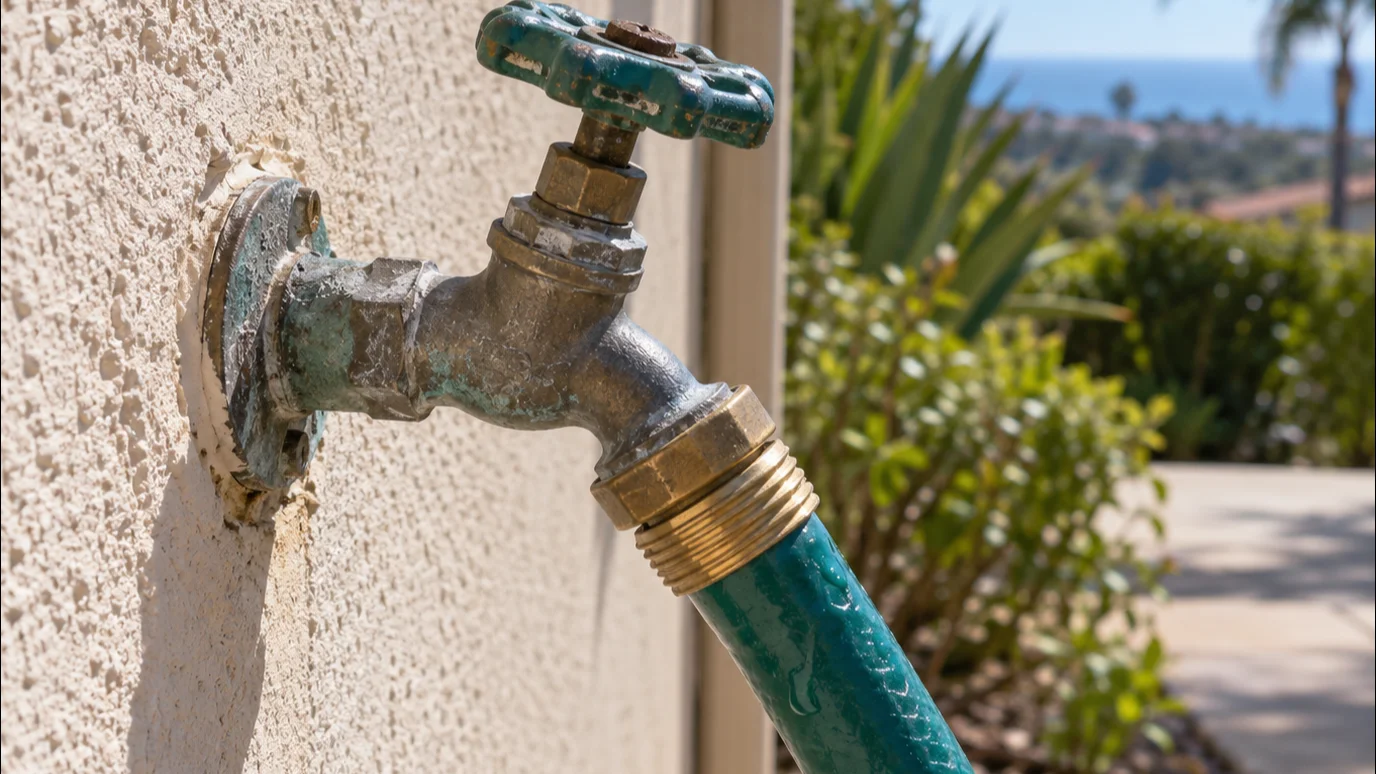
Outdoor faucet replacement in San Diego: repair or replace
Decide when an outdoor faucet needs repair or replacement in San Diego, what anti-siphon parts do, and what to include in a licensed plumber's scope of work.
A dripping outdoor faucet doesn’t always need complete replacement. The right choice depends on where it leaks, whether the body is damaged, and how securely it connects inside the wall.
When a hose bibb is past a washer repair
An exterior hose faucet is commonly called a hose bibb, hose bib, or outdoor spigot. Those names usually describe the same wall-mounted fixture used for a garden hose.
Start by locating the water. A drip from the outlet after closing the handle may point toward an internal sealing problem. Water around the handle suggests a different repair area. Moisture behind the flange, inside the wall, or below the stucco needs closer inspection.
A washer, packing material, or another serviceable component may solve a contained leak. Replacement becomes the stronger option when the faucet body is cracked, badly corroded, deformed, or no longer holds repair parts securely. A handle that keeps slipping after repair also deserves a full inspection.
Movement matters too. The faucet shouldn’t twist freely against the wall when someone attaches a hose. Movement may involve the mounting, the pipe connection, or both. Don’t keep turning the faucet body to test it. That can place more force on a concealed connection.
Our guide to an outdoor faucet leaking covers common repair decisions. If the leak continues after a targeted repair, ask a licensed plumber to inspect the complete assembly.
Replacing a hose bibb isn’t always a simple unscrew-and-swap job. The connection may sit behind stucco, siding, or an interior wall. Access and the condition of the connected pipe change the scope. A plumber can determine whether the fixture can be removed without opening the wall.
No verified countywide replacement price could be confirmed from a public authority. Contractors set their own prices based on access, materials, existing damage, and related work. Request a written scope from the contractor before approving the job.
How coastal salt air and inland freeze risk differ in the county
Outdoor faucets face different conditions across San Diego County. A hose bibb near Ocean Beach, Imperial Beach, or Coronado may show exposed-surface corrosion. Homes in Julian or Mount Laguna need more attention to colder nights and exposed piping.
Those conditions don’t prove that a faucet must be replaced. They tell the plumber what to examine. Near the coast, ask about corrosion around the handle, outlet threads, flange, fasteners, and pipe connection. Discoloration alone doesn’t reveal what’s happening inside the wall.
Our Imperial Beach plumbing guide provides more context for properties near the coast. Salt exposure can vary between homes based on distance, shelter, and the faucet’s location.
In the mountain communities, ask the contractor to examine exposed pipe sections and previous cold-weather damage. The approved claims ledger doesn’t provide a verified freeze date or a failure rate for outdoor faucets. A licensed plumber should judge the fixture and connected piping at the property.
San Diego’s water conditions also belong in the conversation. City drinking water averages about 16 grains per gallon, or 276 parts per million, though hardness varies by location and demand. Mineral buildup may be visible around an outlet or anti-siphon part. It doesn’t, by itself, prove the complete faucet has failed.
Photograph the faucet before requesting a referral. Include the wall surface, pipe entry, handle, outlet, and any staining below it. Also note whether the fixture drips while closed, leaks only with a hose attached, or moves at the wall. Those details help the matched contractor prepare for the inspection.
What an anti-siphon hose bibb is for, without mixing it up with sewer devices
An anti-siphon hose bibb includes a device associated with protecting the water-supply side of the plumbing. Its intended role is to limit water from moving backward through the hose connection under siphoning conditions.
You may see the device integrated into the faucet or attached near its outlet. If water escapes from that upper attachment, the faucet body may not be the failing part. Read our guide to an outdoor anti-siphon valve leaking before assuming the entire hose bibb needs replacement.
Don’t confuse this part with a backwater valve. A backwater valve concerns wastewater moving through a drain or sewer line. An outdoor anti-siphon device belongs to the water-supply side. Similar words can describe very different plumbing functions.
A small outdoor attachment also isn’t the same as every backflow prevention assembly used elsewhere on a property. Irrigation, commercial, and other systems may have separate devices and testing needs. Our backflow testing and prevention service explains how we connect property owners with licensed plumbers for that work.
The approved claims ledger doesn’t confirm a universal San Diego rule requiring one particular hose bibb model at every existing home. Requirements can depend on the property, fixture, location, and scope. Ask the matched contractor what applies to your address. If permitting or inspection is involved, confirm the current requirement with the city or county authority serving the property.
California’s C-36 classification includes repair and replacement of plumbing items and safety devices such as backflow preventers. Individual contractor capabilities still vary. You can check a contractor’s license through the CSLB license lookup before approving work.
What to ask the contractor you’re matched with to include in the scope
A useful scope separates the visible faucet from the connection behind it. Ask the contractor to state exactly what will be inspected, repaired, or replaced. The written description should match the conditions found at your home.
Start with these points:
- Whether the leak comes from the outlet, handle, anti-siphon part, body, or concealed connection
- Whether the existing hose bibb can be repaired with serviceable parts
- Whether replacement requires access through stucco, siding, drywall, or another surface
- Whether the connected pipe and mounting are sound
- Whether an integrated or separate anti-siphon component is included
- What wall patching or finish work is included, if any
- Which party handles cleanup and any surface restoration
- Whether the water shutoff serving the work operates correctly
- What product and materials the contractor proposes to install
- Whether the contractor identified any permit or inspection requirement
Ask whether the quoted work covers only the faucet or also damaged piping. A short description such as “replace outdoor faucet” can leave that unclear. The contractor should document any added work before you approve it.
Replacement product claims also need precision. California’s lead-free requirements apply to products intended to convey or dispense water for drinking or cooking. Different standards apply to products used exclusively for non-potable purposes. Ask the licensed contractor to identify a suitable fixture for the faucet’s intended use.
Don’t choose a faucet based only on handle shape or finish. The wall connection, pipe material, mounting method, and anti-siphon arrangement must fit the property. The contractor should select the fixture after inspecting those conditions.
For broader help, our faucet repair and installation referral service can match you with an independent licensed plumber. You’ll contract with and pay that plumber directly. Plumbing Pro San Diego doesn’t perform the work or set the contractor’s price.
How to request a faucet referral
Tell us that you need an outdoor faucet replacement assessment. Include your San Diego County community and describe the wall surface. Stucco, siding, masonry, and exposed framing can present different access questions.
Share what happens when the faucet is used. Note whether it drips while closed, sprays near the handle, leaks with a hose attached, or leaves moisture around the wall. Mention visible corrosion, a cracked body, damaged outlet threads, or movement at the mounting point.
If you know where the property’s water shutoff is located, include that information. Don’t force a valve that won’t turn. The matched plumber can inspect the shutoff and explain whether it affects the proposed work.
Photos can make the request clearer. Take one close view of the faucet and one wider view of the surrounding wall. Remove an attached hose only if it comes off without force. A stuck coupling may need inspection with the faucet.
We’ll connect you with an independent plumber serving your part of San Diego County. Every plumber in the network is licensed and insured. Ask the contractor for a written scope and confirm who handles wall access, restoration, materials, and any permit question.
You can also verify the contractor through the CSLB lookup before signing an agreement. California property owners can search by license number, business name, or personnel name.
When to call us
Call when the faucet body is damaged, the wall connection moves, or water may be entering the wall. Those conditions need inspection by a licensed plumber before replacement begins. Call us at (858) 400-4417 and we’ll connect you with a licensed plumber.
Areas this guide covers
We connect homeowners with licensed plumbers in these San Diego County communities.
Keep reading
Need a Plumber in San Diego?
Licensed, insured plumbers, ready across San Diego County. The plumber quotes you before any work starts.
Call (858) 400-4417Call any time, day or night, anywhere in San Diego County