Best sewer repair in San Diego: how to choose
How to pick the right sewer repair specialist in San Diego. Gear to look for, permit signals, red flags in quotes, and the questions to ask before signing.
The short answer
- Pick a true sewer specialist who owns the camera, locator, and jetter, and shows you the footage before quoting.
- Five methods: spot repair, CIPP lining, pipe bursting, full open-cut, and lateral connection rebuild; the camera dictates which fits.
- Costs: spot repair $1,500 to $4,000, trenchless $4,000 to $15,000, full open-cut $8,000 to $30,000.
- Most San Diego failures come from tree roots, old clay pipe, and shifted ground; a camera scope is non-negotiable first.
- The contractor must pull the City permit in their name and put restoration in writing. Call (858) 400-4417.
The right sewer specialist for your job depends on what’s wrong, where it is, and what your street looks like. A spot repair under a lawn is a different job than a 60-foot lateral under a driveway. Most sewer failures in San Diego come down to old clay pipe, root intrusion, or shifted ground. You want a contractor whose gear, permits, and written scope match your specific problem. This guide walks through how to tell the difference.
Sewer repair is a specialty, not every plumber does it well
A lot of San Diego plumbing shops handle drains, water heaters, and repipes. Fewer of them do real sewer work. Sewer repair sits at the intersection of three things: heavy equipment, permitting, and field experience reading underground conditions. A shop that runs one camera and subs out the dig isn’t a sewer specialist. They’re a referral middleman.
What separates a true specialist:
- They own the camera, the locator, and the jetter. They don’t rent on the day of the job.
- They’ve pulled City of San Diego sewer permits in the last 12 months. They know the inspector by name.
- They handle excavation in-house, or they have a dedicated excavation partner on every job.
- They show you the camera footage before they quote you. Not after.
- They put restoration in writing. Concrete, asphalt, landscaping, hardscape.
If a plumber can’t check those boxes, they’re not the right call for a lateral failure. They might still be great for a clogged kitchen drain.
Types of sewer repair: pick the right specialist for the right job
There’s no single “sewer repair.” There are five common methods, and each one needs different gear and different experience.
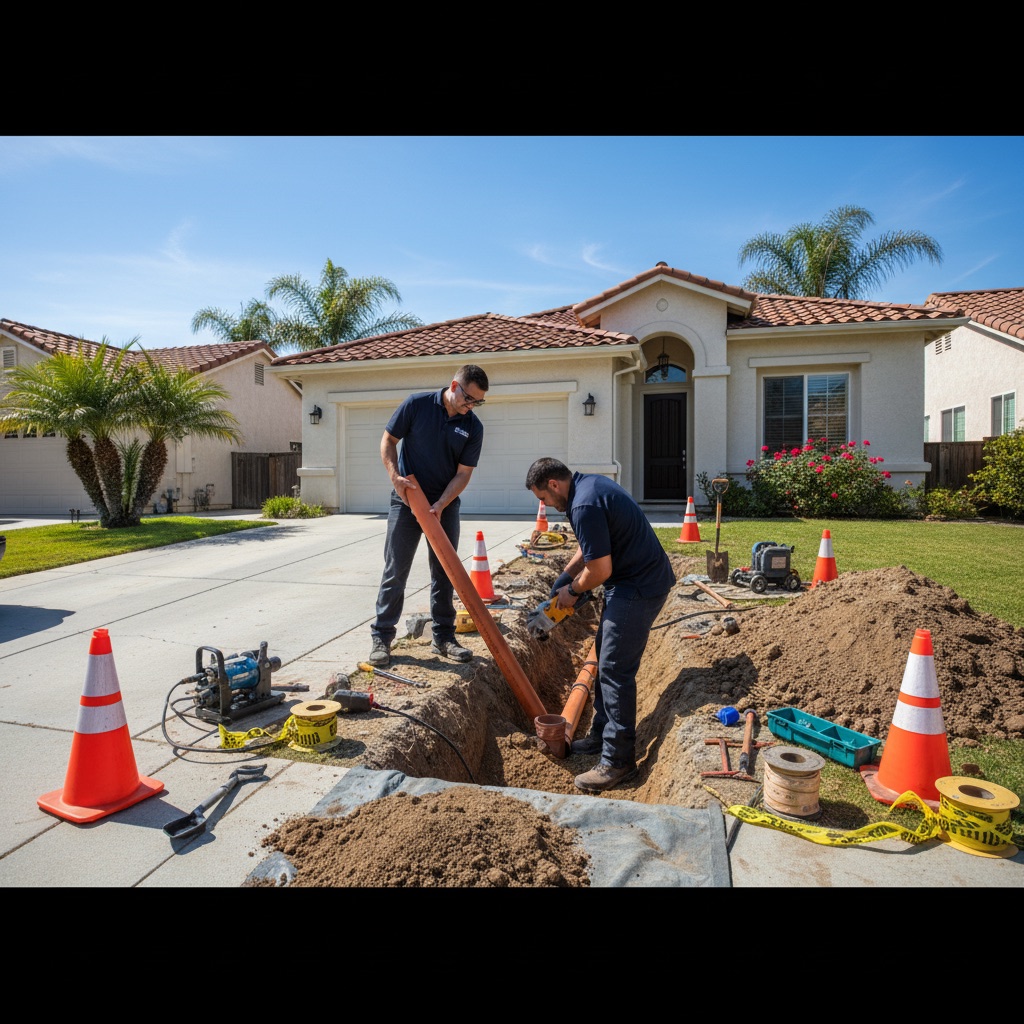
Spot repair (point repair). A single section of pipe gets dug up and replaced. Best when the camera shows one isolated break and the rest of the line is sound. Cheapest option. Needs a small excavator or hand-dig crew plus standard plumbing fittings.
Pipe lining (CIPP, cured-in-place pipe). An epoxy-saturated liner gets inverted into the existing pipe and cured. The result is a new pipe inside the old one. Trenchless. Needs a lining rig, a steam or UV cure system, and a tech trained on the specific liner brand. Not every plumber owns this gear.
Pipe bursting. A bursting head gets pulled through the old pipe, fracturing it outward while pulling new HDPE pipe behind it. Two small access pits, no full trench. Needs hydraulic bursting equipment and a crew that’s done it before. Wrong job for shallow lines or lines under critical hardscape without engineering review.
Full open-cut replacement. The whole lateral gets dug up and replaced with new pipe. Most invasive, most expensive, but the right call when the line has multiple failures, severe bellies, or grade problems. Needs an excavator, shoring if the trench is deep, and a real restoration plan.
Lateral connection rebuild. The connection from the house lateral to the City main needs rebuilding. This is permit-heavy work, usually requires City inspection, and sometimes traffic control if the connection is under the street.
A specialist will tell you which method fits your situation and explain why. If a contractor walks in pushing one method before they’ve seen the camera, that’s a sales pitch, not a diagnosis.
Equipment that signals real capability
You can learn a lot about a sewer contractor by what’s on their truck. Here’s the short list.
Locator and sonde. Used to find the exact path and depth of your lateral. A real sewer crew has one. If they’re guessing at where the line runs, the dig is going to be a mess.
Camera systems, push and mainline. A push camera handles small lines and short runs. A mainline camera with a self-leveling head handles full laterals. Specialists carry both. The footage gets recorded and shared with you.
Hydro-jetter at 4,000 PSI or higher. Roots and grease need pressure. Most box-store rentals top out around 1,500 PSI, which clears soft clogs but won’t cut through root masses. A real jet rig runs 4,000+ PSI and has the right nozzles for the job.
Pipe lining rig. This is a trailer-mounted setup with an inversion drum, a curing system, and the lining inventory. Shops that own one do CIPP regularly. Shops that don’t will sub it out or steer you toward a different method.
Pipe bursting setup. Hydraulic puller, bursting heads in multiple sizes, HDPE pipe inventory. Same logic as lining. If they own it, they use it.
Excavation gear. Mini-excavator for residential work, walk-behind trencher for shallow runs, hand-dig crew for tight spots. A shop with options has flexibility. A shop that only owns one tool will try to make every job fit that tool.
Permit-pulling is a critical signal
The City of San Diego requires a sewer permit for most lateral repair and replacement work. Spot repairs in some cases, full replacements always. The permit triggers an inspection, which protects you. If something fails six months from now, the inspected work has a paper trail.
Contractors who skip permits leave you holding the bag in three ways. First, an unpermitted repair can become a disclosure problem when you sell the house. Second, if the City finds out, you can be required to redo the work to code, on your dime. Third, your homeowner’s insurance may push back on any future claim tied to a sewer line that was repaired without a permit.
Ask the contractor flat out: “Will you pull the permit, and will it be in your name?” A real specialist says yes and includes the permit fee in the quote. A shop trying to cut corners will say “you don’t need one” or “we’ll do it without and save you the fee.” Walk away from that conversation.
What to ask about lateral ownership
In San Diego, your sewer lateral isn’t entirely yours. The line from your house to the property line is the homeowner’s responsibility. The portion from the property line to the City main is sometimes the City’s responsibility, depending on the neighborhood and the era of installation. Older parts of the City have different rules than newer subdivisions.
This matters because it affects who pays. If the failure is on the City portion, you may have a claim. If it’s on yours, you don’t. A specialist who works in San Diego regularly knows how to read the camera footage to identify where the property line crosses, and they’ll tell you before they quote the full repair. A shop that doesn’t know the difference will quote you for the whole line whether you need it or not.
Ask: “Where does my responsibility end on this line, and have you confirmed it on the camera?”
Trenchless vs open-cut: who specializes in what
Trenchless sewer repair methods (CIPP lining and pipe bursting) are the right call for most modern sewer repairs in San Diego. They protect hardscape, save restoration cost, and finish faster. But not every shop owns the gear, and not every line is a trenchless candidate.
Lines with severe collapses, major bellies, or grade issues need open-cut replacement. So do some lines under heavy hardscape where the access pit geometry doesn’t work. A specialist will look at the camera footage and tell you honestly which method fits. A generalist will push you toward whatever they own equipment for.
If a contractor only offers open-cut, ask why. If they only offer trenchless, ask the same question. The right answer is “both, and here’s why this one fits your line.”
Red flags in a sewer repair quote
Quotes tell you a lot about who you’re hiring. Watch for these signals.
No camera footage shown. If you haven’t seen the actual condition of your line on video, the quote is a guess. A real specialist scopes the line first, shows you the footage, and quotes from what they saw.
No written scope. Verbal quotes for sewer work are a recipe for disputes. The quote should list the method, the linear footage, the depth, the access points, and the materials.
Permit not mentioned. Either it’s included or it’s a separate line item. Either way, it should be in the quote.
No restoration plan. Sewer work tears things up. The quote should say exactly what gets demoed, what gets replaced, and to what standard.
Pressure to sign today. Real sewer work isn’t an emergency in the same way a burst pipe is. If a contractor is pushing you to sign on the spot for a non-emergency lateral repair, slow down and get a second look.
Vague warranty language. A specialist gives a written warranty on workmanship and materials. Trenchless liner manufacturers often back the liner itself for decades. Get the warranty in writing.
Restoration scope: the hidden cost
This is where homeowners get burned. The dig is one cost. Putting the property back together is another. A complete quote covers both.
Common restoration items that should be in writing:
- Sidewalk demo and replacement, if the line runs under it
- Asphalt patch if the line crosses a driveway or street
- Landscaping replacement, including specific plant species if anything mature comes out
- Hardscape demo and replacement: patios, walkways, decorative concrete
- Soil compaction and grading after backfill
- Final cleanup and haul-off
If the quote says “restoration not included” or stays silent on it, ask for a separate restoration scope before you sign. Don’t assume it’s included.
Questions to ask before you sign
A short list, in the order you should ask them:
- Can I see the camera footage of my line?
- What method are you recommending, and why does it fit this specific line?
- Are you pulling the City of San Diego sewer permit, and is it in your name?
- Where on the line does my responsibility end?
- What’s the full restoration scope, in writing?
- Who does the excavation and the restoration, you or a sub?
- What’s the workmanship warranty, and what’s the materials warranty?
- What happens if you find something unexpected once you open the line?
If a contractor gets impatient with that list, they’re the wrong contractor. A real specialist welcomes it.
How Plumbing Pro San Diego approaches sewer work
The plumbers we connect you with scope every line on camera before quoting, and they pull the permit. They show you the footage, walk you through the method that fits your line, and put restoration in the written scope. If your line is a trenchless candidate, they’ll tell you. If it isn’t, they’ll tell you that too.
For a camera inspection, a sewer line repair estimate, or a second opinion on a quote you already have, call (858) 400-4417. No pressure, just a clear read on your line.
Frequently asked questions
How much does sewer repair cost in San Diego? Spot repairs typically run $1,500 to $4,000. Trenchless lining and pipe bursting fall in the $4,000 to $15,000 range. Full open-cut replacement can run $8,000 to $30,000 depending on depth, length, and restoration. See our sewer repair cost guide and sewer line replacement cost breakdown for more detail.
Do I need a camera inspection before sewer repair? Yes. Quoting sewer repair without a camera scope is guesswork. A scope confirms the location, the type of failure, and the right method. Read more about what to expect from a sewer camera inspection and typical inspection costs.
Is trenchless sewer repair always better? Often, but not always. Trenchless saves hardscape and finishes faster. But lines with severe collapses or grade problems need open-cut. See our trenchless sewer repair guide for when it fits.
What causes most sewer failures in San Diego? Tree roots, old clay pipe, and shifted ground are the top three. Roots are especially common in older neighborhoods. Read more on tree roots in sewer lines and signs your sewer line is failing.
Do I need a permit for sewer repair? For most lateral repair and replacement work in the City of San Diego, yes. The contractor should pull it. If they tell you it’s not needed, get a second opinion. More on why a licensed plumber matters for permit work.
How often should sewer lines be cleaned? Most San Diego homes benefit from a hydro-jet every two to three years, more often if you have mature trees near the line. See how often sewer lines should be cleaned for a fuller answer.
Areas this guide covers
We connect homeowners with licensed plumbers in these San Diego County communities.
Keep reading
Need a Plumber in San Diego?
Licensed, insured plumbers, ready across San Diego County. The plumber quotes you before any work starts.
Call (858) 400-4417Call any time, day or night, anywhere in San Diego County