
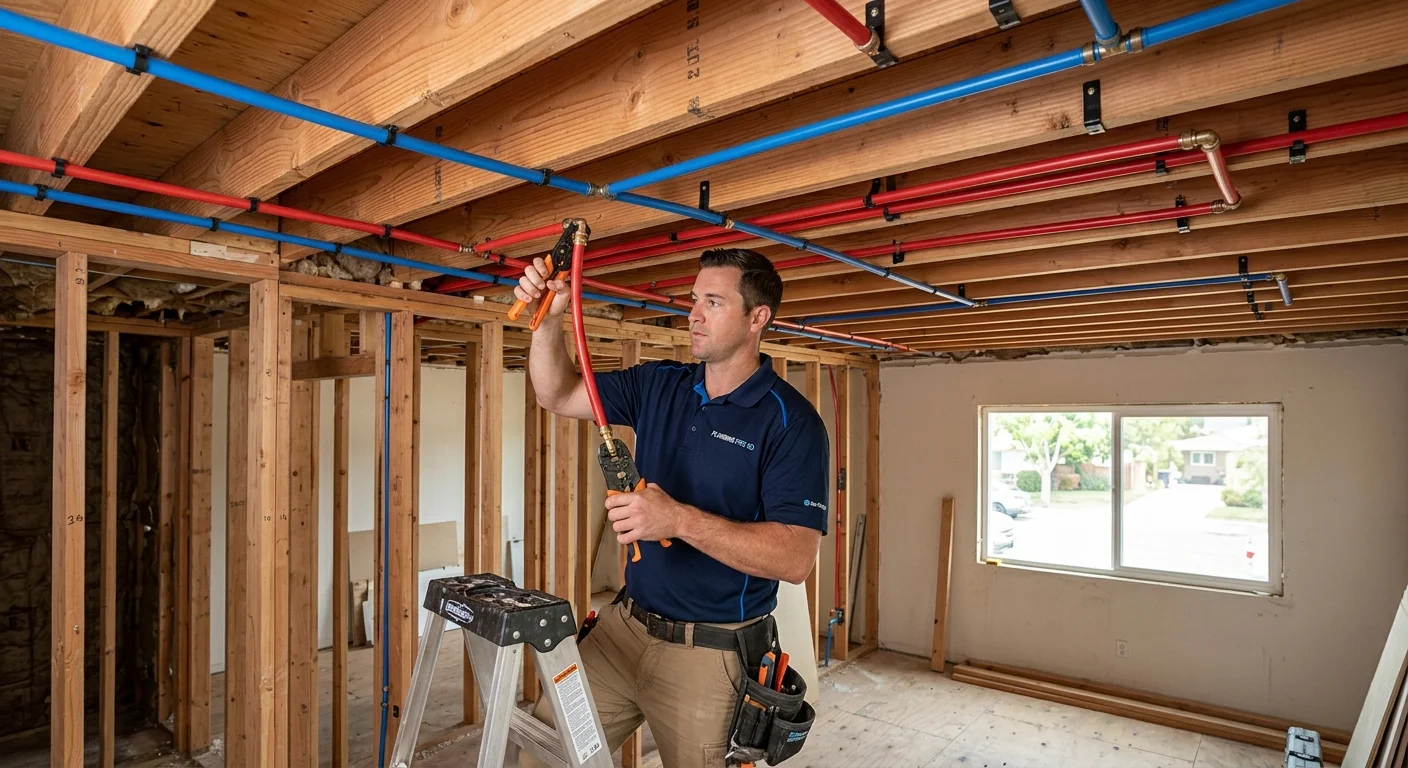
How long does a whole-house repipe take in San Diego
A real day-by-day repipe timeline for San Diego homes, with how slab foundations, raised foundations, and permit scheduling change the schedule.
The short answer
- Most San Diego whole-house repipes take three to five working days for the plumbing itself, and one to two weeks total once drywall patching and paint are included.
- Raised-foundation homes (post-and-pier, common in North Park, Kensington, and older Point Loma) route pipe through the crawlspace and attic, which is usually faster than cutting slab.
- Slab-on-grade homes, the norm in most postwar San Diego tracts, often reroute supply lines overhead through the attic instead of trenching the slab, adding a day of ceiling access work.
- The City of San Diego requires a rough-in inspection before any wall gets closed up, and that inspection is the single biggest schedule variable outside the plumber's control.
- You almost never have to move out. Water gets shut off in blocks, not for the whole project, and most families stay through the entire job.
A typical San Diego whole-house repipe takes three to five working days for the plumbing itself, and one to two weeks total once drywall patching and paint are finished.
That’s the honest range. Where you land inside it depends less on your home’s size and more on two things most cost calculators skip: your foundation type and how easy your walls and attic are to get into. This guide walks through what actually happens day by day, why slab and raised-foundation homes run on different clocks, and where San Diego’s permit process adds real time. For what the job costs, see our whole-house repipe cost guide for San Diego.
The day-by-day repipe timeline
Here’s what a standard 2-bath, 1,400 to 1,800 square foot repipe looks like on the calendar. Bigger homes and more bathrooms stretch the rough-in days; the permit and inspection steps stay roughly fixed.
| Day | What happens | Water status |
|---|---|---|
| Day 1 | Crew arrives, protects flooring, opens access points in walls/attic/crawlspace, starts running new supply lines | Off during work hours, restored evenings |
| Day 2 | Rough-in continues, fixture connections roughed in, drain lines checked if included | Off during work hours, restored evenings |
| Day 3 | Rough-in finishes, plumber requests City of San Diego inspection | Off during work hours, restored evenings |
| Day 3-5 | Inspector visits (typically 1-2 business days after request), confirms pressure test and pipe routing before any wall closes | Water restored full-time once tie-in happens |
| Tie-in day | Old pipe capped, new system connected, house switches over | 4-8 hour hard shutoff |
| Following days (if included) | Drywall patch, texture, paint on cut access points | Water on normally |
Plumbing-only work usually wraps in three to five working days. If your quote includes drywall repair and paint, add three to seven calendar days depending on how many patches need texture matching and dry time between coats. That’s the one to two week all-in window most homeowners actually experience.
Why slab and raised-foundation homes run on different clocks
This is the single biggest schedule variable local competitors gloss over, and it matters more in San Diego than almost anywhere else because the county has a real mix of both.
Raised-foundation homes (post-and-pier, common in older North Park, Kensington, South Park, and much of Point Loma) give a plumber a crawlspace to work from underneath and usually attic access above. New lines route through open space instead of through finished walls in most rooms. Fewer drywall cuts, faster rough-in, less patch work after. These jobs often land on the fast end of the range.
Slab-on-grade homes, the standard in most postwar San Diego tracts from the 1950s through today, don’t give a plumber that option. The original pipes are usually buried in or under the concrete slab. Rather than jackhammer the slab (slow, disruptive, and rarely done anymore), most repipes reroute the new supply lines overhead through the attic and drop them down inside interior walls to each fixture. That means more wall penetrations, more drywall cuts to patch, and typically an extra half day to a full day of routing work compared to a raised-foundation home of the same size.
Two-story slab homes add the most time of any layout, since lines have to run through the attic, down an exterior or interior wall to the first floor, then back out to fixtures on both levels.
If you’re not sure which foundation type you have, check for a crawlspace access panel low on an exterior wall or in a closet floor. No panel usually means slab. Your plumber will confirm on the initial walkthrough.
Permits and inspections: San Diego’s real timeline factor
A whole-house repipe requires a plan-required plumbing permit from the City of San Diego (or the equivalent process through San Diego County for unincorporated areas), not a same-day no-plan permit. Under the California Plumbing Code, a rough-in inspection has to pass before any opened wall gets closed back up. Skip that step and you’re looking at cutting the wall open again later, or a red tag that stalls resale down the line.
In practice, City of San Diego rough-in inspections get scheduled one to two business days after your plumber requests one, sometimes next-day depending on the inspector’s route that week. This is the one part of the timeline mostly outside your plumber’s control. A good crew requests the inspection the same day rough-in finishes rather than waiting, which keeps the gap as small as possible.
County unincorporated areas (parts of Fallbrook, Alpine, Jamul, and similar communities) run their own scheduling through San Diego County’s Planning & Development Services, and timelines can run a day or two longer during busy seasons. If your project is in one of these areas, ask your plumber to confirm current turnaround before you lock in a start date.
What actually delays a repipe
Competitors love a clean bullet list. Here’s the honest version, based on what actually adds days:
Poor access. No attic hatch, a finished basement ceiling with no cut-in access, or a slab home with no crawlspace all slow rough-in. This is the number one delay.
Pre-1950 construction. Older neighborhoods like North Park and Kensington sometimes still have lath-and-plaster walls instead of drywall. Plaster is slower to cut and patch than drywall, and matching old plaster texture takes a skilled hand.
HOA notification for condos and townhomes. Multi-unit buildings, common downtown, Mission Valley, La Jolla, and Hillcrest, often require written notice to the association before work starts, sometimes with proof of insurance and restricted work hours. This step can add a week before the crew shows up at all, separate from the actual repipe days. If you’re in a condo, our guide on who pays for plumbing repairs in a San Diego condo or HOA covers how shared-line responsibility works.
Hidden damage. Once walls open, a plumber sometimes finds an old leak, rot, or corrosion that wasn’t visible before. This is more common in homes still running original galvanized pipe. Our galvanized pipe replacement guide covers what that corrosion looks like and why it’s worth catching during a repipe rather than after.
Inspector scheduling during peak season. Spring and early summer, when San Diego permit volume runs highest, can push that one to two day inspection window closer to three.
Do you have to move out?
No, and this trips people up because some national franchise sites imply otherwise. The vast majority of repipes happen in fully occupied homes. Water goes off in blocks during work hours, not for the whole project, and most homes keep at least one working bathroom through most of the job. The one real disruption is the final tie-in, a four to eight hour hard shutoff while the system switches over.
Families sometimes choose to stay elsewhere for a night or two during the loudest demo days, especially with a newborn or a strict work-from-home setup. That’s a comfort call, not a plumbing requirement.
If you’re still weighing whether your home needs a full repipe versus a partial fix, our guide on whether you need a repipe in San Diego walks through the signs worth checking first, and our PEX vs copper comparison covers how material choice affects both cost and schedule.
Get a real timeline for your home
Every home’s timeline shifts based on foundation type, access, and how many fixtures need connecting. The fastest way to get an accurate schedule instead of a generic range is a walkthrough. Call Plumbing Pro San Diego at (858) 400-4417 and we’ll walk your home, confirm slab or raised foundation, and give you real start-to-finish dates before you commit. Full details on materials and pricing live on our whole-house repipe service page.
Need a Plumber in San Diego?
Licensed, insured plumbers, available 24/7 across San Diego County. Upfront pricing, no surprises.
Call (858) 400-4417Available 24/7, no voicemail, no answering service