
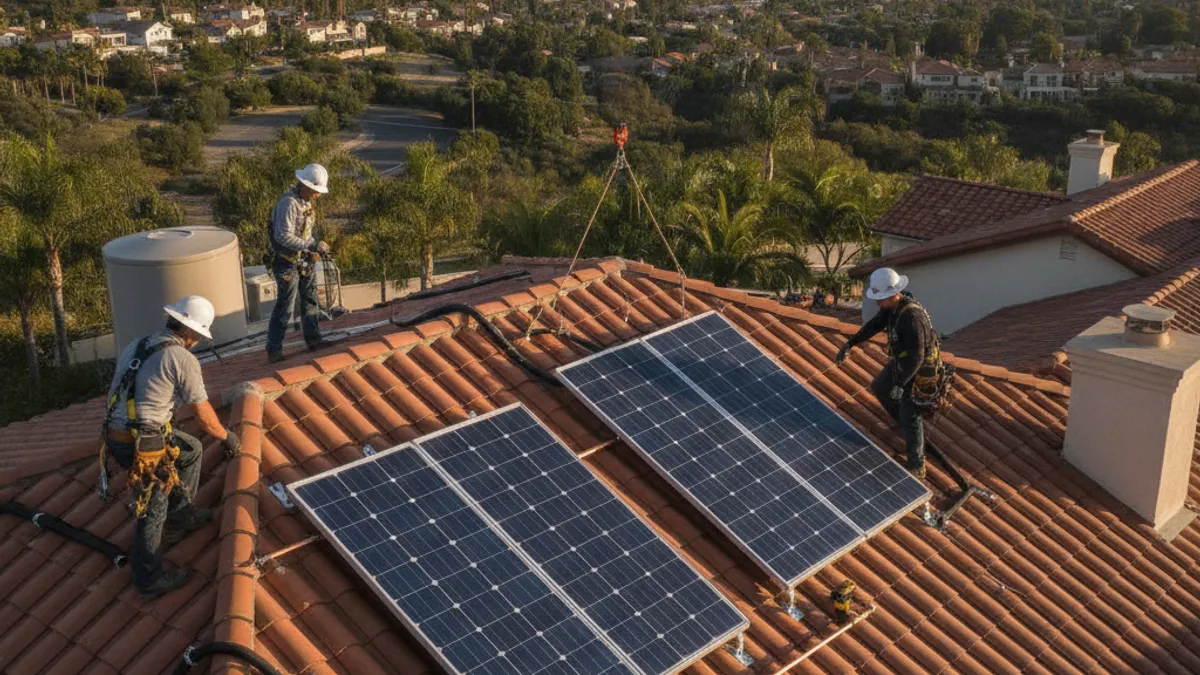
Solar water heater installation in San Diego
San Diego's sun makes solar water heating a real option, with a catch: June gloom mornings still need a backup. Here's the honest cost breakdown.
The short answer
- San Diego's high sun exposure, over 260 sunny days a year in most of the county, makes solar water heating a genuine option, with June gloom mainly affecting coastal mornings.
- Every solar water heater needs a backup electric or gas element for cloudy days and winter. This is standard design, not a flaw.
- Freeze protection, a real concern in colder climates, is largely a non-issue in San Diego's mild temperatures, a genuine advantage here.
- Don't count on a specific rebate or tax credit dollar amount. Incentive programs change often. Confirm what's actually active before budgeting.
- South-facing roofs with minimal shading get the most consistent output. Roof orientation and shading should be evaluated before committing to collector placement.
San Diego gets more usable sun than almost anywhere else in the country, which makes solar water heating a genuinely reasonable option here in a way it isn’t everywhere. It’s also not the maintenance-free, backup-free system some marketing implies, and the honest picture includes a few tradeoffs worth understanding before you commit.
Why San Diego is a strong candidate
Most of San Diego County sees well over 260 sunny days a year, and inland areas away from the coast see even more consistent direct sun, since they’re less affected by the marine layer that rolls in over coastal neighborhoods. That’s a meaningfully better solar resource than most of the country, and it’s the main reason solar water heating pencils out here in a way it might not in a cloudier climate. Coastal areas, La Jolla, Pacific Beach, Del Mar, Encinitas, do deal with June gloom, the persistent marine layer that can keep mornings overcast well into early afternoon during late spring and early summer, which reduces solar collector output on those specific mornings. It doesn’t eliminate the benefit, since afternoons typically clear and inland heat still drives strong output most of the year, but it’s a real factor worth knowing about if you’re right on the coast rather than a few miles inland.
Active vs passive systems
Active systems use a small pump to circulate a heat-transfer fluid between roof-mounted collectors and an indoor storage tank, and they’re the more common setup for residential installs in San Diego. Passive systems rely on natural convection with no pump, which means fewer moving parts and less to maintain, but they generally deliver less consistent output and see less use in new residential installs here as a result. Most installers in the county will steer you toward an active system unless your specific roof and tank layout makes passive genuinely practical.
Flat-plate vs evacuated tube collectors
Flat-plate collectors are the more common and generally less expensive option, performing well in San Diego’s climate where extreme cold isn’t a factor. Evacuated tube collectors are more efficient in cold or cloudy conditions, which makes them more common in colder parts of the country, but they add cost that doesn’t buy you as much advantage here, given how mild and sunny San Diego’s climate already is for a flat-plate system’s performance.
The backup element isn’t optional, and that’s fine
Every residential solar water heater includes a backup heating element, either an electric element built into the storage tank or tied to a conventional gas water heater working alongside the solar system. This isn’t a workaround or a sign the system doesn’t really work. It’s standard design, since no solar system alone can guarantee hot water through a stretch of cloudy days or the shorter daylight of winter. The backup kicks in automatically whenever the solar-heated water isn’t hot enough, so from your perspective at the tap, you never actually notice the switch happening.
One real advantage of San Diego’s climate specifically
Freeze protection is a serious design consideration for solar water heating in most of the country, since collectors and exposed piping can freeze and crack in cold climates, requiring drain-back systems or antifreeze fluid loops. San Diego’s mild temperatures make this largely a non-issue, which simplifies the system design and removes one of the more failure-prone aspects of solar water heating elsewhere. This is a genuine advantage of installing here rather than in a colder region.
Roof orientation and shading
A south-facing roof with minimal shading from trees or neighboring structures gets the most consistent output across the year. East or west-facing roofs still work, generally with a meaningful but not disqualifying reduction in output, while north-facing roofs are usually a poor fit. Before committing to a system, an installer should actually evaluate your roof’s specific angle, orientation, and any shading throughout the day, not just assume a standard placement will work as well on your house as it did on the last job.
Maintenance most homeowners don’t expect
A solar water heater has more moving parts than a standard tank, and that means more to check periodically. Active systems need the circulation pump inspected for wear over time, since it runs whenever the collectors have usable heat to transfer. The heat-transfer fluid in a closed-loop system, common in areas with any freeze risk elsewhere in the country but less critical here, still degrades slowly and typically needs checking every few years. Collectors themselves benefit from an occasional rinse to clear dust, and in San Diego’s coastal neighborhoods, a light film of salt air residue, both of which reduce how much sun actually reaches the absorber surface. None of this is heavy maintenance, but it’s more than a standard tank or tankless unit requires, and it’s worth budgeting for as part of the system’s real cost over time, not just the installation price.
Cost and rebates, honestly
A residential solar water heating system, collectors, tank, pump, and backup element, typically installs in a broad range depending on system size, roof complexity, and collector type, and it’s worth getting a specific quote for your home rather than anchoring to a number from another region’s pricing. On incentives: rebate programs and tax credits for solar water heating change often at both the federal and utility level, and some programs that existed a few years ago have since expired while occasional new ones appear. Don’t build your budget around a specific rebate or credit amount until you’ve confirmed what’s actually active with your utility and a tax professional at the time you’re ready to install, rather than relying on a figure you saw somewhere online.
Comparing it to other water heating options
If solar isn’t the right fit for your roof or budget, it’s worth comparing against a heat pump water heater, which draws on ambient air rather than the sun and works well in San Diego’s mild year-round climate without needing specific roof orientation. Our broader replacement cost guide walks through tank, tankless, heat pump, and solar options side by side if you’re still deciding which direction makes sense for your home.
When you’re ready
If you’re considering solar water heating for your San Diego home and want an honest read on whether your roof, budget, and household actually make it worthwhile, call us at (858) 400-4417. We’ll look at your roof orientation and shading, walk through real cost numbers for your specific home, and tell you straight if it’s the right fit or if another option makes more sense.
Areas this guide covers
We connect homeowners with licensed plumbers in these San Diego County communities.
Keep reading
Need a Plumber in San Diego?
Licensed, insured plumbers, ready across San Diego County. The plumber quotes you before any work starts.
Call (858) 400-4417Call any time, day or night, anywhere in San Diego County