Clogged toilet that won't plunge: when to call a plumber
Plunged and the toilet still won't clear? Here's when a San Diego clogged toilet needs a licensed plumber, what they inspect, and how to request a referral.
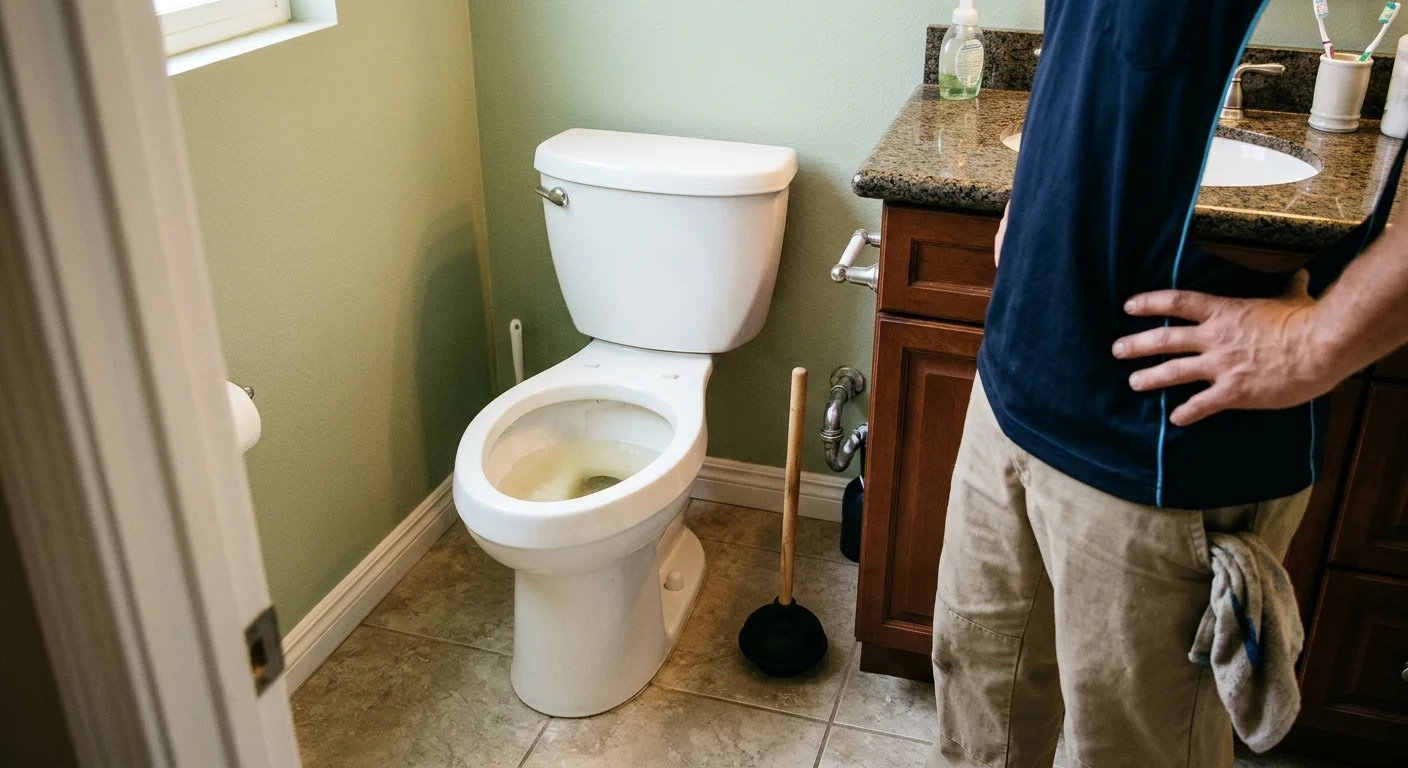
You already plunged. The bowl is still sitting high, and the next flush is a bad idea. That is the point where a clogged toilet in a San Diego home stops being a bathroom chore and starts being a job for a licensed plumber.
What a toilet that still will not flush after plunging usually means
A plunger is built for a clog in the toilet’s own trap, the S-shaped passage baked into the china. When a real seal and a real set of strokes still leave standing water, the blockage is packed tight, sitting past that trap, or made of something the plunger cannot fold. Wet paper is one thing. A wipe, a toy, a hygiene product, or a wad in the closet bend is another.
A cup plunger made for sinks often will not seal on a toilet outlet. A flanged plunger is the toilet tool. Even with the right cup, a clog past the trap will not move. That is why the plunger is not working. The tool is fine. The stop is in the wrong place for a plunger.
Do not count on a clogged toilet to unclog itself. Standing water in the bowl is still a clog. Waiting overnight just leaves sewage in the room. Keep the handle still. If the water is climbing, turn the small shutoff on the wall behind the bowl clockwise until it stops. That valve only stops water into this toilet. It does not clear the line.
If you already did a basic how to unclog a toilet pass, stop stacking household tricks. Hot water, dish soap, baking soda, and vinegar are the internet’s next suggestions. They sometimes move a soft paper clog. They do not reliably move an object, and they do not reach a blockage in the branch line. Chemical drain cleaner in a toilet that already will not drain is a poor next step. The liquid sits in the bowl. The contractor you’re matched with then has to work through whatever you poured.
San Diego’s drinking water averages about 16 grains per gallon, or 276 parts per million, on the city’s published figure, with variation by location and demand. That mineral load can leave a rough film on older bowls. Hard water is not a diagnosis by itself. It is one more reason a weak flush can fail a plunger.
A plunger that does nothing is information. It tells you the problem is past what you can see from the bathroom floor. That is when you want a plumber for a clogged toilet, not another round at the handle.
How a local clog differs from a deeper line problem
A local clog lives in the toilet: the trap, the closet flange, or the first few feet of drain. A deeper problem lives in the branch that serves that bathroom, or in the building sewer that leaves the house. You can often tell them apart without tools.
Watch the other fixtures. If only this toilet is dead and the sink, tub, and the other bathrooms still drain, the stop is usually at the fixture. If the shower gurgles when you try the toilet, or the tub starts to rise, or a floor drain burps, the stop is farther down. Multiple fixtures backing up is a line problem, not a bowl problem.
San Diego County is not one plumbing map. A 1920s bungalow in North Park, Golden Hill, or Mission Hills often sits on original drain runs, with a closet flange that has settled in an old wood floor. Some of those lots send the lateral down a canyon to the main. A postwar ranch in El Cajon, Lakeside, or Santee may have a long run across a wide lot and trees in the parkway. A coastal unit in Pacific Beach, Ocean Beach, or Encinitas may share tight plumbing in a small footprint. South Bay homes in Chula Vista and National City mix postwar laterals with newer tracts. Inland North County houses in Escondido, San Marcos, and Vista often sit farther from the main than a downtown condo. The same plunger failure can mean a wad in the trap in one house and a packed lateral in the next.
Pipe material by neighborhood is not something this page can verify. Claims that East County laterals are clay while coastal laterals are something else did not check out against a primary source we can cite. Ask the sewer agency that actually serves the parcel. Inside the City of San Diego, Public Utilities and the Metropolitan Wastewater Department set the lateral rules. Other cities and districts set their own. Padre Dam, Otay, Helix, and city systems in places like El Cajon are not interchangeable.
In the City of San Diego, the property owner maintains the sewer lateral from the house all the way to the connection with the sewer main. That connection may be in the street past the property line, on an easement, or in a canyon. The city will clear a problem in the section beyond the property line and in the city right-of-way when the homeowner has lost all sewer facilities. There is no reimbursement for plumbing work you already paid for. A single clogged toilet, with other drains still working, is usually still on the house side of that line.
If this toilet has been a repeat offender, that is a different problem. Read why a San Diego toilet keeps clogging after this event is under control.
What the contractor you’re matched with may inspect
Plumbing Pro San Diego is a referral service. We match you with independent C-36 licensed plumbing contractors. You hire the plumber directly. The person in your bathroom is the one who inspects, clears, and repairs.
A C-36 license covers the supply of water and the proper disposal of fluid waste from the building. Clearing a toilet, opening a closet flange, and working the drain that leaves that bathroom sit inside that classification. Forced-air heating does not. Individual contractors still vary in what they carry on the truck.
Before anyone lifts the bowl, check the license on the Contractors State License Board site. Search by license number, business name, or personnel name. The lookup shows status, expiration, classification, bond information, and workers’ compensation. The database is down Sundays 8 p.m. through Mondays 6 a.m. for maintenance.
On site, the contractor you’re matched with typically starts at the fixture. They look at the water level, the way the bowl is set, and whether the closet flange is cracked, buried, or pulled. A bowl that rocks on the floor is a flange and wax-ring question, not a plunging question. They check the supply stop and the fill. They ask what was flushed, and whether other drains are slow. They may pull the toilet if the clog sits in the trap or at the flange. They may go to a cleanout if the stop is past the china.
California requires a contractor license when the aggregate contract price for labor, materials, and everything else is $1,000 or more. That threshold moved from $500 to $1,000 on January 1, 2026. Work under $1,000 is exempt only when it is casual, minor, or inconsequential, and it does not need a building permit. Splitting jobs to stay under the number does not make an unlicensed person legal. Even small plumbing work can still need a permit. A clogged toilet that becomes a toilet reset or a drain repair should be done by a licensed plumber.
What they will not do is guess from the sidewalk. A camera, a closet auger, or a cable is a decision after they see the house. This page cannot tell you what they will find. The inspection is the point of the visit.
When drain cleaning or a camera enters the conversation
If the toilet is clear of objects and the water still will not drop, the conversation often moves from toilet repair into drain cleaning. That is the licensed contractor’s call. A closet auger is a toilet-specific cable. A drum machine or a jet is for the line after the fixture. This page cannot tell you which tool your house needs, and it cannot tell you what a camera will show.
A camera enters when they need to see the pipe, not when a blog promises roots, bellies, or grease. San Diego laterals run under driveways, parkways, and, in some canyon lots, long downhill stretches. The contractor may recommend a sewer camera inspection if the clog is past the bathroom, if backups keep returning, or if they need a picture before they cut or jet. They may skip the camera if the stop is sitting in the toilet itself.
Hydro jetting is another tool some C-36 contractors use on a dirty line. It is not a first move on a mystery clog in a cracked pipe. Let the person who looked at the cleanout decide.
Do not keep running water in that bathroom while you wait. A dishwasher or washing machine on the same branch can push more volume into a stuck line. If sewage is coming up at a floor drain or a tub, treat it as a line event, not a bowl event.
City hardness, older flanges, and long laterals are reasons a San Diego clog can sit past a plunger. They are not a substitute for an inspection. The licensed plumber in our network will tell you whether this is a plumbing clogged toilet job or a drain job. Trust that sequence: fixture first, then the line, then a camera if the line will not explain itself.
How to request a toilet repair referral
Have three facts ready. Which bathroom. Whether other drains are slow or gurgling. What you already tried, including plunging.
Then request a toilet repair referral through Plumbing Pro San Diego. We connect you with an independent licensed plumber who serves your city. You talk through the clog, you hire them, and you pay them. We do not set prices, and we do not send a company truck.
Mention standing water, sewage on the floor, or a cleanout that is already weeping. That changes how the contractor stages the visit. Mention if you are in the City of San Diego or in a city with its own sewer agency, because the lateral rules are not the same. If you do not know the agency, the water bill and the city or district website will name it.
Ask the plumber for their CSLB number and check it before work starts. Ask whether they think this stays at the toilet or moves into drain cleaning. You want that in plain words. If the job is a toilet reset, a flange, or a clear, that is still licensed plumbing work. If it becomes line work, the same C-36 contractor may handle it, or they may tell you the next step.
Keep kids and pets out of the bathroom. Do not mix cleaners in the bowl. Do not force a wire hanger through the trap. Porcelain chips, and objects drop farther in.
When you are ready, call. The match is the start. The inspection is what tells you whether this was a stubborn toilet or a deeper San Diego drain.
When to call us
Call when plunging has already failed, when more than one drain is slow, or when sewage is at the rim. A licensed plumber needs to see the fixture and the line. Call us at (858) 400-4417 and we’ll connect you with a licensed plumber.
Areas this guide covers
We connect homeowners with licensed plumbers in these San Diego County communities.
Keep reading
Need a Plumber in San Diego?
Licensed, insured plumbers, ready across San Diego County. The plumber quotes you before any work starts.
Call (858) 400-4417Call any time, day or night, anywhere in San Diego County