
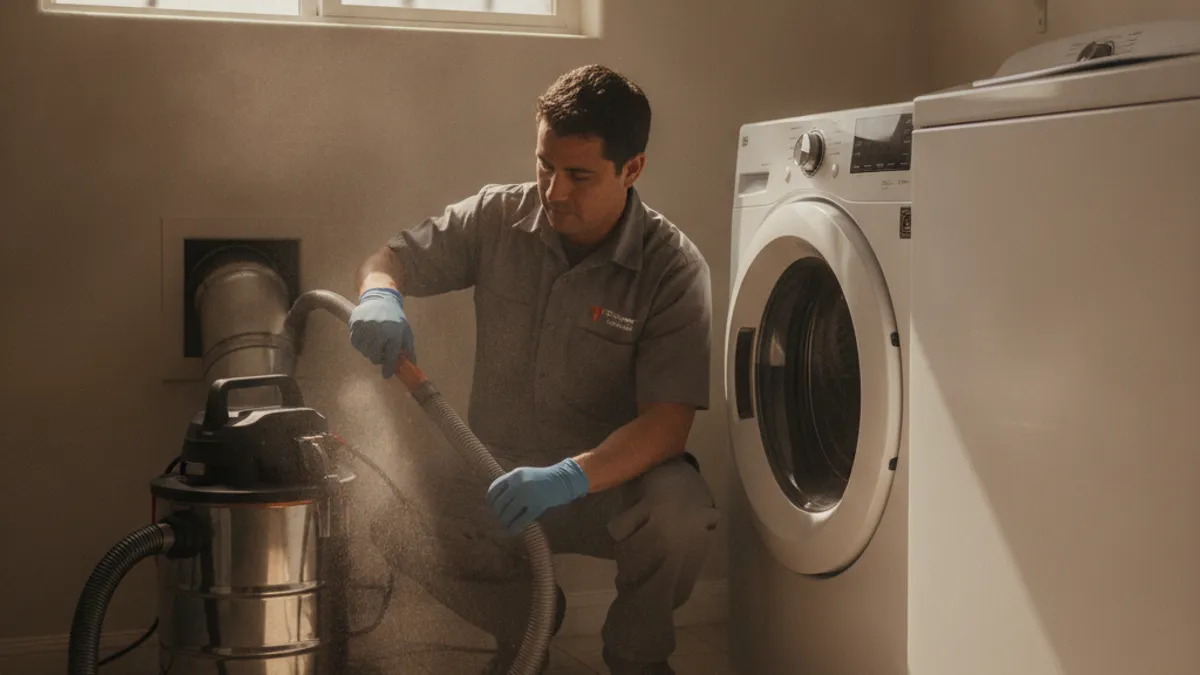
Dryer vent installation and cleaning in San Diego
Lint buildup in a dryer vent is a leading cause of home fires. Here's what a safe vent setup looks like in San Diego homes and how often to clean it.
The short answer
- Clogged dryer vents are one of the leading causes of home dryer fires, according to the U.S. Fire Administration, and lint buildup is largely preventable with regular cleaning.
- Most current codes call for smooth rigid or semi-rigid metal duct, not foil or vinyl accordion duct, which traps lint and poses a greater fire risk.
- Many San Diego tract homes have centrally located laundry rooms with long vent runs (15 to 25+ feet), which need more frequent cleaning than a short run to an exterior wall.
- Condo and high-rise vent runs can exceed 30 feet through shared chases and sometimes need a booster fan to maintain safe airflow.
- Clean the vent annually at minimum. Longer dry times, a hot-to-the-touch dryer exterior, or a weak outside vent flap are signs it's overdue.
A dryer vent is one of the most overlooked fire hazards in a home, mostly because it does its job quietly for years until it doesn’t. Lint buildup inside the duct is one of the leading causes of home dryer fires, according to the U.S. Fire Administration, and it’s almost entirely preventable with the right setup and a regular cleaning schedule.
Why the duct material matters more than people think
A lot of older installs, and a fair number of DIY dryer hookups, use flexible foil or vinyl accordion-style duct because it’s cheap and easy to route around tight corners. The ridged surface inside that duct is exactly the problem. Lint catches in every ridge, building up far faster than it would in a smooth duct, and vinyl duct specifically is a recognized fire hazard, since it can ignite if trapped lint catches heat from the dryer’s exhaust. Most current codes call for smooth rigid or semi-rigid metal duct instead, which lint moves through cleanly rather than snagging along the way. If your dryer is still connected with foil or vinyl duct, swapping it for rigid metal is one of the more straightforward fire-safety upgrades available in a home, and it’s worth checking with your city’s building department for the exact requirement that applies before starting any duct work, since specifics can vary.
Why San Diego’s home layouts make this a bigger deal than it sounds
A lot of San Diego tract homes built through the 1970s and 80s, common in Clairemont, Serra Mesa, and similar neighborhoods, put the laundry room centrally in the house rather than against an exterior wall. That means the vent run to the outside is longer than the simple, short path you’d get in a home with the laundry near an exterior wall, sometimes 15 to 25 feet with multiple turns to route around framing. Every extra foot and every additional bend gives lint more opportunity to build up before it clears the duct entirely, which means these longer runs need cleaning more often than a short, straight shot to a nearby exterior wall.
Condos and high-rises add their own version of the problem
Shared-wall construction, common in Downtown San Diego and Mission Valley condo and apartment buildings, often routes dryer vents through shared vertical chases that can stretch 30 feet or more with several elbows before reaching an exterior termination point. At that length, gravity and the dryer’s own exhaust fan sometimes aren’t enough to maintain the airflow needed to clear lint effectively on their own. An inline booster fan, installed partway along the duct run, can restore adequate airflow on these longer condo and apartment setups, and it’s worth having a technician measure your actual run length and turn count before assuming a standard setup will perform the same way it would in a single-family home with a short run.
What a proper new install looks like
A new dryer vent installation starts with the shortest, straightest possible path to the outside, since every foot of duct and every turn adds resistance the dryer’s fan has to push against. Rigid metal duct is the standard for any run that’s accessible, typically 4-inch diameter aluminum or galvanized steel with sealed, screwed joints rather than tape, which can dry out and separate over the years. Semi-rigid metal duct, which flexes slightly to route around an obstacle, is acceptable for short transition sections but shouldn’t make up the bulk of a long run. The termination point outside needs a proper vent hood with a functioning damper flap, sized to match the duct diameter, positioned away from walkways and landscaping that could restrict airflow or get scorched by warm exhaust air.
Total run length matters. A long, winding path with several 90-degree turns can push a system past what a standard dryer’s built-in fan can move air through effectively, which is exactly the situation a booster fan is designed to correct. A plumber or HVAC technician measuring a new install should account for both the straight-line footage and an equivalent length penalty for each elbow, not just the visible distance from the dryer to the exterior wall.
How often to actually clean it
Once a year is the standard recommendation for most households. Families doing frequent laundry, homes with pets shedding into the wash, and any home with a longer-than-average vent run should plan on checking more often, sometimes twice a year. The signs that you’re already overdue are worth knowing regardless of your last cleaning date: clothes taking noticeably longer to dry than they used to, the dryer’s exterior feeling hot to the touch during a cycle, a burning smell while it’s running, and visible lint collecting around the outside vent hood itself, all point to restricted airflow that a cleaning should address.
What a proper cleaning and inspection includes
A thorough dryer vent service disconnects the duct at the dryer, runs a brush or rotary cleaning tool through the full length of the vent to clear built-up lint, checks that the exterior vent hood’s flap opens fully and closes properly when the dryer’s off (a stuck-open flap lets pests and moisture in, a stuck-closed one restricts airflow entirely), and confirms the duct material and route meet current smooth rigid metal standards rather than degraded foil or vinyl left over from an old install. If your dryer is gas-powered, it’s also worth having the flexible gas connector checked at the same time, since that’s a separate but adjacent safety point behind most dryers, similar to what we cover in our gas line repair guide.
Pairing this with other laundry room checks
A dryer vent problem often shows up alongside other laundry room plumbing issues, since the same appliance area tends to get overlooked as a whole. If your washing machine’s supply hoses haven’t been checked in a while, our guide to washing machine repair in San Diego covers what else is worth a look while a technician’s already back there working on the vent.
When you’re ready
If your dryer’s been taking longer to finish a load, you’re not sure what kind of duct is currently installed, or it’s simply been longer than a year since anyone checked the vent, call us at (858) 400-4417. The plumbers we connect you with will inspect the full run, clear it out, and tell you honestly whether your current setup meets a safe standard or needs an upgrade.
Areas this guide covers
We connect homeowners with licensed plumbers in these San Diego County communities.
Keep reading
Need a Plumber in San Diego?
Licensed, insured plumbers, ready across San Diego County. The plumber quotes you before any work starts.
Call (858) 400-4417Call any time, day or night, anywhere in San Diego County