
Last updated: September 17, 2026
How plumbers find a hidden leak in San Diego
A licensed plumber finds a hidden San Diego supply leak with pressure tests, acoustic listening, thermal imaging, and tracer gas. Ask what they will open.
The short answer
- A licensed plumber finds a hidden supply leak by isolating zones, watching pressure drop, then tracing sound, heat, or tracer gas to a marked spot before cutting.
- This is the methods visit, not a recap of household leak signs and not a confirmed slab leak repair.
- Ask to see the pressure reading, the marked location, and the size of the opening before anyone opens drywall, tile, or concrete.
- Detection narrows the cut. Repair still needs an access hole, and finish restoration is a separate question.
- We connect you with licensed, insured C-36 plumbers. You contract with that plumber directly. Call (858) 400-4417.
A licensed plumber finds a hidden supply leak by shutting water into zones and watching a gauge lose pressure. Then they trace the escape with a listening set, a thermal camera, or tracer gas before anyone cuts. That’s the visit after you already know water is leaving the system. It isn’t a recap of household leak signs, and it isn’t the same job as repairing a leak already confirmed under the slab.
If you are still deciding whether a leak exists at all, start with signs of a hidden water leak. This page is the next step: how the plumber you hire actually locates a pressurized supply leak in a San Diego County house without opening every wall.
Pressure drop tells the plumber which zone is leaking
The first useful fact is not a hole in the drywall. It is which part of the system is losing water.
The plumber closes fixtures, the ice maker, and irrigation. A gauge goes on an isolated stretch, often at a hose bibb or a drained, capped run. Then they wait. A closed zone that holds pressure is not the leaking zone. A zone that falls is.
That split matters in this county because the leak is not always in the house you are standing in. Many Mira Mesa, Rancho Bernardo, El Cajon, and Santee homes sit on slab with the yard line, the house line, and the hot run as separate questions. A falling gauge on the yard side of the house shutoff points toward the buried service, not a bathroom wall. A drop only after the house is opened points inside. A drop only on the hot side, isolated at the water heater, points at the hot run.
Ask to see the starting number, the ending number, and how long they watched. A verbal “it is leaking” is not a map. The zone is the map. Location tools come after.
Pressure drop does not mark the hole. It keeps the plumber from listening to the wrong half of the property. That is the whole point of the first hour.
Acoustic listening follows the hiss through slab and soil
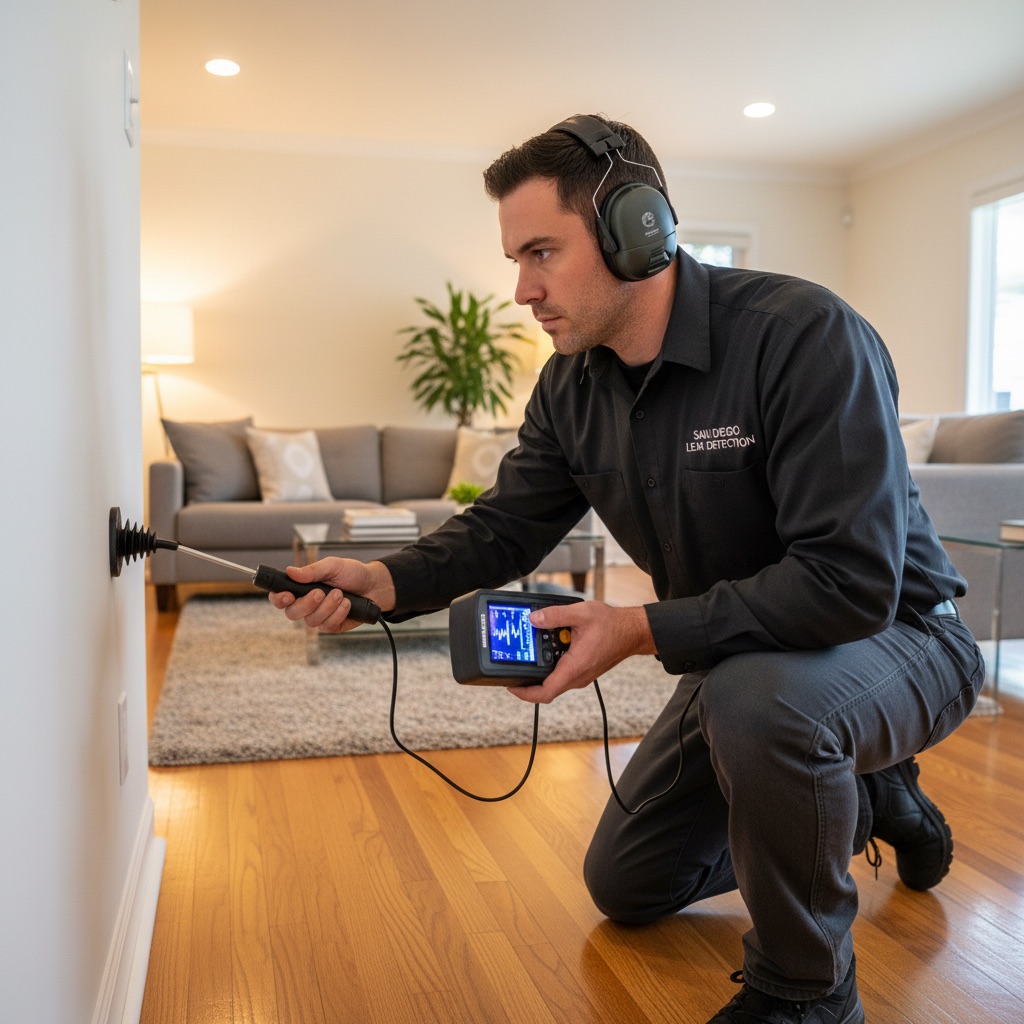
Pressurized water escaping into soil, concrete, or a wall cavity makes a hiss. Acoustic gear amplifies that sound so the plumber can walk it down.
The kit is a contact mic or ground microphone plus an amplifier. The plumber places it on the slab, on soil along the suspected pipe path, or on an exposed section at the water heater or under a sink. They are listening for a peak, not for a story. The peak gets a mark on the floor, the stucco, or the lawn.
San Diego daytime noise fights this method. HVAC, traffic on I-5 or I-15, leaf blowers, and a fridge cycling all sit in the same range as a small leak. A good locate often happens with the house quiet and irrigation off. If a plumber wants to “just open the wall and look,” they skipped this step.
Sound travels differently through copper in a North Park plaster wall, through a Mira Mesa slab, and through damp soil in a Clairemont parkway. The plumber still has to interpret it. Ask them to show you the peak on the meter, or to let you hear the hiss they are following. If they cannot point to a mark, they are not done locating.
Very small leaks, or leaks with the water already shut off, do not give the gear much to hear. That is when thermal work or tracer gas earns its keep.
Thermal imaging maps heat from a hot-water leak
A thermal camera does not see water. It sees temperature. A hot supply leak under tile or slab can show as a warm path on the floor. A cold leak can show as a cooler, wet stripe if the surface is evaporating.
This is why a hot line under a slab-on-grade house in inland North County or East County is a thermal job when the pressure zone says hot. The camera is fast on a live hot line. It is weaker on a cold line buried in mixed fill, and it can lie when afternoon sun has cooked a west-facing slab in El Cajon or Escondido. Ask whether the image was taken after the line was run hot, and whether solar gain was in play.
Tile, stucco, and concrete spread heat. The warmest pixel is not automatically the hole. The plumber should treat the thermal still as a clue that has to agree with the pressure zone and, when possible, the acoustic peak.
Ask to see the stills, not just a wave of the camera. A photo of the thermal pattern next to a tape mark on the floor is the record you want if the next step is a cut, an insurance note, or a second opinion.
Tracer gas when the leak is too quiet to hear
Tracer gas is the method for a leak that will not speak. The plumber drains and isolates the line, introduces a tracer, and walks a sniffer over the slab, the yard, or the wall. Gas escapes at the failure and the sniffer peaks there.
This is not sewer smoke. It is not pool dye. It is not a guess with a shovel. It is a locate on a closed, drained supply line when acoustic gear is fighting noise or the leak is too small to hiss.
We do not have a verified primary source in our claims ledger for a required gas mix, a detection distance, or a success rate, so those figures are not stated here. What you can ask on site is simpler. Was the line fully isolated. Where did the sniffer peak. Does that peak sit on the same spot as the pressure zone.
If the plumber jumps to tracer without a pressure test, ask why. Tracer is a location tool. It is not a substitute for knowing which zone is actually leaking.
What access damage looks like, and what to ask to see
Finding the leak is not the same as a zero-cut promise. Detection is supposed to shrink the hole. Repair still needs a hole.
In a two-story North Park or Clairemont house, that hole may be a rectangle of drywall on a ceiling or a chase. In a 1970s Mira Mesa or Rancho Bernardo slab home, it may be a cut through tile and concrete. In a Pacific Beach or Ocean Beach cottage, it may be stucco and lath on an exterior wall, or a crawlspace opening. In the yard, it may be sod, a walk, or a driveway saw cut.
Ask these things before anyone opens a finish:
- Which zone failed the pressure test, with the readings
- The marked location, in person, on the floor, wall, or lawn
- Acoustic peak, thermal still, or tracer peak that supports that mark
- How large the opening will be, and which finish it cuts
- Whether they will retest after the repair, with the same gauge
- Who patches drywall, tile, stucco, or concrete, and whether that is in the plumbing quote
- A written location and a written repair quote after the locate, not a flat repair price before the leak is found
Do not accept “we will open until we find it.” That is demolition as detection. The leak detection visit exists so the plumber opens the marked spot, not a whole room.
California’s C-36 plumbing classification covers water piping from the property owner’s utility meter side to the structure, plus repair and replacement of that piping. Individual contractor capabilities still vary. Verify the person at the door on the CSLB license lookup by license number, business name, or personnel name. The database is down Sundays 8 p.m. through Mondays 6 a.m. for maintenance.
We connect you with independent licensed plumbers. We do not own trucks, we do not hold the trade license, and we do not set the price. You contract with the plumber directly.
No verified official price schedule for leak detection or access repair is in our claims ledger. Get the locate and the repair as separate, written items. Even work under California’s contractor license threshold can still need a plumbing permit. The exemption in Business and Professions Code section 7048 is $1,000 for casual, minor work as of January 1, 2026. It does not apply if the job is part of a larger operation, if contracts are split to stay under the cap, if someone advertises as a contractor, or if they hire another person to do the work.
City of San Diego drinking water averages about 16 grains per gallon of hardness, or 276 parts per million, with variation by location and demand. That mineral load is one reason older copper gets pinholes. It is not a locate method. Other cities and districts publish their own quality reports. If a spinning meter is how you first noticed the problem, the water is still billed. For City of San Diego single-family customers with a 3/4-inch meter, the monthly base fee is $35.53 as of January 1, 2026, and the first tier is $8.51 per hundred cubic feet. Other cities and meter sizes use different schedules.
How this visit is not a slab leak repair
A hidden supply leak can be in a wall, a ceiling, a crawlspace, the yard, or under the slab. The locate visit has to find which of those it is. A slab leak repair is what happens after the mark is already under the concrete.
If the plumber’s mark is under the floor of a slab-on-grade house, stop treating this as a generic wall patch. The repair options, the opening, and the restoration all change. That conversation lives on our slab leak repair in San Diego page. Do not let a locate visit slide into jackhammering on a hunch, and do not let a slab repair quote ignore the locate you just paid for.
If the mark is in the yard between the meter and the house, that is a service line, not a slab leak and not an under-sink supply. If the mark is a hot line in a wall, the camera and the listening set did their job and the opening is a different trade of access.
Lead-free rules apply when the work replaces piping that conveys water for drinking or cooking. California and federal standards define lead-free as no more than 0.25% lead, weighted average across wetted surfaces of pipes and fittings, and 0.2% for solder and flux. The plumber on site should use parts meant for potable supply.
When to call us
Call when a meter or a pressure test already says water is leaving, and you need a licensed plumber to mark the leak before anyone opens a wall, a slab, or a yard. The licensed plumbers we send use isolation, listening gear, thermal imaging, and tracer gas on that visit. Call us at (858) 400-4417 and we’ll connect you with a licensed plumber.
Areas this guide covers
We connect homeowners with licensed plumbers in these San Diego County communities.
Keep reading
Need a Plumber in San Diego?
Licensed, insured plumbers, ready across San Diego County. The plumber quotes you before any work starts.
Call (858) 400-4417Call any time, day or night, anywhere in San Diego County