
Pipe Leak Repair in San Diego: Methods, Costs, Fixes
San Diego pipe leak repair guide. Compare epoxy, push fittings, soldering, PEX patches, sleeve clamps, and full replacement. Real costs and what fits your pipe.
The short answer
- A San Diego pipe leak can be a small patch or a full repipe; the fix depends on pipe material, location, and how it's failing.
- Ranked by durability: full replacement and PEX patches last decades, push-fittings and soldered joints hold for years, sleeve clamps and epoxy putty are temporary.
- Most exposed-pipe repairs run $250 to $650; hidden leaks behind walls or in the slab run $800 to $4,500, and a whole-home repipe is $4,500 to $12,000.
- Two copper pinholes within 18 months means the run is failing; stop patching and get a repipe quote.
- Insurance usually covers the water damage but not the pipe repair; shut your main and call (858) 400-4417 to get connected with a plumber.
A pipe leak in your San Diego home can mean a five-dollar fix or a five-figure repipe. The method depends on the pipe material, the location, and how the pipe is failing. Epoxy putty and sleeve clamps stop drips for a week. Push-to-connect fittings and PEX patches hold for years. Cutting out the bad section and soldering or PEX-replacing it is the only real fix. Costs run from $150 to $1,200 per leak in San Diego.
This guide walks through how to find the leak, every repair method ranked by how long it actually lasts, and which method fits which pipe. If you want the short version, call (858) 400-4417 and we’ll connect you with a plumber who can quote it.
How to locate a pipe leak before tearing into a wall
You don’t want to cut drywall guessing. There are four ways to narrow down a hidden leak before any demo.
The water-bill math. Read your meter at night, don’t use water for two hours, read it again. Any movement means a leak somewhere. A typical San Diego household runs 200 to 300 gallons a day. If your bill jumps 30 percent with no change in usage, you have a leak.
The sub-meter isolation test. Shut off every fixture, then close the main valve to the house. Watch the meter dial. If it spins, the leak is between the meter and the house. If it stops, the leak is inside. Open one fixture branch at a time to narrow it down.
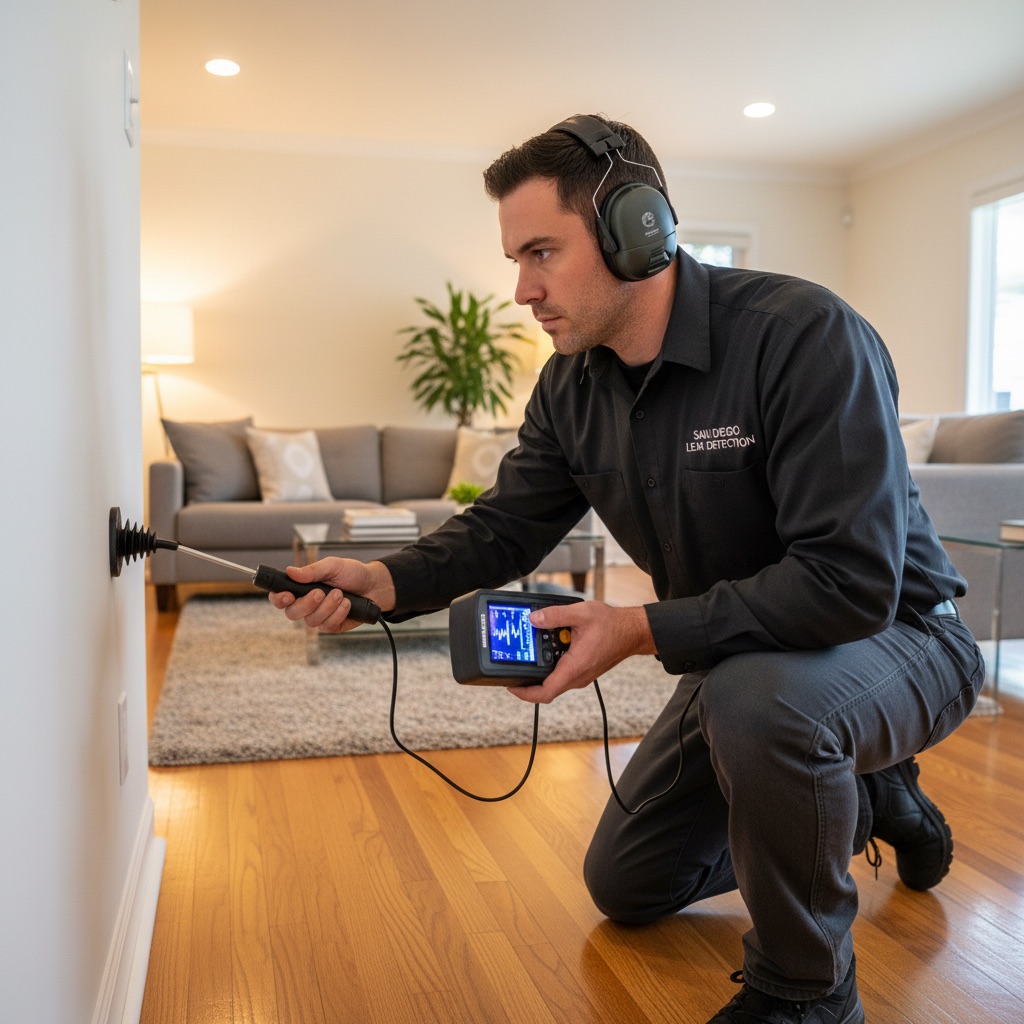
Acoustic listening. A plumber’s listening disc or a stethoscope pressed against the wall can pick up the hiss of a pressurized leak. This works best on copper and galvanized. PEX is quieter and harder to hear.
Thermal imaging. A FLIR camera shows the cold or hot stripe of water tracking behind drywall. Works well on slab leaks and hot-water-side pinholes. The plumbers we connect you with use thermal imaging on most hidden leaks in San Diego homes built after 1970.
Dye test. Drop food coloring in the toilet tank. If color shows in the bowl without flushing, the flapper is leaking. That’s not a pipe leak, but it’s the second most common culprit on a high water bill.
For more on what hidden leaks look like before they get bad, see our post on signs of a hidden water leak in San Diego.
Repair methods, ranked by durability
Not every fix is a real fix. Here’s how the common methods stack up.
Full section replacement (best, lasts the life of the system)
Cut out the damaged section, install new copper or PEX, solder or crimp the joints. Pressure-test. This is what a plumber does when the goal is permanent. On copper, the plumbers we connect you with use Type L for hot-water runs and any line under pressure stress. Type M is thinner, cheaper, fine for cold runs in newer homes but more prone to pinholes long-term.
Lasts 40-plus years on copper, 50-plus on PEX.
PEX patch (excellent, 50-year service life)
When the bad section is in an accessible bay, the plumbers we connect you with cut it out and crimp in PEX-A or PEX-B with brass fittings. PEX-A is more flexible and uses expansion fittings. PEX-B uses crimp rings. Both are standard in San Diego repipes since about 2010. A PEX patch on a copper line uses a brass transition fitting on each side.
Lasts as long as the pipe itself.
Push-to-connect fittings (very good, 25 to 50 years)
SharkBite and similar push-fit couplings slide onto cut copper, PEX, or CPVC with no torch. They have an internal O-ring and stainless teeth that grip the pipe. Manufacturer ratings are 25 years; field data is showing longer.
The plumbers we connect you with use these for fast emergency fixes and in tight spots where a torch is dangerous. The cost per fitting is high, around $10 to $20, but the labor savings are real.
Soldered joint (very good, 30-plus years on Type L)
Cut out the bad section, clean the pipe ends with emery cloth, flux, slide in a copper coupling, sweat-solder with lead-free solder. The right way to fix copper. Requires a dry pipe and an open path for the torch flame.
In San Diego wood-frame stucco homes, soldering inside a wall cavity near old insulation, paper backing, or dust-coated framing is a fire hazard. The plumbers we connect you with bring a heat shield and a fire extinguisher, and sometimes a push-fitting is the safer call.
Sleeve clamp / repair clamp (temporary, 6 months to 2 years)
A stainless sleeve with a rubber gasket clamps over a small hole or split. Good for galvanized in the short term. Won’t seal a pinhole in copper that’s already pitting from inside, because the next pinhole is 6 inches down the same run.
Use this to stop a leak so you can shower tonight. Replace the section properly within the week.
Epoxy putty (temporary only, days to weeks)
Two-part epoxy putty hand-kneaded onto a dry pipe. Stops drips on a non-pressurized line or a slow weep. Will not hold on a hot line, a pressurized split, or anything bigger than a pinhole.
Useful as a 24-hour bandage. Not a repair.
Pipe material matters
What’s in your wall determines what can be patched.
Copper (Type M and Type L). Standard in San Diego homes built 1970 to present. Type L is thicker, lasts longer. Type M is fine but pinholes earlier in some water conditions. Both are patchable, solderable, and accept push-fittings.
Galvanized steel. Standard in San Diego homes built before 1970, common in pre-1960 La Mesa, North Park, Hillcrest, and Mission Hills bungalows. Galvanized rusts from the inside. By the time it leaks, the rest of the run is corroded too. You can sleeve-clamp a galvanized leak, but it’ll spring another one within months. The right move is replacement. See galvanized pipe replacement in San Diego.
Polybutylene. Gray plastic pipe installed in some San Diego tract homes from 1978 to about 1995, mostly in Mira Mesa, Rancho Penasquitos, and parts of Carmel Valley. It fails at the fittings without warning. There is no good patch. Every polybutylene leak should trigger a full repipe quote.
PEX-A and PEX-B. Patchable with crimp or expansion fittings. Easy to repair. Rarely the source of a leak unless a nail hit it during a remodel.
ABS and PVC drain pipe. Solvent-weld a coupling in. Cheap fix. Just make sure the joint is dry and the pipe is cut square.
If you’re choosing materials for a repipe, our PEX vs copper pipes guide walks through the trade-offs.
Pinhole leaks in San Diego copper
San Diego has hard water, and the hot-water side of a copper system is where pinholes show up first. Two failure modes drive almost every pinhole call we get.
Pinhole erosion. Water moving too fast inside the pipe scours the inside wall thin. Common where a run has too many tight elbows or the pump pressure is set above 75 psi. Fix: replace the section, install a pressure-reducing valve if the static pressure is above 80 psi.
Formicary corrosion. Microscopic tunnels through the copper wall caused by chloramine in the water reacting with trace contaminants. Looks like a single pinhole but the pipe is honeycombed nearby. You can patch one hole. The next one shows up six feet away within a year.
When a homeowner gets a second copper pinhole within 18 months, the plumbers we connect you with stop patching and quote a repipe. A repipe runs $4,500 to $12,000 in San Diego depending on home size and access.
Slab leaks: a different category
A leak in a copper line running through the slab is not a pipe leak in the normal sense. You can’t cut a hole in the floor and slip in a coupling. The fix is either a re-route through the attic, a pipe lining, or a partial repipe.
If you feel a warm spot on the floor, hear water running with everything off, or see your water bill climb without explanation, that’s a slab leak signature. We cover the full diagnosis and repair path in slab leak repair in San Diego.
Repair cost in San Diego
These are real 2026 ranges for this work, before any drywall, tile, or texture work to put the wall back together.
| Repair method | Typical cost (San Diego) |
|---|---|
| Epoxy putty (temporary) | $20 to $40 in materials |
| Sleeve clamp | $150 to $300 |
| Push-to-connect fitting | $200 to $450 |
| Soldered copper section | $275 to $650 |
| PEX patch | $250 to $600 |
| Full section replacement | $400 to $1,200 |
| Slab leak re-route | $1,800 to $4,500 |
| Whole-home repipe | $4,500 to $12,000 |
Drywall and finish repair adds $300 to $1,500 depending on the wall, the texture, and whether tile or stone is involved. The plumbers we connect you with don’t do tile, but leave the access cut clean for the tile guy.
For a deeper cost breakdown, see leak repair cost in San Diego.
Insurance and water damage
Most homeowners policies in California cover the water damage from a sudden pipe leak. They almost never cover the pipe repair itself. That’s the homeowner’s responsibility.
What’s typically covered: drywall replacement, flooring, baseboards, cabinet bottoms, contents damage, mold remediation if the leak was recent. What’s typically not covered: the plumber’s labor, slow leaks that went unnoticed for months, anything the adjuster decides was neglect.
How to document a leak for a claim: photos before any demo, the plumber’s invoice with the words “sudden failure” if accurate, moisture readings from a meter (the plumbers we connect you with leave these in their notes), and a clean timeline. Adjusters reject claims that read like the homeowner knew about it and didn’t act.
Our post on does homeowners insurance cover plumbing goes deeper.
DIY vs hire a plumber
What’s safe to DIY: tightening a slip nut under a sink, replacing a supply line to a toilet or faucet, applying epoxy putty to a dry weep, swapping a hose bib. Most homeowners can handle these.
What trashes your house: soldering inside a wall cavity without a heat shield, cutting into a pressurized line without finding the shut-off, gluing ABS to PVC (it won’t bond, the joint will fail), installing a push-fitting on a pipe that wasn’t deburred (it’ll leak slow for months).
The DIY threshold: if the pipe is exposed, the shut-off works, and the repair is one fitting away, it’s a Saturday project. If the leak is behind drywall, in the slab, or on a hot line near framing, call a plumber.
A common DIY trap in San Diego: a homeowner finds a pinhole, patches it with a sleeve clamp, and feels good for a month. The next pinhole shows up behind a finished wall. Now there’s flooring damage and the original $80 sleeve clamp turned into a $6,000 claim. If the first pinhole is in copper, get an opinion on the whole run.
FAQs
How long does a SharkBite push-fitting last?
Manufacturer rates them at 25 years. Field installations are running well past that. They’re code-approved in California and fine inside walls when properly installed on a deburred, square-cut pipe.
Can I solder a wet pipe?
No. The water boils inside the joint and the solder won’t bond. Use bread or a pipe-freeze tool to block the line above the joint long enough to make the solder, then thaw it.
Is epoxy putty a permanent fix?
No. It’s a bandage. Days to weeks. Schedule a real repair before it fails again.
My copper has one pinhole. Do I need a repipe?
Not yet. Patch the one and watch it. If a second pinhole shows up within 18 months, get a repipe quote. Two pinholes means the rest of the run is failing.
What does pipe leak repair cost in San Diego?
Most exposed-pipe leaks run $250 to $650 with a real fix. Hidden leaks behind walls or in the slab run $800 to $4,500. See the cost table above.
Should I use copper or PEX for a repair?
PEX if the section is more than 18 inches and the pipe is in a wall. Copper if you’re matching an exposed run or the pipe is in a hot, tight spot where PEX doesn’t fit. For new installs, our PEX vs copper guide covers the call.
Get the leak looked at
If you have a leak right now, the first step is to shut off the main, then call. The pipe repair plumbers we connect you with will diagnose the pipe material, the failure mode, and quote the right repair before any wall comes down. Many offer same-day service across San Diego County.
Call (858) 400-4417 or see how we approach finding a plumber for a water leak in San Diego. If the leak is already a flood, see burst pipe repair in San Diego first.
Areas this guide covers
We connect homeowners with licensed plumbers in these San Diego County communities.
Keep reading
Need a Plumber in San Diego?
Licensed, insured plumbers, ready across San Diego County. The plumber quotes you before any work starts.
Call (858) 400-4417Call any time, day or night, anywhere in San Diego County