
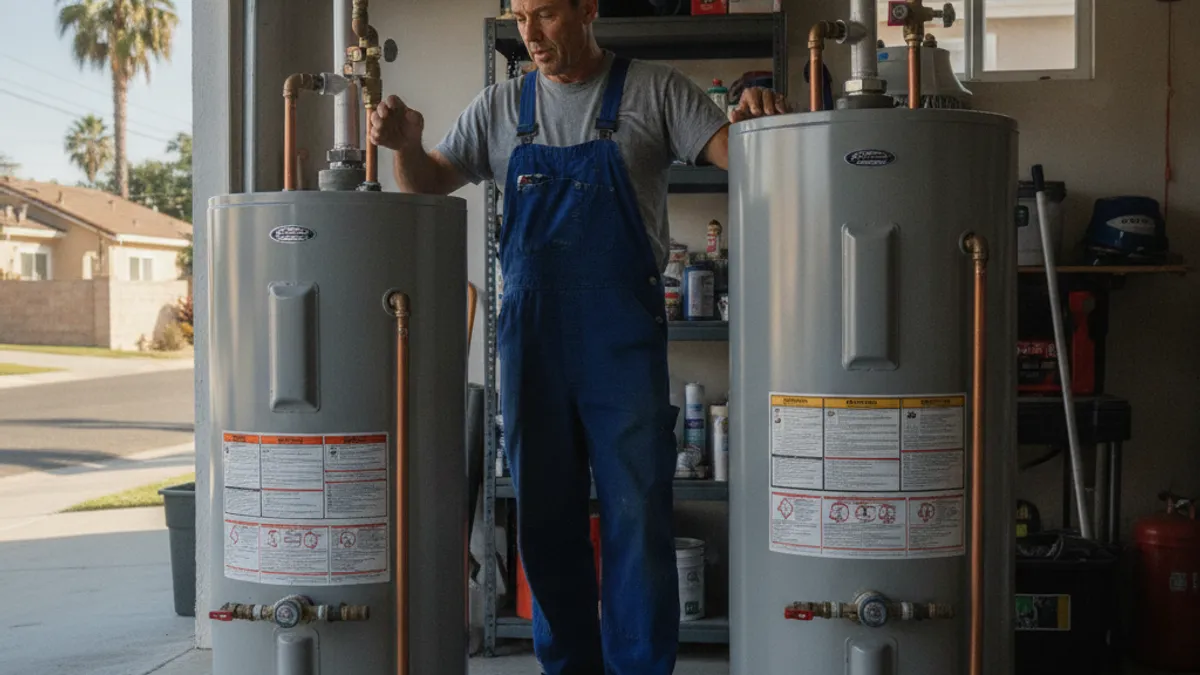
40-gallon vs. 50-gallon water heaters in San Diego
Running out of hot water isn't always a broken water heater. Sometimes it's the wrong size. Here's how to size a tank correctly for your San Diego household.
The short answer
- Running out of hot water regularly, not just during unusual demand, usually points to an undersized tank rather than a failing one.
- A 40-gallon tank generally fits 2 to 3 people or 1 to 2 bathrooms. A 50-gallon tank fits 3 to 5 people or 2 to 3 bathrooms.
- The first-hour rating (FHR), not the gallon number alone, is the real measure of how much hot water a unit can deliver in an hour.
- Upgrading to a bigger tank costs $30 to $60 a year more to run in most San Diego homes, a small price against daily cold showers.
- Many San Diego condos and older homes have a water heater closet sized for a specific tank diameter, which can limit your upgrade options.
A lot of “my water heater is broken” calls turn out to be a sizing problem instead. The unit works fine. It’s just too small for the household it’s serving, especially in homes where a family grew, a garage got converted into a bedroom, or a second bathroom got added without anyone reconsidering the tank feeding it.
The sign that it’s sizing, not a failure
If your water heater is running out of hot water only occasionally, during a stretch of houseguests or an unusually busy laundry day, that’s normal demand exceeding normal capacity, not a sign anything’s wrong. If it happens as a matter of routine, two people can’t shower back to back without the second one going cold, or the dishwasher running at the same time as a shower reliably empties the tank, that’s a sizing mismatch, not a maintenance issue. Worth ruling out an actual malfunction first, which we cover in our water heater not working guide, but if the unit heats fine and simply runs out too fast, size is almost always the answer.
The rough sizing guide
A 40-gallon tank typically fits a household of 2 to 3 people with 1 to 2 bathrooms, which describes a lot of San Diego’s older tract homes, especially 1970s and 80s builds in areas like Clairemont, Serra Mesa, and parts of Chula Vista, where a 40-gallon unit was standard from the original construction. A 50-gallon tank fits 3 to 5 people with 2 to 3 bathrooms, which covers most growing families and homes that have added a bathroom or converted space into an additional bedroom since the original build.
These are starting points, not rules. A household of three that showers back to back every morning and runs a dishwasher at the same time needs more capacity than a household of five with staggered schedules and mostly quick showers. Actual usage patterns matter more than headcount alone.
Why the gallon number isn’t the whole story
The number that actually determines whether a tank fits your household is the first-hour rating (FHR), which accounts for both the water stored in the tank and how quickly the unit reheats as hot water gets drawn out. Two 50-gallon tanks can have meaningfully different FHRs depending on their recovery rate. A gas water heater generally recovers faster than an electric unit of the same tank size, since gas burners heat water more quickly than electric elements. If you’re comparing two units by gallon size alone, you can end up with a tank that’s technically bigger but doesn’t actually deliver more usable hot water during your household’s peak demand window, usually weekday mornings.
A simple way to estimate your own peak demand
A rough way to check your own household against a tank’s first-hour rating: count the gallons each fixture typically uses in a single event, a shower runs about 10 to 15 gallons, a dishwasher cycle around 6 to 10 gallons, a washing machine load 15 to 30 gallons depending on the machine and setting. Add up what typically runs within the same hour-long window in your house, usually a weekday morning with overlapping showers, and compare that total against the FHR listed on a unit you’re considering, not just its stored gallon capacity. A 50-gallon gas tank with an FHR around 70 gallons handles a busy two-bathroom morning far more comfortably than its stored capacity alone would suggest, while an electric tank of the same size, with a lower FHR due to slower recovery, might still fall short during the same window.
What size actually costs to run
A 50-gallon tank costs modestly more to maintain at temperature than a 40-gallon tank, since there’s more standing water losing heat over time, even with a well-insulated unit. In practice this runs $30 to $60 a year more depending on your energy rate and the tank’s insulation rating. For a household that’s genuinely running out of hot water on a 40-gallon unit, that cost is a small price against the daily frustration of cold showers, and it’s worth weighing against the alternative of upsizing anyway a few years later once the smaller tank fails.
Space constraints that limit your options
A real number of San Diego homes, especially condos and some older tract construction, have a dedicated water heater closet or utility space built around a specific tank diameter and height. Downtown and Mission Valley condo utility closets in particular are often sized tightly, sometimes capping you at a shorter or narrower unit than a standard 50-gallon tank would need. Measure your actual space, height, width, and clearance for the vent or flue, before assuming an upgrade from 40 to 50 gallons is a straightforward swap. In tight spaces, a shorter, wider “low-boy” tank or a switch to tankless sometimes solves the capacity problem without the physical constraint.
When to skip the sizing question entirely
If you’re already replacing a water heater and space allows it, it’s worth comparing tank sizing against going tankless instead, since a properly sized tankless unit sidesteps the gallon-capacity question by heating water on demand rather than storing it. That comes with its own tradeoffs, upfront cost, venting requirements, and the annual descale maintenance San Diego’s hard water makes necessary, so it’s a different decision rather than a simple upgrade path, but worth considering at replacement time rather than defaulting straight to a bigger tank. Our full breakdown of replacement cost by unit type covers both paths side by side.
Getting the size right the first time
Sizing correctly at replacement time avoids the common cycle of installing the same size that was already too small, only to be back in the same situation a few years later. A plumber sizing your replacement should ask about household size, bathroom count, typical morning routines, and any appliances (like a soaking tub) that draw an unusually large volume at once, not just measure the old tank and order the same size again.
When you’re ready
If you’re tired of running out of hot water, or you’re replacing a water heater and want it sized for how your household actually uses it rather than however the last one happened to be sized, call us at (858) 400-4417. We’ll walk through your household’s real usage and make sure the next unit actually fits it.
Areas this guide covers
We connect homeowners with licensed plumbers in these San Diego County communities.
Keep reading
Need a Plumber in San Diego?
Licensed, insured plumbers, ready across San Diego County. The plumber quotes you before any work starts.
Call (858) 400-4417Call any time, day or night, anywhere in San Diego County