
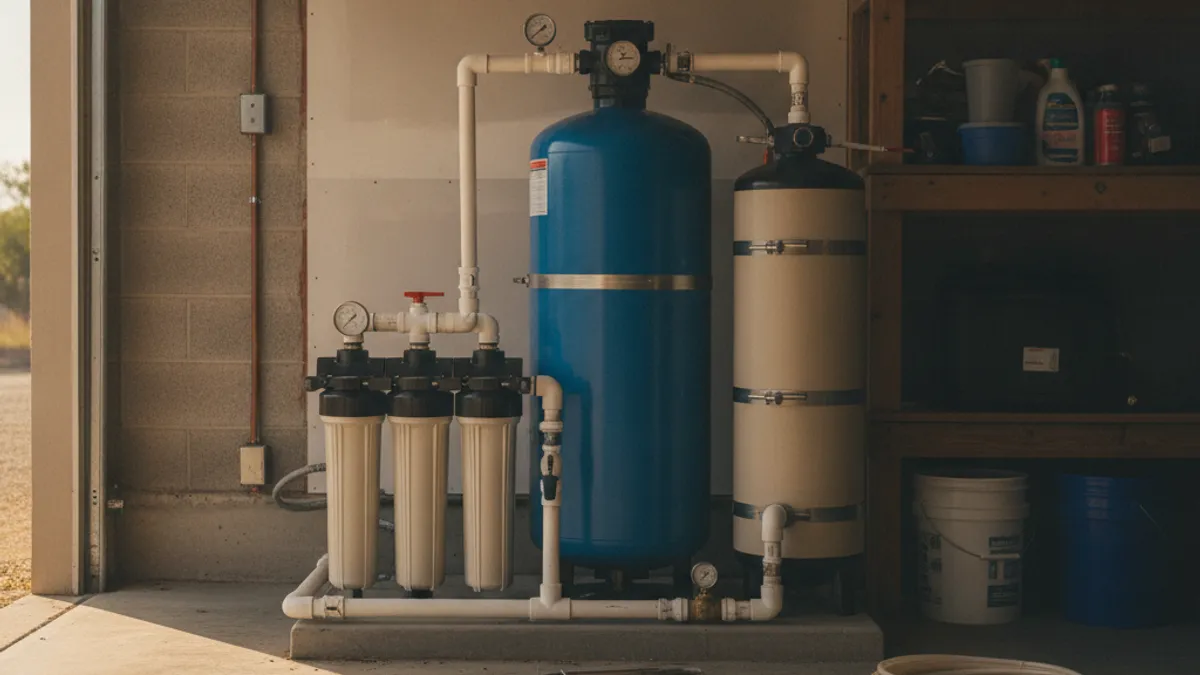
Well water filtration systems for San Diego County homes
Backcountry San Diego homes on a private well face different water problems than city addresses. Here's what shows up in well water and how it's treated.
The short answer
- Private wells in San Diego's backcountry, Julian, Ramona, Valley Center, Alpine, and similar areas, get zero treatment before reaching your tap unless you install it.
- The most common well issues in the county are sediment from fractured granite aquifers, dissolved iron and manganese causing staining, sulfur odor, and bacterial contamination.
- A sediment filter and iron filtration solve different problems. Neither substitutes for the other, and a softener alone won't fix any of them.
- UV disinfection is a common addition even for wells with a clean history, since groundwater quality can shift after rain or nearby land disturbance.
- Test first. A treatment system designed around an actual lab result works. One designed around a guess usually doesn't fix the real problem.
Most of San Diego County is on municipal water, but a real slice of the backcountry runs on private wells: Julian, Ramona, Valley Center, Pauma Valley, Jamul, Alpine, Pine Valley, and pockets of Fallbrook and Bonsall among them. A well changes the entire water treatment conversation, because none of the protections a city water customer takes for granted, disinfection, filtration, mineral monitoring, happen before that water hits your pressure tank.
What’s actually different about well water out here
San Diego’s backcountry sits on granite and decomposed granite aquifers for the most part, with wells commonly drilled anywhere from 100 to over 600 feet depending on the property and how far you are from a reliable water table. That geology shapes what shows up in the water. Fractured granite lets fine sediment and grit into the well casing, which is why sand and cloudiness at the tap are a common complaint in areas like Descanso and Pine Valley. Iron and manganese occur naturally in a lot of the county’s mineral deposits and show up as reddish-brown staining on fixtures, laundry, and sometimes a metallic taste. Sulfur-reducing bacteria in the aquifer produce hydrogen sulfide gas, the classic rotten-egg smell, especially in wells that sit unused for stretches between visits at vacation or weekend properties. And because a well has no chlorination step the way city water does, bacterial contamination, including coliform and occasionally E. coli, is a real risk, particularly for wells near septic systems, which describes most of the backcountry given how common private septic is out there.
Sediment: the physical problem
A sediment or spin-down pre-filter is usually the first stage on any well system in this part of the county, and it solves a narrow but important problem: grit, sand, and fine rock particles that come up through the casing, especially after the pump kicks on hard or during dry spells when the water table drops. A 5 to 20 micron spin-down filter, installed right after the pressure tank, catches this before it reaches anything downstream, including your water heater and any other treatment stage. Skipping this step shortens the life of every other filter and appliance in the system, since grit is abrasive and wears out valves, cartridges, and fixtures fast.
Iron and manganese: why a sediment filter doesn’t touch it
Dissolved iron and manganese pass straight through a sediment filter, since they’re not particles yet, they’re minerals in solution. The staining you see on sinks, tubs, and laundry happens when that dissolved iron hits air and oxidizes into a solid rust-colored form. Treating it requires an oxidizing filter, commonly an air-injection or catalytic media system that forces the iron and manganese to oxidize inside the filter tank, where it gets trapped and flushed out during a backwash cycle, rather than at your fixtures. The right media and tank size depend on how much iron your specific test shows, since a system undersized for high iron levels clogs and loses efficiency fast.
Sulfur odor: a specific fix for a specific smell
Hydrogen sulfide gas from sulfur-reducing bacteria needs its own treatment, usually oxidation, either with an air-injection system similar to iron treatment or a chlorination or ozone step, followed by carbon filtration to polish out any residual taste or smell. Shock chlorination of the well itself is also a standard first move when sulfur odor shows up suddenly, since it can knock back the bacteria population at the source, though a permanent oxidation system is usually needed if the odor keeps returning.
Bacteria: the risk you can’t see, smell, or taste
This is the piece that catches new well owners off guard the most. Water can run clear, taste fine, and still carry total coliform bacteria or worse. The only way to know is a lab test, which we cover in detail in our guide to well water testing in San Diego County. If a test comes back positive, options range from shock chlorination to fix an isolated issue, to a continuous UV disinfection unit installed at the point where water enters the house, which treats bacteria and viruses without adding any chemical residual. A lot of backcountry homeowners install UV even after a clean test, simply because groundwater conditions can shift after a heavy rain year or nearby grading work, and a clean result today isn’t a permanent guarantee.
Hardness: the one thing well water and city water share
Hardness from calcium and magnesium shows up in well water just like it does in the municipal supply, sometimes worse, since backcountry groundwater can run higher than the county’s already-hard municipal average. A water softener handles that piece the same way it would on city water, but it’s a separate system from anything addressing sediment, iron, or bacteria. None of these systems substitute for each other. A softener alone does nothing for sulfur odor. An iron filter does nothing for hardness. Building the right stack starts with knowing exactly what’s in your specific well.
Building the right system for your well
There’s no universal backcountry filtration package, because no two wells in Julian, Ramona, or Valley Center have identical water chemistry, even on the same street. A system built around an actual lab test, sediment first, then whatever the test shows (iron, sulfur, bacteria), then a softener if hardness is also a factor, solves the problem that’s actually there. A system built around a guess, or copied from a neighbor’s setup, often leaves the real issue untouched while adding equipment for a problem you don’t have.
When you’re ready
If you’re on a private well anywhere in San Diego County’s backcountry and dealing with staining, odor, sediment, or you just want a straight answer on what your water actually needs, call us at (858) 400-4417. We’ll walk through your test results, or help you get tested first if you haven’t, and build a system around what’s actually in your water instead of a one-size-fits-all package.
Areas this guide covers
We connect homeowners with licensed plumbers in these San Diego County communities.
Keep reading
Need a Plumber in San Diego?
Licensed, insured plumbers, ready across San Diego County. The plumber quotes you before any work starts.
Call (858) 400-4417Call any time, day or night, anywhere in San Diego County