Last updated: August 22, 2026
Boiler vs water heater in San Diego
Boiler vs water heater in San Diego: identify tank, tankless, hydronic, and combi units, understand pilot symptoms, permits, and when to call a plumber.
The short answer
- In San Diego, an appliance called a boiler is often a water heater serving faucets and showers rather than a hydronic space-heating system.
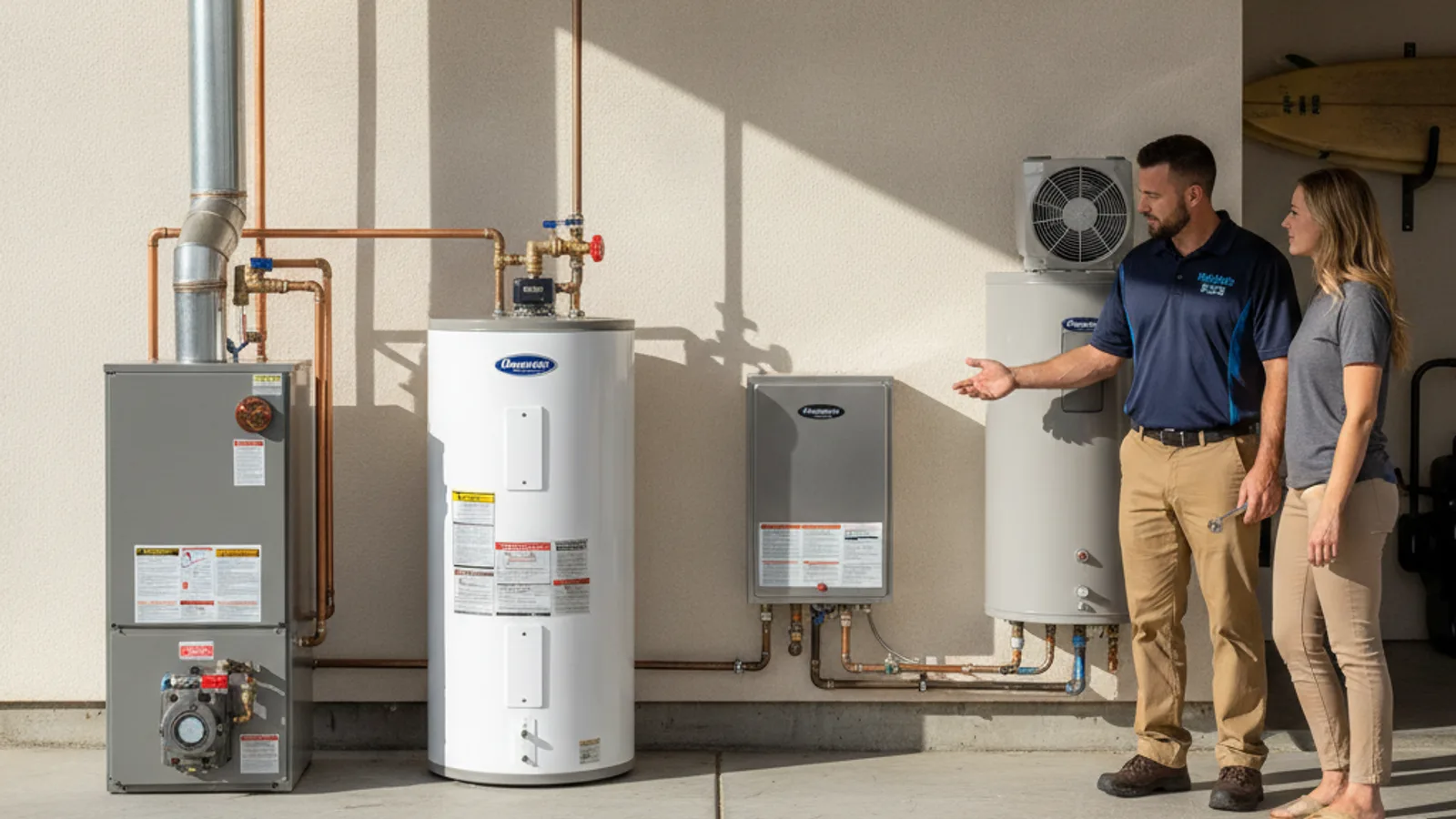
- A floor-standing tank, wall-mounted tankless box, hydronic pipe loop, or paired set of connections usually identifies the appliance type.
- A pilot that won't stay lit is a specific symptom, but it doesn't identify the appliance or prove replacement is needed.
- City of San Diego water heater replacements require permits, with different review paths for standard, tankless, and historically designated projects.
- California's C-36 classification includes water-heating equipment but excludes forced warm-air units, and individual contractor capabilities vary.
In most San Diego homes, the appliance called a boiler is actually a water heater serving taps and showers, not a hydronic boiler heating rooms. That distinction is good news because it points you toward the right service and the right trade.
San Diego’s mild coastal climate rarely calls for hydronic space heating. Yet the word “boiler” remains useful everyday language for hot-water equipment across the county. Before requesting water heater service, identify what the appliance heats and where its pipes go.
You probably don’t have a boiler, and that’s good news
A true boiler belongs to a space-heating system. It sends heated water or another fluid through a closed loop connected to room-heating equipment. A water heater serves the domestic hot-water pipes feeding sinks, showers, tubs, and appliances. A combi unit does both jobs from one cabinet.
The practical distinction isn’t the word printed on a search screen. It’s the path leaving the appliance. If the hot outlet joins the home’s domestic plumbing, you’re looking at water-heating equipment. If paired supply-and-return lines travel to room-heating equipment, the appliance is acting as a boiler. If both sets are present, it may be a combi unit.
That identification keeps the call focused. A water-heater plumber can discuss a tank, its burner or electric controls, and its domestic connections. A hydronic or combi system may also require someone experienced with circulation, zones, and space-heating controls. California’s license classification sets a legal scope, but it doesn’t make every contractor equally experienced with every system.
Don’t remove a panel to solve the naming question. A clear photo of the full appliance, its rating plate, and the visible pipes usually gives the pro you’re matched with a useful starting point. The brand, model, fuel or power source, and exact symptom matter more than whether someone called it a boiler.
Why the word sticks around here
In San Diego, someone searching for “boiler service sd” or “boiler repairs sd” may mean a domestic water heater rather than a hydronic space-heating system. The useful distinction is what the appliance heats.
Someone may also describe a pilot problem as “porque se apaga el piloto del boiler.” It means the appliance’s pilot goes out. The phrase can describe a domestic hot-water problem even though it uses boiler. The appliance’s connections still show whether it serves taps, rooms, or both.
The language persists because it works. A person can say boiler while pointing to a tank in a garage, a wall box in a side yard, or a gas appliance in a closet. The useful follow-up is simple: does it heat water for faucets, heat rooms, or do both?
That question also prevents the wrong comparison. Someone replacing a domestic tank may be choosing between storage and tankless. Someone with a hydronic loop needs a different system diagnosis. Our tankless versus tank comparison addresses the first decision. It doesn’t cover a true space-heating boiler.
Identify the four appliance types in about thirty seconds
Stay outside the cabinet and look at the overall shape. Then trace only the visible pipes. Don’t touch a gas valve, electrical cover, vent, or hot surface just to identify the appliance.
| Appliance type | How to recognize it | What it heats | What commonly fails or needs diagnosis |
|---|---|---|---|
| Tank water heater | A floor-standing cylinder with cold-water entry and hot-water outlet connections | Stored domestic water for taps, showers, and appliances | Gas pilot or ignition parts, gas controls, electric elements or controls, pipe connections, or the tank itself |
| Tankless water heater | A compact wall-mounted cabinet with domestic water connections and a fuel or power connection | Domestic water as a fixture calls for it | Ignition, flow sensing, controls, venting, condensate handling, or the heat exchanger |
| Hydronic boiler | Supply-and-return piping forms a loop to room-heating equipment | Water or another fluid used for space heating | Ignition, circulation pumps, zone controls, pressure components, or expansion components |
| Combi unit | One cabinet has domestic hot-water connections plus a space-heating supply-and-return loop | Domestic hot water and hydronic space heating | Either side can need diagnosis, including flow sensing, ignition, circulation, valves, or controls |
Now do a quick use test. Run one hot faucet and watch the appliance from a safe distance. A tankless or combi display may react to the hot-water call. A storage tank may not visibly change because it heats stored water. Don’t infer failure just because nothing moves or lights immediately.
Next, look for a room thermostat and hydronic emitters connected to the same system. Paired loop piping is the stronger clue. A wall-mounted shape alone doesn’t prove tankless because combi units and some boilers can share that general form.
If your choice is clearly domestic tankless, review tankless water heater installation before discussing replacement. The appliance type affects both the work and the permit path.
The pilot that won’t stay lit
A pilot may light and then go out again. That symptom doesn’t prove the appliance is a true boiler. It also doesn’t prove the entire water heater needs replacement.
First identify whether the appliance uses a standing pilot. Some gas-fired equipment does. Electric equipment doesn’t, and equipment using electronic ignition may have no continuously burning pilot to inspect. Follow the instructions attached to the exact model instead of applying generic relighting steps.
A plumber diagnosing a pilot problem may inspect the flame-sensing device, pilot assembly, gas control, combustion air, and venting. Those are fault areas, not a ranked list of what fails most often. The result depends on the appliance and what it does after an attempted start.
Our focused guide to a water heater pilot light that won’t stay lit covers that symptom, so it isn’t repeated here. If you have no hot water but no visible pilot issue, start with the broader water heater not working guide.
Stop troubleshooting if you smell gas, hear gas escaping, see scorching, or find damaged venting. Leave the area and contact the appropriate emergency provider from outside. Once the immediate hazard is addressed, emergency plumbing help can connect you with a local plumber for the water-heating or plumbing side of the problem.
What actually needs a licensed plumber
California’s C-36 plumbing classification includes installing equipment that heats water or fluids to suitable temperatures. Its scope also covers described gas appliances, flues, connections, piping, storage tanks, and related repairs. Forced warm-air units are expressly excluded. That language describes the classification’s scope only, and individual contractor capabilities vary. You can confirm a contractor’s status and classification through the CSLB license lookup.
Within the City of San Diego, water heater replacement requires a permit. Standard replacements, except tankless types, qualify for a Simple No-Plan Plumbing/Gas Permit when the property isn’t historically designated. A single-family home or duplex can select a Simple No-Plan Combination Permit that includes plumbing and gas work. Applications go through the online portal, and the permit is issued after the application is submitted and its invoice is paid.
Tankless installations don’t qualify for that simplified process. They need full plan-based permitting. A historically designated property also needs the more detailed plan-based route. HERS verification is required to meet Title 24 energy standards for final inspection approval. The City plumbing permit page explains that process. For an address outside city limits, confirm the current path with the building authority serving it.
Title 24, Part 6 mandatory requirements under Sections 110.3 and 150.0(j) apply to new residential construction, major HVAC changes or replacements, and additions exceeding 1,000 square feet. For covered scopes, heat-pump water-heater primary storage must be set to at least 135°F, with compressor cut-off at or below 40°F ambient temperature. Unfired storage needs combined internal and external insulation of at least R-16, or external insulation of at least R-12. Recirculation-loop storage must be set at least 10°F below primary storage, and hot-water distribution piping must follow California Plumbing Code Appendix M. Specific requirements vary by building and scope. A Building Official may allow verification without submitted plans when the scope permits it.
Frequently asked questions
Is a boiler the same as a water heater in San Diego?
Not technically. A water heater supplies domestic hot water. A hydronic boiler serves space heating. San Diego searches often use boiler for the first appliance, so identify what the pipes serve before booking help.
How can I identify my appliance quickly?
Look for a floor cylinder, a compact wall box, and visible pipe destinations. Domestic hot-water connections indicate a water heater. A closed supply-and-return loop to room-heating equipment indicates a boiler. Both sets suggest a combi unit.
Does a pilot problem mean I have a boiler?
No. Some gas water heaters and heating appliances use standing pilots. The pilot symptom identifies an ignition or flame-proving problem area, while the pipe layout identifies the appliance.
Does a water heater replacement need a permit?
The City of San Diego requires one. Standard non-tankless replacements at non-historically designated properties can use the Simple No-Plan route. Tankless work and historically designated properties require plan-based permitting. HERS verification is required for Title 24 final inspection approval.
Can any C-36 plumber handle a boiler or combi unit?
Don’t assume that from the classification alone. C-36 scope includes water-heating equipment and excludes forced warm-air units, but individual capabilities vary. Confirm experience with the exact model and both hydronic and domestic sides when applicable.
When to call us
If the label is unclear, the unit leaks, the pilot keeps failing, or the appliance serves both taps and room heat, have a licensed plumber identify it before parts are ordered. Call (858) 400-4417 with a photo of the label, the appliance and its visible connections, plus the symptom you’re seeing, and we’ll connect you with a licensed and insured local plumber.
Areas this guide covers
We connect homeowners with licensed plumbers in these San Diego County communities.
Keep reading
Need a Plumber in San Diego?
Licensed, insured plumbers, ready across San Diego County. The plumber quotes you before any work starts.
Call (858) 400-4417Call any time, day or night, anywhere in San Diego County