Last updated: August 11, 2026
Plumbing in San Diego's East County backcountry
Alpine, Jamul, Descanso, and Dulzura share well water, septic, propane, and elevation cold, so a plumbing call there starts differently than in the city.
The short answer
- Alpine, Jamul, Descanso, and Dulzura are grouped here because they share the same unincorporated, off-grid conditions, not because they're identical towns.
- A property here may run on a private well and a septic system instead of a metered water and sewer connection, and it's worth checking which applies to yours.
- Where natural gas doesn't reach, a property may run on propane instead, which changes how a gas problem gets diagnosed.
- Elevation means colder nights than the coast, so exposed pipe and hose bibs face a real freeze risk in winter.
- Long private driveways and gated access roads affect how quickly a plumber can reach the actual problem.
- Knowing which of the four systems you have before you call saves time when something breaks.
A plumbing call in Alpine, Jamul, Descanso, or Dulzura starts with a different question than a call in Pacific Beach: what system are you even on? These four communities sit east and southeast of the city of San Diego, in unincorporated backcountry at meaningfully higher elevation than the coast. We’re covering them as one cluster because they share the same conditions to check for, not because every property has the same setup: a home out here may run on a private well instead of a metered connection, may run on septic instead of sewer, may use propane instead of natural gas, and sits at an elevation where winter nights get genuinely cold in a way the coastal band never does.
None of that is true for every house in these towns, and it’s never safe to assume one way or the other. If you own or manage a backcountry property out here, the plumber who shows up needs to know which of these systems your specific property actually has before they can diagnose anything. Each town’s own service page has more on what’s local to that address: Alpine, Jamul, Descanso, and Dulzura.
Know your four systems before something breaks
A service call goes faster when you can answer these four questions before the plumber picks up the phone. Water source, waste, gas, and hot water each work differently out here than they do in a subdivision on municipal utilities.
| System | How to identify it | Who’s responsible |
|---|---|---|
| Water source | A water agency bill in the mail, or a well casing, pressure tank, and wellhead on the property | If metered: the agency named on your bill. If well: the property owner, entirely |
| Waste | A sewer charge on a utility bill, or a septic tank lid and leach field in the yard | If sewer: confirm the owner-agency split with the agency on your bill, since it isn’t uniform. If septic: the homeowner handles the whole system |
| Gas | A propane tank near the house, or a gas meter connected to a street line | Propane: the property owner and the propane delivery company under contract. Natural gas: the utility to the meter, the owner beyond it |
| Hot water | The tank or unit itself, and where it sits: an interior closet versus an exposed shed or crawl space | The property owner, with elevation-driven exposure a real factor here |
Your water source: well or delivered
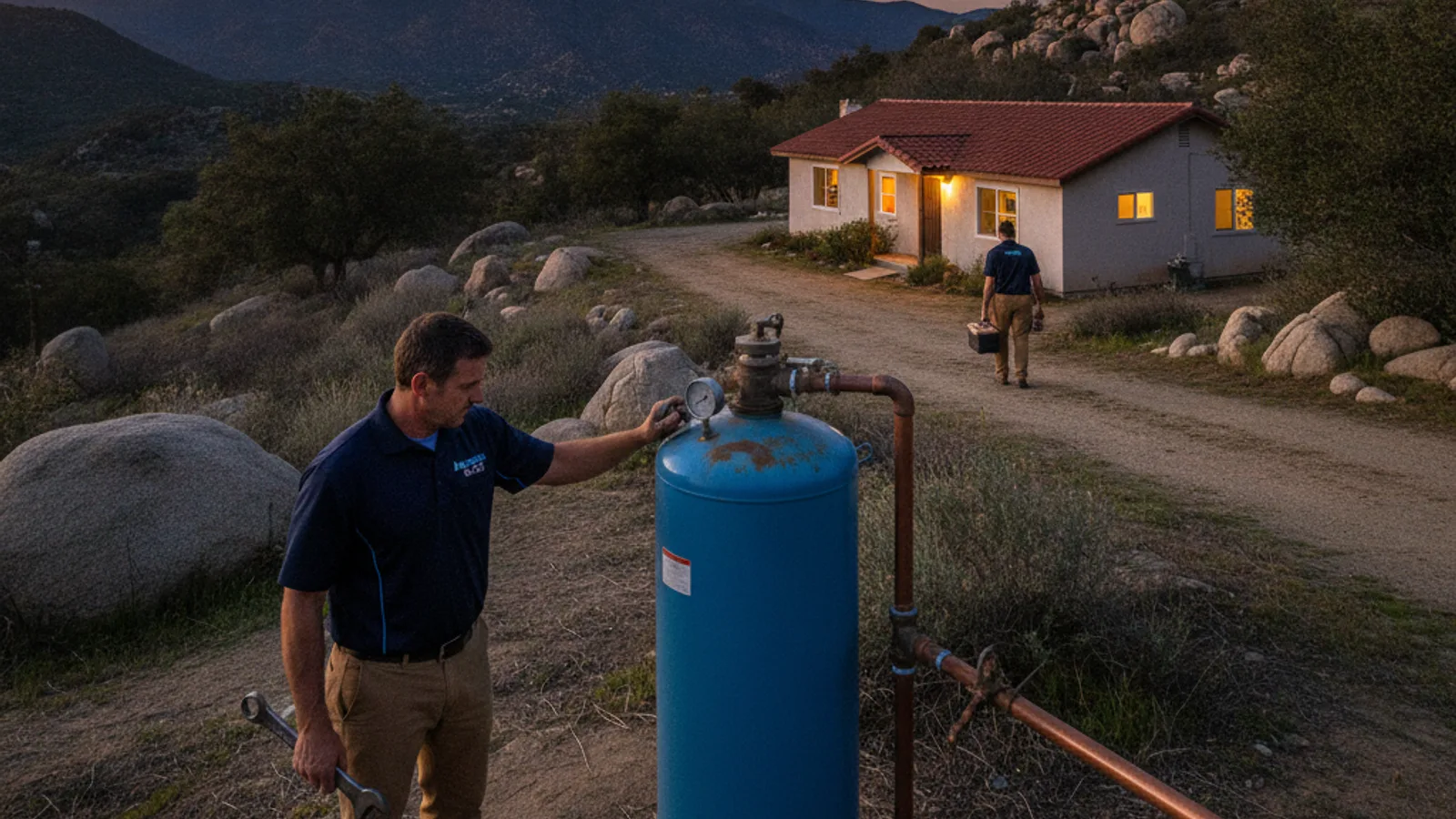
Some properties in this cluster run on a private well rather than a metered connection, and some sit on a water agency’s line. It is never safe to assume one way or the other for a specific address. The only reliable way to know is to check your mail for a bill or look for a wellhead on the property, often a casing, a pressure tank, or a fenced enclosure somewhere on the lot.
If you’re on a well, the property owner is responsible for the entire system: the pump, the pressure tank, the wiring, and the plumbing from the wellhead into the house. If you’re on a metered connection instead, the agency named on your water bill sets the rules for your account and is the correct place to direct account-specific questions. Never assume which agency, if any, serves a given backcountry address. Read the name on your own bill and call the number listed there.
If you’re on a well and haven’t had the water tested recently, our guide to well water testing in San Diego County covers what a basic test checks and how often to run one. Our well water filtration guide covers the sediment, iron, and bacteria issues a well test can turn up, and what treating each one involves, and a plumber can walk through water filtration options once you know what your test found. A sudden change in flow or pressure from a well line is also worth a leak detection visit rather than a guess.
Your waste system: septic, not sewer
Some properties in this cluster connect to a municipal sewer main. Others run on a private septic tank and leach field instead. Check your utility bill for a sewer charge, or look in the yard for a septic tank lid or access riser, to find out which one applies to your address. The two systems put responsibility in different places.
On municipal sewer, the split between owner and agency is set by whichever agency serves the address, so read your own bill rather than assuming. The City of San Diego is the one case documented here: it makes the property owner responsible for the lateral from the house all the way to the connection with the sewer main, even past the property line, and repairs the section in the public right-of-way at no charge only once the homeowner has lost all sewer facilities. Out here, treat that as an illustration of how the split can work, not as the rule for your address. That is the contrast worth understanding: on septic, there is no equivalent backstop from any agency. The property owner owns the tank, the leach field, and every foot of pipe between them. There’s nobody downstream to call when the tank itself needs attention.
A plumber still has a role on a septic property. They handle the drain lines inside the house and the lateral running out to the tank: clogs, slow drains, camera inspections, and pipe repair work when a section is damaged. Pumping the tank is a different trade, done by a licensed septic service, not a plumber. Our septic vs. sewer guide walks through how to tell which system you have and where the line falls between the two trades.
Your gas source: propane, not always natural gas
Natural gas lines don’t reach every corner of the backcountry the way they do in denser parts of the county. A property out here may run on propane instead, delivered and stored in a tank on-site under a contract with a propane provider. Check for a propane tank near the house or a gas meter connected to a street line to find out which fuel actually serves your property.
That distinction matters before any gas work starts. Propane and natural gas systems run at different pressures and need different regulators and appliance settings. A plumber licensed for gas piping work needs to know which fuel is actually in the lines before touching anything. If you smell gas near a propane tank or appliance connection, treat it the same way you would a natural gas leak: leave the area and call for help before doing anything else.
Your hot water and the cold nights that stress it
Elevation is the other variable that separates this cluster from the coast. Alpine, Jamul, Descanso, and Dulzura all sit well above sea level, and winter nights here regularly run colder than anything Pacific Beach or Point Loma ever sees. A water heater or hot water line that would never freeze near the bay can be at real risk out here, especially if it sits in an uninsulated shed, an exposed crawl space, or a hose bib on an exterior wall.
Check where your water heater actually sits. An interior closet is protected. A garage, shed, or crawl space that shares outside air is not, and any exposed supply line running to it deserves attention before a cold stretch hits.
The cold-snap checklist
A short list to run through before a hard freeze warning for the backcountry:
- Wrap any exposed pipe, especially runs to an outdoor hose bib or a shed-mounted water heater, with foam pipe insulation.
- Disconnect garden hoses from every outdoor spigot so water can’t sit trapped in the bib.
- If you have a well, check that the pump housing and any exposed wellhead plumbing are insulated or otherwise protected from direct cold air.
- Know where your main shutoff is, whether that’s a well pressure tank, a wellhead valve, or a meter, before you need it in an emergency.
- If the property will sit empty during a cold stretch, consider draining exposed exterior lines rather than relying on a thermostat alone, especially if the power could go out.
For more detail on thawing a pipe that has already frozen and on protecting a property during an extended absence, our frozen pipes guide for San Diego’s mountain towns covers the same elevation-driven cold that reaches parts of this cluster too. A pipe that has already split is an emergency plumbing situation, not a wait-and-see one.
Frequently asked questions
Why are Alpine, Jamul, Descanso, and Dulzura covered together?
These are unincorporated backcountry communities at a higher elevation than the coast. A property here may run on a private well instead of a metered connection, septic instead of sewer, or propane instead of natural gas. The specifics vary by property, so check your own address rather than assuming from the town name.
How do I know if my home is on a well or a water district?
Check your mail for a bill and read the agency’s name on it directly, since a backcountry address can’t be assumed to fall under any particular agency. If there’s no bill at all, look for a well casing, pressure tank, or wellhead somewhere on the property.
Does a plumber pump my septic tank?
No. A plumber handles the house drains and the lateral out to the tank. Pumping the tank is a separate trade done by a licensed septic service.
Why does a plumber ask about propane before starting gas work?
Propane and natural gas run at different pressures and need different regulators. A plumber needs to know which fuel is in the lines before doing any gas piping work.
What should I tell a plumber about my driveway before they come out?
Mention a locked gate, a long dirt or gravel driveway, or a hard-to-find backcountry address. That affects how much time the visit takes and whether they need a gate code on arrival.
When to call us
A backed-up drain, a suspected gas smell, a leak you can’t trace, or a frozen pipe all need a licensed plumber, whether your property runs on a well, city water, septic, or sewer. Call (858) 400-4417 with your address, which of the four systems above you’re on if you know it, and any access notes for a gated or long driveway, and we’ll connect you with a licensed and insured local plumber.
Areas this guide covers
We connect homeowners with licensed plumbers in these San Diego County communities.
Keep reading
Need a Plumber in San Diego?
Licensed, insured plumbers, ready across San Diego County. The plumber quotes you before any work starts.
Call (858) 400-4417Call any time, day or night, anywhere in San Diego County